
When it comes to developing tours, exhibitions, events, school programs, or publications, the most important concept is to start with the goal in mind or to “design backwards.” Goals are usually defined as products, services, or deliverables, but museums are educational institutions, so our goals should shift from being about the museum or historic site produces or creates to being about what the visitor learns. In other words, what do you want visitors to know, feel, or do as a result of your tour, exhibition, or program?
“Appreciate” and “understand” are often typical outcomes, but they’re hopelessly vague and amorphous. It’s too easy for us to have different definitions of what it means to “appreciate history” or “understand the Constitution.” Thankfully, educators, psychologists, and neuroscientists have been working on the science and practice of learning for decades, providing us with frameworks and methodologies to craft more precise and actionable learning goals.
The Popular but Incomplete Bloom’s Taxonomy (skip to next section if too nerdy)
Let’s start with a brief history of the development of educational taxonomies, which systematically classify learning goals and objectives. Bloom’s Taxonomy is perhaps the most well-known framework in this area. However, users often overlook that it was originally published in 1956 as part of a broader work titled Taxonomy of Educational Objectives: The Classification of Educational Goals. This foundational text was actually the first of three planned volumes.
The first volume, authored by Benjamin Bloom and colleagues, focused on the cognitive domain (knowledge). The second volume, which addressed the affective domain (emotion), was published in 1964 by David Krathwohl. Unfortunately, the third volume, intended to cover the psychomotor domain (action), was never completed, leaving Bloom’s Taxonomy somewhat incomplete despite its significant influence on educational theory and practice.
In the decades following its initial publication, Bloom’s Taxonomy has been revised and expanded by various educators and scholars to address its limitations and to provide more comprehensive frameworks. These revisions often include more specific verbs and descriptors for each level of learning, offering clearer guidance for educators in designing and assessing educational experiences.
I was first introduced to Bloom’s Taxonomy and similar frameworks by Randi Korn during a workshop on evaluation about twenty years ago. In the context of museums, if you’re going to evaluate a tour, program, or exhibition, you need to clearly define the goals to compare the intended outcomes with the actual visitor experience. Without clear objectives, you can’t truly determine whether a program has succeeded or failed.
Writing out these goals can be challenging, especially when avoiding vague terms like “appreciate” and “understand.” This is where taxonomies like Bloom’s are invaluable; they provide a structured list of action verbs (e.g., identify, connect, compare) that can be used to articulate specific learning outcomes. These verbs are organized from shallow to deeper learning experiences, such as foundational knowledge and application, helping educators craft precise and measurable learning objectives.
Fink’s Taxonomy as a Basis for NEW Significant Verbs for Learning Outcomes
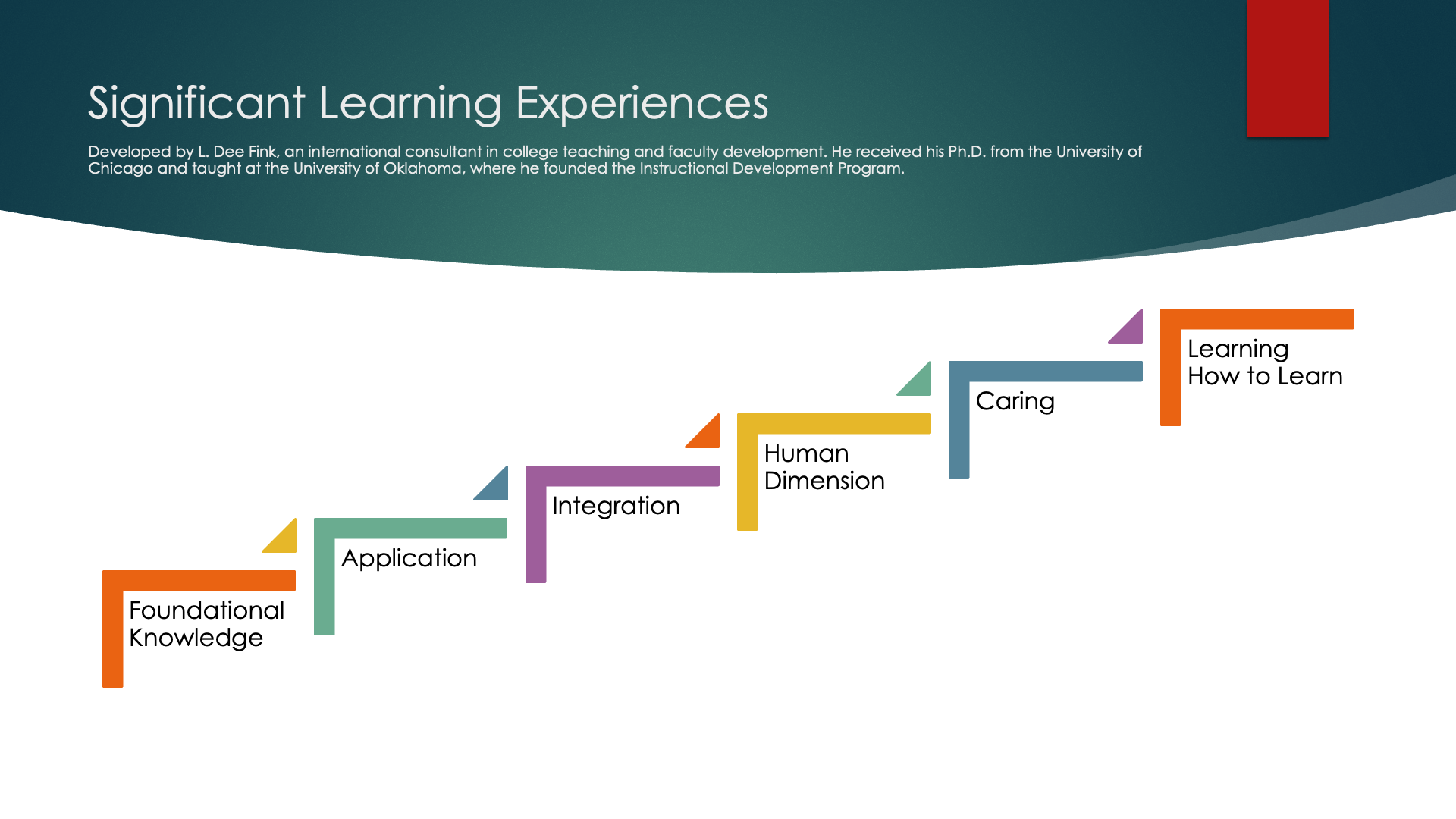
L. Dee Fink’s taxonomy, introduced in Creating Significant Learning Experiences (2003, updated and revised in 2013), has become a highly influential framework for designing educational experiences. I was introduced to Fink’s taxonomy during a course design institute at George Washington University five years ago. Although originally intended for college courses, the principles can be effectively applied to educational programs and activities at museums and historic sites.
Universities across the country, including the University of Denver, University of Delaware, and Brown University, have expanded upon Fink’s initial list of verbs to create more comprehensive resources. These verbs serve as tools to articulate specific and meaningful learning outcomes, providing clarity and focus in educational planning.
The widely rebranded two-page list of Verbs for Significant Learning Objectives has become an invaluable resource in my work, helping me to craft precise goals tailored to both the museum and its diverse audiences. Whether assessing museum exhibits or developing interpretive plans—or even graduate courses—Fink’s taxonomy has been my guiding framework from start to finish.
However, I have found that the Verbs for Significant Learning Objectives can sometimes be overwhelming and uneven, with categories like Integration suggesting 10 verbs while Application has 111. Additionally, certain verbs, such as “experiment,” “plan,” and “describe,” appear in multiple categories, sometimes leading to confusion.
To address this, I have refined and simplified this essential reference into a more user-friendly version, specifically tailored for museums and historic sites. My version of “Verbs for Significant Learning Outcomes” retains Fink’s six categories of learning experiences, each accompanied by a description and a selected list of ten diverse verbs with definitions (download below). In cases where verbs appear in multiple categories, distinct definitions clarify their use.
By streamlining and clarifying the verb list, I aim to make Fink’s framework more accessible and practical for educators and managers in museums and historic sites, ensuring that learning outcomes are both significant and achievable. Tomorrow, I’ll explain how to use them. In the meantime, if you have any comments or suggestions for improvement, I welcome them.
 Engaging Places