Tag Archives: Outcomes

Rethinking Learning Outcomes for Historic Sites

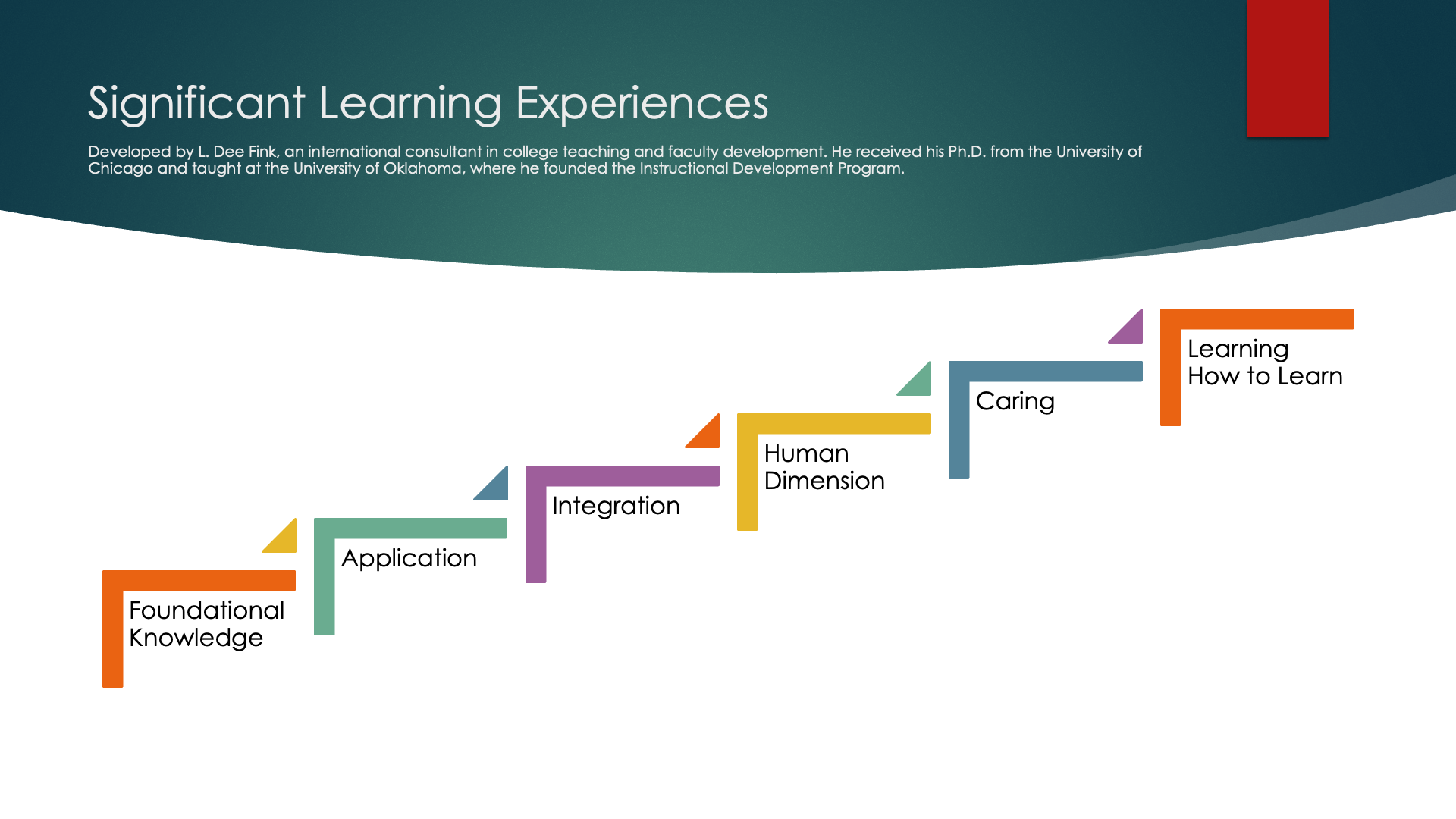
For several years, I have been adapting L. Dee Fink’s taxonomy of significant learning for use in museums and historic sites. Fink’s framework is enormously useful in formal education because it pushes teachers beyond simple content delivery (i.e., foundational knowledge) to application, integration, human dimension, caring, and learning how to learn. That is a helpful corrective in classrooms, where learning unfolds over a semester and where students can be asked to practice, reflect, revise, and demonstrate growth.  But I am increasingly convinced that this framework does not translate as easily as I hoped to the interpretation of house museums and historic sites.

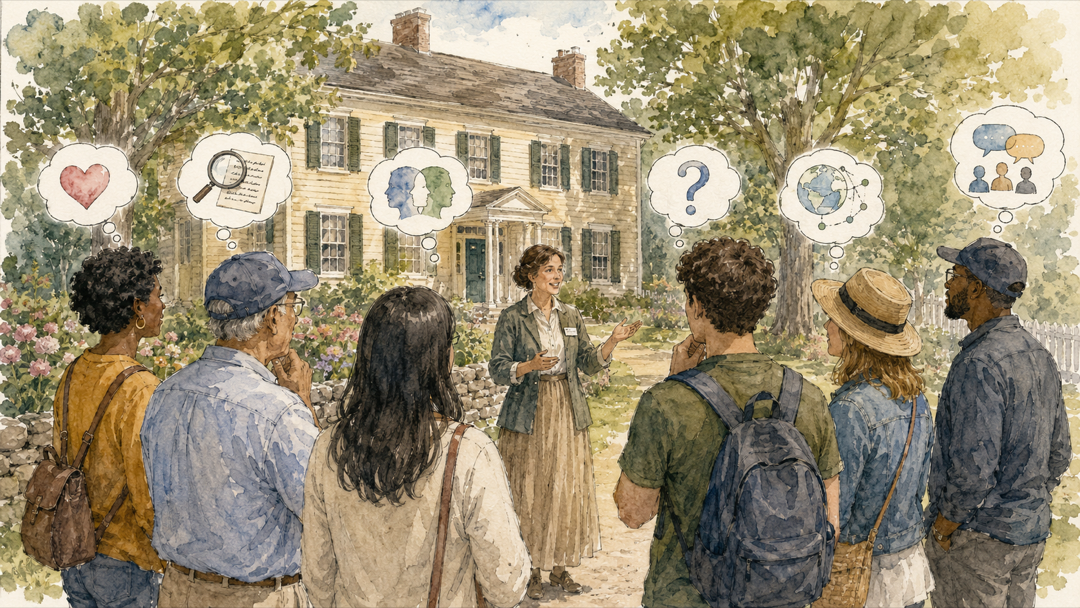
The problem is not Fink’s taxonomy itself. The problem is that historic site visitors are usually not students in a course. They are often there by choice, joined by family or friends, have uneven prior knowledge, and motivated by many different reasons: curiosity, leisure, family activity, travel, identity, or a search for meaning. They may spend 45 minutes in a guided tour, 20 minutes in an exhibition, or an afternoon in the gardens. We need a framework that recognizes these distinct conditions.

My earlier handout, “Verbs for Significant Learning Outcomes,” tried to help museums define what they wanted visitors to know, feel, or do and to create relevant, meaningful experiences. That part still feels right. The challenge is that the categories remained too close to classroom learning. Some verbs—apply, execute, operate, practice, monitor—make sense for students or professional training but are less useful for visitors at a historic house. Because house museums and historic sites interpret history, the framework should also reflect the discipline’s core practices: using evidence, recognizing perspective, acknowledging uncertainty, connecting local stories to broader patterns, and inviting public dialogue about the past.  More importantly, the framework did not clearly align with the visitor journey from first encounter to deeper meaning.

That’s a lot to juggle and I may be dropping a few balls, so here’s my preliminary draft work-in-progress revised framework organized around two related ideas: Outcome Level and Outcome Ambition.

Outcome Levels

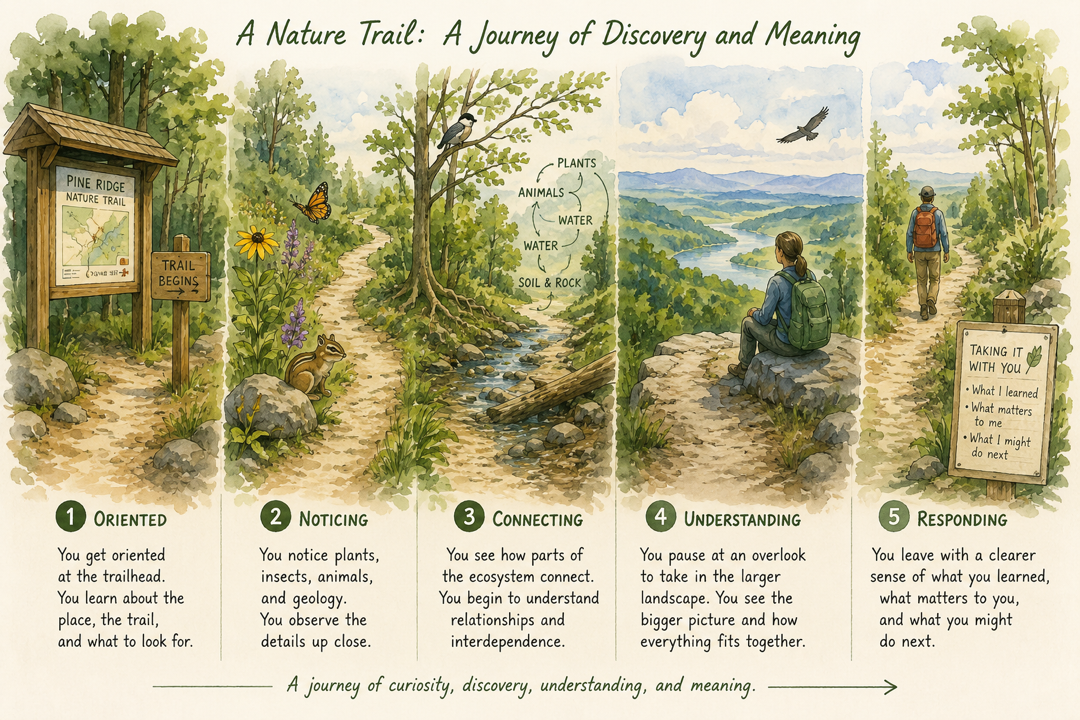
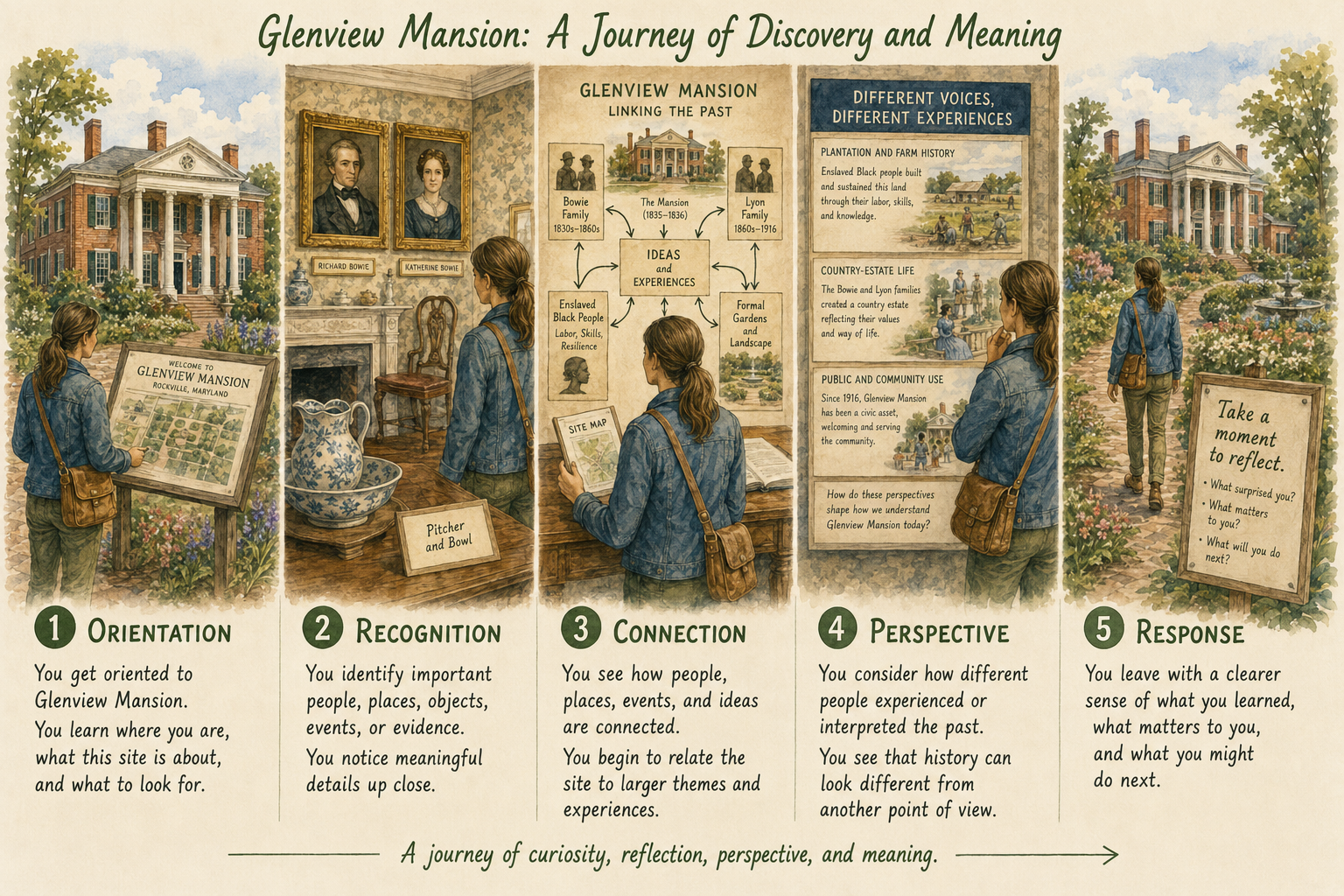
The Outcome Level describes the kind of visitor change an interpretive experience is designed to support. In plain terms, it asks: What kind of change are we trying to create in visitors? Imagine levels as a journey on a nature trail:  getting oriented at the trailhead; noticing plants, insects, animals, and geology; seeing how parts of the ecosystem connect; pausing at an overlook to understand the larger landscape; and leaving with a clearer sense of what you learned, what matters to you, and what you might do next. 

Continue reading

Rethinking Goals in History Organizations: A New Framework for Internal and External Impact

For many years, history organizations—including history museums, historical societies, house museums, and historic sites—have measured success using a traditional planning framework focused on outputs (what an organization produces). By the 1990s, there was a growing recognition of the importance of outcomes (how visitors change because of that work), over merely completing tasks.

While the confusingly-named outputs and outcomes framework have improved museum projects, they often overlook how history organizations themselves evolve—how their staff, volunteers, and boards gain knowledge, shift perspectives, and take action to improve their work.

I’d like to introduce a new way of thinking about goals in museums, distinguishing between internal change (within the organization) and external change (within the community and visitors). Using the Know, Feel, Do framework, this model helps history organizations better understand their impact—both inside and outside the institution.

The Know, Feel, Do framework is a structured approach to understanding how individuals and organizations learn, experience emotions, and take action. It is based on Benjamin Bloom’s Taxonomy of Learning Domains, which classifies learning into three categories:

  1. Cognitive (Know) – Intellectual engagement and knowledge acquisition.
  2. Affective (Feel) – Emotional and attitudinal responses.
  3. Behavioral (Do) – Actions taken as a result of learning.

This model is widely used in education, marketing, nonprofit management, and project evaluation to design experiences that lead to meaningful change.


The Traditional Model: Outputs vs. Outcomes

Continue reading

Learning Outcomes for the Semiquincentennial

In a previous post, I offered a detailed guide on using the “Verbs for Significant Learning Outcomes” framework. However, I find that many people benefit from concrete examples, particularly when it comes to the deeper learning experiences—the “yellow” ones related to the human dimension, caring, and learning how to learn.

As a case study, let’s use the “Unfinished Revolutions” theme from the Making History at 250: The Field Guide for the Semiquincentennial:

In the United States, the fight for liberty, equality, and justice has a long and complex history. Through formal politics, grassroots organizing, boycott, protest, litigation, war, and a wide range of other mass and individual actions, people have continually challenged America to live up to our highest ideals—often drawing on ideas expressed in our founding documents. Before, during, and after the Revolution, people have fought for their rights to life, liberty, and the pursuit of happiness and worked tirelessly to secure the blessings of liberty for themselves and their posterity. This history is not a consistent march of progress, but a complex story full of both advancements and setbacks. These stories reveal the ways the Revolution began before 1776 and reverberates through to the present.

Examples of Outcomes

Some potential outcomes for adults during a two-hour visit to a history museum or historic site based on the Unfinished Revolutions theme are:

Foundational Knowledge

1. Visitors will identify three key figures and three pivotal events in U.S. history that significantly contributed to the fight for liberty, equality, and justice.

2. Visitors will describe two core principles from the U.S. founding documents and their influence on major social justice movements.

3. Visitors will define and contextualize three essential terms related to equality and fairness, such as civil rights, freedom, and suffrage.

Application

Continue reading

Using “Verbs for Significant Learning Outcomes” in Museums and Historic Sites

As museum educators and managers, our goal is to create impactful and memorable experiences for our visitors. Whether we’re designing tours, exhibitions, programs, or events, it’s crucial to start with clear and measurable learning outcomes. “Verbs for Significant Learning Outcomes” can guide us in articulating what we want our visitors to know, feel, or do as a result of their experience. Here’s how you can use this taxonomy to develop effective learning outcomes for your museum or historic site.

1. Start with the End in Mind

Before diving into the content, consider the ultimate goals of your tour, exhibition, or school program. What do you want your visitors to know, feel, or do? Are you aiming to increase their knowledge, change their attitudes, or develop new skills? By defining these goals upfront, you can ensure that your entire project aligns with your desired outcomes.

2. Choose the Right Category

“Verbs for Significant Learning Outcomes” is divided into six categories: Foundational Knowledge, Application, Integration, Human Dimension, Caring, and Learning How to Learn. Each category addresses different aspects of learning in ever-deepening levels:

  • Foundational Knowledge: Focuses on understanding and remembering essential information.
  • Application: Involves using knowledge and skills in practical situations.
  • Integration: Encourages connecting and synthesizing ideas across disciplines.
  • Human Dimension: Emphasizes personal growth, empathy, and interpersonal skills.
  • Caring: Involves developing new feelings, interests, and values.
  • Learning How to Learn: Focuses on developing self-directed learning skills.

Select the category that best aligns with your goals. For instance, if you want to deepen visitors’ understanding of a historical period, you might focus on Foundational Knowledge. If you want to encourage visitors to apply what they’ve learned, consider the Application category. Most museums confine their outcomes to the most basic levels (the “green” experiences) so take a risk and try to add one from the more ambitious levels (the “yellow” experiences).

Continue reading

Verbs for Significant Learning Outcomes: New for Museums and Historic Sites

When it comes to developing tours, exhibitions, events, school programs, or publications, the most important concept is to start with the goal in mind or to “design backwards.” Goals are usually defined as products, services, or deliverables, but museums are educational institutions, so our goals should shift from being about the museum or historic site produces or creates to being about what the visitor learns. In other words, what do you want visitors to know, feel, or do as a result of your tour, exhibition, or program?

“Appreciate” and “understand” are often typical outcomes, but they’re hopelessly vague and amorphous. It’s too easy for us to have different definitions of what it means to “appreciate history” or “understand the Constitution.” Thankfully, educators, psychologists, and neuroscientists have been working on the science and practice of learning for decades, providing us with frameworks and methodologies to craft more precise and actionable learning goals.

The Popular but Incomplete Bloom’s Taxonomy (skip to next section if too nerdy)

Let’s start with a brief history of the development of educational taxonomies, which systematically classify learning goals and objectives. Bloom’s Taxonomy is perhaps the most well-known framework in this area. However, users often overlook that it was originally published in 1956 as part of a broader work titled Taxonomy of Educational Objectives: The Classification of Educational Goals. This foundational text was actually the first of three planned volumes.

The first volume, authored by Benjamin Bloom and colleagues, focused on the cognitive domain (knowledge). The second volume, which addressed the affective domain (emotion), was published in 1964 by David Krathwohl. Unfortunately, the third volume, intended to cover the psychomotor domain (action), was never completed, leaving Bloom’s Taxonomy somewhat incomplete despite its significant influence on educational theory and practice.

Continue reading

Highlights from the Latest Journal of Travel Research

I doubt many people read the Journal of Travel Research (yes, there are such things!) but I’ve been referring to it in preparation for a presentation at the Historic House Museum Consortium of Washington, DC.  Looking at the September 2012 issue of the Journal of Travel Research, I thought I’d share some of the highlights from articles that might interest historic sites and house museums:

  • In “GPS as a Method for Assessing Spatial and Temporal Use Distributions of Nature-Based Tourists,” Jeffery Hallo et al examine the use of GPS devices to study visitor behavior in national parks (an idea that can be easily be applied to large historic sites).  This research typically has to be done either by asking visitors to recall their experiences in a survey or by asking visitors to record their own behavior in diaries–both cumbersome and highly subjective methods.  GPS provides a better way to study human behavior, but so far the inaccuracy and cost has been major hurdles.  A test of three of the newest GPS devices, however, shows that these hurdles have been overcome by Continue reading