
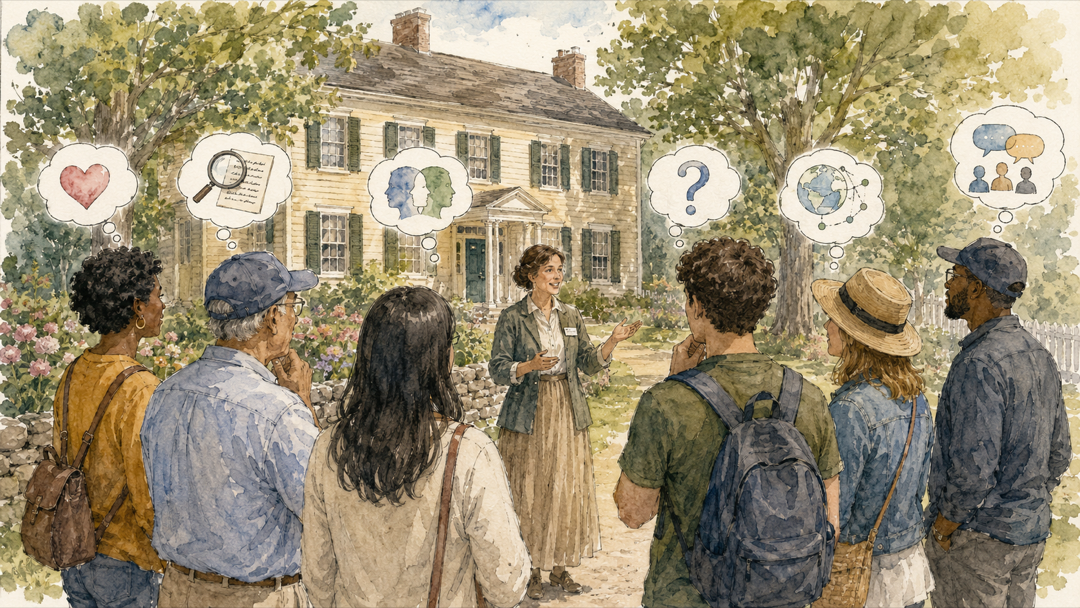
Note: This essay is part of an ongoing exploration of how museums and historic sites can define meaningful visitor experiences. I continue that work in “Beyond ‘Learn’ and ‘Appreciate’: Writing Better Visitor Outcomes,” which builds on these ideas by introducing five Outcome Types and a more structured approach to writing interpretive outcomes.
For several years, I have been adapting L. Dee Fink’s taxonomy of significant learning for use in museums and historic sites. Fink’s framework is enormously useful in formal education because it pushes teachers beyond simple content delivery (i.e., foundational knowledge) to application, integration, human dimension, caring, and learning how to learn. That is a helpful corrective in classrooms, where learning unfolds over a semester and where students can be asked to practice, reflect, revise, and demonstrate growth. But I am increasingly convinced that this framework does not translate as easily as I hoped to the interpretation of house museums and historic sites.
The problem is not Fink’s taxonomy itself. The problem is that historic site visitors are usually not students in a course. They are often there by choice, joined by family or friends, have uneven prior knowledge, and motivated by many different reasons: curiosity, leisure, family activity, travel, identity, or a search for meaning. They may spend 45 minutes in a guided tour, 20 minutes in an exhibition, or an afternoon in the gardens. We need a framework that recognizes these distinct conditions.
My earlier handout, “Verbs for Significant Learning Outcomes,” tried to help museums define what they wanted visitors to know, feel, or do and to create relevant, meaningful experiences. That part still feels right. The challenge is that the categories remained too close to classroom learning. Some verbs—apply, execute, operate, practice, monitor—make sense for students or professional training but are less useful for visitors at a historic house. Because house museums and historic sites interpret history, the framework should also reflect the discipline’s core practices: using evidence, recognizing perspective, acknowledging uncertainty, connecting local stories to broader patterns, and inviting public dialogue about the past. More importantly, the framework did not clearly align with the visitor journey from first encounter to deeper meaning.
That’s a lot to juggle and I may be dropping a few balls, so here’s my preliminary draft work-in-progress revised framework organized around two related ideas: Outcome Level and Outcome Ambition.
Outcome Levels
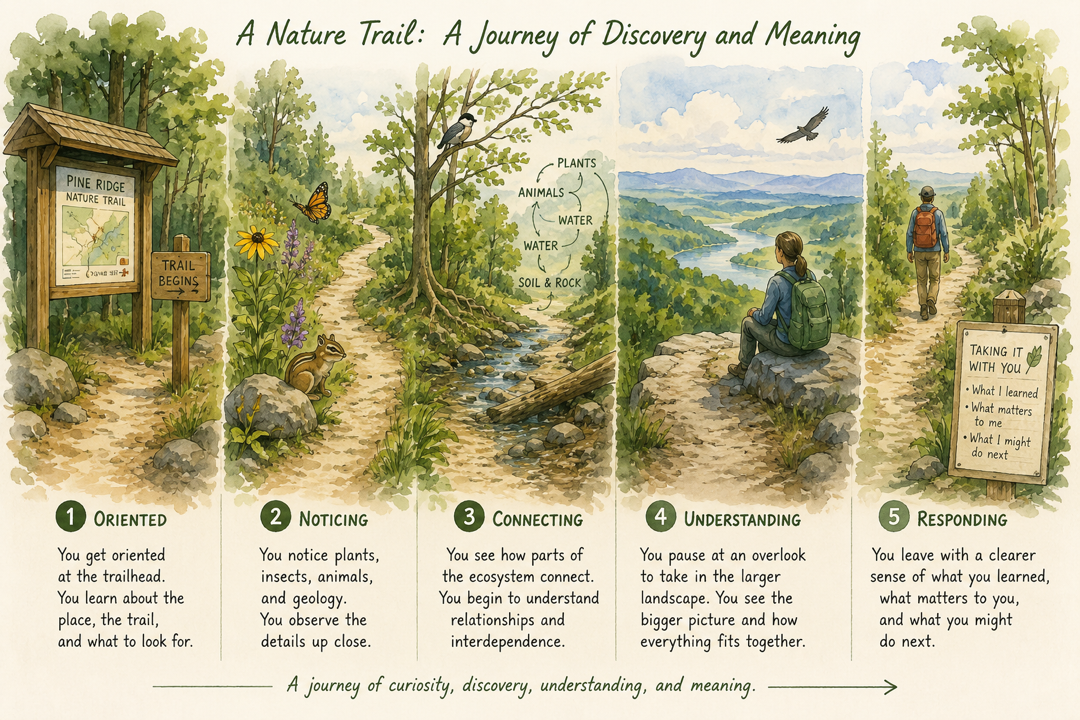
The Outcome Level describes the kind of visitor change an interpretive experience is designed to support. In plain terms, it asks: What kind of change are we trying to create in visitors? Imagine levels as a journey on a nature trail: getting oriented at the trailhead; noticing plants, insects, animals, and geology; seeing how parts of the ecosystem connect; pausing at an overlook to understand the larger landscape; and leaving with a clearer sense of what you learned, what matters to you, and what you might do next.
For historic sites, I am currently testing five levels as an alternative to Fink’s six categories:
| Outcome Level | Description |
| 1. Orientation | Visitors become grounded in the place, topic, purpose, time period, format, and methods. |
| 2. Recognition | Visitors identify key people, places, events, objects, sources, themes, or historical questions. |
| 3. Connection | Visitors link evidence in the site’s history (e.g., people, places, objects, and events) across time and place, including the present and their own lives. They begin to describe relationships such as cause and effect, continuity and change, influence and consequence. |
| 4. Perspective | Visitors consider how different people interpreted, experienced, and remembered the same events, places, and objects. They recognize that historical interpretation is shaped by viewpoint, context, sources, and questions. |
| 5. Response | Visitors carry meaning beyond the visit through reflection, sharing, support, stewardship, advocacy, or civic action. |
These levels are not a rigid script for every visitor and every program. Instead, they help interpreters think about what needs to be in place for deeper engagement to occur. Visitors usually need some orientation before they can make sense of a site. They often need to recognize key people, places, objects, or questions before they can make meaningful connections. Those connections can then open the door to perspective-taking and, in some cases, a response beyond the visit.
Visitors also bring knowledge with them. They may arrive with personal memories, family stories, school lessons, travel experiences, assumptions, or questions that already support higher-level outcomes. The interpreter’s task is to recognize what visitors bring, supply what they need, and design experiences that help them move toward meaning.
Outcome Ambitions
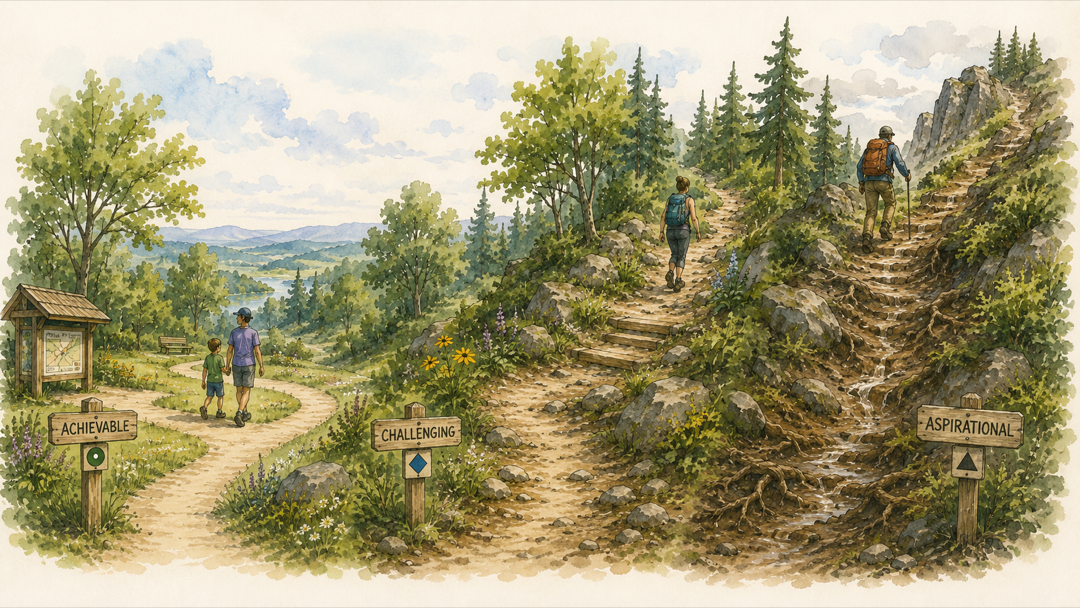
Outcome Ambition describes how much change an interpretive experience is designed to support within a level of outcome. Some outcomes should be achievable for most visitors. Others should be challenging but possible with strong interpretation. A few may be aspirational: outcomes the museum can support and encourage, even if not every visitor reaches them. Imagine we’re back on the nature trail. Now we need to choose the appropriate difficulty: a short, mostly level loop; a longer unpaved path with steps and gentle climbs; or a backcountry route that is steep and muddy at times.
For now, I am exploring three working categories:
| Outcome Ambition | Description |
| Achievable | Most visitors can reasonably reach this outcome. Visitors notice, identify, or describe historical evidence, people, places, events, objects, or topics. Useful for brief, introductory, self-guided, or first-time visitor experiences. |
| Challenging | Many visitors can achieve a challenging outcome with good facilitation, enough time, and well-designed interpretation. Visitors use evidence to explain relationships, compare perspectives, connect local history to broader patterns, or discuss interpretation. Useful for structured experiences, such as guided tours, small exhibitions, facilitated activities, or short events. |
| Aspirational | Some visitors may reach this outcome, especially through sustained engagement, prior knowledge, or follow-up opportunities. Visitors evaluate interpretations, acknowledge uncertainty, reframe assumptions, participate in dialogue, or take action as stewards of history. Useful for longer sustained experiences, such as major exhibitions, school partnerships, civic initiatives, community engagement efforts, or a multi-day study tours. |
Ambition matters and it’s rarely addressed directly. Instead of a one-size-fits-all approach, we need outcomes that are appropriate for the audience, format, methods, and purpose. Outcome Ambition allows an interpretive team to ask:
- What is realistic for this audience?
- How much can the experience support?
- What would strengthen the experience?
- What would be worth aiming for, even if every visitor doesn’t get there?
- Which outcomes are essential versus optional?
- What mix of achievable, challenging, and aspirational outcomes would motivate staff and visitors without setting them up to fail?
Choosing the right level of ambition is essential because audiences differ. A field trip for local fourth grade students should have different outcomes than a seminar for history buffs or a guided tour for international visitors. As a case study, I’ll use Rancho Los Cerritos (RLC), a historic house-turned-museum in Long Beach, California. The site, which includes an 1844 adobe and landscaped gardens, has the recognition of being a local, state, and national historic landmark. At RLC, fourth grade students might be asked to describe how land, water, work, and family life connect to the California history they are learning in school. History buffs might contextualize the site within broader histories of Indigenous presence, ranching, labor, architecture, environmental change, or urbanization. International visitors might first need orientation to the house, landscape, Long Beach, and Southern California history before making broader comparisons to places they know.
The Outcome Matrix
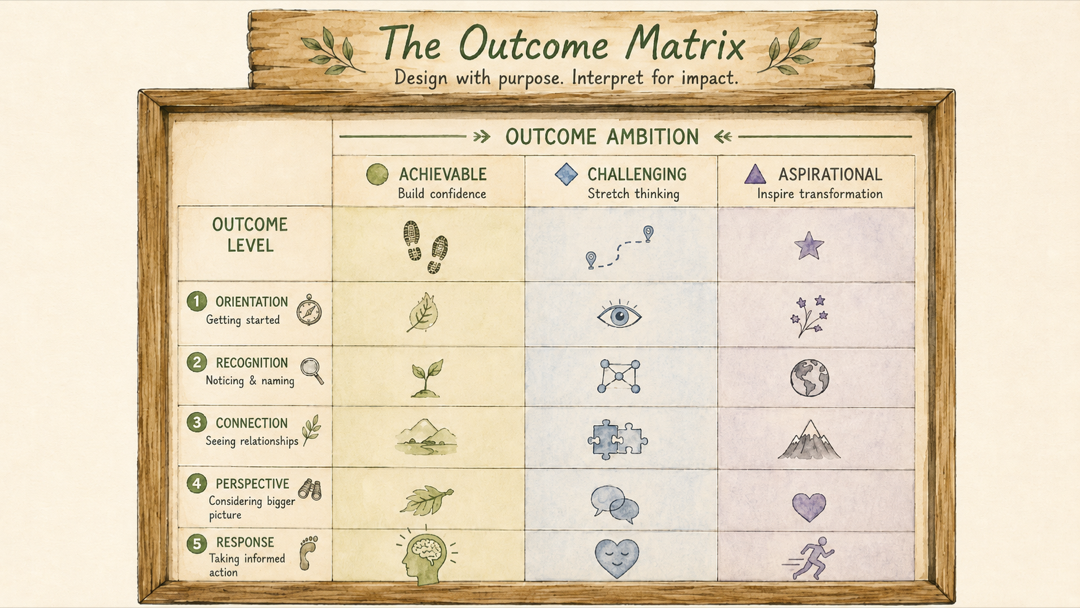
The two ideas—Outcome Level and Outcome Ambition—can be combined into an Outcome Matrix. The matrix helps interpreters design outcomes at different levels and degrees of ambition, depending on the audience, content, and format of the experience. If you’re a teacher, you might recognize it as a rubric to assess student learning.
For example, compare these potential outcomes at the low and mid-level for international tourists visiting Rancho Los Cerritos:
| Outcome Level vs Ambition | Achievable | Challenging | Aspirational |
| 1. Orientation | Visitors identify Rancho Los Cerritos as a historic house and landscape. | Visitors describe the site as a place to learn through guided tours, exhibits, and events. | Visitors identify two major time periods or two major families significant in the history of the Rancho. |
| 3. Connection | Visitors connect one feature to their home, work, family, land, water, or memory. | Visitors compare the Rancho with historic places or landscapes they know. | Visitors connect the site to global questions of memory, preservation, and belonging. |
That looks different from outcomes for local Grade 4 students who are studying California history and live on land once connected to Rancho Los Cerritos:
| Outcome Level vs Ambition | Achievable | Challenging | Aspirational |
| 1. Orientation | Students identify Rancho Los Cerritos as a historic house and landscape. | Students identify their neighborhood as part of the Rancho Los Cerritos. | Students identify two major time periods significant in the history of the Rancho. |
| 3. Connection | Students connect one feature to land, water, work, family, or ranching. | Students compare Rancho history with life in their community today. | Students explain how the Rancho helps tell the story of California over time. |
Outcomes farther down or to the right usually require more time, context, facilitation, prior knowledge, or visitor motivation. They are not automatically better. A brief self-guided visit may appropriately focus on achievable orientation outcomes. A school program, morning workshop, or community partnership may aim for more challenging or aspirational outcomes.
The point is to be selective and strategic. You don’t need to fill every box and determine every possible outcome. Instead, use the matrix to craft a small number of outcomes that are most appropriate for a specific audience for a particular experience. Choose three to five outcomes that fit the audience, content, methods, and mission. Adopt a couple achievable outcomes and one that’s challenging or aspirational. Then design the experience around those outcomes, test them with visitors, and revise as needed.
Testing the Framework
I’ll be testing this framework in my courses and projects. But you can, too, by applying it to something you already do. Choose a specific experience—a general public tour, school program, exhibition, website, newsletter article, or public event—and ask what outcomes are already present. What do you seem to be asking visitors to know, feel, or do? Are the outcomes mostly about Orientation and Recognition, or do they also invite Connection, Perspective, or Response? Are they mostly achievable, or is there a healthy mix of achievable, challenging, and perhaps one aspirational outcome?
This can be especially useful as a group exercise. Ask staff, volunteers, docents, educators, board members, or community partners to review the same tour or program and identify the outcomes they see. You may discover that people are working from different assumptions about what the experience is supposed to accomplish. That conversation alone can be valuable because it helps everyone get on the same page before revising the experience.
The framework can also be used when creating something new. Instead of beginning with “What are we going to tell visitors?” start by identifying the primary audience and drafting three to five outcomes that fit the experience. A short self-guided visit may appropriately emphasize achievable Orientation and Recognition outcomes. A guided tour, school program, or exhibition might include a stronger mix, perhaps with two achievable outcomes, one or two challenging outcomes, and one aspirational outcome that points toward deeper meaning.
The point is not to fill every box in the matrix. The point is to be selective and intentional. Choose the outcomes that best fit the audience, content, methods, mission, and values of the site. Then design the experience around those outcomes, test them with visitors, and revise as you learn more.
Continuing the Interpretive Planning Journey
Historic sites and house museums have no shortage of stories, objects, buildings, landscapes, and community connections. The challenge is bringing those pieces together into experiences that are focused, meaningful, and useful for visitors. This framework is part of my continuing effort to think more practically about that challenge: how can we design interpretation that connects audience, content, methods, and impact into a more holistic practice?
Several authors are shaping this rethinking. Fink remains important because he insists that learning is more than remembering information. Randi Korn’s work on intentional practice is helping me distinguish impact from outputs and outcomes, and to see impact as the larger public difference a museum seeks to make. Connie Graft’s writing on evaluation for historic house museums reinforces the practical value of asking what visitors should know, feel, and do as a result of an experience. I am also drawing from Sam Ham’s TORE framework, Biggs and Collis’s SOLO taxonomy, John Doerr’s work on OKRs, and the AHA’s Statement on Standards of Professional Conduct, especially as I think about relevance, increasing complexity, levels of ambition, and the practice of history.
At this stage, these are preliminary ideas, not a finished model. I am interested in whether this framework helps historic sites write outcomes that are meaningful, mission-based, and assessable without becoming mechanical. House museums and historic sites need tools that help them move beyond “What will we tell visitors?” toward “What difference will this experience make?” I’ll be testing this framework over the next few years with clients and in the classroom, and I’d be grateful if you would try it out and let me know how it goes.


Max – I love this. I too have been wrestling with outcomes at HHMs and this is a helpful shift in thinking. I’m going to see how this works with a current project and let you know. 🙂
LikeLike
Thanks, Kristin! This framework is much easier to remember than Fink’s or Bloom’s plus it allows much more flexibility for different situations. I’ll continue to explore it from different perspectives to see how it might be applied and adapted (e.g., could this be used to improve onboarding for new board members? Could it be applied to exhibition development?).
LikeLike
Hi Max,
I love your blog. You have such great insights and I hope that those in the field pay attention to them and follow your advice. You really know your stuff and I hope everyone appreciates that.
All the best,
Susan Hellman shellman1852@gmail.com
LikeLike
Thanks, Susan! Coming from you, that’s high praise and I very much appreciate it.
LikeLike
Aw, shucks. Thank you!
LikeLike