Note: This essay is part of an ongoing exploration of how museums and historic sites can define meaningful visitor experiences. I continue that work in “Beyond ‘Learn’ and ‘Appreciate’: Writing Better Visitor Outcomes,” which builds on these ideas by introducing five Outcome Types and a more structured approach to writing interpretive outcomes.
For several years, I have been adapting L. Dee Fink’s taxonomy of significant learning for use in museums and historic sites. Fink’s framework is enormously useful in formal education because it pushes teachers beyond simple content delivery (i.e., foundational knowledge) to application, integration, human dimension, caring, and learning how to learn. That is a helpful corrective in classrooms, where learning unfolds over a semester and where students can be asked to practice, reflect, revise, and demonstrate growth. But I am increasingly convinced that this framework does not translate as easily as I hoped to the interpretation of house museums and historic sites.
The problem is not Fink’s taxonomy itself. The problem is that historic site visitors are usually not students in a course. They are often there by choice, joined by family or friends, have uneven prior knowledge, and motivated by many different reasons: curiosity, leisure, family activity, travel, identity, or a search for meaning. They may spend 45 minutes in a guided tour, 20 minutes in an exhibition, or an afternoon in the gardens. We need a framework that recognizes these distinct conditions.
My earlier handout, “Verbs for Significant Learning Outcomes,” tried to help museums define what they wanted visitors to know, feel, or do and to create relevant, meaningful experiences. That part still feels right. The challenge is that the categories remained too close to classroom learning. Some verbs—apply, execute, operate, practice, monitor—make sense for students or professional training but are less useful for visitors at a historic house. Because house museums and historic sites interpret history, the framework should also reflect the discipline’s core practices: using evidence, recognizing perspective, acknowledging uncertainty, connecting local stories to broader patterns, and inviting public dialogue about the past. More importantly, the framework did not clearly align with the visitor journey from first encounter to deeper meaning.
That’s a lot to juggle and I may be dropping a few balls, so here’s my preliminary draft work-in-progress revised framework organized around two related ideas: Outcome Level and Outcome Ambition.
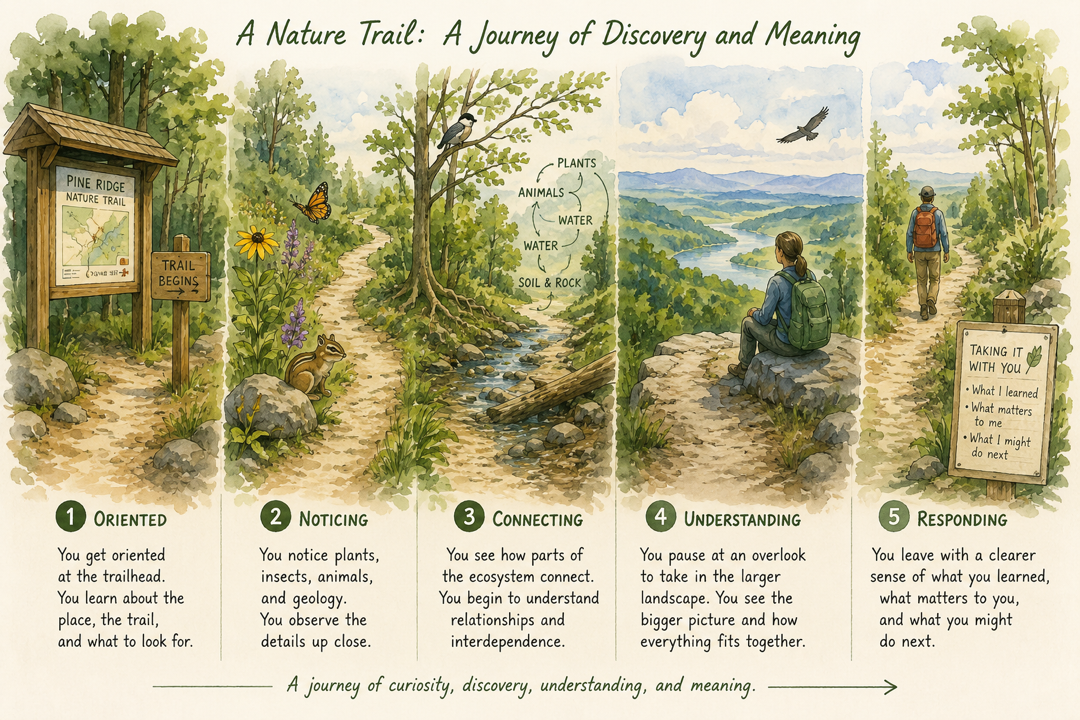
Outcome Levels
The Outcome Level describes the kind of visitor change an interpretive experience is designed to support. In plain terms, it asks: What kind of change are we trying to create in visitors? Imagine levels as a journey on a nature trail: getting oriented at the trailhead; noticing plants, insects, animals, and geology; seeing how parts of the ecosystem connect; pausing at an overlook to understand the larger landscape; and leaving with a clearer sense of what you learned, what matters to you, and what you might do next.
Continue reading