
When we visit the home of a famous writer, what are we hoping to discover? The works have already been written. Their biographies have been published. Their letters have been collected. So what can walking through the rooms where they lived add to our understanding?
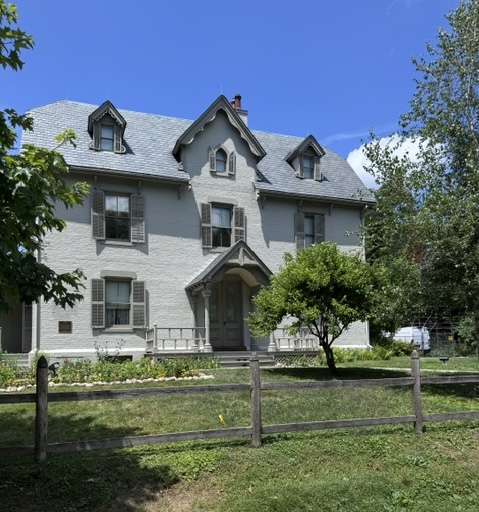
Those questions were on my mind as I visited the Harriet Beecher Stowe Center in Hartford, Connecticut. The Center asks visitors to look beyond Uncle Tom’s Cabin and consider how Harriet Beecher Stowe became one of the nineteenth century’s most influential antislavery writers. It is an ambitious interpretive approach, one that emphasizes the firsthand accounts of enslaved and formerly enslaved people, abolitionist networks, and the many individuals whose experiences, testimony, and activism shaped Stowe’s writing.
As I reflected on the tour afterward, however, I found myself asking a different question: What can a historic house contribute to this story that no biography, lecture, or documentary can?
That question has become increasingly important to me as I visit the homes of America’s literary women. The greatest opportunity is not simply to recount what these women wrote. It is to reveal the dynamic relationship between writer and place. How the places in which they lived shaped their work and how, in turn, they transformed ordinary domestic spaces into places of creativity.
At the Stowe Center, the interpretation explored how Stowe became an antislavery writer through the people she encountered, the events she experienced, and the firsthand accounts she drew upon. The guides presented this story thoughtfully. But as I moved through the house, I kept wondering what the rooms, furnishings, and objects themselves could contribute to that interpretation. They are not merely decorative settings; they are historical evidence.
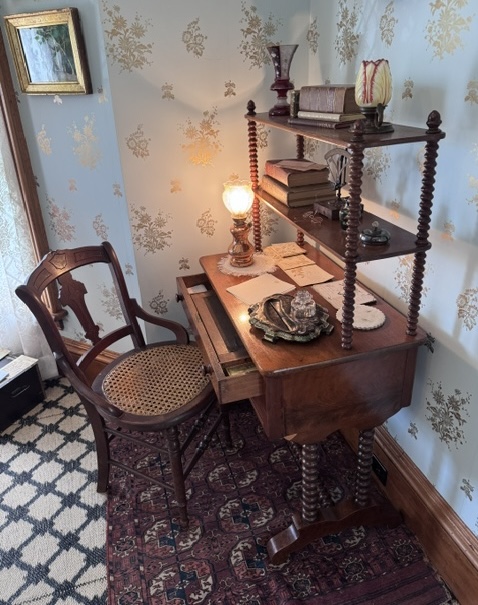
One object stayed with me long after the tour ended: Harriet Beecher Stowe’s writing desk in her bedroom. It is surprisingly modest. In fact, its small size is precisely what makes it so compelling. Although Stowe did not write Uncle Tom’s Cabin in the Hartford house—she wrote it while living first in Brunswick, Maine, and later in Andover, Massachusetts, where Calvin Stowe was a professor—the desk represents the life she led as a professional writer. It reminds visitors that extraordinary books are often produced under ordinary circumstances.
Modern scholarship reminds us that Stowe was not simply an inspired author waiting for ideas to arrive. She was the financial mainstay of her family, raising children, managing a household, hiring help when she could afford it, and constantly trying to carve out the time and space to write. While working on Uncle Tom’s Cabin, she wrote wherever she could—at the dining room table, in borrowed moments of quiet, and later in Andover after her sister Catherine Beecher assumed many of the household responsibilities so Harriet could finish the manuscript. Writing was not separate from domestic life; it took place in the spaces and moments that domestic life allowed.
The Hartford house make those realities visible. Calvin Stowe was also an accomplished scholar and his private workspace reflects nineteenth-century expectations that a male intellectual required a room of his own. Harriet, equally committed to intellectual work, wrote wherever family life allowed.
Harriet’s writing spaces, however, may offer the more powerful lesson. The dining table where she also wrote reminds visitors that literary work often unfolded in shared domestic spaces. Rather than imagining the solitary author secluded in a private room, visitors encounter a woman who built a literary career while balancing the competing demands of home, motherhood, and writing.
The contrast is not simply explained; it is experienced. Moving from Calvin’s private workspace to the shared rooms where Harriet wrote allows visitors to grasp, in a tangible way, the different circumstances under which each pursued intellectual work.
Imagine pausing beside Harriet’s desk and asking visitors:
What does it mean to become one of America’s most influential writers without a room of your own?
Or standing in Calvin’s private room and asking:
How did physical space shape whose work was expected, whose work was interrupted, and whose work changed the world?
Those questions arise naturally from the house itself.
They also connect directly to the Center’s mission of encouraging literary activism. Before visitors are inspired to write themselves, they might first reflect on the circumstances under which Harriet Beecher Stowe wrote—finding time between family responsibilities, relying on networks of support, and transforming ordinary domestic spaces into places of extraordinary creativity. That, to me, is where historic house museums possess their greatest interpretive strength.
The Stowe Center presents a thoughtful and intellectually engaging interpretation grounded in current scholarship. Yet the house itself remains its greatest interpretive resource. Authentic place allows visitors not only to understand the history but also to experience the physical realities that shaped it.
As I continue visiting the homes of America’s literary women, I find myself returning to the same question: What can this house reveal that no biography, lecture, or documentary can? At the Harriet Beecher Stowe Center, I believe the answer begins with a modest writing desk and a shared domestic space that remind us great literature is created somewhere. Places shape writers, but writers also shape places, investing ordinary rooms with extraordinary meaning. Understanding that relationship and the opportunities and constraints those spaces embodied brings us one step closer to understanding both the writer and the house she left behind.

