
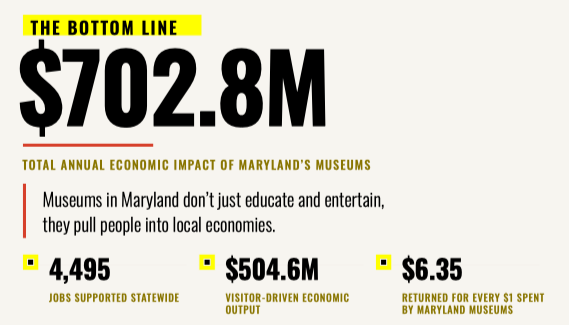
Maryland’s new museum economic impact study raises important questions about workforce compensation, organizational sustainability, and public value.
The Maryland Museums Association recently released its Economic Impact Study of Maryland Museums, prepared by Parker Strategy Group using data from fiscal year 2025. It’s an impressive report that provides museum advocates with valuable evidence of the contributions museums make to Maryland’s economy. The report also includes case studies of four museums and recommendations for strengthening the field.
But what caught my attention wasn’t the economic impact figures. It was the report’s discussion of three issues that deserve greater attention from museum boards, staff, funders, and policymakers: the challenges of building and retaining a professional workforce, the financial vulnerability of museums, and the importance of demonstrating public value beyond economic activity.
These issues are closely connected. Museums cannot fulfill their missions without capable people, sustainable organizations, and meaningful relationships with the communities they serve.
Are We Investing in the People Who Make Museums Work?
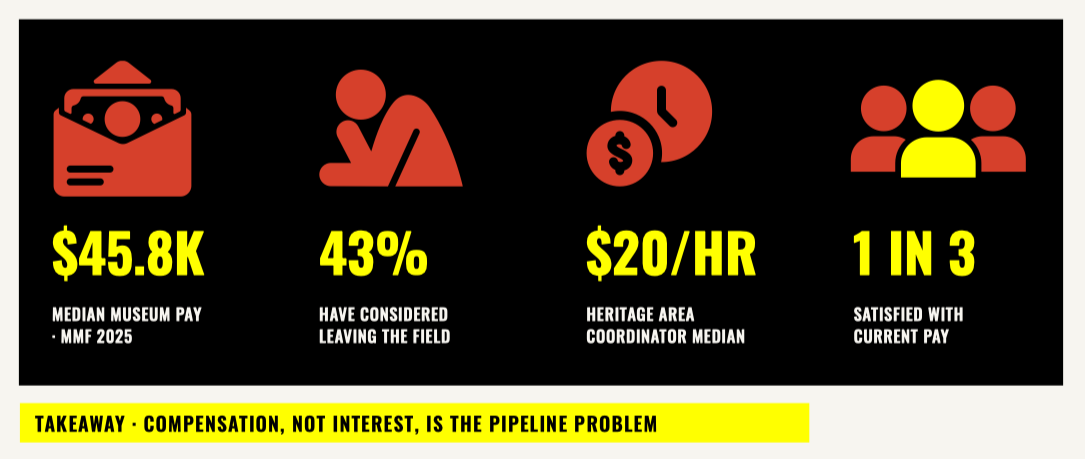
One of the report’s most troubling findings concerns compensation and career advancement. Drawing on national workforce studies and interviews with museum professionals, it describes a field struggling to retain experienced employees and develop its next generation of leaders.
The report cites research indicating that museum and preservation professionals in the Mid-Atlantic region sometimes earn just $48,000–$52,000 annually after a decade or more of experience. It also references the American Association for State and Local History’s 2025 national survey, which found that 43 percent of history practitioners had considered leaving the field during the previous five years.
Perhaps most concerning is the report’s identification of a missing middle: professionals who have progressed beyond entry-level positions but lack adequate compensation, advancement opportunities, and leadership development. These are not simply human resources problems. They are fundamental museum management problems.
Museums invest considerable resources in preserving collections, maintaining historic buildings, creating exhibitions, and attracting visitors. But are we making comparable investments in the people who carry out this work? What happens when experienced employees leave because they cannot afford to remain in the profession? How much institutional knowledge disappears when positions remain vacant or are repeatedly filled by inexperienced employees?
The report recommends investing in mid-career professional development, mentorship, and more competitive compensation. These are worthwhile steps, but museums also need to examine their organizational structures, personnel policies, and expectations of employees. We should be asking whether our organizations provide viable careers, not simply opportunities to gain experience before moving elsewhere.
Financial Sustainability Requires More Than Additional Funding
Another important finding concerns the mismatch between what museums need and what funders are willing to support. Museums often find it easier to raise money for exhibitions, educational programs, and special projects than for salaries, insurance, utilities, collections care, and building maintenance. Yet these basic operating expenses determine whether an institution can fulfill its mission.
The report appropriately recommends expanding Maryland’s Museum Assistance Program, which resumed funding in FY2026 after a 14-year suspension. General operating support is particularly important for smaller museums with limited staffing and few unrestricted resources. But increased funding, while essential, is only part of the solution.
Financial sustainability is also a management responsibility. Museums need to examine the decisions, practices, and assumptions that shape their financial condition. This includes diversifying revenue, evaluating the full costs of programs and facilities, establishing appropriate reserves, strengthening financial oversight, and making difficult choices about organizational priorities. Nonprofit organizations often find themselves in a “I want to do it all” predicament because it is difficult to choose among so many good ideas.
Governance deserves equal attention. Museum boards must understand financial statements, anticipate risks, evaluate organizational performance, and make decisions that balance mission with available resources. Too often, however, boards focus on fundraising without giving sufficient attention to the goals they are expected to achieve. That’s because most museums do not have a long-range plan nor a clear mission and vision to establish shared priorities, clarify what the museum will and will not do, and assess whether the organization is achieving its intended outcomes.
These strategies cannot solve every funding problem. Museums operate under very different circumstances, and approaches that work for a large regional institution may be impractical for a small volunteer-operated historical society. Nevertheless, asking for additional support should be accompanied by a willingness to examine how existing resources are managed.
A sustainable museum is not necessarily one that continually grows. It is one that can reliably fulfill its mission, care for its resources and employees, adapt to changing circumstances, and maintain the trust of its community.
Economic Impact Is Not the Same as Public Value
Economic impact studies provide important information, particularly when museums are competing for attention and resources alongside other public priorities. Demonstrating that museums support employment, tourism, and local businesses can strengthen arguments for public and private investment.
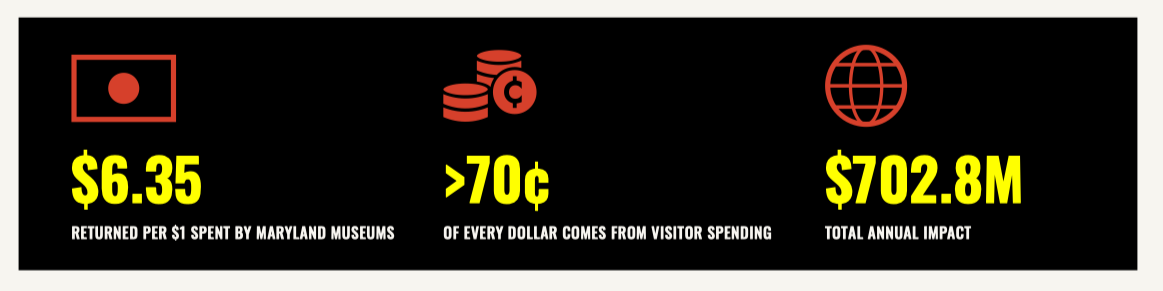
But economic activity is only one dimension of a museum’s value. Consider the report’s repeated assertion that every dollar spent by Maryland museums “returns” $6.35. Returns to whom and in what form?
The $6.35 does not represent money returned to museums, their funders, or taxpayers. It measures economic activity associated with museum operations and visitor spending, not a financial return on investment. Moreover, some visitors might have traveled to Maryland and spent money regardless of whether they visited a museum. We should celebrate museums’ contributions to local economies without confusing economic output with financial returns, organizational sustainability, or public value.
To its credit, the Maryland report recognizes that economic modeling tells only part of the story. Its conclusion describes museum experiences that cannot be captured by economic calculations: a child building a relationship with grandparents during a museum program, a teenager is inspired by an exhibition to pursue a career, and a family learning that an ancestor’s contributed to the nation’s history. These examples remind us that museums contribute to society in ways that cannot be measured in dollars.
More than a decade ago, the History Relevance Campaign developed The Value of History, a statement identifying seven ways history is essential to individuals, communities, and society:
- Identity: Understanding ourselves and our place in the world.
- Critical skills: Developing the ability to evaluate evidence, consider different perspectives, and think independently.
- Vibrant communities: Strengthening connections among people and places through shared history.
- Economic development: Contributing to the vitality of communities and local economies.
- Engaged citizens: Helping people understand contemporary issues and participate in civic life.
- Leadership: Drawing inspiration and lessons from the experiences of others.
- Legacy: Preserving knowledge, places, and resources for future generations.
This framework reminds us that economic development is one of history’s contributions, not the definition of its value. The challenge for museum professionals is to move beyond asserting these benefits and begin demonstrating them.
We already collect information about attendance, membership, admissions revenue, and program participation. But how often do we investigate what changes because someone visits a museum or participates in its work? Do visitors develop a stronger understanding of their community? Do they encounter perspectives they had not previously considered? Do community members develop a greater sense of belonging? Do partnerships create new opportunities for participation and influence? Do museum programs help people make more informed decisions about issues affecting their lives? These questions require different approaches to evaluation, including interviews, observations, community feedback, and longer-term assessments of learning, relationships, and behavior.
Importantly, the benefits of museums are not limited to visitors. Organizations can create public value by preserving resources for future generations, supporting community initiatives, facilitating difficult conversations, and changing their own practices in response to community needs.
Measuring these contributions may be more difficult than calculating economic activity, but difficulty is not a reason to ignore them.
Three Questions for Museum Leaders
I’m grateful that the Maryland Museums Association commissioned this report about the state of museums and heritage areas in Maryland. It offers compelling material for advocacy and identifies challenges that deserve continued discussion. But I hope it also encourages museum leaders to look more closely at their own organizations:
- Are we creating workplaces where capable professionals can build sustainable careers?
- Are we developing organizations that can sustain their missions through sound management, responsible governance, and financial resilience?
- And are we demonstrating how our museums make meaningful differences in the lives of individuals and communities?
These questions are more difficult to answer than how much money museums contribute to the economy. They require us to examine our assumptions, evaluate our decisions, and sometimes change familiar practices.
Economic impact studies can help explain why museums deserve investment. The harder task is ensuring that museums are well managed, sustainable, and genuinely valuable to the people and communities they exist to serve.
This analysis was prepared with the assistance of ChatGPT-6 to review and summarize the economic impact study and related reports. I selected the issues to highlight, evaluated their significance, and reviewed and edited the final post.

