
Note: I revised this post on October 2, 2026 to clarify the terminology: Outcome Levels changed to Outcome Types. Outcome Types describe the kind of change an experience is intended to encourage. Ambition Levels describe the degree of change it is reasonable to expect.
A few months ago, I shared a preliminary framework for rethinking learning outcomes at historic sites. I was trying to solve a problem I had encountered repeatedly: educational taxonomies developed for classrooms do not always translate well to historic sites and house museums. Visitors are not students enrolled in a semester-long course. They arrive with different motivations, prior knowledge, amounts of time, and degrees of interest. I proposed a framework organized around two ideas—Outcome Levels and Ambition Levels—that better reflect the visitor journey and the practice of interpreting history.
Since then, I’ve continued testing and refining those ideas. One part of that work has been developing a more practical vocabulary for writing outcomes at each level. The result is a new six-page handout, What You Want Visitors to Know, Feel, or Do: Five Outcome Types for Historic Sites and House Museums, which I’m sharing with this post (and subject to change!). I also realized that using “levels” for both is confusing and that Outcome Levels may suggest that a higher level is better than a lower one, thus I changed to Outcome Types (I’ll restate this again later to reinforce the distinction).
Historic sites and house museums often begin planning interpretation by asking what stories they want to tell, which objects they want to display, or what activities visitors should experience. Those are important questions, but they don’t define success.
A stronger starting point is:
- What do we want visitors to know, feel, or do as a result of this experience?
That shift—from what the museum presents to what happens for the visitor—can make interpretation much more intentional.
Clear outcomes focus attention on the changes we hope to encourage in visitors’ knowledge, emotions, and behavior. Some may be modest: identifying an important person, noticing evidence in a historic room, or recognizing why a building changed over time. Others may be more ambitious: connecting the past to contemporary life, reconsidering a familiar narrative, feeling concern for a place or community, or deciding to take action after a visit.
What Happens When Outcomes Are Weak—or Missing?
Without clear outcomes, interpretation can easily become a collection of interesting things rather than a coherent experience. Guides add a fact because it is fascinating. An object goes on display because it is available. An interactive is developed because it seems engaging. A room gets another label because there is more information to share.
Each decision may be perfectly reasonable on its own, but visitors can encounter dozens of individual elements without seeing how they fit together or why they matter. That can be confusing or boring.
Weak outcomes also make evaluation difficult. If your goal is for visitors to “learn about the Bowie family” or “appreciate the importance of Glenview Mansion,” what exactly would success look like? What would a visitor think, feel, say, or do differently?
Strong outcomes make those questions easier to answer.
They help determine which stories deserve emphasis, what evidence is necessary, which interpretive methods are appropriate, and—just as importantly—which ideas can be left out. They also encourage us to think beyond information transfer. Interpretation can help visitors make connections, develop curiosity, reconsider assumptions, continue conversations, support preservation, or participate in civic life.
Five Outcome Types
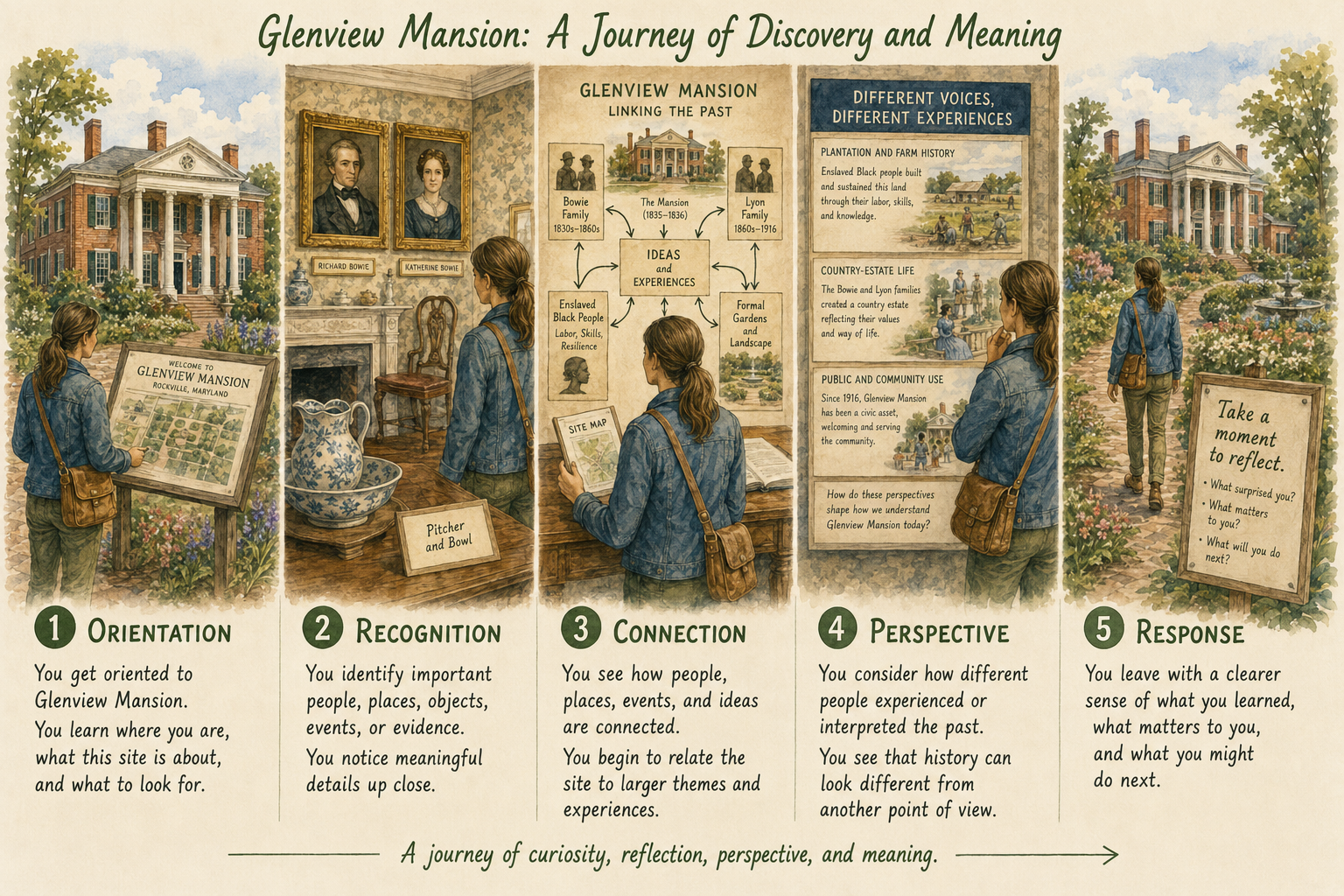
In the earlier post, I proposed five Outcome Levels as an alternative to the classroom-oriented categories I had previously adapted from L. Dee Fink. I am now proposing five Outcome Types to distinguish different kinds of visitor change, from becoming oriented to a place or topic, to recognizing significant evidence, making connections, considering perspectives, and responding beyond the experience.
| Outcome Level | Visitors will… | The Visitor’s questions |
|---|---|---|
| 1. Orientation | Become grounded in the place, topic, time period, purpose, and experience. | Where am I? What is this about? |
| 2. Recognition | Identify significant people, places, events, objects, evidence, themes, or questions. | What should I notice or discover? |
| 3. Connection | Link evidence across time, place, themes, and personal or contemporary experience. | How does this relate to something else? |
| 4. Perspective | Consider how different people experienced, interpreted, or remembered the past. | How might this look different from another point of view? |
| 5. Response | Carry meaning beyond the experience through reflection, discussion, exploration, support, stewardship, or action. | What might I think, feel, or do as a result? |
These levels are not a ladder that every visitor must climb, so to avoid misunderstandings, I have changed from levels to types. As I noted in the earlier framework, visitors may arrive with knowledge, memories, assumptions, and experiences that already support higher-level outcomes, and different experiences will appropriately emphasize different outcome types. A brief tour might concentrate on Orientation, Recognition, and Connection. A longer exhibition or facilitated program might create opportunities for Perspective and Response as well.
Three to five outcomes are usually enough. The goal is not to check every box but to decide intentionally what kind of change you hope to encourage.
Choose Verbs Carefully
The verbs used to write outcomes force us to clarify what we really expect visitors to experience.
Some verbs appear at more than one Outcome Type because the same action can serve different purposes depending on its context and complexity. Visitors might compare two objects within Recognition to notice differences, for example, while in Perspective they might compare conflicting accounts to consider why people interpreted the same event differently.
The Outcome Type is determined not by the verb alone, but by what visitors are being asked to do with it.
I’m also increasingly cautious about a small group of words that appear constantly in museum outcomes:
- understand, learn, know, appreciate, become aware of, and realize
They aren’t necessarily wrong, but they often hide the actual outcome.
If you write, “Visitors will understand the role of women at this site,” ask yourself:
- What would visitors think, feel, say, or do that would convince us this outcome was achieved?
Perhaps you actually want visitors to identify evidence of womenr, explain how they contributed to the site’s development, connect the experiences of women to men, question an earlier interpretation of the site, or value efforts to recover histories that have been overlooked.
Those verbs give interpreters something much more useful to design toward—and eventually to evaluate.
From Content to Consequence
The earlier post was deliberately a work in progress, as is this one. I continue to explore and test more useful ways to think about interpretation at historic sites. This new handout develops one piece of that framework in greater detail by giving practitioners a practical set of verbs for writing clearer outcomes. The next step is to pair those outcome types with an appropriate degree of ambition—Achievable, Challenging, or Aspirational—depending on the audience, format, time, and purpose of the experience.
The purpose is not to make interpretation sound more academic. It is to make our intentions clearer.
Instead of beginning only with, “What do we want to tell visitors?”, we can also ask:
- “What difference do we want this experience to make?”
That question changes how we select stories, objects, evidence, activities, and interpretive methods. And ultimately, it can help us create experiences that are clearer, more meaningful, and more consequential for visitors.
The attached six-page handout, What You Want Visitors to Know, Feel, or Do: Five Outcome Types for Historic Sites and House Museums, includes definitions, suggested verbs for each type, examples, and guidance for developing outcomes. I hope you’ll try it with a tour, exhibition, school program, or other interpretive experience—and let me know where the framework works and where it still needs refinement.

