
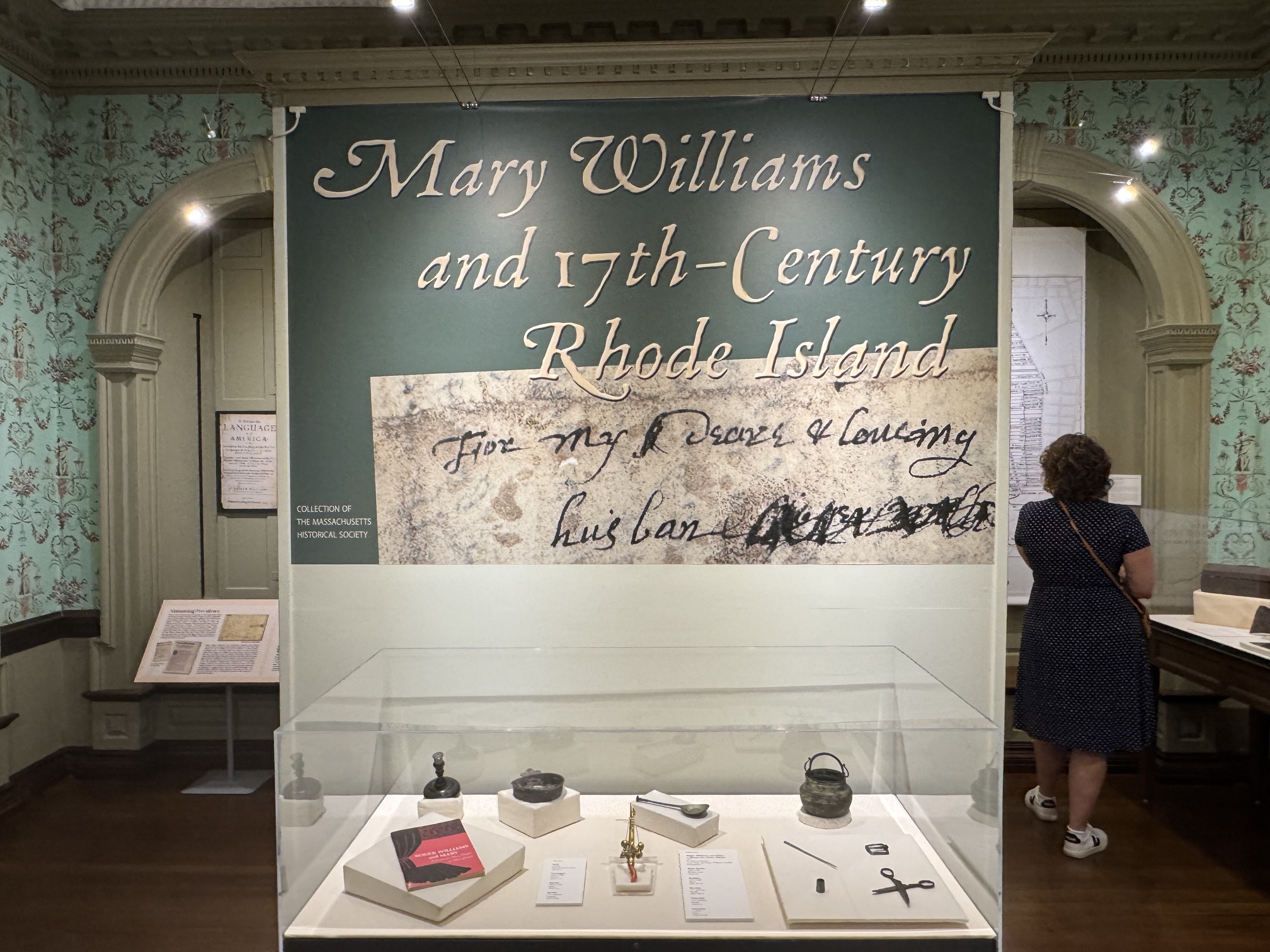
How can a historic site interpret a woman when no diary, letters, or other substantial body of her writing survives? While attending the joint AASLH/NCPH conference in Providence, Rhode Island, I joined a three-site tour, Mary Williams, Making History in Providence, that demonstrated one approach: return to the available evidence and ask different questions of it.
Historian Charlotte Carrington-Farmer led the tour with National Park Service Ranger Andrew Schnetzer. We began at the Rhode Island Historical Society’s John Brown House Museum, where we viewed an exhibit Carrington-Farmer created from her research into Mary’s life—the first public history exhibit to tell Mary’s story. From there, we traveled to the Charter Museum at the Rhode Island State House and then to Roger Williams National Memorial, which encompasses part of the original settlement, including the Williams house lot and the site where Roger was first buried. Together, the three sites helped us explore the Providence Mary knew.
Banished from Massachusetts Bay for his religious dissent, Roger Williams founded Providence in 1636 as a place offering greater religious liberty. Mary Williams was his wife of nearly half a century and often headed their household during his long absences. Historical accounts of Providence and Rhode Island have long focused on Roger’s ideas and accomplishments. That emphasis has left Mary at the edges of the story, in part because most of the surviving documents concern him.
The absence of Mary’s own writings does not mean there is little to say about her. The problem may not be missing evidence but the questions historians have asked of it. What I found most important about the tour was seeing Charlotte put that idea into practice. She had not discovered a new collection of Mary’s papers. Instead, she approached familiar records with questions centered on Mary rather than Roger.
Roger’s travels provide one example. Historians have used his absences from Providence to document his journeys, negotiations, political work, and efforts on behalf of the colony. But what happens when we examine those absences from Mary’s perspective? Roger was away for weeks, months, and sometimes years. Mary remained in Providence, managing the household, raising children, enduring pregnancies and childbirth, and living through periods of financial hardship and political uncertainty. The same records used to trace Roger’s public life also show how often Mary carried these responsibilities alone, making decisions for her family and, at times, the wider community. Charlotte summarized this interpretation in one memorable phrase: Mary “held the site.”
At the Charter Museum, Charlotte discussed another document showing that Mary’s importance extended beyond maintaining the Williams household. By 1661, disputes among Providence residents over land claims had led town leaders to revisit the settlement’s original agreement with Narragansett leaders. They consulted Roger, but they also turned to Mary for her recollection and assent. On December 20, 1661, she placed her mark on a document confirming the nature of the original agreement.
The document does not prove that Mary witnessed the original agreement. It does show that she knew about it and may have been present when it was made. Most important, Providence’s leaders turned to Mary because they considered her knowledge of the town’s beginnings authoritative. Charlotte used the document to present Mary as a trusted and respected figure in her own right, with a role in the founding and governance of Providence.
The John Brown House exhibit reinforced this interpretation through a timeline, documents, and maps. The timeline placed Roger’s absences alongside Mary’s pregnancies, the births of their children, economic difficulties, and other events in her life. The maps showed the Williams household near the town spring and within the surrounding community. The tour’s discussion of the family’s house, furnishings, food, and domestic work helped visitors understand what maintaining the household required.
These methods do not produce a complete biography and the evidence still has limits. We do not know what Mary thought about Roger’s religious ideas, how she felt about his prolonged absences, or how she understood her place in Providence’s religious and political experiment. Those gaps should remain visible rather than be filled with assumptions about her thoughts or motivations.
Mary’s burial shows how thoroughly she disappeared from public memory. Roger was originally buried on the Williams property, now part of Roger Williams National Memorial. When the grave was excavated in the nineteenth century, a woman’s remains, presumed to be Mary’s, were found nearby. Their presumed remains were eventually reinterred at Prospect Terrace, a separate park uphill from the National Memorial, but the inscription states only:
“Here reposes dust from the grave of Roger Williams.”
Mary’s presumed remains may be there, but her name is not. The absence of Mary’s name brings the tour’s larger point into sharp focus. “We know very little about her” does not have to end an investigation. It can lead to a better question: What might the surviving sources, places, and memorials reveal if we asked them about Mary?
For further reading: Charlotte Carrington-Farmer, “More Than Roger’s Wife: Mary Williams and the Founding of Providence,” The New England Quarterly 97, no. 3 (September 2024): 308–44.


The article discusses the challenges in interpreting a historical figure without substantial written material. It highlights the unique context of interpreting a woman’s legacy, emphasizing the need for innovative approaches in historical interpretation.
LikeLike
This technique is similar to one used at Colonial Williamsburg to flesh out historical individuals for whom little is known beyond a name. It is particularly helpful when interpreting women, African Americans, and tradespeople. Interpreters also present a public program called “My Story, My Voice” in which the historical character speaks to the audience first and then the interpreter breaks out of character to describe the documentation, cultural history, archaeology, or period primary sources used to develop the character.
LikeLike