
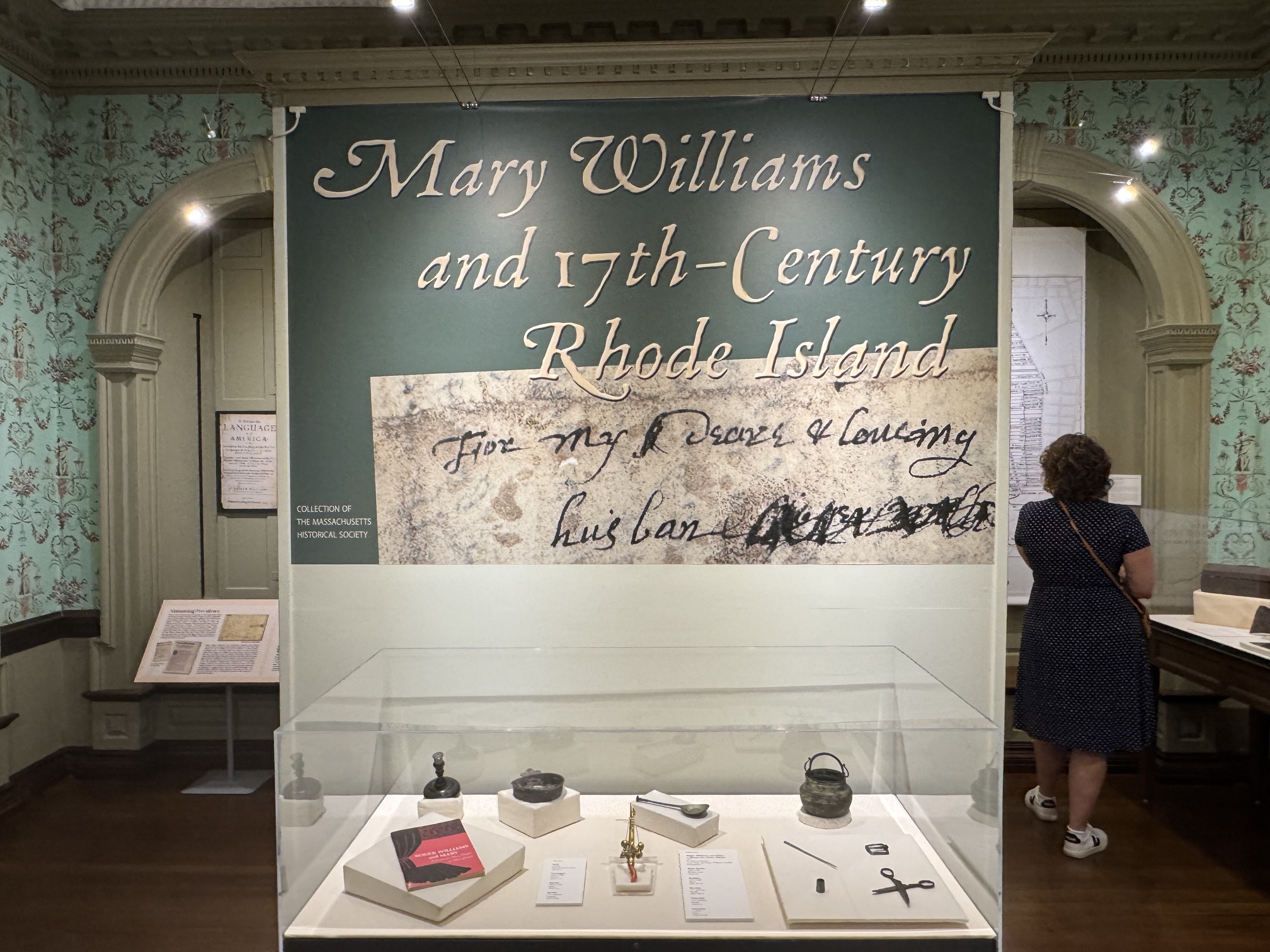
How can a historic site interpret a woman when no diary, letters, or other substantial body of her writing survives? While attending the joint AASLH/NCPH conference in Providence, Rhode Island, I joined a three-site tour, Mary Williams, Making History in Providence, that demonstrated one approach: return to the available evidence and ask different questions of it.
Historian Charlotte Carrington-Farmer led the tour with National Park Service Ranger Andrew Schnetzer. We began at the Rhode Island Historical Society’s John Brown House Museum, where we viewed an exhibit Carrington-Farmer created from her research into Mary’s life—the first public history exhibit to tell Mary’s story. From there, we traveled to the Charter Museum at the Rhode Island State House and then to Roger Williams National Memorial, which encompasses part of the original settlement, including the Williams house lot and the site where Roger was first buried. Together, the three sites helped us explore the Providence Mary knew.
Banished from Massachusetts Bay for his religious dissent, Roger Williams founded Providence in 1636 as a place offering greater religious liberty. Mary Williams was his wife of nearly half a century and often headed their household during his long absences. Historical accounts of Providence and Rhode Island have long focused on Roger’s ideas and accomplishments. That emphasis has left Mary at the edges of the story, in part because most of the surviving documents concern him.
The absence of Mary’s own writings does not mean there is little to say about her. The problem may not be missing evidence but the questions historians have asked of it. What I found most important about the tour was seeing Charlotte put that idea into practice. She had not discovered a new collection of Mary’s papers. Instead, she approached familiar records with questions centered on Mary rather than Roger.
Continue reading
