
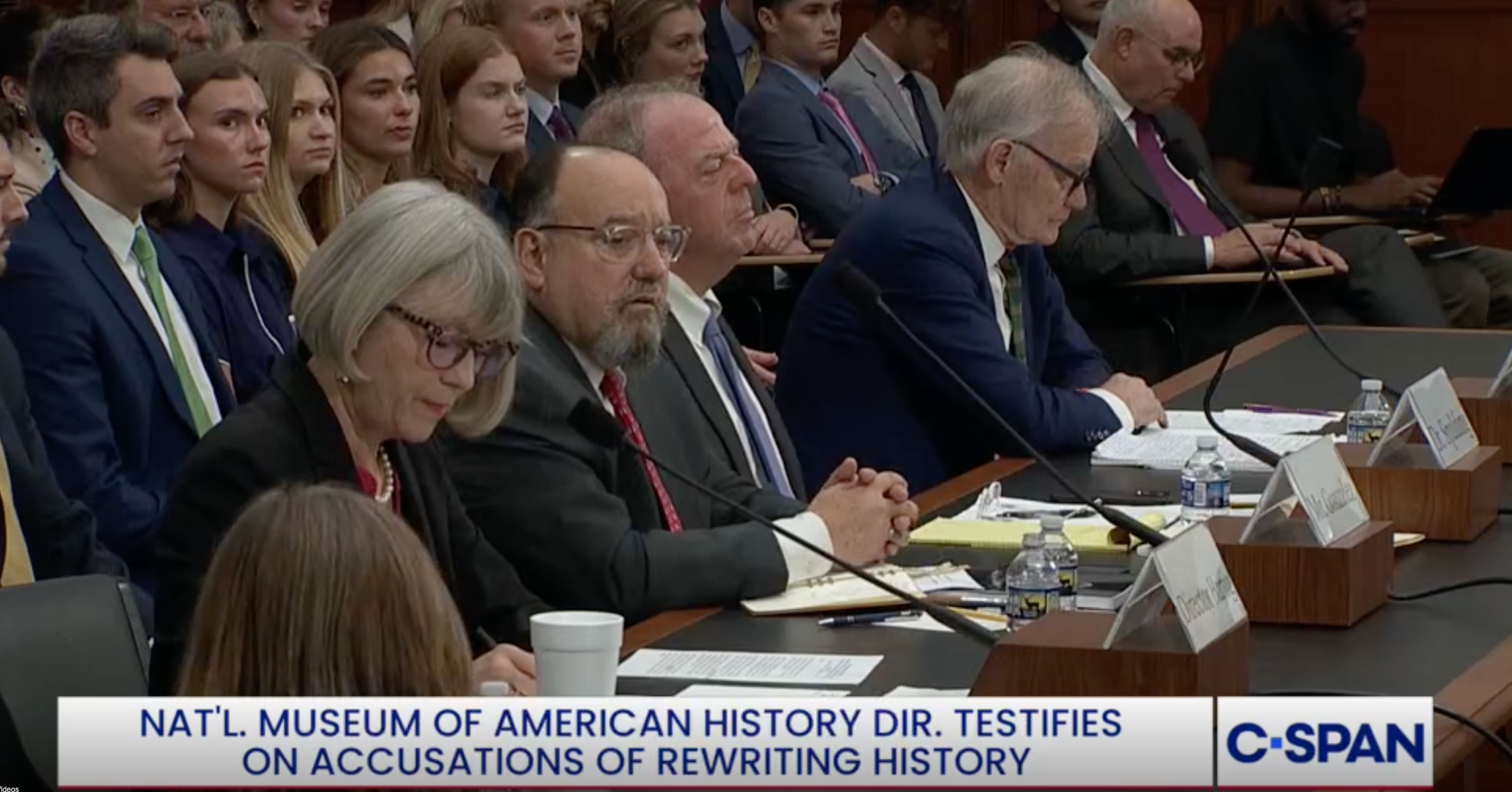
At a congressional hearing on July 21, Mike Gonzalez of the Heritage Foundation accused the Smithsonian’s leadership of subverting its national purpose and called upon Congress to “clean house.” He also urged lawmakers to deauthorize the proposed National Museum of the American Latino and Smithsonian American Women’s History Museum before either institution has opened a permanent building.
His statement is important—not because it provides an independent or particularly rigorous evaluation of the Smithsonian, but because it reveals how quickly the argument has moved from criticizing exhibitions to demanding the removal of museum leaders.
The July 4 White House report, properly titled Saving America’s Story, accused the National Museum of American History of “ideological capture” and concluded that the Smithsonian could not be trusted under its current leadership. Gonzalez largely repeats that report’s assumptions and examples, but goes further by calling explicitly for a purge.
Gonzalez’s oral statement
The following transcript has been lightly edited for punctuation and clarity without changing its substance.
Chairman, Ranking Member, members of this committee, thank you for the opportunity to testify.
Following Election Day 2024, Thomas Frank published an op-ed in The New York Times, suitably titled “The Elites Had It Coming.” Here’s what Frank, who’s a liberal, wrote:
“Everyone has a moment when he first realized that Donald Trump might well return, and here is mine. It was back in March during a visit to the Smithsonian’s National Portrait Gallery, when I happened to read a text beside an old painting. It described the westward advance of the United States as settler colonialism. I knew instantly where this nation was going. Some curator of one of the most exalted institutions had decided to use a morally loaded academic keyword to address a visitor to the museum—say, a family from the Midwest—and teach them a lesson about American wickedness.”
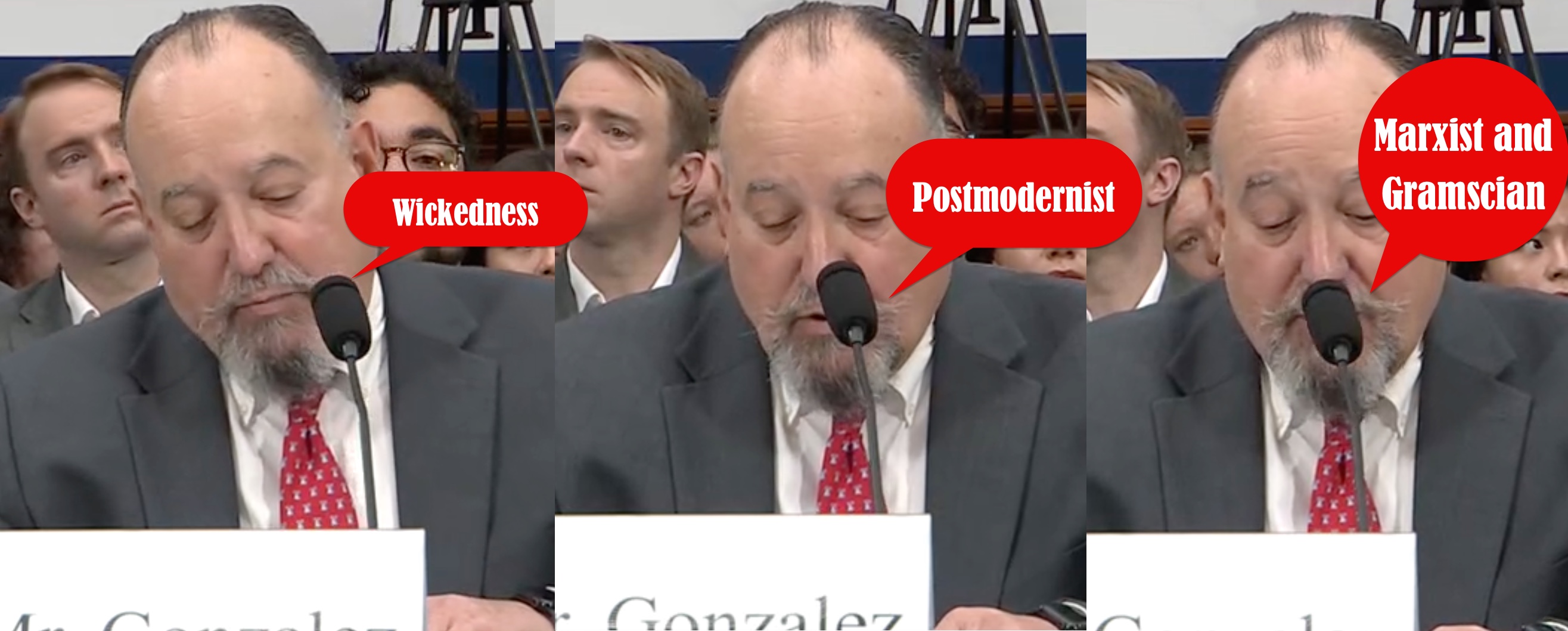
Teaching lessons about American wickedness is now the mission of the Smithsonian. It is the intent of the leadership, and it is precisely what they trained the staff to do.
Secretary Lonnie Bunch III, Anthea Hartig, the director of the National Museum of American History and one of today’s witnesses, and other museum leaders have commandeered the world’s largest museum complex and admit that they intend to use it as a tool of societal transformation.
This is not why Americans entrusted these institutions to them. Culture is not passed on in the bloodstream. National museums are repositories of a nation’s collective inheritance so that it can be transmitted to future generations.
However, the Smithsonian’s leadership has subverted this mission.
Under Dr. Hartig, the History Museum has erased two words from the mission statement. The first is “history” itself. The word “history” had to go because Dr. Hartig preferred the museum to be “very future-facing.”
The other word that disappeared in the new mission statement was “America” itself. Director Hartig said the term America should include “the entirety of the Americas, not just our part of North America.” She also said that loving America is complicated.
Dr. Hartig, the director of the National Museum of American History, has deconstructed the museum’s mission statement, to borrow the terms of the postmodernists who clearly guide her work.
We’re here today, as you said, because on July 4 the White House released a devastating report focusing on Anthea Hartig’s museum and the agenda that she pushes.
Read the report and you will find that it is not just postmodernism that guides the leadership. They see the world in terms of power dynamics: who has dominance and how to wrest it from them by dismantling the American narrative.
This is deeply Marxist and Gramscian. In fact, the action toolkit that leadership used to indoctrinate staff at the Smithsonian for years even quotes approvingly from the works of Frankfurt School critical theorist Herbert Marcuse.
You can understand why Bunch began his tenure by tying the institution to two ideological and destructive movements: the 1619 Project and Black Lives Matter.
BLM’s main leader had made clear in 2019 that the group’s goal was to “keep dismantling the organizing principle of this society.”
Yet in July 2020, as the country was burning, Lonnie Bunch wrote that he saw a moment of promise and possibility. Bunch said that the Smithsonian would legitimize the 1619 Project, except that historians from both sides of the spectrum decried the shoddy scholarship and inaccuracies of the 1619 Project.
For ideological reasons, Lonnie Bunch put the Smithsonian’s reputation at serious risk, and Director Hartig endorsed all of it, pledging to “work to reframe the traditional celebratory narrative of U.S. history” to force a national reckoning.
National reckoning—from a history museum.
This erasure of American culture must end now.
As Stanley Kurtz wrote last week, you can say that the economy and foreign policy are more important than these cultural battles. Over the long haul, however, that is simply not true.
You need to clean house and relieve all Smithsonian leadership of their duties.
Also, deauthorize the yet-to-be-built Latino and women’s museums, which will no doubt become two more incubators of anti-American grievances. We can see this in the precursor exhibits that they’ve had.
Loving America is not complicated. Dr. Hartig is wrong.
I implore you to do your jobs.
Thank you for your attention.
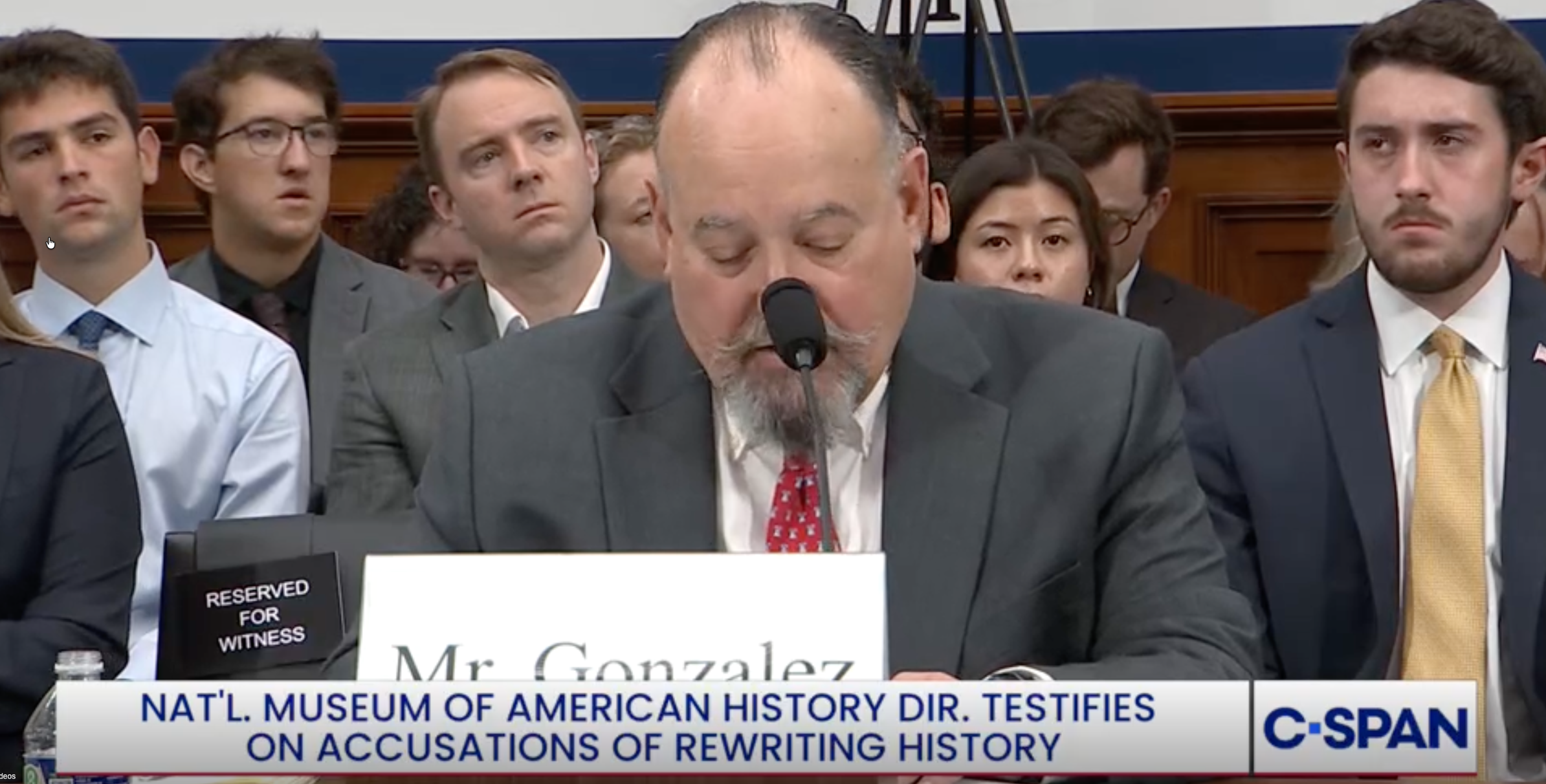
Is Gonzalez a credible evaluator?
Gonzalez is an experienced journalist, former government speechwriter, author, and conservative policy advocate. He has substantial expertise in political communications and ideological argument. His Heritage Foundation biography does not identify professional training or experience in museum administration, history, historical research, exhibitions, interpretation, collections, education, or nonprofit governance.
That does not disqualify him from criticizing the Smithsonian. Museums are public institutions and should be evaluated by visitors, elected officials, journalists, scholars, and citizens—not merely by other museum professionals.
His background does, however, affect the kind of authority his statement carries. Gonzalez appeared as a political advocate, not as an independent museum evaluator. The Heritage Foundation is an explicitly conservative policy organization, and Gonzalez has written extensively about Marxism, identity politics, multiculturalism, and what he regards as the ideological capture of American institutions. His Smithsonian testimony applies that established argument to a new target.
Readers should therefore examine his evidence rather than accept his conclusions because of his title or congressional invitation.
From a label to an institutional conspiracy
Gonzalez begins with a legitimate criticism. Thomas Frank did object to a Smithsonian exhibition label that described westward expansion as “settler colonialism.” Museums should take such reactions seriously. Academic terminology can alienate visitors when it is unexplained, morally loaded, or used as a substitute for interpretation.
But Gonzalez makes an enormous evidentiary leap. From one label at the National Portrait Gallery, he concludes that “teaching lessons about American wickedness is now the mission of the Smithsonian.”
Frank did not make that claim. His essay was primarily about the Democratic Party’s cultural distance from working-class voters—not about a coordinated plan by Smithsonian leadership. The label was also at the National Portrait Gallery, not the National Museum of American History. It provides no direct evidence about Anthea Hartig’s management of her museum.
One questionable label cannot establish the intentions of the world’s largest museum and research complex. A credible evaluation would examine a representative body of exhibitions, programs, collections, internal policies, and visitor experiences. It would distinguish among the Smithsonian’s many museums rather than treating them as a single curatorial voice.
Assertions presented as evidence
Gonzalez refers to actual statements, programs, and institutional documents. The difficulty is that he routinely treats his interpretation of them as though it were an established fact.
Collecting objects related to Black Lives Matter becomes proof that the Smithsonian endorsed the movement’s entire political agenda. Participation in the 1619 Project becomes evidence that Smithsonian leaders intended to discredit the United States. The use of concepts associated with social justice becomes proof of Marxist or Gramscian control. Those conclusions require more evidence than Gonzalez provides.
Terms such as “indoctrination,” “Marxist,” “postmodernist,” “subverted,” and “anti-American” carry considerable rhetorical force, but Gonzalez does not define standards by which they could be tested. Nor does he demonstrate that Smithsonian scholarship, collection procedures, peer review, or exhibition development were abandoned in favor of partisan directives.
His argument depends heavily on inferred motives: museum leaders did not merely make decisions he considers misguided; they intended to dismantle the American narrative and use the Smithsonian to transform society. That may be his sincere interpretation, but it is not a demonstrated finding.
An extension of the White House report
Gonzalez’s testimony is best understood as an extension of Saving America’s Story, not independent confirmation of it. Both use the same vocabulary of “ideological capture.” Both treat attention to race, gender, immigration, inequality, and colonialism as evidence of political radicalism. Both move from selected documents and quotations to broad conclusions about the trustworthiness of Smithsonian leadership. The hearing itself was announced by the committee majority as an examination of alleged “extreme political activism” following the White House report.
Gonzalez, however, makes the desired consequences much clearer. The White House report exerted pressure on Smithsonian leadership without directly ordering their dismissal. Gonzalez told Congress to “clean house” and remove the leadership. He also condemned two congressionally authorized museums in advance, asserting that they would “no doubt” become centers of anti-American grievance. “No doubt” is especially revealing. Evaluation normally begins with questions and evidence. Gonzalez supplies a verdict before the museums exist.
How museums should be evaluated
Museums should not respond to criticism by becoming defensive or insisting that only museum professionals are qualified to judge their work. The public has every right to ask whether a national museum is accurate, balanced, accessible, relevant, and worthy of public support. But responsible evaluation requires more than collecting provocative quotations. A serious review should:
- examine a representative range of exhibitions and programs rather than isolated examples;
- quote staff and institutional documents in their full context;
- distinguish among separate museums, departments, and levels of authority;
- compare the work with recognized historical and museum standards;
- identify specific factual errors or procedural failures;
- allow the people and institutions being criticized to respond;
- distinguish disagreement over interpretation from evidence of misconduct; and
- recommend remedies proportionate to the documented problem.
A disputed label might require revision. An unbalanced exhibition might require additional evidence or perspectives. A flawed process might require stronger peer review. None of those findings automatically justifies removing an institution’s leadership.
Critique should help museums become more accurate, useful, and trustworthy. It should not merely gather ammunition for a predetermined political outcome.
Why Gonzalez’s statement matters
Gonzalez’s statement is significant because it transforms the White House’s accusations into an explicit personnel demand. It indicates that at least some of the Smithsonian’s critics are not primarily seeking better labels, stronger scholarship, or more balanced exhibitions. They want to remove the Institution’s leadership and halt museums devoted to Latino and women’s history. Museum professionals and members of the public should take that objective seriously.
Readers can voice their opinions by writing not only to their senators and representatives but also to the Smithsonian’s Board of Regents. Congress placed responsibility for administering the Smithsonian in that Board, and the Board provides oversight of the Secretary and the Institution. Franklin D. Raines is currently chair of the Board of Regents, and the Smithsonian maintains a Board contact page through which correspondence can be directed to him and the other Regents.
Those who write should be specific. They might ask the Regents to protect the Smithsonian from partisan control while also requiring rigorous scholarship, transparency, fair evaluation, and responsiveness to legitimate public criticism. The choice is not between accepting everything the Smithsonian does and accepting Gonzalez’s demand to “clean house.”
Museums need criticism. They also need critics who examine evidence carefully, acknowledge complexity, consider competing explanations, and propose remedies that fit the facts. Gonzalez’s statement demonstrates what happens when evaluation begins with a verdict. The museum field should insist on something better.


Max, Thanks so much for this post. I only saw a snippet of the hearing so I welcome this transcription. I did go to the House Dems press release, and I’ve downloaded Morelle’s report, “The White House Campaign to Seize Control of the Smithsonian and REwrite History.” I’m heading to physical therapy and will bring your post and the Morelle report to the PT waiting room! I’d already contacted all of my elected reps. Am doing the Regents this afternoon.
Thanks again.
Marsha
Marsha L. Semmel 3111 14th Street South Arlington, VA 22204 marsha.semmel@gmail.com (o) 703.527.2687 (m) 571.205.3920
LikeLike
Thanks for the excellent and thorough explanation, Max. Your eight points by which a museum should be reviewed make very plain that the White House report and supporting testimony missed every mark. Nonetheless, as you note, their attempt to inflict a very narrow and twisted history on the Smithsonian and the American people will continue. Again, thanks for the well-argued post.
LikeLike