
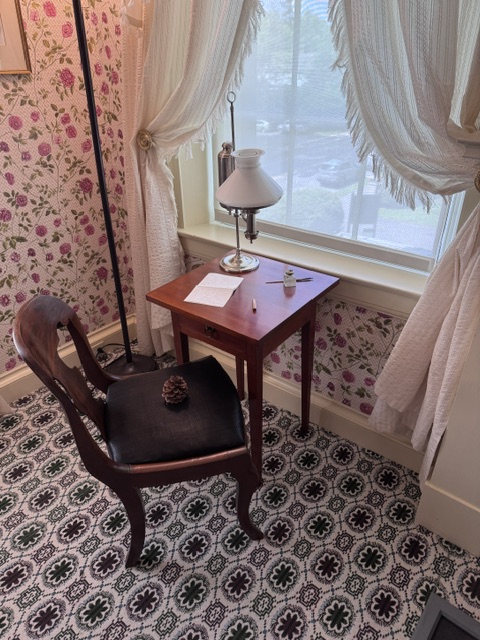
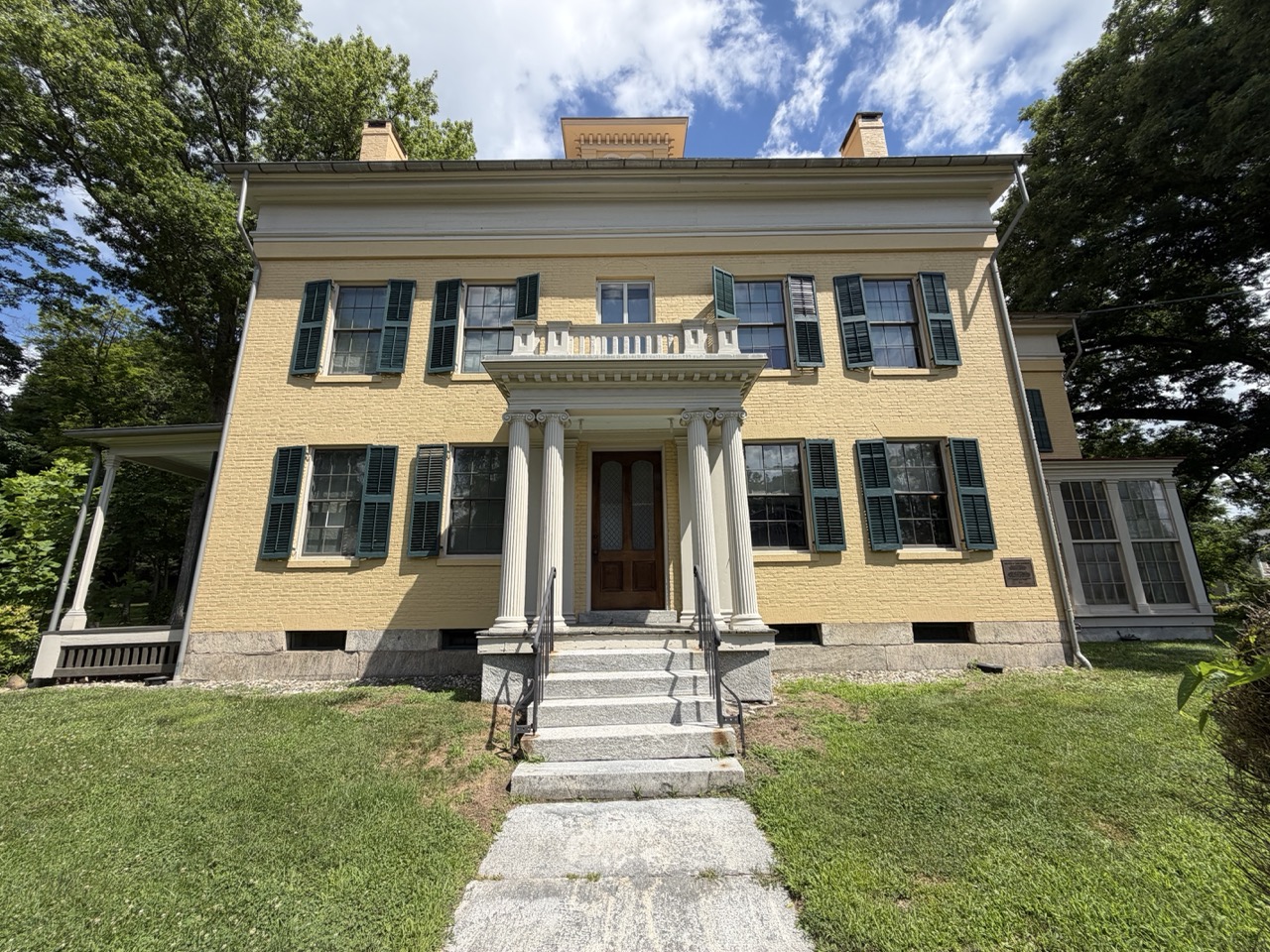
Before visiting the Emily Dickinson Museum in Amherst, Massachusetts, I knew surprisingly little about Emily Dickinson. The Museum encompasses two historic houses: the restored Homestead, where Dickinson was born, died, and wrote most of her poetry, and the unrestored Evergreens, the neighboring home of her brother Austin, his wife Susan, and their family. Although the Museum includes both houses, it was the Homestead that demonstrated how a historic house can become the key to understanding a poet.
I knew Emily Dickinson was one of America’s greatest poets, that she published very little during her lifetime, and that she lived much of her adult life in relative seclusion. I was also familiar with a few of the recurring stories surrounding her life—her correspondence with Thomas Wentworth Higginson, her close relationship with her sister-in-law Susan Gilbert Dickinson, and the questions surrounding her withdrawal from society. Beyond that, she remained something of a mystery. What I did not expect was that the house itself would become the key to understanding her.
Many literary house museums preserve the places where authors lived and worked. The Emily Dickinson Homestead does something more ambitious. Rather than treating the Homestead simply as the place where Emily Dickinson lived, the guide used the house as a framework for understanding the person behind the poet. Each room served as a setting for exploring a different aspect of her life. This was done not through dates and events alone, but through her own poetry, her education, her family relationships, her intellectual curiosity, and her creative choices. In doing so, the house became not simply the setting for Dickinson’s story but an essential part of telling it.
Instead of beginning with furniture or architecture, the guide frequently began with one of Dickinson’s poems. Often, one of Dickinson’s poems opened a conversation, and the room became the backdrop for understanding the experiences, questions, and relationships that informed her writing. The library became a place to discuss education and the books that expanded her thinking. Her bedroom became a place to examine the extraordinary burst of creativity that produced more than a thousand poems in just a few years. Family spaces became opportunities to explore the network of people who made her work possible—from her father, who supplied books; to her sister Lavinia, who assumed many household responsibilities; to sister-in-law Susan, her closest reader and intellectual companion. The result was a tour that never reduced Dickinson to either biography or legend. It was one of the most effective literary house tours I have experienced.
What impressed me most was the guide’s willingness to embrace uncertainty. Rather than presenting tidy answers, she repeatedly acknowledged where historians continue to debate Dickinson’s life. Why did she withdraw from much of Amherst society? What was the nature of her relationship with Susan Dickinson? How should we understand her religious beliefs? Instead of resolving these questions, the tour demonstrated that uncertainty itself was central to Dickinson’s way of thinking. She resisted simple conclusions in both her life and her poetry, and the interpretation respected that complexity.
The house itself became more than a collection of historic rooms. It became evidence of the environment that shaped Dickinson’s intellectual and creative life. Visitors could see the spaces where Dickinson read, wrote, observed, questioned, and developed the distinctive poetic voice that challenged nineteenth-century literary conventions. The physical setting helped explain not simply where she lived but how her intellectual world was formed.
That approach sets the Homestead apart. Many literary house museums understandably focus on the author’s daily life or preserve rooms much as they appeared during the occupant’s lifetime. The Dickinson Homestead certainly does that, but it goes further. The furnishings and objects rarely become ends in themselves. Instead, they serve the larger goal of helping visitors understand the development of a remarkable mind.
By the end of the tour, I realized I wanted to do something I had not expected: read more Emily Dickinson. Not because I felt obligated to appreciate a famous poet, but because the tour made me curious. It introduced Dickinson not as an icon frozen in history but as an endlessly questioning thinker whose poems continue to reward careful reading.
That may be the highest compliment one can give a literary house museum. It did not simply teach me about Emily Dickinson. It made me want to know her better.
Historic house museums often ask visitors to imagine what life was like within their walls. The Emily Dickinson Homestead accomplishes something more difficult. It uses the house, its objects, and Dickinson’s own words to illuminate the experiences, ideas, and relationships that shaped one of America’s greatest poets. Emily Dickinson remains unknowable in many respects—as all remarkable people do—but I left feeling that I understood not simply more about her life, but more about the mind that produced her poetry.


Thanks for this, Max. My partner and I toured the museum a couple of years ago when we were in Amherst seeing some other museum friends and relatives. We were so impressed. I purchased a copy of White Heat, and, when we got back to Arlington, we watched the bioflick about Dickinson, A Quiet Passion. I’ve enjoyed the emails I continue to receive from the museum, and have even made a modest donation or two.
Marsha
Marsha L. Semmel 3111 14th Street South Arlington, VA 22204 marsha.semmel@gmail.com (o) 703.527.2687 (m) 571.205.3920
LikeLike