
Tag Archives: Women Writers

Louisa May Alcott’s Orchard House: Revealing More Than Little Women

Louisa May Alcott’s desk in her bedroom at Orchard House in Concord, Massachusetts. Courtesy of Orchard House.

Many visitors come to Orchard House because they love Little Women. The museum embraces that connection. As it notes on its website, visitors often remark that a tour is “like a walk through Little Women!” It is easy to understand why. The house inspired the setting of the March family home, and many of the people who lived there found their way into Louisa May Alcott’s novel.

After touring Orchard House, however, I came away with a different realization. The house certainly rewards visitors who come looking for Little Women. But its greatest contribution is something deeper: it reveals the creative world that shaped Louisa May Alcott as a writer.

That distinction became clear as the tour unfolded. Rather than treating Louisa as the sole focus, the guide introduced each member of the Alcott family through the rooms they occupied and the activities that took place there. Instead of presenting a series of biographical sketches, the house gradually revealed a household alive with writing, theater, art, education, reform, conversation, and, at times, financial struggle.

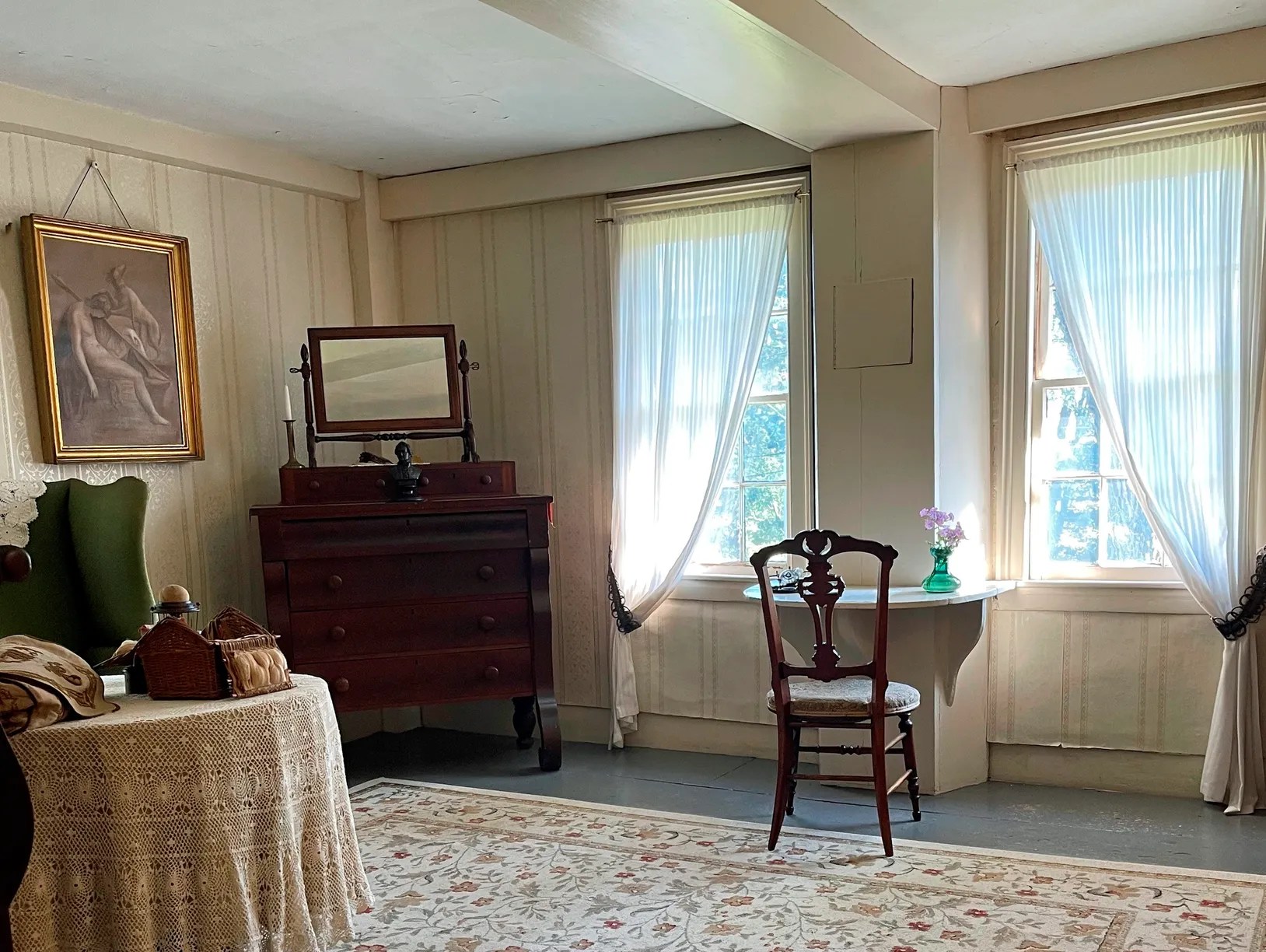
By the end of the tour, Little Women seemed less like the work of an isolated author than the literary expression of a remarkable family’s shared experiences. The rooms themselves reveal the different ways creativity found expression within the Alcott family. The dining room and parlor evoke oldest daughter Anna’s family theatricals, younger sister May’s rooms preserve the work of an aspiring artist, and Louisa’s bedroom centers on the desk where she wrote much of Little Women. Together, these rooms reveal a household where writing, art, and performance were all part of everyday life.

Continue reading
The Emily Dickinson Museum: A House That Reveals a Poet

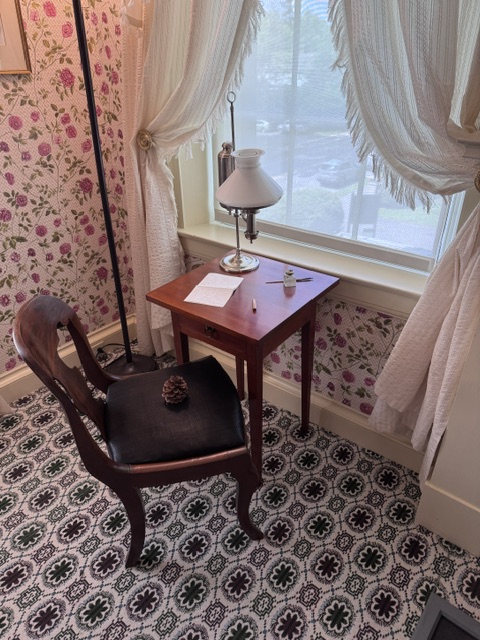
Emily Dickinson’s writing table, preserved in her bedroom at the Homestead in Amherst, Massachusetts.

Before visiting the Emily Dickinson Museum in Amherst, Massachusetts, I knew surprisingly little about Emily Dickinson. The Museum encompasses two historic houses: the restored Homestead, where Dickinson was born, died, and wrote most of her poetry, and the unrestored Evergreens, the neighboring home of her brother Austin, his wife Susan, and their family. Although the Museum includes both houses, it was the Homestead that demonstrated how a historic house can become the key to understanding a poet.

I knew Emily Dickinson was one of America’s greatest poets, that she published very little during her lifetime, and that she lived much of her adult life in relative seclusion. I was also familiar with a few of the recurring stories surrounding her life—her correspondence with Thomas Wentworth Higginson, her close relationship with her sister-in-law Susan Gilbert Dickinson, and the questions surrounding her withdrawal from society. Beyond that, she remained something of a mystery. What I did not expect was that the house itself would become the key to understanding her.

Many literary house museums preserve the places where authors lived and worked. The Emily Dickinson Homestead does something more ambitious. Rather than treating the Homestead simply as the place where Emily Dickinson lived, the guide used the house as a framework for understanding the person behind the poet. Each room served as a setting for exploring a different aspect of her life. This was done not through dates and events alone, but through her own poetry, her education, her family relationships, her intellectual curiosity, and her creative choices. In doing so, the house became not simply the setting for Dickinson’s story but an essential part of telling it.

Continue reading

The Harriet Beecher Stowe Center: What Only A Writer’s House Can Reveal

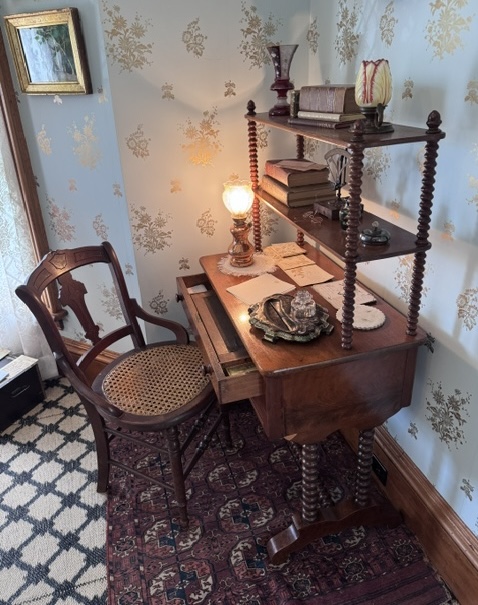
Harriet Beecher Stowe’s writing desk in her Hartford home.

When we visit the home of a famous writer, what are we hoping to discover? The works have already been written. Their biographies have been published. Their letters have been collected. So what can walking through the rooms where they lived add to our understanding?

Those questions were on my mind as I visited the Harriet Beecher Stowe Center in Hartford, Connecticut. The Center asks visitors to look beyond Uncle Tom’s Cabin and consider how Harriet Beecher Stowe became one of the nineteenth century’s most influential antislavery writers. It is an ambitious interpretive approach, one that emphasizes the firsthand accounts of enslaved and formerly enslaved people, abolitionist networks, and the many individuals whose experiences, testimony, and activism shaped Stowe’s writing.

As I reflected on the tour afterward, however, I found myself asking a different question: What can a historic house contribute to this story that no biography, lecture, or documentary can?

Continue reading