
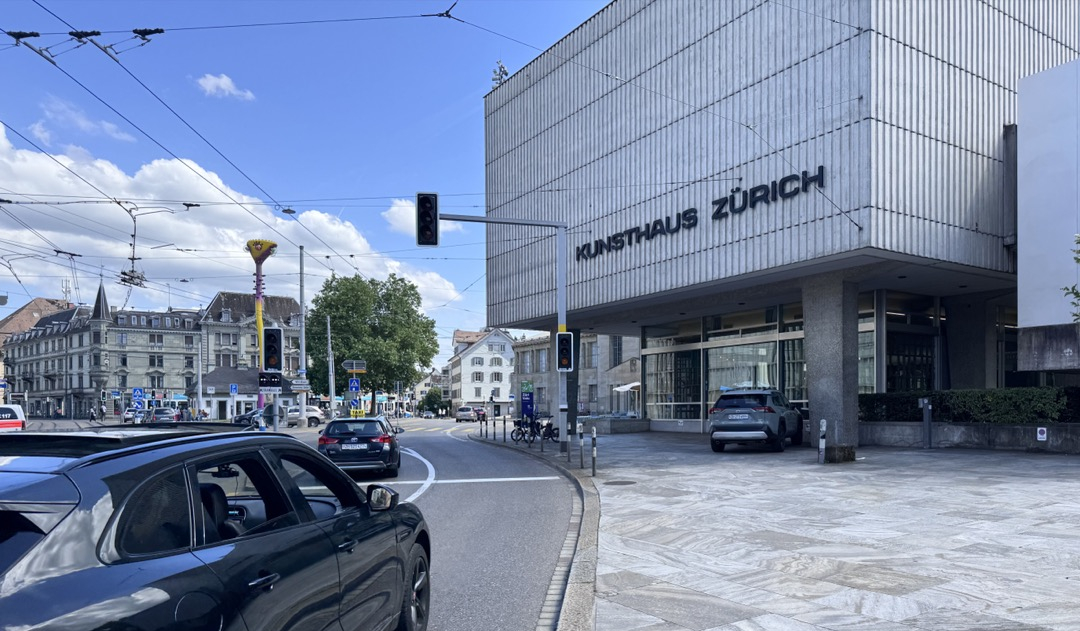
We recently returned from a two-week visit to Switzerland, where we visited more than fifty museums and historic sites across the German-, French-, and Italian-speaking regions. Among the many differences in museum practice, one pattern was especially noticeable in the art museums of the German-speaking cantons: their organization around named private collections, or Sammlungen.
A wealthy collector may have assembled works of art over a lifetime and later donated or loaned the collection to a museum. Rather than fully integrating those works into a chronological, thematic, or art-historical presentation, the museum often retains the collection as a distinct unit bearing the donor’s name.
There are legitimate reasons for doing this. A named collection preserves its provenance and recognizes the role of private collecting in the formation of public museums. It can reveal an individual collector’s tastes, preferences, ambitions, and blind spots. The collection itself can become a historical document.
This model is not unique to Switzerland. American museums such as the Barnes Foundation in Philadelphia, the Phillips Collection in Washington, DC, and the Frick Collection in New York preserve, to varying degrees, the identity and vision of their founders’ private collections. In those institutions, however, the collector’s personality, residence, installation choices, or philosophy of looking is central to the museum’s public identity. Visitors generally understand that they are entering a particular person’s conception of art.
The situation becomes more complicated when several named collections coexist within a larger institution. The visitor is no longer encountering one clearly defined collector’s museum but moving among several private visions whose differences are not always explained.

A Fragmented Art-Historical Experience
At the Kunsthaus Zürich, visitors pass through several named collections, identified by titles near the ceiling or subtle introductory labels that explain who the donor was, how the collection was formed, where the donor’s wealth came from, why particular artists or genres were favored, how they relate to other artworks in the museum, or how the collection came to the museum.
Most of the time, however, visitors do not notice that they have moved from one Sammlung to another. The galleries largely look alike: paintings arranged in a single row along white walls, accompanied by tombstone labels (title, artist, date). Paintings are rarely clustered to encourage comparisons or positioned in the center of galleries to create relationships across a room. The arrangement gives each painting considerable visual space, but it also produces a sequence of relatively independent encounters.
More significantly, organizing galleries by donor fragments the larger history of art. Works by the same artist may appear in different parts of the museum because they came from different collectors. The same period, artistic movement, or genre may recur in several locations. Paintings by Monet, nineteenth-century landscapes, or works associated with Impressionism may be separated instead of brought together for comparison.
The primary organizing principle is provenance—the identity of the collector—rather than a story about artistic development, historical circumstances, technique, or subject matter. Visitors must therefore assemble those relationships themselves. They encounter artworks primarily as individual objects or as components of a donor’s collection rather than as parts of a larger interpretive argument. Over the course of a large museum visit, that repeated work of constructing meaning can become exhausting. A museum organized in this way risks preserving the collector’s acquisitions, organization, and categories without explaining what these decisions mean. Who’s controlling the interpretation: the dead or the living? What’s the role of a curator: scholar or caretaker? Whose experience matters most: the donor or the visitor?
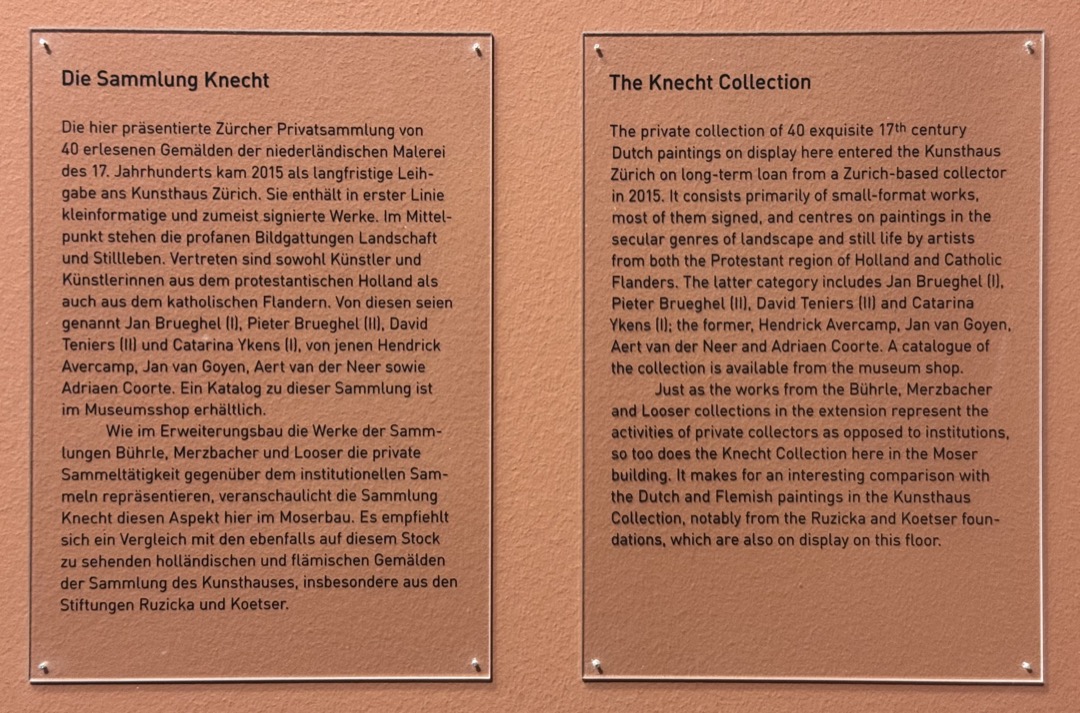
Identifying a Collection Is Not Interpreting It
The limited interpretation of the collectors themselves makes the fragmentation more pronounced. A donor’s name may identify a collection, but identification is not interpretation.
An effective introduction to a Sammlung might explain the collector’s artistic preferences, philosophy of collecting, sources of wealth, social position, relationship with artists and dealers, and connection to the museum. It might also identify what the collector overlooked or rejected. Such interpretation would allow visitors to consider the collection as a product of personal taste, economic power, historical circumstances, and institutional negotiation. Without this context, the donor’s name functions primarily as a designation of ownership.
The object labels generally reinforce the focus on individual works. Most are limited to the artist, title, date, and medium. Some offer additional historical details, especially provenance, but extended interpretation is less common.
Language creates another barrier. Labels are frequently presented only in German, with translations available in a booklet from the reception desk, on an introductory panel, or through a QR code. The information may technically be available, but visitors must know where to find it and take an additional step to access it. When interpretation is physically or digitally separated from the object, many visitors will simply experience the artwork without it.
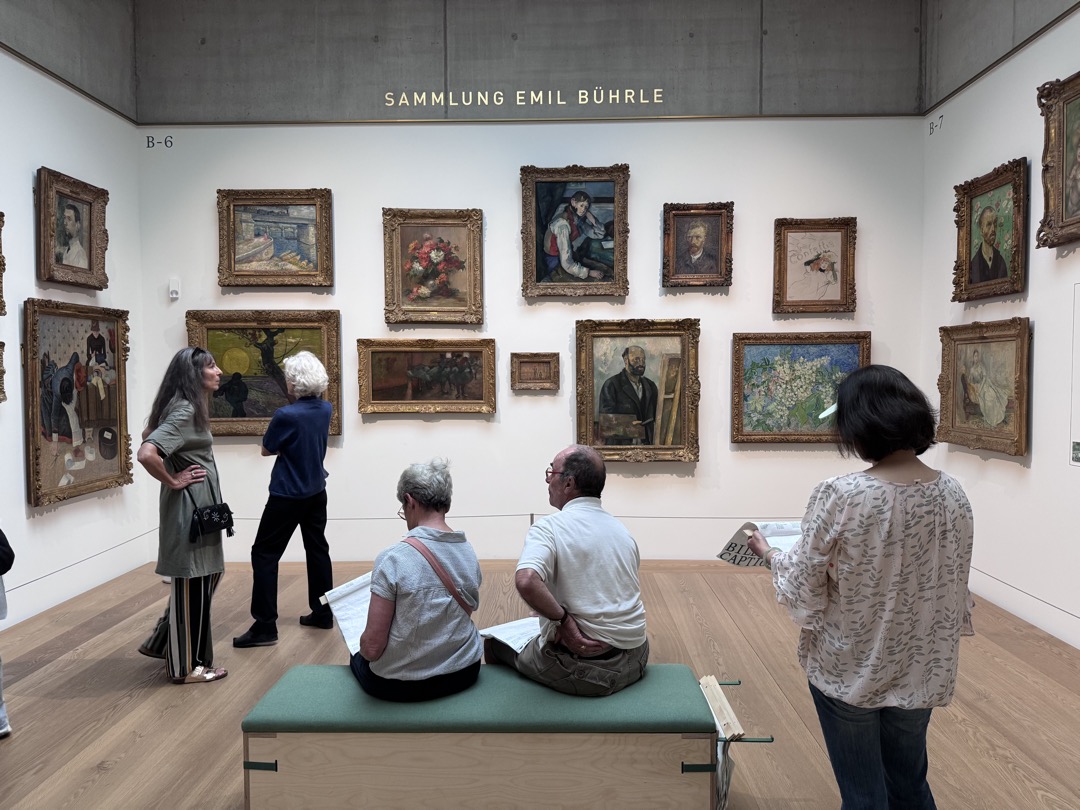
The Bührle Collection: A Significant Exception
The Foundation E. G. Bührle Collection at the Kunsthaus Zürich is a striking exception. Its galleries are interpretively distinct from the museum’s other named collections and demonstrate how a museum can retain a Sammlung while critically examining how it was formed.
The collection comprises 205 works ranging from seventeenth-century Dutch painting through Impressionism and modern art. It includes works by artists such as Vincent van Gogh, Henri de Toulouse-Lautrec, Paul Cézanne, and Paul Gauguin. But the Kunsthaus does not present it solely as an assembly of masterpieces.
The interpretation explicitly addresses controversy surrounding the collection’s formation and the provenance and ownership histories of particular works. One gallery examines how the Bührle Collection has been exhibited since the 1950s, making exhibition history itself part of the visitor experience. The display reminds visitors that museum installations are not neutral or permanent. They change in response to scholarship, public criticism, ethical standards, and institutional priorities.
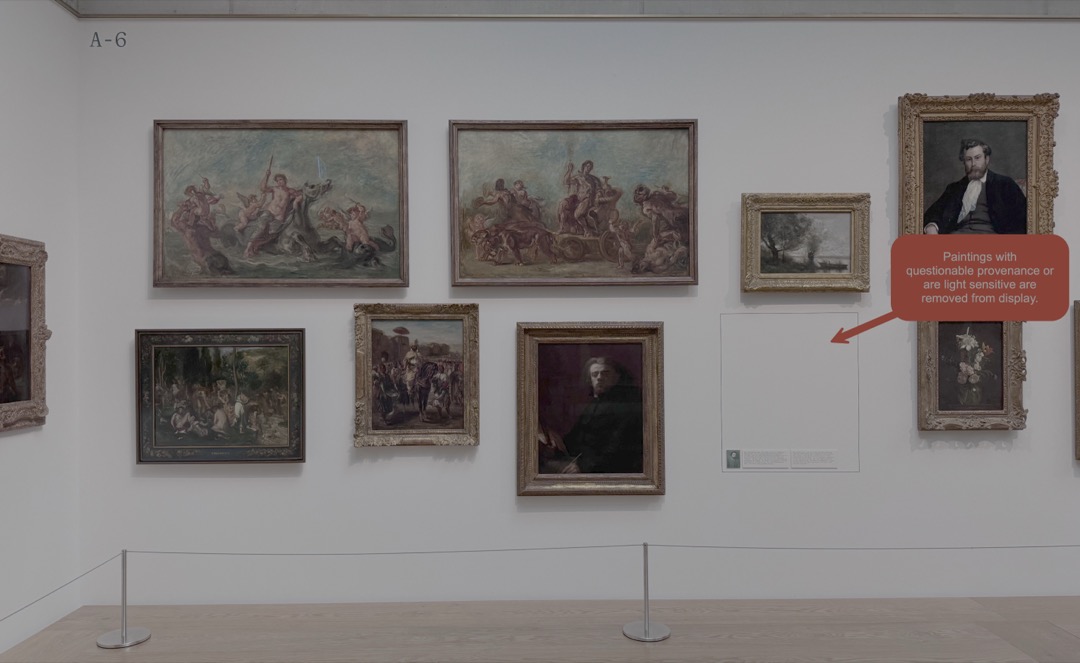
Individual labels also address provenance directly. One explains that an artwork was sold by a previous owner who had emigrated from Germany because of Nazi persecution. The label identifies the work as cultural property lost because of that persecution and states that the Bührle Foundation is negotiating with the owner’s legal successors to find a “just and fair solution.”
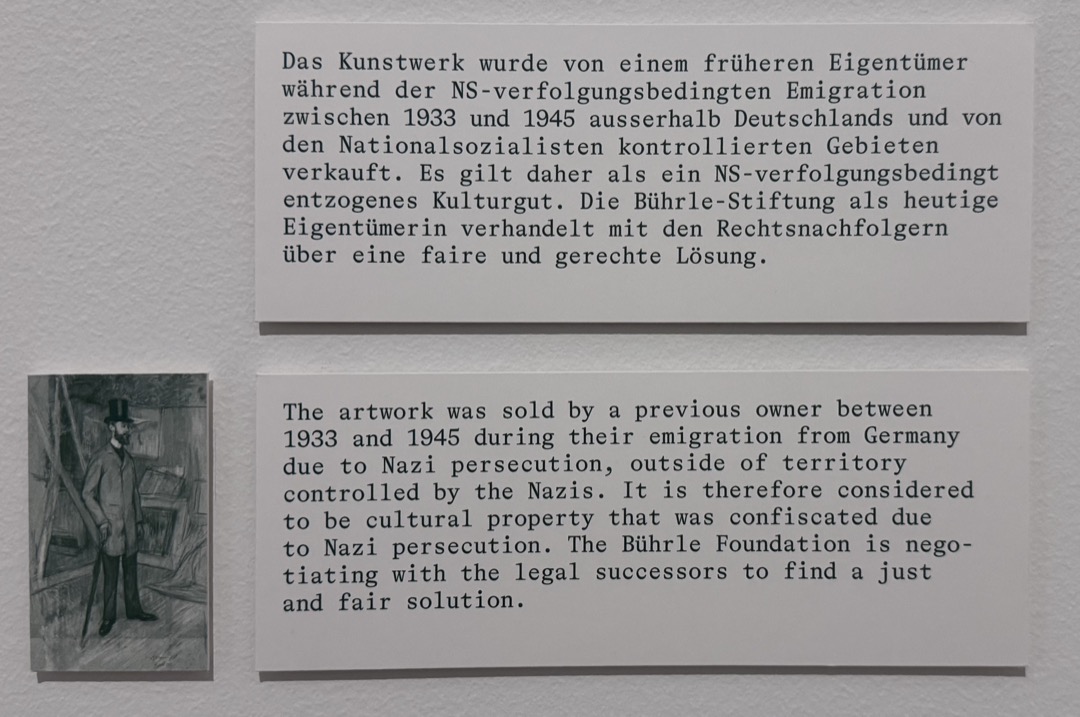
That language is unusually direct. It does not hide uncertainty or imply that current museum ownership resolves an artwork’s history. Instead, it acknowledges that provenance research is ongoing and that the ethical and legal status of an object may remain unsettled.
The Kunsthaus describes the current display as transitional. A new exhibition planned for 2027–28 is being developed with a feedback panel, external experts, archival research, and additional provenance investigation. It is expected to address the collection’s origins, collecting practices, and the legacies of Jewish collectors.
This represents a significant step in a productive direction. A named collection does not need to disappear as an organizing unit, but its name should open a line of inquiry rather than end one. Who was the collector? How was the collection financed? Under what conditions were the works acquired? Whose losses made those acquisitions possible? How did the collection evolve? How has the museum represented—or avoided—those histories?
The Bührle presentation demonstrates that collecting history, provenance, and institutional responsibility can add meaning rather than distract from the art.
The Collector’s Vision at “Am Römerholz”
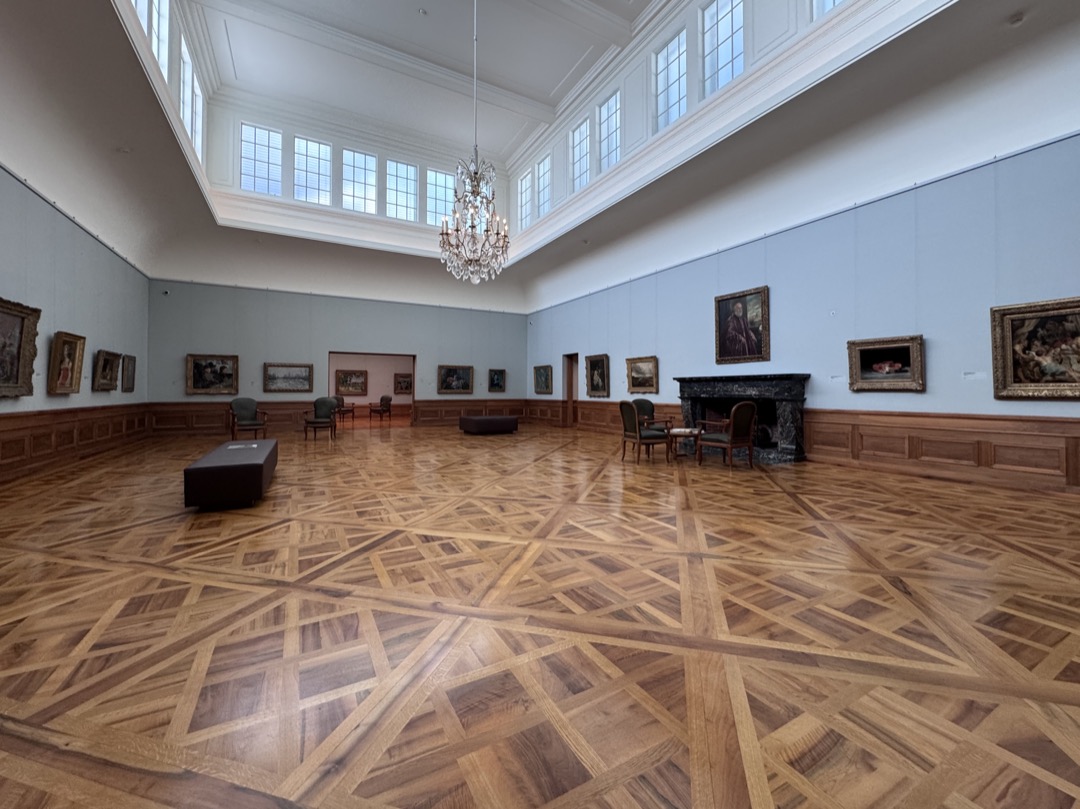
The Sammlung Oskar Reinhart “Am Römerholz” in Winterthur offers a different type of collector’s museum because the art remains in Reinhart’s former home.
The museum provides a free booklet in German that explains that Reinhart came from a prominent Winterthur business family whose economic success was closely connected to international cotton trading. His father’s support of the arts brought him into contact with artists and artworks at an early age.
Reinhart began collecting while young, developed an independent critical judgment, and established the foundations of his collection during the 1920s. In 1924, he withdrew from the family business to devote himself fully to art and purchased the country house, “Am Römerholz.” One year later, he added the large gallery.
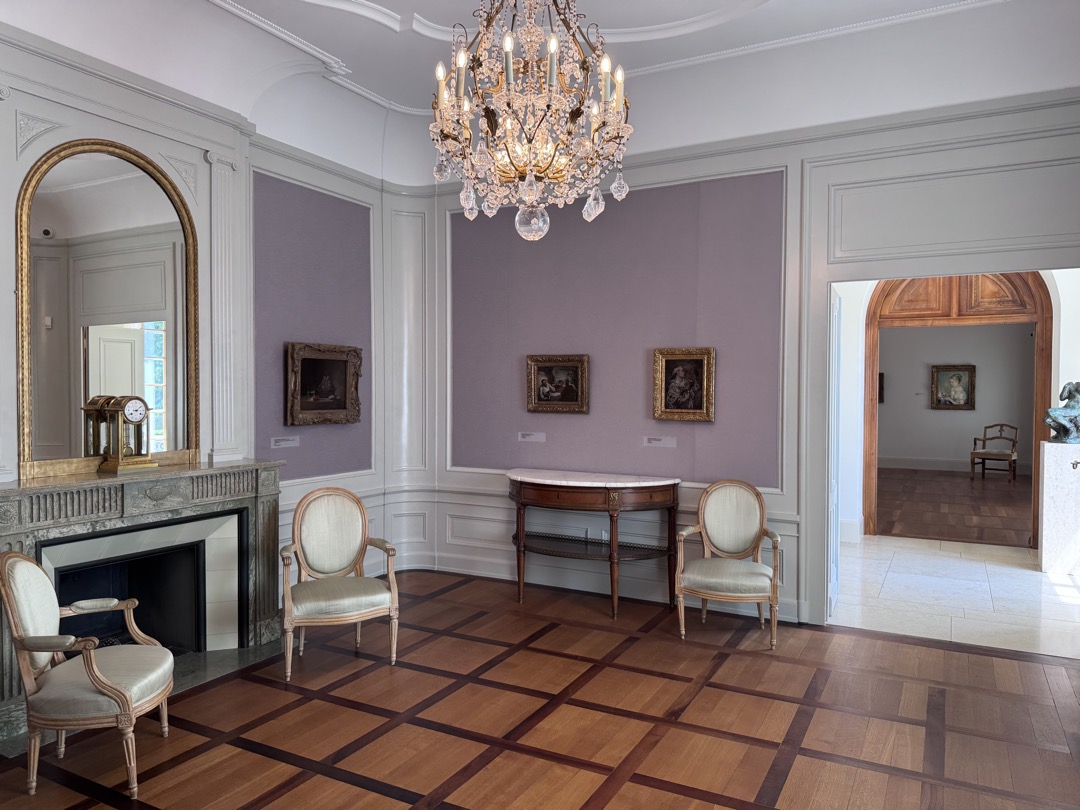
The booklet describes the property as a place where “living and collecting were combined in a unique way.” This suggests that the house was not merely a container for paintings. Reinhart created an environment in which domestic life, collecting, architecture, and the viewing of art were deliberately connected.
The museum also states that its new presentation follows a dual approach. It seeks to preserve the “original spirit” of the collection while expanding it through a contemporary art-historical perspective. The installation attempts to reconstruct Reinhart’s sensitivity to painterly qualities and relationships among individual works while also creating new lines of sight.
That is a reasonable curatorial goal, but the museum provides visitors with little guidance to distinguish between these two approaches. There are no historic photographs, inventories, floor plans, or quotations in the galleries that allow visitors to determine which arrangements reflect Reinhart’s choices and which are later curatorial interpretations. The entrance signs enthusiastically announce that the “masterworks are back,” but they do not explain whether the works have returned to their historic positions or have been newly arranged.
The booklet provides helpful introductions to Reinhart and the major galleries, but it is devoted almost entirely to paintings. Architecture receives only brief attention, even though Reinhart’s decision to add a large gallery just one year after purchasing the villa demonstrates that the building was central to his conception of the collection. The gallery was not simply where the paintings happened to be displayed. It was part of Reinhart’s thinking about how art should be experienced.
Beyond Paintings
The emphasis on paintings also minimizes the role of sculpture, architecture, interior design, and landscape. These elements are often treated as secondary settings rather than as parts of the collector’s larger composition.
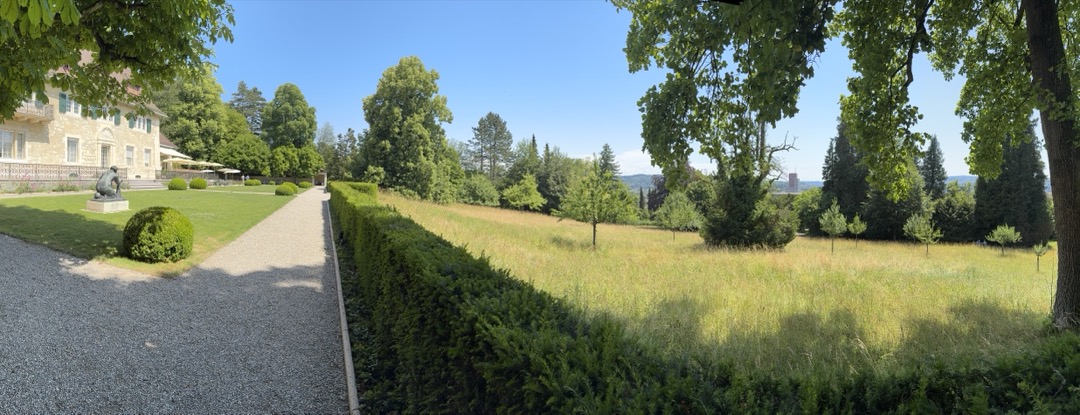
At “Am Römerholz,” the relationship among the collection, house, gallery, and grounds might be understood as a series of nesting environments: the artwork within the gallery, the gallery within the house, the house within the designed landscape, and the cultivated landscape within a broader natural setting. Near the house, the landscape is formal and visibly shaped by human design. Farther away, it becomes a wildflower meadow. The contrast between cultivated formality and apparent naturalness is striking.
The landscape, however, is not interpreted. It is unclear whether its present appearance reflects Reinhart’s intentions, a historic landscape plan, later alterations, or contemporary ecological management. Without additional evidence, it would be speculative to attribute the contrast directly to Reinhart.
Nevertheless, its absence from the interpretation illustrates the museum’s tendency to treat the paintings as the collection and everything else as their backdrop. A more holistic interpretation would ask whether Reinhart was simply acquiring individual masterpieces or creating an environment for experiencing art. His architectural choices strongly suggest the latter.
Interpreting the Collector
Named collections can reveal much more than individual taste or philanthropy. They can show how wealth, social position, historical circumstances, personal ambition, and institutional relationships determine which objects eventually become public culture.
But retaining a donor’s name is not the same as interpreting the donor.
When museums organize galleries around Sammlungen, visitors need to understand why each collection exists as a unit, what distinguishes it from the collections nearby, and whether its current installation reflects the collector’s intentions or later curatorial decisions. They also need help identifying relationships across collections so that artists, periods, movements, and subjects do not become disconnected by ownership history.
The Barnes, Phillips, and Frick demonstrate how the distinctive vision of one collector can become the organizing premise of an entire museum. The challenge at institutions such as the Kunsthaus Zürich is different: several collectors’ visions occupy a museum that also appears to offer a broader history of art.
The Bührle Collection demonstrates one promising response. It treats provenance, collecting history, exhibition history, and institutional accountability as essential parts of interpretation. “Am Römerholz” offers another opportunity: to interpret collecting not only as the acquisition of paintings but also as the construction of an environment where art, architecture, wealth, and private life came together.
The art museums of German-speaking Switzerland preserve remarkable works and historically important collections. Their next interpretive challenge is to make the collectors—and the consequences of their collecting—as visible as the art.

