
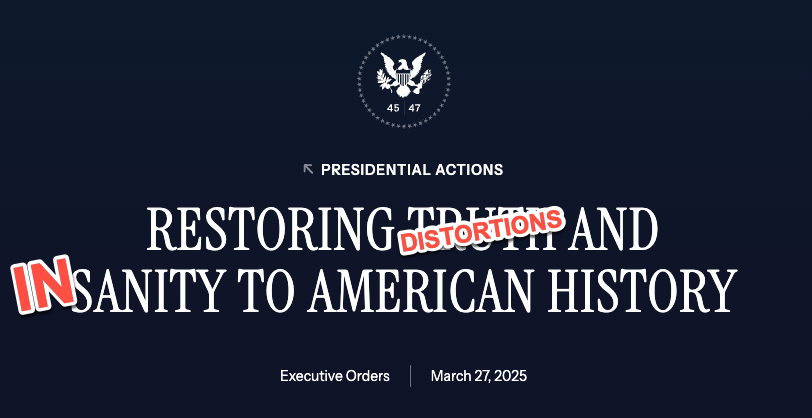
Today, the White House issued an executive order titled “Restoring Truth and Sanity to American History”, which aims to reshape the presentation of history within federal institutions—particularly the Smithsonian. The directive calls for the removal of “divisive or anti-American ideology,” restoration of monuments that have been “improperly removed,” and new restrictions on federally funded exhibits that “degrade shared American values.” While some may see this as a return to patriotic education, as a historian and museum professional, I see troubling implications for our field.
The Illusion of a Single Truth
At the heart of the order is the assertion that a “true” version of American history must be restored. But history is not a static set of facts—it is a discipline grounded in evidence, interpretation, and debate. Historical understanding evolves as new sources emerge, as questions shift, and as voices long excluded are brought into the conversation. There is no single, timeless narrative to return to—only a continuing effort to make sense of the past as honestly and inclusively as possible.
Independence Under Threat
The Smithsonian Institution, like many of our most trusted public history institutions, relies on scholarly rigor and curatorial independence. By assigning Vice President JD Vance a role in overseeing content and linking congressional appropriations to ideological compliance, this executive order politicizes museum interpretation and undercuts professional standards. When history is shaped by political power instead of evidence, public trust erodes.
Complexity Is Not Division
The order criticizes exhibitions and programs that “divide Americans based on race.” But exploring racism, slavery, Indigenous displacement, or civil rights is not divisive—it’s necessary. These stories are part of the American story. Reckoning with them does not degrade our national identity; it strengthens it by acknowledging both struggle and progress. Sanitizing history in the name of unity leaves us with a hollow patriotism that cannot withstand scrutiny.
Public Memory Is Not Set in Stone
The call to restore removed monuments ignores an important reality: public memory evolves. Statues are not just historical artifacts—they are expressions of contemporary values. When communities remove monuments to enslavers or secessionists, they are not erasing history but re-evaluating whom they choose to honor. These are local democratic decisions, not acts of historical vandalism.
Museums Must Stand for Inquiry
The greatest strength of museums and historic sites is their ability to invite curiosity, pose difficult questions, and foster understanding. When federal policy begins to dictate what stories we can or cannot tell, we risk turning our institutions into instruments of propaganda rather than places of learning. History should provoke, challenge, and inspire—not conform to a single approved script.
As we approach the 250th anniversary of the Declaration of Independence, now is the time to reflect deeply on what it means to tell the American story. Museums must continue to uphold the principles of scholarship, inclusion, and intellectual freedom—even when it’s hard. Especially when it’s hard.
 Engaging Places
Smithsonian Institution Secretary Bunch released the following message today:
Dear colleagues,
As an Institution, our commitment to scholarship and research is unwavering and will always serve as the guiding light for our content. Late yesterday, the White House issued a presidential Executive Order (EO) related to cultural institutions including the Smithsonian. The EO directs Vice President Vance, in his role as an ex-officio Smithsonian Regent, to work with our Board of Regents on issues related to content.
We remain steadfast in our mission to bring history, science, education, research, and the arts to all Americans. We will continue to showcase world-class exhibits, collections, and objects, rooted in expertise and accuracy. We will continue to employ our internal review processes which keep us accountable to the public. When we err, we adjust, pivot, and learn as needed. As always, our work will be shaped by the best scholarship, free of partisanship, to help the American public better understand our nation’s history, challenges, and triumphs.
As we have done throughout our history, the Smithsonian will work with the Board of Regents, including the Chief Justice, Vice President, and our congressional and citizen Regents. The Smithsonian is fortunate to have a dedicated board that understands and appreciates the Institution’s mission, as well as the importance of scholarship, expertise, and service to the American public.
For more than 175 years, the Smithsonian has been an educational institution devoted to continuous learning with the public in mind and driven by our most important mission – the increase and diffusion of knowledge. We remain committed to telling the multi-faceted stories of this country’s extraordinary heritage. Thank you for all you do to carry our mission forward. I remain honored to be your colleague and in awe of your daily service to our nation.
Sincerely,
Lonnie Bunch
Lonnie G. Bunch III | Secretary
LikeLike