
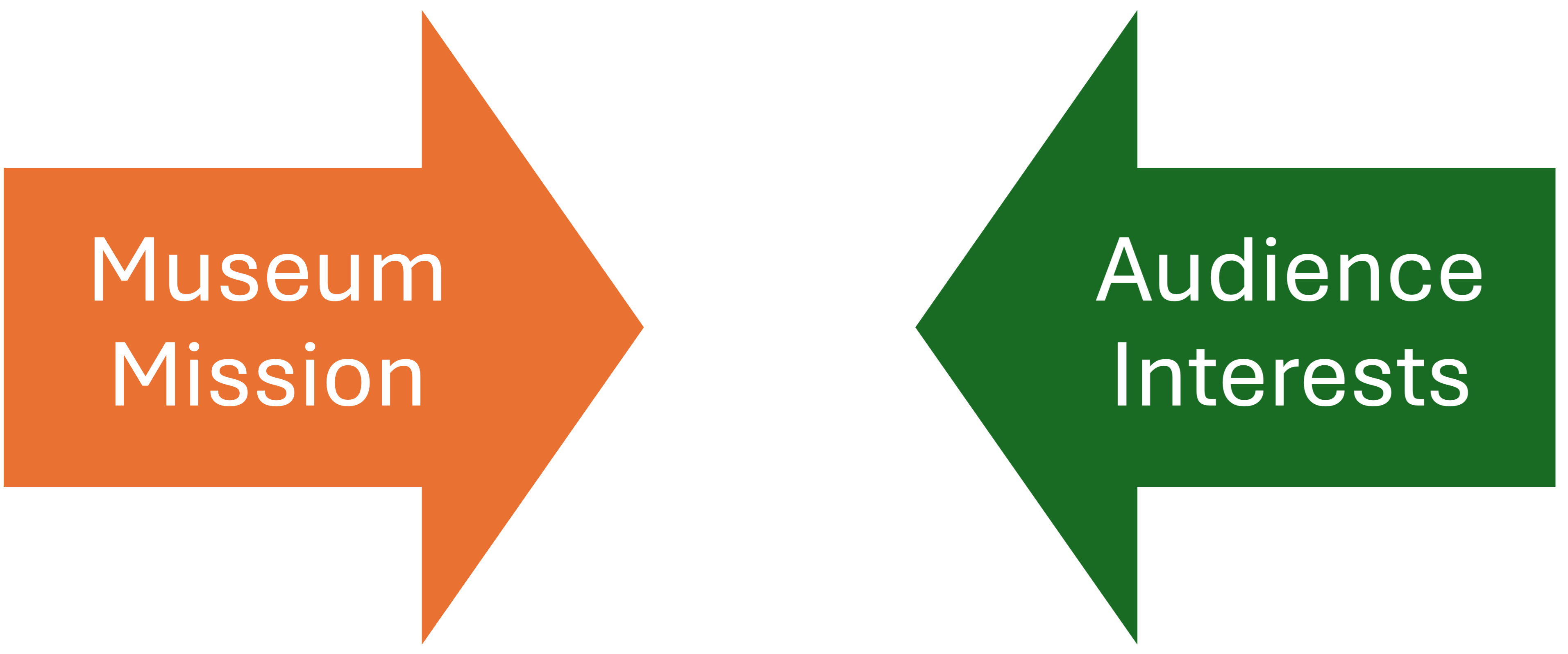
In museums and historic sites, whether you’re designing school programs, workshops, docent training, or exhibitions, understanding the needs and interests of your audience is key to success. But how do you efficiently analyze diverse feedback and connect it to your goals? Recently, I experimented with a creative process that combined audience input and AI to revise the learning objectives for my graduate course, Creating Sustainable Museums. The results not only improved the course but also offered insights into how AI can be used to enhance museum work.
This approach was inspired by research conducted by Conny Graft at Colonial Williamsburg decades ago, which revealed that the goals of museum educators for school field trips often didn’t align with those of teachers. When those misalignments went unaddressed, they could lead to disappointment for both parties. Graft’s work emphasized the importance of finding common ground between institutional goals and participant expectations—a principle that remains essential in museum work today.
Start with Your Audience’s Goals
My course revision process began with a pre-course online survey, asking students to share what they hoped to know, feel, and do by the end of the semester. Using GPT, I quickly synthesized and categorized their responses to reveal predominant interests in financial, social, and environmental sustainability, as well as a strong desire to gain practical, job-ready skills. This step is akin to understanding your audience in a museum setting: what do your participants want to know, feel, or do? Are they looking for historical context, practical skills, or a new way to connect with the past?
Pair Audience Input with Organizational Goals
Next, I used GPT to align the student responses with my course goals using the prompt, “Based on these student comments, how might I modify my learning objectives for the course: [insert list of learning objectives].” For instance, one of my original learning objectives was:
- Original: “Analyze Sustainability Principles. Develop a comprehensive understanding of financial, social, and environmental sustainability principles and their application in museum operations and strategy.”
Students expressed a desire not just to understand these principles but to explore how they intersect with practical challenges and opportunities. Based on this feedback, GPT revised it to:
- Revised: “Understand Sustainability Principles: Examine and interpret financial, social, and environmental sustainability principles and evaluate their relevance to museum operations, collections care, programming, and community engagement.”
This change reflected the students’ interest in a more holistic approach to sustainability that includes collections care and community impact, aligning their goals with the course’s broader purpose. But I also made an edit: “understand” is too vague for an outcome, so I changed it to “analyze.”
Another example:
- Original: “Integrate Professional Skills. Apply interdisciplinary skills, such as academic research, grant writing, project planning, and budget preparation, to create practical strategies for improving museum sustainability.”
Students wanted to feel confident advocating for sustainability and communicating with diverse stakeholders. To address this, GPT revised the objective to:
- Revised: “Apply Interdisciplinary Skills. Integrate practical skills such as sustainability assessments, collections care planning, grant writing, budget preparation, and strategic communication to develop comprehensive and feasible solutions.”
This revision emphasized communication and advocacy, reflecting student priorities while maintaining the course’s core focus.
Practical Applications for Museums
- School Programs: Use AI to analyze feedback from teachers or students and adapt programs to better meet their educational needs. For example, if teachers mention challenges aligning museum visits with curriculum goals, GPT can help suggest connections between your content and state standards.
- Workshops and Training: Collect feedback from participants or docents-in-training. GPT can highlight recurring themes, such as the need for more interactive teaching techniques or in-depth historical context, and help you refine your approach.
- Staff and Volunteer Training: Analyze surveys or interviews from docents to identify knowledge gaps or challenges. For example, if docents express discomfort with answering complex visitor questions, GPT can help develop training materials that address these issues.
- Exhibitions: Use visitor surveys to understand what audiences want to learn or experience. GPT can suggest ways to make exhibitions more engaging, such as integrating interactive elements or highlighting underrepresented stories.
A Collaborative, Iterative Process
In my course, GPT didn’t replace my role as the instructor; instead, it acted as a collaborator, helping me identify patterns and refine ideas, significantly reducing the time and effort involved. Importantly, I didn’t rely on GPT to create the objectives from scratch (though it’s capable of doing so). As the instructor, I drafted the initial learning goals, while students contributed their own goals through a survey. GPT then used these inputs to propose a revised set of learning objectives that aligned with both my instructional priorities and the students’ interests.
For museums, this process can help balance audience needs with institutional goals. By aligning participant feedback with your mission, you can design programs and experiences that resonate more deeply. By leveraging tools like AI, we can approach audience engagement with fresh perspectives. Whether revising a course or developing a new exhibition or workshop, this technology helps us connect our goals with the goals of those we serve.
Have you used GPT or similar tools in your museum? I’d love to hear your thoughts in the comments below!
 Engaging Places