
Community engagement is essential to modern museum work—but let’s face it, it’s not always easy. Building authentic, long-term relationships with your community takes time, effort, and a willingness to rethink how your museum operates. Two recent studies in Curator: The Museum Journal offer practical tips and ideas to help you navigate the challenges and make a bigger impact.
Let the Community Lead
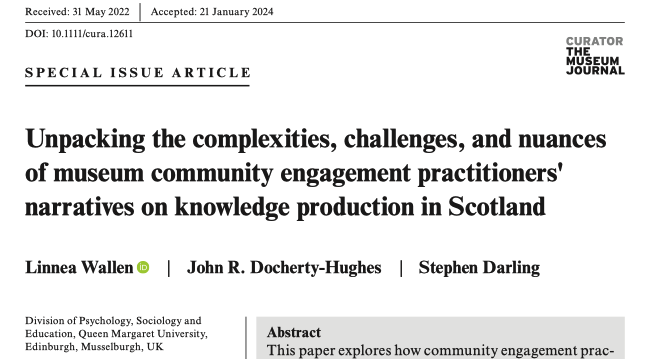
In “Unpacking the Complexities, Challenges, and Nuances of Museum Community Engagement Practitioners’ Narratives on Knowledge Production in Scotland” (Wallen et al., 2024) researchers explore how museums and communities can collaborate to co-create knowledge. The big takeaway? Museums need to value the lived experiences of their community partners as much as their own expertise. Smaller museums seem to do this best because their tight-knit teams often integrate community engagement into everything they do.
But it’s not always smooth sailing. Unequal power dynamics, emotional labor, and balancing community needs with organizational goals can make this work tricky. To address these challenges, the study suggests:
- Making equity a priority from the start of any project.
- Seeing relationship-building as an ongoing effort, not a one-time event.
- Sharing decision-making power to let community voices shape museum projects.
This approach isn’t just about being inclusive—it can transform your museum into a space for authentic, diverse narratives.
Be Flexible and Adaptable
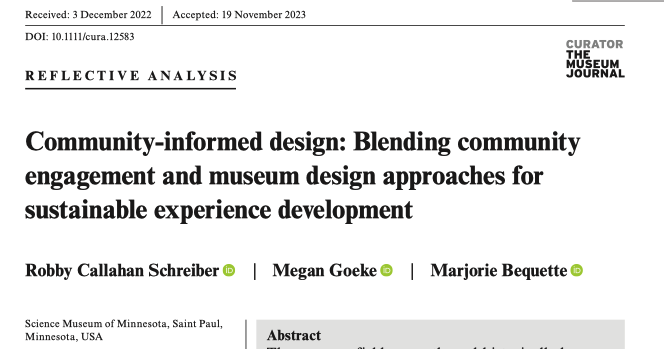
The second study, “Community-Informed Design” (Callahan Schreiber et al., 2024), shows how flexibility and adaptability are key to lasting community partnerships. Drawing from a 10-year makerspace project at the Science Museum of Minnesota, the researchers offer five practical practices you can use:
- Name shared values upfront.
- Embrace emergent planning—expect the unexpected and adjust as you go.
- Create flexible staffing models that bring in diverse skills and perspectives.
- Build organization-to-organization partnerships to share resources and knowledge.
- Use layered data (like surveys and focus groups) to track progress and gather feedback.
This kind of iterative approach—where you test ideas, gather feedback, and make changes—keeps projects relevant and community-centered. As the authors note, “Doing it requires some intentional choices about how to plan, how to communicate, and how to act.”
What This Means for You
These two studies are a powerful reminder: community engagement isn’t one-size-fits-all. It takes creativity, patience, and a willingness to share power. Whether it’s embedding equity into your workflows or adopting flexible planning methods, these insights can help you build meaningful, sustainable partnerships.
How might your museum apply these ideas to its engagement work? Maybe it’s starting small, like inviting community input on an upcoming exhibit, or thinking big, like launching a new collaborative program. Either way, the goal is the same: make your museum a place where the community feels seen, heard, and valued.
We’d love to hear how your museum is engaging with its community! Share your successes (and challenges) in the comments.
Citations
- Wallen, Linnea, John Docherty-Hughes, and Stephen Darling. “Unpacking the Complexities, Challenges, and Nuances of Museum Community Engagement Practitioners’ Narratives on Knowledge Production in Scotland.” Curator: The Museum Journal 67, no. 3 (2024): 683–694.
- Callahan Schreiber, Jennifer, Megan Goeke, and Marjorie Bequette. “Community-Informed Design: Blending Community Engagement and Museum Design Approaches for Sustainable Experience Development.” Curator: The Museum Journal 67, no. 2 (2024): 441–457.
 Engaging Places