
Move beyond what we tell visitors to what they actually do—and discover how eight types of experiences can deepen learning and meaning.
When we think about interpretation in museums and historic sites, we often focus on what we want to say—the stories, facts, and insights that bring history to life. But what if we focused instead on what visitors do?
That simple shift—from content to experience—changes how we design tours, exhibitions, and programs. It encourages us to move beyond “telling” and toward engaging, offering visitors a range of ways to learn, reflect, and connect.
Recently, I’ve been revisiting an idea from educational research called the Eight Learning Events Model, developed at the University of Liège in Belgium. It identifies eight ways people learn: receiving, imitating, practicing, experimenting, exploring, creating, debating, and reflecting. Although the language in their articles is academic (and a bit European in tone), the concept translates beautifully into the world of museums. With a little adaptation, I’ve reimagined these eight learning events as the “Eight Ways to Engage Visitors.”
A Spectrum of Engagement
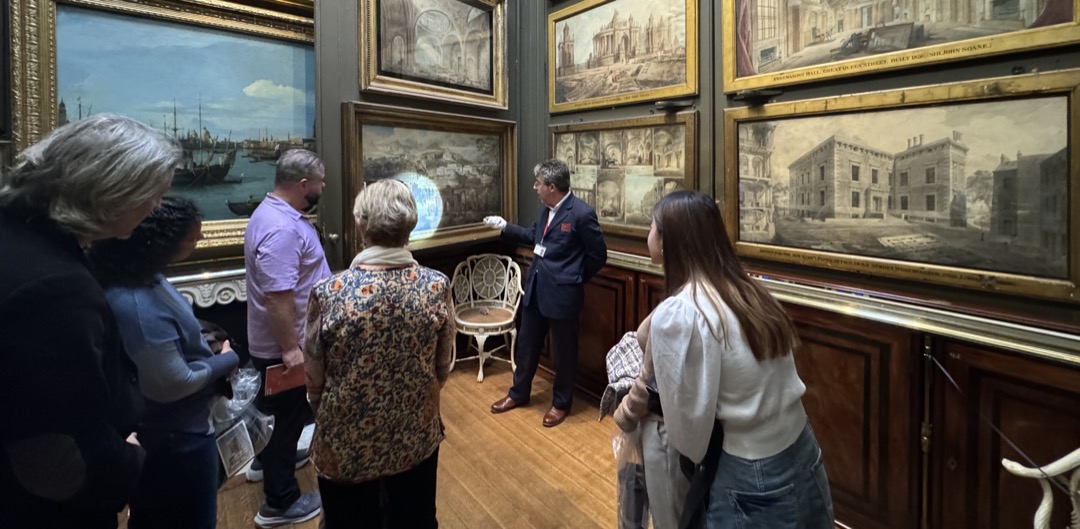
At one end of the spectrum, visitors receive information. They listen, read, or watch as museums provide structure and context—through a guided tour, an introductory panel, or a short video.
The next few experiences—observing, practicing, and experimenting—invite more active participation. Visitors watch a demonstration, try out a skill, or test how something works. These steps increase a visitor’s sense of agency. The museum moves from telling to showing to inviting.
Further along the continuum, visitors begin to explore on their own. They follow curiosity, seek patterns, or investigate questions that matter to them. When museums provide open-ended routes or interactive tools, visitors start to direct their own learning.
The most powerful experiences often come at the far end: creating, discussing, and reflecting. Here, visitors synthesize what they’ve learned, share ideas with others, and connect it to their own lives.
These moments—discussion circles, story walls, quiet spaces—are the ones people remember long after they leave. When visitors experiment, discuss, and reflect, they create personal meaning from shared experiences.
Methods and Formats
In my own interpretive planning work, I distinguish between methods and formats:
- Formats are the forms or physical shapes of museum activities—tours, exhibitions, workshops, publications, or webinars.
- Methods, by contrast, are the ways that people teach and learn with each other—such as transmitting, demonstrating, discussing, or practicing. They describe how engagement happens.
A person can share knowledge in a one-to-many method (transmission) through different formats, such as a guided tour or a lecture. Likewise, a single format—say, a guided tour—can include multiple methods: a lecture, a conversation, and a demonstration.
Most museums design for formats because they are visible and tangible; methods, by contrast, are often invisible. Yet method may be the more powerful design tool because it determines how meaning is created. The Eight Ways to Engage Visitors provides a vocabulary for thinking about methods—the range of ways museums and visitors can exchange knowledge, ideas, and skills.
When we combine intentional methods with thoughtfully chosen formats, interpretation becomes both more dynamic and more inclusive.
Two Sides of Every Experience
Each visitor experience also involves an action by the museum. Learning isn’t something that happens to visitors—it’s something museums design for.
- When a museum provides information, the visitor receives.
- When a museum demonstrates, the visitor observes and imitates.
- When a museum encourages discussion, the visitor exchanges ideas.
- When a museum prompts reflection, the visitor connects meaning to their own life.
This back-and-forth—between facilitation and participation—helps us see where interpretation succeeds and where it stalls.
If most of our programs fall into the “receiving” category, visitors may leave informed but not transformed. If we neglect the reflective end of the spectrum, visitors may have fun but not find meaning. The goal isn’t to replace one kind of experience with another, but to weave several together in an intentional manner.
A Tool for Reflection and Design
I’ve started using this framework in workshops with museum managers and graduate students, and the results are eye-opening. When museums map their current programs against the eight visitor experiences, patterns quickly emerge.
- A historic site might rely heavily on receiving (guided tours) and observing (demonstrations), but do little to encourage discussion or reflection.
- A history msueum might excel at experimenting and exploring but overlook opportunities for creating or connecting.
Once these patterns are visible, teams can ask sharper questions:
- Where could we build in opportunities for visitors to try, talk, or reflect?
- How can we balance structured and self-directed learning?
- How might our interpreters shift from delivering content to facilitating engagement?
Even small adjustments can make a big difference—a single open-ended question, a pause for reflection, or a prompt inviting visitors to share their own story can move people toward deeper engagement.
From Learning to Meaning
In the end, the Eight Ways to Engage Visitors isn’t just a checklist of techniques; it’s a mindset. It reminds us that visitors are active participants in meaning-making, not passive recipients of information.
Museums design the spaces where people can observe, wonder, test, create, and connect. By intentionally varying the kinds of experiences we offer, we not only serve different learning styles but also invite more personal, memorable encounters with the past.
Museums don’t simply preserve history or display art—they host experiences that help people understand themselves and the world around them.
If visitors leave not just knowing something new, but feeling inspired to explore, question, or create, then we’ve done our job well.
References
Leclercq, Dieudonné and Marianne Poumay. “The Eight Learning Events Model and Its Principles, Release 2005-1.” Liège, Belgium: LabSET, University of Liège, 2005. http://www.labset.net/media/prod/8LEM.pdf.
Verpoorten, Dominique, Marianne Poumay, and Dieudonné Leclercq. “The Eight Learning Events Model: A Pedagogic Conceptual Tool Supporting Diversification of Learning Methods.” Interactive Learning Environments 15, no. 2 (August 2007): 151–160. https://doi.org/10.1080/10494820701343694.
 Engaging Places