Author Archives: Max van Balgooy

Unknown's avatar

About Max van Balgooy

President of Engaging Places LLC, a design and strategy firm that connects people to historic places.

Grants Awarded for Experimental Interpretive Research

Congratulations to Jebney Lewis, Sandy Lloyd, Philip Seitz, and Randall Mason on their 2011 HPP Awards for Interpretive Inquiry and Investigation from the Heritage Philadelphia Program (HPP) of The Pew Center for Arts & Heritage. Formerly known as the HPP Scholars in the Interpretation of History, this professional development opportunity supports individual practitioners in the investigation of imaginative projects in public history by connecting the present to the past in engaging, imaginative, and meaningful ways; responding to audience/community interests or needs; and
demonstrating a complex understanding and presentation of history.  There are four recipients this year, an unprecedented number:

  • Jebney Lewis for We Make the City.  Lewis will develop and construct a small exhibit with a focus on the intersection of Broad and Market Streets between the years 1900–10. It will examine “how the aspirations of the industrializing city were embodied in the creation of grand expressions of pride and ostentation,” as illustrated through Continue reading

Mark Twain House Embezzlement Case Featured by IRS

The million-dollar embezzlement case that hit the Mark Twain House has been memorialized as a featured fraud case for Fiscal Year 2012 by the Internal Revenue Service:

On November 21, 2011, in Bridgeport, Conn., Donna Gregor, of East Hartford, was sentenced to 42 months in prison and three years of supervised release, for embezzling more than $1 million from the Mark Twain House & Museum. On August 5, 2011, Gregor waived her right to indictment and pleaded guilty to one count of wire fraud and one count of filing a false tax return.  According to court documents and statements made in court, between 2002 and 2010, Gregor employed two different schemes to defraud the Mark Twain House.  In the first scheme, Gregor submitted false information via the Internet to the Mark Twain House’s payroll management vendor in order to receive, as a direct deposit in her personal bank account, an additional amount of pay to which she was not entitled.  Gregor then adjusted Continue reading

History Places

HistoryPlaces.WordPress.com by Tim Grove

Some of you may know Tim Grove as the Chief of Education at the National Air and Space Museum or as the History Bytes columnist in History News, but you may not know he started a weekly blog about historic places in April.  Through a wide variety of sites, he posts ideas and opinions about interpretation, visitor experience, and historical significance.  It’s part travelogue, part museum studies.  Most recently he’s discussed the C & O Canal near DC, the Forbidden Drive in Philadelphia, Appomattox Court House, and Fort Mantanzas in Florida.  If you’re enthusiastic about historic sites, check out his blog at HistoryPlaces.WordPress.com.

Montpelier Adopts New and Improved Mission Statement

Mission statements are required part of non-profit organizations, but I’ve often found that they’re treated like death and taxes–inevitable but you don’t want to think about it. In museums and historic sites, you can tell when they’re particularly useless when you can swap the name of the organization with another and it still makes sense.  Good mission statements are distinctive, memorable, and passionate.  They have to help you make decisions–is this project, activity, donor, or partnership right for us?  They have to go beyond “collect, preserve, and interpret” and describe what you want your audience to “think, feel, and do“.  Creating a good mission statement isn’t easy and examples are hard to come by, so when I find them, I collect them like golden eggs.
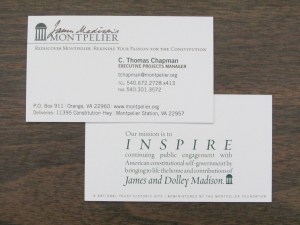
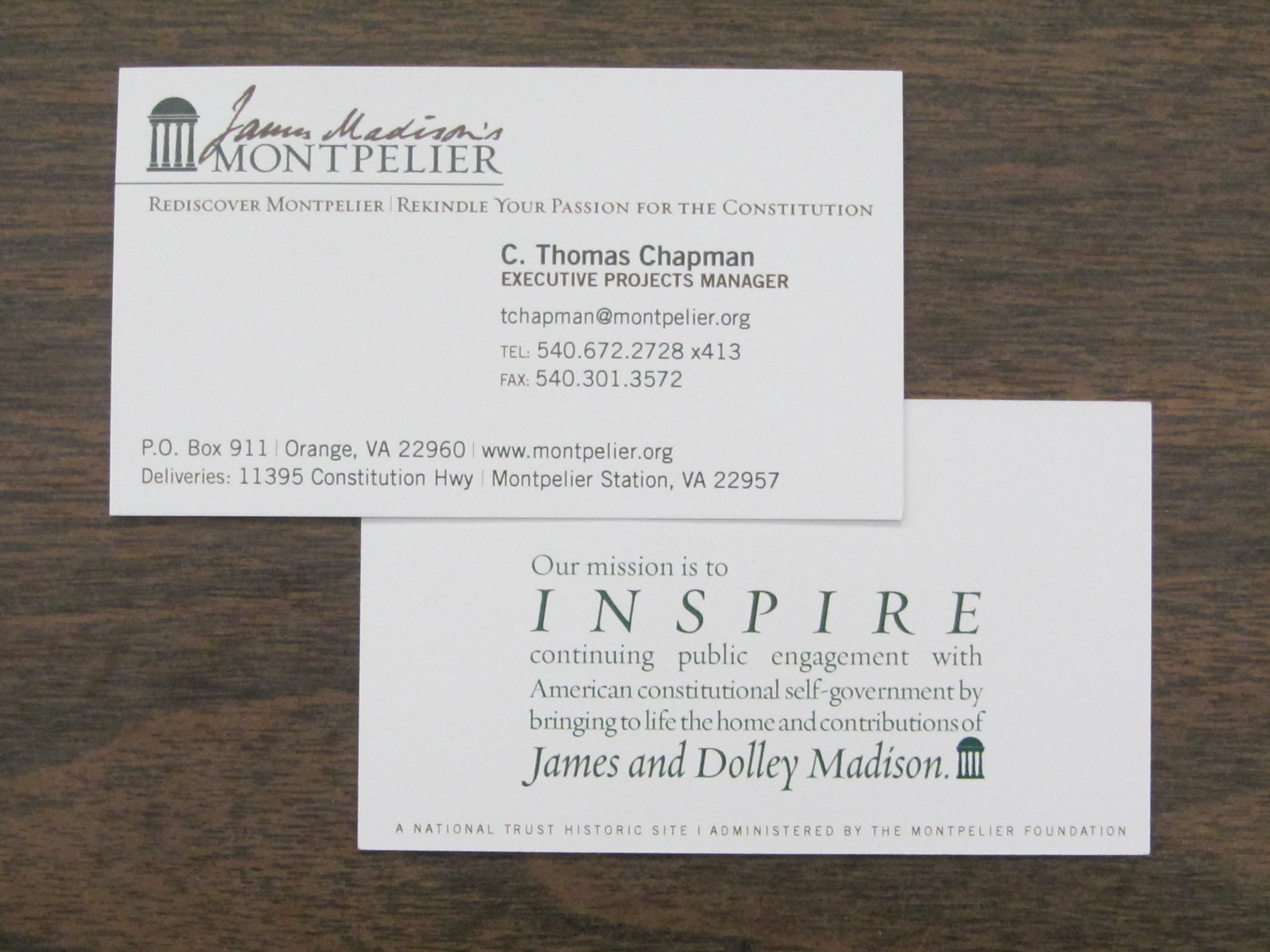
Montpelier's new mission statement on the back of a business card.

When I visited James Madison’s Montpelier last week, I learned they adopted a new mission statement.   Developed as part of their strategic planning process by a small team of trustees and staff, it was then shared with the entire board and staff for comment and revision before it was adopted by the board of trustees.  I thought it was so good I wanted to share it as an exemplar:

Our mission is to inspire continuing public engagement with American constitutional self-government by bringing to life the home and contributions of James and Dolley Madison.

Yes, there’s a bit of jargon that requires some explanation but it’s so much better than the previous one:

The Montpelier Foundation preserves the legacy of James Madison, his family, and
Montpelier’s plantation community, and seeks to inspire an understanding and
commitment to the ideals of the Constitution as the first successful form of self
governance to secure liberty for its citizens. The Foundation’s mission is founded on
the fact that the Constitution is a landmark in the history of mankind’s quest to achieve
freedom. James Madison, the individual most responsible for the Constitution,
provided both the innovative ideas central to its success and the leadership that
brought about its creation and ratification.

Yikes.  Try to fit that on the back of a business card.

Want Buy-In? Build Trust

John Kotter is a prolific author of books about “change” in organizations.  Getting people, organizations, and communities to move in new directions or to end old habits is difficult, but he’s developed lots of practical strategies and outlined a step-by-step process to succeed based on his studies of dozens of companies.  Fundamental is a relationship of trust among the participants (e.g., managers and employees, city council and residents, historic sites and neighbors), which is a result of transparency and openness, and a willingness to listen and discuss tough issues.  It sounds obvious but I’ve seen national organizations create an atmosphere of suspicion, hostility, and fear simply because they hold too many closed door meetings, only communicate bland or stale news when the environment is clearly unsettled, and won’t answer simple questions about what’s happening.  The result is change has to be forced (and enforced and reinforced) and buy-in, participation, and support is low.  It’s the worst way to implement change, except for war.

If you’re dealing with change at your historic site or house museum (either leading or experiencing it), John Kotter introduces this idea in, “Levering Trust to Achieve Buy-In,”  a short video at Forbes posted last week.  If you want to explore his ideas further, I’ve found his books Leading Change (a classic) and Buy-In:  Saving Your Good Idea from Getting Shot Down (really a handbook, great for advocacy and fundraising) to be helpful.

Engaging Exhibits: An Experimental Approach at the Smithsonian Institution

Andrew Pekarik discussing a new theory of visitor typologies to the education staff at the National Air and Space Museum.

Yesterday I had lunch with Tim Grove, the Chief of Interpretation at the National Air and Space Museum and author of the History Bytes column in History News, to catch up on various things.  We were discussing my current puzzling out of methodologies for my book on interpretive planning for historic sites and discussing Howard Gardner’s “multiple intelligences,” when he mentioned that I might be interested in joining his staff meeting that afternoon.  Andrew Pekarik in the Office of Policy and Analysis at the Smithsonian was giving a presentation on a new theory for visitor engagement–would I like to come?   Absolutely!

Andy’s presentation was a short 30 minutes but was incredibly intriguing.  It’s based on dozens of evaluations on various exhibits at several different Smithsonian exhibits and is currently being independently verified, but the framework is public and was published with Barbara Mogel in the October 2010 issue of Curator as “Ideas, Objects, or People?  A Smithsonian Exhibition Team Views Visitors Anew.”  Here’s the new framework in a nutshell: Continue reading

Maintaining Your Entreprenuerial Edge

The people who work in historic sites and house museums are often among the most entrepreneurial I’ve encountered, mostly because circumstances force them to be risky, resourceful, creative, and innovative.  Working with a tight budget and a reliance on volunteers to change the world (or at least their community), they are continually looking for new ways to succeed.  The trick is how to do it without getting overextended, derailed by interruptions, and staying in a rut.  In the Daily Muse, Adelaide Lancaster recently shared Three Bad Habits of Entrepreneurs and How to Break Them to attain these goals:

  1. To have a clearer head. At any given time, you should have only a few main areas of focus—no more than three a quarter. Other initiatives must be declared a secondary priority, and projects or “opportunities” unrelated to your business goals must be declined. [A focus on a few things done well rather than many things done poorly seems to Continue reading

Flat Stanley Goes Mobile; Will He Visit Your Site?

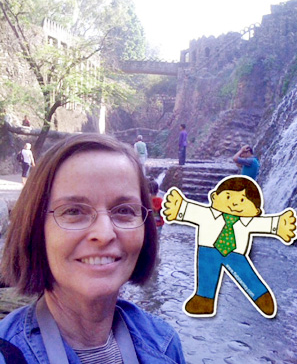
Flat Stanley with Suzie Boss in India. From Edutopia.org.

“Flat Stanley,” the elementary school activity that’s designed to get students to explore places around the world, has moved from a paper-cutout to a clever smartphone application.  He can now be integrated into a phone’s camera to be part of photos taken in places visited by children–the result of some clever computer programming and a legal agreement with the estate of the author.  Read more at Suzie Boss’ blog at Edutopia.org.

Pennsylvania Historical and Museum Commission names James M. Vaughan as Executive Director

Pennsylvania Historical and Museum Commission (PHMC) Chairman Andrew E. Masich today announced that James M. Vaughan of Washington, D.C. has been appointed as the agency’s new executive director, effective November 28, 2011.

Vaughan most recently served as Vice President, Stewardship of Historic Sites for the National Trust for Historic Preservation in Washington, D.C., where he Continue reading

Apps Students Want

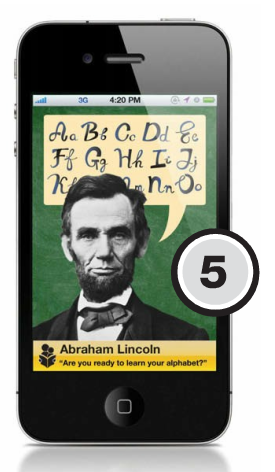
Artist's rendition of "The Past Speaks to Us" mobile app. From THE Journal.

Project Tomorrow asked students from kindergarten through high school to imagine their ideal mobile app for learning.  They received more than 200,000 responses and T.H.E. Journal highlighted fifteen of them that could transform student learning and take advantage of this budding technology in their November/December 2011 issue.  For museums and historic sites, here are the ones with most potential (as well as what’s happening currently in the field):

  • The Real Thing.  Suggested by a sixth grader in California:  “Some students have a hard time with subjects but they don’t want to ask teachers.  This app would let them watch videos or talk to real professionals about the subjects they are learning in school.”  Some institutions are already offering YouTube videos like this to explain the job of a curator or an expert’s view on a topic.
  • iMu-see-’em.  Suggested by an eighth grader in New Jersey:  “This app is at once a virtual planner, information database, and textbook archives.  It includes a three-dimensional model viewer for referencing subjects, like Continue reading