Category Archives: Collections

2012 Webby Awards Point Out Models for Historic Sites

Historic sites are always looking for good models for online activities, such as websites and mobile applications, and one of the best places to look for inspiration is the annual Webby Awards, the leading international award honoring excellence on the Internet. Established in 1996 during the Web’s infancy, the Webbys are presented by the International Academy of Digital Arts and Sciences.

The 2012 Webby Awards received nearly 10,000 entries from over 60 countries and all 50 states and awards were given in over a hundred categories for website, interactive advertising and media, online film and video, and mobile and apps. As a result, there is a lot to cull through but here are several that seem to be most related to historic sites (and hang on, this is a long list):

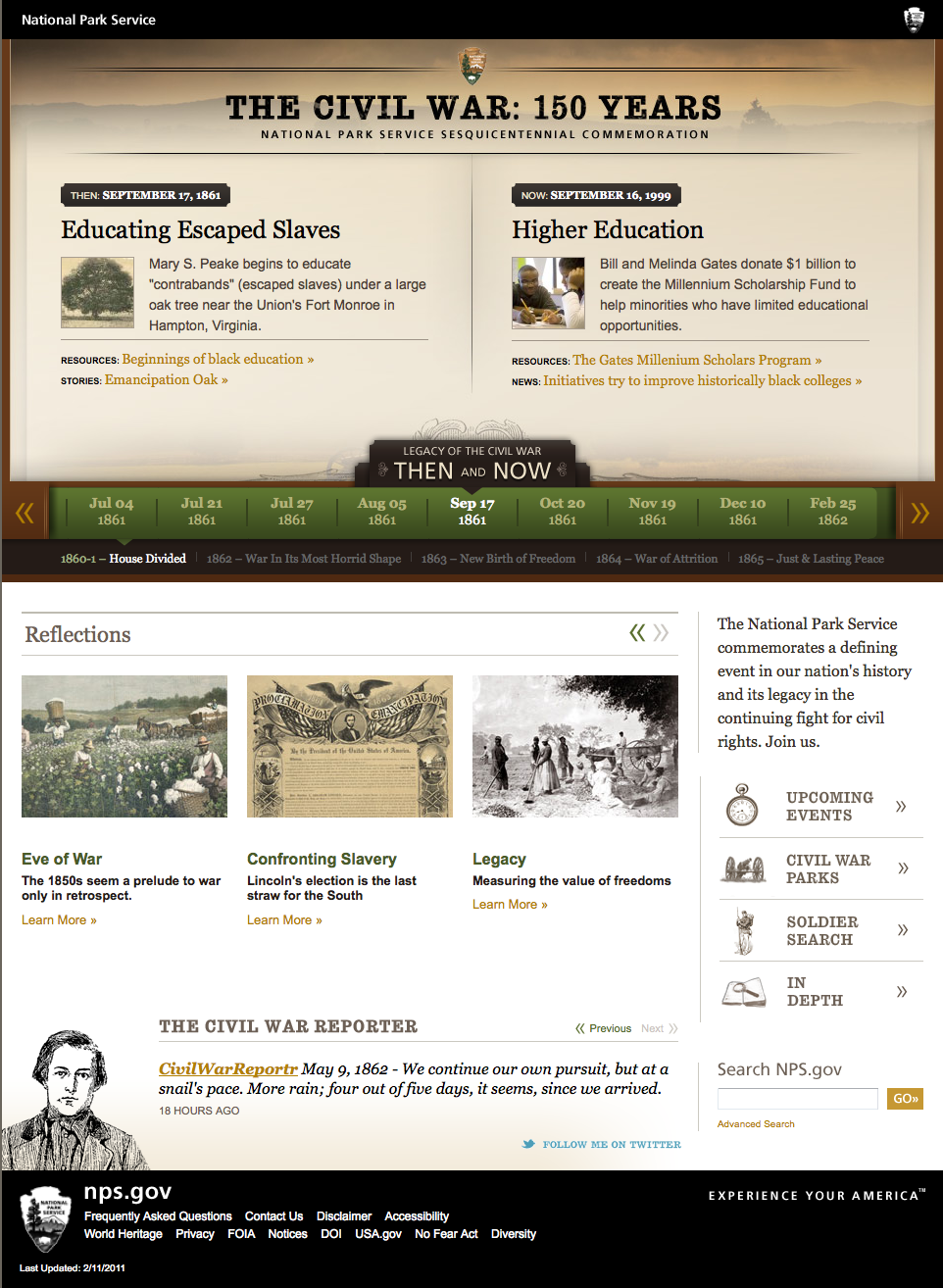
  • NPS’ Civil War: 150 Years features a Then and Now Timeline at the top and a Civil War Reporter sending tweets at the bottom.

    The Civil War: 150 Years has the form and content of websites that will be most familiar to historic sites, except that it commemorates “a defining event in our nation’s history and its legacy in the continuing fight for civil rights” rather than a specific place.  I like their use of Twitter to create a virtual “Civil War Reporter” whose tweets report on events from the 1860s but the major innovation is the featured Then and Now Timeline that compares similar events during the Civil War and today (although I was only able to jump months, not years).  Another way to compare the past and the present is demonstrated by Slavery Footprint, a website and mobile app that was launched on the 149th anniversary of the announcement of the Emancipation Proclamation.  It’s designed to raise awareness of modern-day slavery and can tell you approximately how many slaves have pitched in to make the goods you enjoy on a daily basis.

  • Timelines appeared in several other forms in the winning entries and along with the Then and Now version is Continue reading

WebWise 2012: Managing Oral History Collections and Projects

The final session from WebWise 2012 that I’ll be reporting on is creating and preserving oral history collections.  If you think that oral histories are just about recording hour-long interviews with oldtimers, the digital age has changed that considerably.  Not only are oral histories collected digitally, but they are being presented in many new ways, including audio tours, podcasts, radio programs, and in websites.  Remember, if you want the complete details, the videos from WebWise are now available at online and you’ll find this session on Day Two.

Broadcastr, an app that finds stories and tours near you

Eileen McAdam discussed how she was using 21st century tools to reach new audiences.  She’s been working for many years to engage people in the Hudson Valley through stories through the Sound and Story Project of the Hudson Valley.  Rather than deliver audio tours as lectures, she presents stories from the people who live there.  She noted that it was difficult to find oral histories that were recorded previously (often they’re not catalogued or easily available) which led to a partnership project to identify what had been done, conduct condition assessments, access the content, and then use the materials to engage new audiences.  Much of the initial growth of oral histories came with the availability of inexpensive cassette tape recorders in the 1970s and this project’s work was to graduate these collections to digital formats.  In her presentation, she outlined the process of digitizing and editing files to select compelling content and create 1-2 minute stories, recommending Audacity (free), Garage Band (comes with Mac), and Hindenburg (inexpensive), and providing some examples of edited snippets and presentation methods, including Continue reading

WebWise 2012: Using Volunteers Online

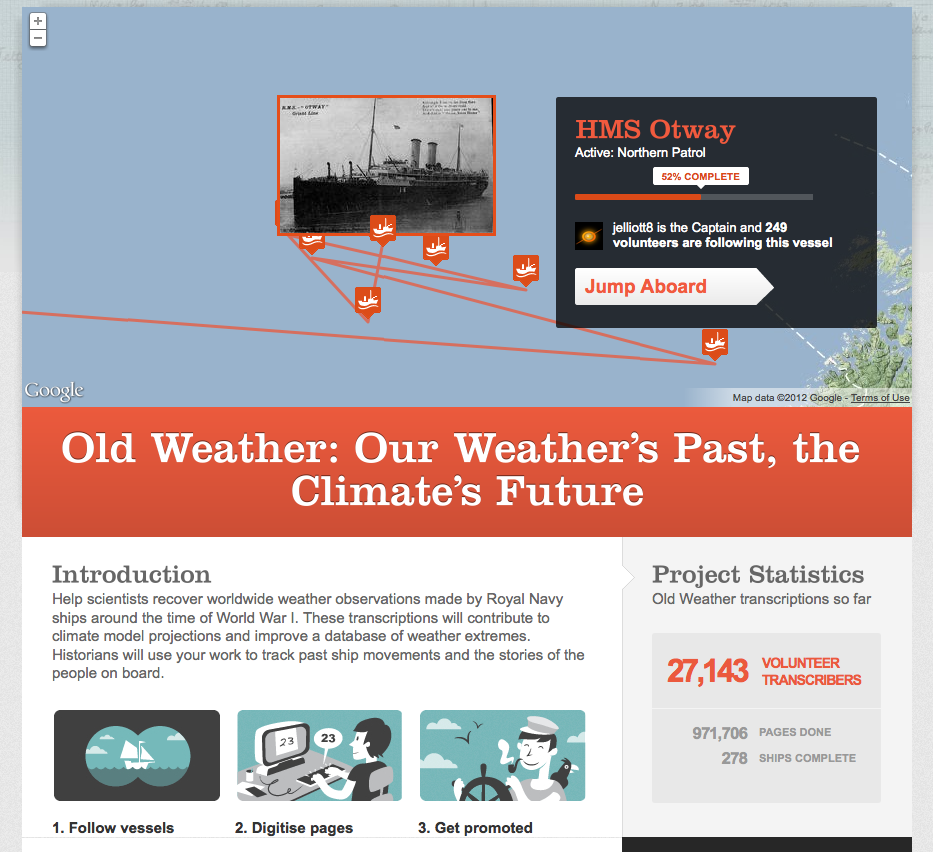
Much of the work at historic sites and history museums wouldn’t be possible without volunteers (and we just passed National Volunteer Week) but very few organizations have recruited volunteers for work online.  Is it possible? What would they do? A session at WebWise 2012 explored these ideas in a panel called, “Sharing Public History Work: Crowdsourcing Data and Sources.”

OldWeather.org, a project of the Citizen Science Alliance

Ben Brumfield of FromThePage Open-Source Transcription Software shared his experiences from small crowdsourcing projects.  He noted that many organizations often object to public participation in scholarly projects because they don’t have the skills or expertise, but he’s found that those people participating are self-selecting and highly focused.  Participation is not equally distributed but mostly done by a small number of people, thus it’s not really crowdsourcing but nerdsourcing.  He provided some examples of “well informed enthusiasts” conducting exemplary work, such as Continue reading

WebWise 2012: Learning and Participation on the Move

WebWise 2012 in Baltimore.

It’s been a couple weeks since the WebWise conference in Baltimore, but the information hasn’t gone stale yet.  It’s still cutting edge and thought-provoking because most of the projects discussed are still underdevelopment and it’s unclear if they’ll succeed or not.  However, they do provide a glimpse of current and potentially future practices in the use of technology for historic sites. The webcast videos are now available except for LeVar Burton’s presentation, which is waiting for broadcast permission. Heritage Preservation will be using portions of the webcasts to create webinars that will be available later this summer including, “Crowdsourcing in Public History” and “Oral History in the Digital Age.”

The first panel session, History Places and Spaces:  Learning and Participation on the Move, was moderated by Nancy Proctor and looked at the ways that mobile technologies (that is, technologies that are aware of your location) can provide new and better experiences for visitors.

Rob Stein at the Indianapolis Museum of Art opened the session by stating that the field already recognizes that location should be a required element in basic content but the challenge is the proliferation of software and hardware platforms.  Every digital device (website, cellphone, tablet) seems to be in a unique format and requires special treatment.  To overcome this, Stein suggested we rethink Continue reading

Q&A: Managing Collections at Historic Sites with Terri Anderson

Terri Anderson

Terri Anderson is swapping history collections for art when she joins the Corcoran Gallery of Art next week as a Contract Registrar to help them migrate their collections database from Filemaker to TMS (The Museum System).  For the past five years, she has focused her work on collections management at the 29 National Trust Historic Sites as the John and Neville Bryan Director of Collections at the National Trust for Historic Preservation, where she also taught collections management for George Washington University and became one of the national leaders on the challenges of deaccessioning collections at historic sites.  With this transition, I thought it would be a good time to capture some of her thoughts about managing collections at historic sites.

Max:  You’ve been managing the collections of the National Trust for the last five years–what have been the major successes?

Terri:  Our most visible successes were opening several Sites to the public for the first time, including the Philip Johnson Glass House in New Canaan, Connecticut; President Lincoln’s Cottage in Washington, DC; and Villa Finale in San Antonio, Texas. Each of these Site openings required many important decisions about collections stewardship and access, and each Site demanded a different approach: one size did not fit all.

At the same time, we had successes that, while less visible, were important to me and the parties involved.  We did a lot of great work with thoughtful, appropriate deaccessions at several of our Sites.  I wrote about our experiences in Continue reading

Collections Chat on NEH’s Preservation Assistance Grants

"Skeleton Room" at the Smithsonian Institution, ca. 1890.

On Monday, March 12 at 1 pm Eastern, the Connecting to Collections
Online Community
will host another live chat in their series. Join Elizabeth Joffrion, Senior Program Officer in the National Endowment for the Humanities’
Division of Preservation and Access
to learn about Preservation Assistance Grants. She will review what Preservation Assistance Grants fund, share tips on making a strong application, and answer your questions. No preregistration is required;
on Monday at 1 pm EDT just go to http://www.connectingtocollections.org/meeting and log in.

National Endowment for the Humanities’ Preservation Assistance Grants help small and mid-sized institutions—such as historic sites, museums, historical societies, cultural organizations, Continue reading

WebWise Attracts 400 Museums, Libraries, and Research Orgs

This slideshow requires JavaScript.

This week I was fortunate to spend two days in Baltimore with 400 persons representing museums, libraries, archives, and research organizations from 40 states at WebWise, the annual conference hosted by the Institute of Museum and Library Services.  This is always one of my favorite conferences and despite a rapid sell-out, I was able to snag a seat.

There seems to be a growing number of history museums and historic sites attending WebWise, and perhaps that’s due to increased recognition that digital technologies are no longer a fad but an essential part of a successful organization (indeed, one of the presenters remarked that staff with technology in their titles are rising up to senior levels with more frequency).  Among the history organizations represented this year are the American Continue reading

Why We Have Curators and Collections Managers

Times are tough and many museums and historic sites wonder about the value of keeping curators and collections managers on the payroll.  What do they do besides sit in their offices all day?  Well, boardmembers and CEOs, they keep an eye on your most valuable assets.  The University of California Berkeley, that fine institution of learning, provides a useful lesson on what happens when you don’t have curators or collections managers involved in managing your artifacts.  According to the New York Times:

Everybody misplaces something sometime. But it is not easy for the University of California, Berkeley, to explain how it lost a 22-foot-long carved panel by a celebrated African-American sculptor, or how, three years ago, it mistakenly sold this work, valued at more than a million dollars, for $150 plus tax. The university’s embarrassing loss eventually enabled the Huntington Library, Art Collections and Botanical Gardens, a large museum and research center in San Marino, Calif., to acquire its first major work by an African-American artist.

Fortunately, there’s a happy ending to this tale for the object, the artist, and the museum–but the university has egg on its face. First, for not recognizing and properly caring for a significant work of art and secondly for disposing of it for so little money. I’m not surprised. Most colleges and universities are notorious for treating their historic sites and museum collections poorly (have we forgotten about the University of Southern California’s long mistreatment of Frank Lloyd Wright’s Freeman House or Cal Poly Pomona’s neglect of Richard Neutra’s VDL House?).

For the complete story, see “Berkeley’s Artwork Loss Is a Museum’s Gain” by Carol Pogash in the New York Times (February 20, 2012) and Huntington Library Acquires Sargent Johnson Monumental Depression-Era Sculpture in Black Artist News (June 22, 2011).

For Lovers of New England: A Week on the Road in June

Discover the rich history of the region with Historic New England’s Program in New England Studies, an intensive week-long exploration of New England from Monday, June 18 to Saturday, June 23, 2012.  The Program in New England Studies includes lectures by noted curators and architectural historians, hands-on workshops, behind-the-scenes tours, and special access to historic house museums and museum collections. The program examines New England history and material culture from the seventeenth century through the Colonial Revival. Curators lecture on furniture, textiles, ceramics, art, and wallpaper and cover their history, craftsmanship, and changing methods of production. Architectural historians explore a timeline of regional architecture starting with the Massachusetts Bay styles of the seventeenth century through the Federal and Georgian eras, to Gothic Revival and the Colonial Revival. Participants visit historic sites and museums with curators and enjoy special receptions.

Expert lecturers include:

  • Richard Candee, professor emeritus, Boston University
  • Cary Carson, retired vice president of the research division at Colonial Williamsburg
  • Abbott Lowell Cummings, former director, Historic New England Continue reading

Field Trip: Homestead Museum in California

This slideshow requires JavaScript.

Last week I had a chance to visit with my colleagues at the Workman and Temple Family Homestead Museum in the City of Industry, California.  I was the assistant director there a decade ago and it continues to be a special place to me (if you haven’t visited, it has great architecture and a great story).  After a generous lunch with the staff, director Karen Graham Wade and some of her staff took me to see the Workman House, the earliest house on the site.  It’s undergoing extensive interior rehabilitation to make it more suitable and attractive as an exhibit gallery.  It’s part of a major effort to respond to the changing interests of their visitors by increasing the self-guided experiences.  They are also reducing the number of days per week the Homestead Museum will be open for walk-in public tours and  increasing the number of days they’ll be open for tours by appointment and for other activities.  At La Casa Nueva, the second house on site, they are Continue reading