
In October, two international students from the University of New Mexico went behind a split rail fence and carved their nicknames on the sandstone walls of El Morro National Monument. They knew enough English to write “Super Duper Dana” and “Gabriel” but claimed they didn’t know enough English to read the sign posted just a few feet away that said, “It is unlawful to mark or deface El Morro Rock.” Now their graffiti joins “Pedro Romero 1758” and two thousand other signatures, dates, messages, and petroglyphs that have been left over hundreds of years by Puebloans, Spaniards, and Americans. They were recently charged with damaging an archaeological resource on public land and face fines, prison, and repair costs of nearly $30,000. For more details, see the Albuquerque Journal and Cibola Beacon. Continue reading
Category Archives: History
History Places
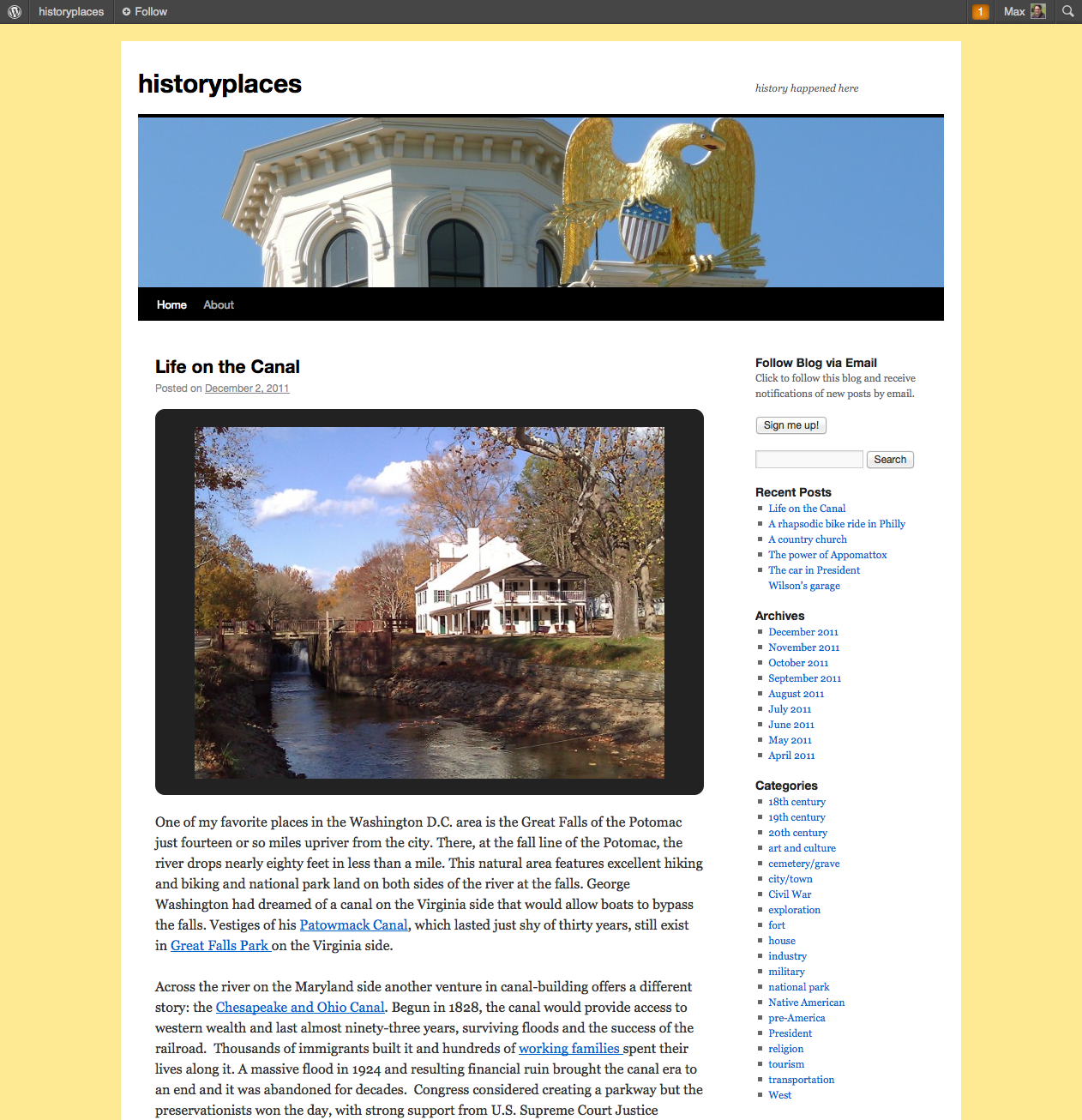
HistoryPlaces.WordPress.com by Tim Grove
Some of you may know Tim Grove as the Chief of Education at the National Air and Space Museum or as the History Bytes columnist in History News, but you may not know he started a weekly blog about historic places in April. Through a wide variety of sites, he posts ideas and opinions about interpretation, visitor experience, and historical significance. It’s part travelogue, part museum studies. Most recently he’s discussed the C & O Canal near DC, the Forbidden Drive in Philadelphia, Appomattox Court House, and Fort Mantanzas in Florida. If you’re enthusiastic about historic sites, check out his blog at HistoryPlaces.WordPress.com.
Teaching History Through Inquiry
If you’ve ever worked with students, you know that lectures and PointPoint presentations are a sure way to kill any interest in history or historic places. In Teaching History Through Inquiry, Stephen Lazar, a social studies teacher at the Academy for Young Writers in Brooklyn, lists six ways he engages high school students to provide cultural literacy and help them develop as critical thinkers:
- Carefully craft your questions.
- Engage students in examining evidence.
- Move on to more nuanced questions.
- Navigate myths with the inquiry approach.
- Identify helpful resources.
- Prepare critical thinkers.
You can find details of each of these points at TeacherMagazine.org, which is making this premium article available for free. But let me add another point:
7. Engage with the real thing: use original documents, visit historic sites, look at objects, and examine historical photographs and maps. Those experiences bring mind and eye (and perhaps heart) together in a way that’s not possible in textbooks and classrooms.
 Engaging Places