Category Archives: Resources

The Emergency Response Wheel has Turned into a Mobile App

This slideshow requires JavaScript.

Long known as the authoritative resource for salvaging artifacts after a disaster, the Emergency Response and Salvage (ERS) Wheel has been used by historic sites, museums, libraries, and archives around the world.  In partnership with the National Center for Preservation Technology and Training, Heritage Preservation has turned the Wheel into a mobile application, providing invaluable guidance accessible to anyone who is in need of practical advice for saving collections in the first 48 hours after disaster strikes.

ERS app provides the same reliable content found in the original Wheel. The app outlines critical stages of disaster response and provides practical salvage tips for nine types of collections, from photographs to natural history specimens. ERS can help users protect precious collections and significant records, access reliable information instantly, and save damaged objects.

The “ERS: Emergency Response and Salvage” app is available free for Continue reading
NEA Survey Reveals Patterns in Historic Site Visitation

On Monday, March 11, I’ll be a plenary speaker at the Virginia Association of Museums conference to discuss the trends, challenges, and opportunities facing historic house museums.  It will be followed by a forum with historic site managers, tourism experts, preservationists, and community leaders on the needs and opportunities for historic sites in Virginia, such as a statewide association for historic house museums.  It’s great timing for this topic:  Governor McDonnell declared 2013 as the Year of the Virginia Historic Home in recognition of the bicentennial of the Executive Mansion and Virginia’s more than 100 historic homes, most of which are open to the public as museums and historic sites.

Whenever I’m asked to give a presentation or write an article, it’s an opportunity to do some research and reading to gains some new or deeper perspectives on the issue.  For the VAM presentation, I’ve been looking closely at the Survey of Public Participation in the Arts by the National Endowment of the Arts.  For decades, NEA has interviewed thousands of people across the United States to learn about their involvement in music, art, theater, festivals, reading, and dance.   NEA conducted the last survey in 2008 and published a series of analytical reports in 2009-2011.

Looking back over 30 years, the survey confirms that attendance closely correlates with Continue reading

Resources for Historic Sites from the American Alliance of Museums

The American Alliance of Museums (formerly known as the American Association of Museums) is offering several resources and workshops that may be interest to historic sites, including:

TrendsWatch 2013: Upcoming Town Hall
This year’s edition of TrendsWatch, the annual report on key social, economic, technological and other trends that are shaping the future of museums, will be released next month.  You can also learn about it at the Alliance’s Web-based Town Hall on March 27 at 2 pm ET, which will be hosted by their Center for the Future of Museums.  Registration is free for Alliance members, and will open soon.  Meanwhile, read (or re-read) TrendsWatch 2012 for a taste of the future.

2012 National Comparative Museum Salary Study Available
A national salary study has long been a top request from Alliance members. Demonstrating that we’re stronger together, the 2012 study was prepared in collaboration with the Association of Midwest Museums (AMM), the Mountain-Plains Museums Association (MPMA), the New England Museum Association (NEMA) and the Southeastern Museums Conference (SEMC) and based on surveys conducted in their regions. Together, these associations represent 36 states, 64 percent of the American population and approximately two-thirds of all museums in the United States. Available free to Continue reading

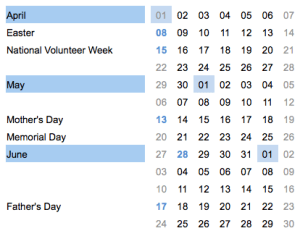
Compact Calendar for 2013

Detail from the Compact Calendar

Detail from the Compact Calendar

Happy New Year!

For those who plan events, programs, and activities months ahead of time, I’ve updated my Compact Calendar for 2013 based on a design by David Seah.  The entire year is listed on one page as a continuous series rather than broken out by months so you can quickly calculate time between dates and avoid getting messed up by months with five Mondays.  In addition, it includes major holidays to schedule towards or around them, as needed.  I’ll use the Compact Calendar to plot out all my events and deadlines for the year to ensure they don’t pile up too much in one place, and I’ll place a copy in a project file to have a handy calendar to determine milestones and coordinate tasks.  If the last three sentences didn’t make any sense, you probably don’t need this calendar (and if they do, this calendar will make your year happier!).

For more time and project organization ideas, visit David Seah’s blog (I use his emergent task planner as well).

An Interactive Holiday Calendar for Historic Sites

Make Your Holidays Historic at The History List.

Make Your Holidays Historic at The History List.

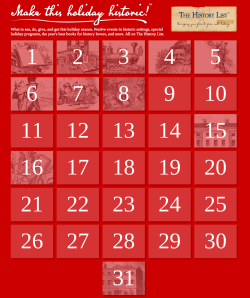
Lee Wright at The History List has developed a clever interactive calendar for the holidays which highlights events at historic sites around the country with changing images and sounds wrapped in an attractive bright red package.  It’s fun to play with it to find what’s hidden underneath each date and the best part is that any historic site or history organization can participate.  So far, it includes a Victorian Christmas at the Ramsey House, a whiskey tasting at Jefferd’s Tavern, and a holiday masquerade at Tryon Palace.  If you’d like to include your event, Lee provides instructions for participating via History List or Facebook.

December’s calendar is part of The History List’s, “Make this Holiday Historic” campaign, however, you can include events from the rest of the year as well.  The History List is Lee Wright’s effort to create a one-stop place for history lovers to find places and events happening near them, whether at home or on the road, as well as provide a convenient, easy-to-use online calendar for Continue reading

AAM Unveils New Logo, Name, and Attitude

AAM logos: old and new

Today, the American Association of Museums becomes the American Alliance of Museums, which may appear at first to be merely a cosmetic change ushered in by a marketing consultant, but actually signals some significant changes in attitude.  Those of us in the history field often felt like outsiders at AAM, which seemed to be dominated by art museums, our classier and richer cousins.  But take look at the new AAM and you may find two major changes that may appeal to history organizations:

1.  Accreditation becomes the end Continue reading

IMLS’ Revised Grant Guidelines Need Revision

In May, the Institute of Museum and Library Services (IMLS)–the national agency devoted to museums and libraries–released a new set of proposed guidelines that would significantly revise their grant programs for museums (and that includes historic sites, historical societies, house museums, and preservation organizations).  Initially, these changes were proposed to go into effect without comment from the field, but fortunately enough museums spoke up that director Susan Hildreth changed her mind and announced she would welcome comments–but the comment period ends on Friday, July 6, 2012.

According to IMLS, the guidelines affect the Museums for America and National Leadership Grants for Museums programs, however, the impact is much larger because these programs are proposed to consume two other grant programs: Conservation Project Support and 21st Century Museum Professionals.  Claudia French, deputy director for museums, proposed the changes so that the grant programs would align better with the IMLS strategic plan and make it easier for grantees and IMLS staff.

Here are the major changes that caught my eye:

1.  One deadline to rule them all:  January 15.  Currently, the deadlines for Continue reading

Teaching History Without Textbooks? Stanford Proves It’s Possible.

In 2008, Stanford University introduced “Reading Like a Historian,” a non-traditional history curriculum to five schools in the San Francisco Unified School District.  According to Sam Wineburg, who directs the Stanford History Education Group and has been a longtime proponent of revising the teaching of history, “We need to break the stranglehold of the textbook by introducing students to the variety of voices they encounter in the past through primary sources.”  It seems this new curriculum is doing that and more, as recently reported in Futurity:

There are no orderly rows of desks in Valerie Ziegler’s 11th-grade history class—students sit in groups of three or four at small tables around the room. There also is no lectern because there are no lectures. And perhaps most striking, there are no textbooks.

These students at Abraham Lincoln High School in San Francisco learn about the Vietnam War, women’s suffrage, civil rights, the Great Depression, and other major events in U.S. history by analyzing journal writings, memoirs, speeches, songs, photographs, illustrations, and other documents of the era.

“I always tell my students they’re historians-in-training, so the work we do in here is that of a historian,” Ziegler says.

That sounds like fun, but does it have any impact? Continue reading

Renting an Academic Research Article Now Possible

Conducting scholarly research has become much easier thanks to DeepDyve, a company that makes “authoritative information more affordable and accessible to users who are unaffiliated with a college or university and therefore lack easy and affordable access to scholarly sources of information.”  They’re a Netflix for academic journals.

If you’re like me, access to journals is nearly impossible unless you have access to something like JStor–an incredibly expensive option for occasional use (although JStor may soon be improving access for individuals).  DeepDyve allows you to search for articles in one place and if you find what you’re seeking, provides two options:  rent or purchase.  Renting gives you read-only access (no printing or downloading allowed) for a low cost.  If you want to print or save it, you can purchase a pdf copy.   If you want to investigate it, they’ve made it easier by providing a 14-day free trial.

Among the journals they currently list that might be of interest to those working with historic places are: Continue reading

A Six-Stage Strategy for Engaging People

Engaging people is one of the primary responsibilities of an historic site, although we might call it membership, attendance, advocacy, support, fundraising, or “resources development” (yup, that’s what it was called at one place I worked).  Expanding and growing engagement is usually focused on direct and simple efforts, such as working on individuals to give increasingly greater sums or putting out more announcements to increase attendance.  Results are usually sporadic, rough, and unpredictable.

Engagement Pyramid by Gideon Rosenblatt.

I recently learned of a thoughtful strategy from Gideon Rosenblatt, the former executive director of Groundwire, a company that helps environmental organizations connect, inspire, and mobilize their communities.  He lays out engagement in a spectrum of six stages from Observers to Leaders and each has a decreasing number of people involved.  This is best illustrated as a pyramid, with the large group of Observers at the bottom and the small group of Leaders at the top.  He’s found that each group has a specific mindset and communication preference, and therefore, organizations can effectively engage Continue reading