Category Archives: Resources

IMLS’ Revised Grant Guidelines Need Revision

In May, the Institute of Museum and Library Services (IMLS)–the national agency devoted to museums and libraries–released a new set of proposed guidelines that would significantly revise their grant programs for museums (and that includes historic sites, historical societies, house museums, and preservation organizations).  Initially, these changes were proposed to go into effect without comment from the field, but fortunately enough museums spoke up that director Susan Hildreth changed her mind and announced she would welcome comments–but the comment period ends on Friday, July 6, 2012.

According to IMLS, the guidelines affect the Museums for America and National Leadership Grants for Museums programs, however, the impact is much larger because these programs are proposed to consume two other grant programs: Conservation Project Support and 21st Century Museum Professionals.  Claudia French, deputy director for museums, proposed the changes so that the grant programs would align better with the IMLS strategic plan and make it easier for grantees and IMLS staff.

Here are the major changes that caught my eye:

1.  One deadline to rule them all:  January 15.  Currently, the deadlines for Continue reading →

Teaching History Without Textbooks? Stanford Proves It’s Possible.

In 2008, Stanford University introduced “Reading Like a Historian,” a non-traditional history curriculum to five schools in the San Francisco Unified School District.  According to Sam Wineburg, who directs the Stanford History Education Group and has been a longtime proponent of revising the teaching of history, “We need to break the stranglehold of the textbook by introducing students to the variety of voices they encounter in the past through primary sources.”  It seems this new curriculum is doing that and more, as recently reported in Futurity:

There are no orderly rows of desks in Valerie Ziegler’s 11th-grade history class—students sit in groups of three or four at small tables around the room. There also is no lectern because there are no lectures. And perhaps most striking, there are no textbooks.

These students at Abraham Lincoln High School in San Francisco learn about the Vietnam War, women’s suffrage, civil rights, the Great Depression, and other major events in U.S. history by analyzing journal writings, memoirs, speeches, songs, photographs, illustrations, and other documents of the era.

“I always tell my students they’re historians-in-training, so the work we do in here is that of a historian,” Ziegler says.

That sounds like fun, but does it have any impact? Continue reading →

Renting an Academic Research Article Now Possible

Conducting scholarly research has become much easier thanks to DeepDyve, a company that makes “authoritative information more affordable and accessible to users who are unaffiliated with a college or university and therefore lack easy and affordable access to scholarly sources of information.”  They’re a Netflix for academic journals.

If you’re like me, access to journals is nearly impossible unless you have access to something like JStor–an incredibly expensive option for occasional use (although JStor may soon be improving access for individuals).  DeepDyve allows you to search for articles in one place and if you find what you’re seeking, provides two options:  rent or purchase.  Renting gives you read-only access (no printing or downloading allowed) for a low cost.  If you want to print or save it, you can purchase a pdf copy.   If you want to investigate it, they’ve made it easier by providing a 14-day free trial.

Among the journals they currently list that might be of interest to those working with historic places are: Continue reading →

A Six-Stage Strategy for Engaging People

Engaging people is one of the primary responsibilities of an historic site, although we might call it membership, attendance, advocacy, support, fundraising, or “resources development” (yup, that’s what it was called at one place I worked).  Expanding and growing engagement is usually focused on direct and simple efforts, such as working on individuals to give increasingly greater sums or putting out more announcements to increase attendance.  Results are usually sporadic, rough, and unpredictable.

Engagement Pyramid by Gideon Rosenblatt.

I recently learned of a thoughtful strategy from Gideon Rosenblatt, the former executive director of Groundwire, a company that helps environmental organizations connect, inspire, and mobilize their communities.  He lays out engagement in a spectrum of six stages from Observers to Leaders and each has a decreasing number of people involved.  This is best illustrated as a pyramid, with the large group of Observers at the bottom and the small group of Leaders at the top.  He’s found that each group has a specific mindset and communication preference, and therefore, organizations can effectively engage Continue reading →

Free Webinar on the Hispanic Traveler on Feb. 10

If you are trying to reach an Hispanic or Latino audience, Laura Mandala of Mandala Research, LLC is leading a webinar on “Understanding the U. S. Hispanic Traveler” on February 10, 2012 at 2:00 pm Eastern. Produced in conjunction with Longwoods Travel USA, she’ll be providing comprehensive data and analysis on the U.S. Hispanic Traveler, including spending, activities, social media usage, mode of transport, trip purpose, trip planning, booking, destinations for both day and overnight stays, and much more.  Cost is $299 and pre-registration is required.  For more details, visit mandalaresearch.com.

If you’re not familiar with Laura Mandala, she  one of the leading research and analysis firms specializing in leisure travel (that includes those of us who work in museums and historic sites).  I became familiar with her study of heritage and cultural travelers at the National Trust.  Her website offers several free reports including the use of social media by travelers, behaviors of leisure travelers who drive, and culinary cultural travelers (foodies!).  If you’re a member of the American Association of Museums, you can receive the Cultural and Heritage Traveler Study for 50% off.

Will iBooks Textbooks Extend the Reach of Historic Sites?

iBook textbook on an iPad. Image courtesy of Apple, Inc.

Today at the historic Guggenheim Museum in New York, Apple announced an expansion of their iBooks app to include textbooks for their iPads.  Students will no longer have to lug around heavy books, content will be always be current, and it will cost less.  As Apple describes it:

A Multi-Touch textbook on iPad is a gorgeous, full-screen experience full of interactive diagrams, photos, and videos. No longer limited to static pictures to illustrate the text, now students can dive into an image with interactive captions, rotate a 3D object, or have the answer spring to life in a chapter review. They can flip through a book by simply sliding a finger along the bottom of the screen. Highlighting text, taking notes, searching for content, and finding definitions in the glossary are just as easy. And with all their books on a single iPad, students will have no problem carrying them wherever they go.

They’ve already partnered with Houghton Mifflin Harcourt, Pearson, and McGraw Hill to produce textbooks on math and science.  With the big publishers in play, what’s in it for historic sites and history organizations? A lot. Continue reading →

2012 Compact Calendar for Engaging Places Available

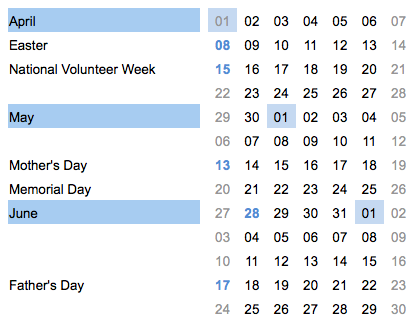
Detail from the Compact Calendar

Much of my work revolves around managing complex projects and programs, which requires checking in on a regular schedule, looking months ahead, or planning backwards from a deadline.  A typical monthly calendar doesn’t work very well–I need to see the entire year on one page so I can envision it all at one time, preferably as a single stream so I can more accurately see the distance between days (having been tripped up by months with five Mondays, for example).   I also need to know about major holidays and events so I don’t make the inadvertent mistake of scheduling a meeting on Memorial Day or Yom Kippur, dates that move around from year to year.

I’ve found a great solution from David Seah, an “investigative designer” who has this insatiable desire for Continue reading →

Learn How the Museum Assessment Program Can Help Your Site

The Museum Assessment Program is one of those program that’s been a major benefit to the field for decades, but unless you’ve participated, it’s a mystery.  You may have heard how it can transform an organization, move it to the next level of development, or solve a vexing situation.  It sounds dramatic, but I’ve seen it happen at both large and small museums who have gone through the process.

So how does this happen?  You can find out at a free webinar about MAP on Thursday, November 10 at 3pm Eastern Standard Time presented by the American Association of Museums and the Institute of Museum and Library Services.  Registration isn’t required but Continue reading →

Best Practices for Community Engagement and Interpretation Available

For your convenience, I’ve pulled together in one page the various standards and best practices for community engagement, public education, and historical interpretation at historic places and by historical organizations, including scholarship, curriculum development, visitor research, and staff training, as well as the broad range of public programs presented by historic sites, from tours and exhibits to publications and the Internet.  You’ll find “Best Practices” as a topic on the navigation bar on EngagingPlaces.net.

These resources can be used to: Continue reading →

The Best Resources on HistoricSites.WordPress.com

Although it’s unclear if the blog I formerly managed will continue after the reorganization at the National Trust, I would encourage you to download and copy the many free resources that are available now while you have a chance.  My recommendations are: