What Sites Can Learn from the Olympics

The summer Olympic games in London are now over and if you were watching, I bet you not only reveled in the athletic competition, but you also contemplated the logistics and expenses.  Those of us who work at historic sites don’t experience events like most other people.  Sure, we like the music, food, and tours, but we also look at the placement of signs, calculate ratios between attendance and restrooms, check out the store for items we can sell, and mentally map out visitor circulation and note the bottlenecks.  Or is that just me?

The Olympics is just another special event, although it’s huge and involves a cast of thousands and decades of planning.  The designers and planners of this event are the best of the best, so what can historic sites, at a much smaller scale, learn from their experience?  One of the most valuable lessons is that Continue reading

NEH Announces $39M in Grants but Sites Fare Poorly IMHO

At the end of July, the National Endowment for the Humanities (NEH) announced $39 million in grants for 244 projects across 15 program areas (e.g., America’s Historical and Cultural Organizations, Landmarks of American History and Culture, and Sustaining Cultural Heritage Collections Grants).  NEH is the major federal source of funds for historic sites and house museums, so these grant announcements provide a sense of what’s happening in the field to see what’s innovative or excellent (or what attracts funding).  Some examples of grant recipients who are focused on historic sites include:

Chicago Architecture Foundation
NEH Program: Landmarks of American History, $172,393
Project Director: Jean Linsner
Project Title: The American Skyscraper: Transforming Chicago and the Nation
Project Description: Two one-week workshops for eighty school teachers on the
development of the skyscraper in Chicago and the relationship of skyscrapers to
urbanization.

U.S.S. Constitution Museum 
NEH Program: Landmarks of American History, $179,548
Project Director: Sarah Watkins
Project Title: The U.S.S. Constitution and the War of 1812
Project Description: Two one-week workshops for eighty school teachers on the naval War of 1812 and its most important and complex artifact, the United States frigate Constitution, anchored in Boston.

Wilderstein Preservation
NEH Program: Sustaining Cultural Heritage Collections, $50,000
Project Director: Duane Watson
Project Title: Planning for a Sustainable Preservation Environment in the Wilderstein Mansion
Project Description: A planning project to identify ways to create and maintain Continue reading

Jump Start Your Interpretation with a Scholars Workshop

As an interpretive planner, one of the common circumstances I encounter at a site or house museum is that historical research hasn’t been conducted for years, perhaps even decades.  It’s not that research and scholarship isn’t appreciated by the staff.  Typically there was lots of research done when the site first opened, but staff just hasn’t had time since then (the distractions of “toilet paper and light bulbs”, alas!) or there isn’t the incentive now that the place is open (“history hasn’t changed that much in twenty years, has it?”).

The past may not have changed, but our interests continually change.  Right now, the Civil War is hot but in a couple years it could be jazz.  Without new historical research, eventually tours, exhibits, events, and programs, and yes, even staff lose their edge and the place seems dull and boring.  And you have to stay committed to research for the long term because as other sites mimic your innovative interpretation, it eventually settles into a regional monotony when everyone does the same thing (e.g., now it seems that every Colonial house museum is discussing foodways, lives of servants, and the contradictions of liberty and slavery).

Scholars Workshop underway at Drayton Hall. Director George McDaniel is providing an introduction to the site during the first part of the workshop.

If you find that you’ve ignored research far too long or that your research endeavors need some direction and refinement, a scholars workshop may help.  For a day or two, a small team of scholars gathers at your site to review the current interpretation and historical resources (archives, collections, and buildings) and then discusses how they might be refined, updated, or approached in new ways.  They can also confirm existing plans, support new ideas, and suggest new books or archives to explore.  By including staff in the workshop, it rekindles their energy and allows them to think longterm and strategically about interpretation.  For an example of the structure of a scholars workshop, take a look at Continue reading

Making Mission and Vision Visible: Put it by the Coffee Pot

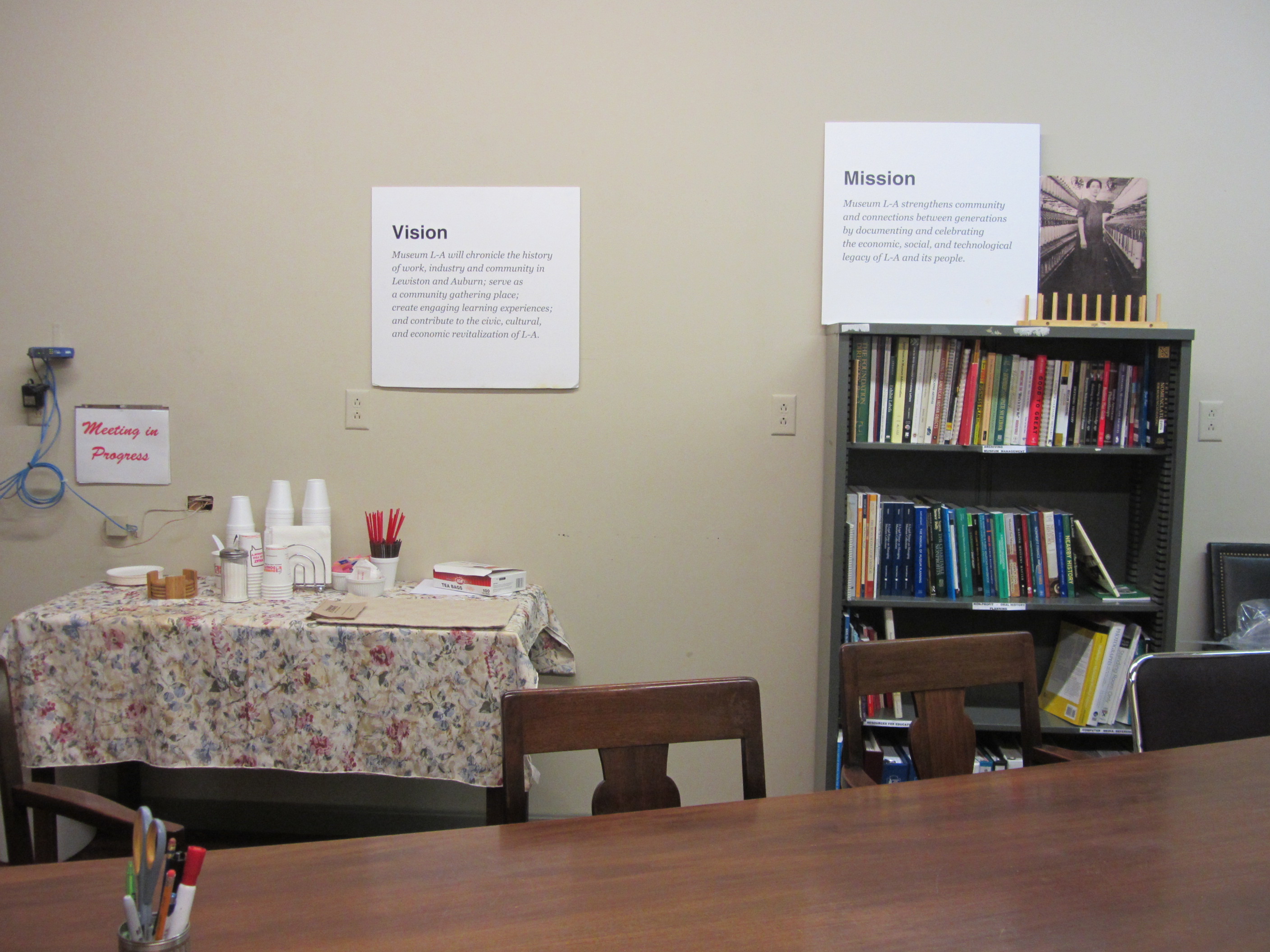
A recent visit to Museum L-A in Maine, a local history museum serving the communities of Lewiston and Auburn, revealed a clever way to keep the mission and vision visible and prominent.  They were posted on large boards in the conference room above the refreshments–whenever a group met, they couldn’t miss these reminders of the organization’s purpose and direction.

Their mission and vision were developed through a community-wide facilitated process led by E. Verner Johnson and they came up with statements that go far beyond the typical “collect, preserve, and educate”:

Mission

Museum L-A strengthens community and connections between generations by documenting and celebrating the economic, social, and technological legacy of L-A and its people.

Vision

Museum L-A chronicles the history of work, industry and community in Lewiston and Auburn; serves as a community gathering place; creates engaging learning experiences; and contributes to the civic, cultural, and economic revitalization of L-A.

For more details, see their strategic plan highlights on their website.  I was pretty impressed with this local history museum, so you’ll find a post or two about it in the future.

Put Your Organization to the Rorschach Test

This slideshow requires JavaScript.

If you’re finding that your organization is in a rut and you no longer feel as inspired about its work, it might be useful to look at it in a new way by creating a “word cloud” of key documents, such as a strategic plan, mission and vision statements, interpretive themes, or visitor evaluation.  A word cloud is a visual presentation of the most frequently used words, sized by frequency.  For example, if you use the word “history” ten times more than “preservation” in your strategic plan, “history” shows up much larger than “preservation” in the word cloud.  The word cloud allows you to look at your organization from a different perspective: words jump out at you and prompt questions about what’s being emphasized (and what’s not).

As examples, in the slide show above I’ve assembled word clouds from the first few paragraphs of the About section of the websites (which often includes the mission or vision statements) of the following historic sites:

I’ve used word clouds in strategic planning sessions to Continue reading

Google Expands its Access to Museums (but not yet Historic Sites)

Floor plan of the American Museum of National History displayed as a Google Map on a smartphone.

Google Maps recently expanded its capabilities of mapping indoor places (mostly  airports and shopping malls) by including two dozen museums in the United States (such as the Philadelphia Museum of Art, Indianapolis Museum, and the Smithsonia–the many museums that make up the Smithsonian Institution) and England (such as the British Museum, Victoria and Albert Museum, and the National Portrait Gallery).  Currently, this feature is only available on Android smartphones or tablets (that may seem limiting but nearly 2 million people have downloaded this app).  More museum maps are in the works but it doesn’t look like any historic sites are participating.  Consider how useful it would be to visitors at such places as Colonial Williamsburg, Gettysburg Battlefield, Sturbridge Village, the Huntington, and James Madison’s Montpelier.  If you’re interested in adding your site details to Google Maps, you can upload floor plans yourself or get help from Google.

In a similar vein, Google Street View just added 360-degree panoramic views of Yosemite and four other national parks in California.  And of course, these are nice complements to the Google Art Project.  It looks like Google is taking a much greater interest in museums along several paths, but historic sites currently seem to be left out of the mix.  I don’t think that’s intentional. I just think it’s a common oversight because most people don’t associate museums with historic sites.  Perhaps I’ll give them a call.

Thanks to John Durel for alerting me to this news item!

Boston MFA takes Flight with New American Wing

This slideshow requires JavaScript.

The Boston Museum of Fine Arts, one of the great public museums established just after the Civil War, has recently opened “Art of the Americas,” a new wing filled with its outstanding collections of American fine and decorative arts.  As some of you know, the Boston MFA underwent a controversial restructuring more than a decade ago, shifting from departments organized by media (e.g., paintings, ceramics, furniture) to geography (e.g., Europe, Asia, and America) and firing some longtime curators (including Jonathan Fairbanks, who created the American Decorative Arts and Sculpture department at the MFA).  I’m assuming one of the results of this restructuring is “Art of the Americas.”  This four-story exhibit consists of 53 galleries tracing the history of art from pre-Columbian to Modern periods for the continents of North and South America, so along with the expected Chippendale chairs and Copley portraits, there are Peruvian funerary urns and Acoma pots.  It’s so large that it took me nearly three hours just to cruise through it at a walking pace and I didn’t make it to the fourth floor, which explored the 20th century.

Unlike most art museums, the exhibit mixes Continue reading

Historic Sites Garner A Dozen+ Grants from IMLS

The Institute for Museum and Library Services recently announced the awards for the latest round of Museums for America grants, which include projects at more than a dozen historic places.  It’s always a quick way to see what’s happening around the country to get ideas as well as identify what projects are attractive to funders.  Congratulations to the recipients, especially our colleagues who are working with historic sites, including:

Kodiak Historical Society – Kodiak, AK
Award Amount: $52,706; Matching Amount: $52,810
Contact: Ms. Anjuli Grantham, Curator of Collections
(907) 486-5920; anjuli@baranovmuseum.org

The Kodiak Historical Society will complete design development for 2,800 square feet of exhibits at the Baranov Museum, located within the National Historic Landmark building known as the Russian-American Magazin. The project will foster the planning and design of Continue reading

IMLS Moves Deadline in Response to Comments from Museums

In a surprising move, the Institute of Museum and Library Services will be changing the application deadline for Museums for America and National Leadership Grants from January 15, although it won’t happen until 2014 at the earliest and the new deadline hasn’t been announced.  The 2013 deadline remains January 15.  According to Claudia French, Deputy Director for Museums, “We wholeheartedly support this suggestion and will change the deadline for FY2014. The time required for final approval of new grant guidelines through the Office of Management and Budget (OMB) will not allow us to alter the date for FY2013.”

This was a result of more than 100 comments received from the field as a result of a major restructuring of their grant programs.  IMLS did not reveal what other changes are under consideration or what concerns were reflected in the comments, however, they did affirm that, “In 2013, there will be no restrictions on the number of applications a museum may submit to MFA or NLG-Museums. . . .Museums submitting applications in more than one project category will compete with other museums in each category, not with themselves.”

Thanks to everyone who submitted comments on the proposed IMLS grant guidelines.  This has been one of the most controversial topics in the museum field that I encountered this year, so I’m happy to hear that museums and historic sites had some influence and that the IMLS was willing to accept public comments and provided an initial response so quickly.  A complete statement from IMLS is available on their blog.


Contemporary Visitor Center opens at French Historic Site

MuséoParc Alésia in Burgundy, France. The new orientation center is on the right and reconstructed sections of Roman fortifications are on the left.

On the site in Burgundy, France where Julius Caesar laid siege to Gallic leader Vercingetorix, architect Bernard Tschumi of New York created a circular concrete orientation center wrapped in a wood lattice on the site occupied by the Roman army.  (Although Napoleon II erected a 22 foot tall statue of Vercingetorix in 1865, he doesn’t seem to have caught on as a celebrity and no one names their kids after him.)  Called MuseoParc Alesia, the design of the interpretation center echoes the ringed fortifications built by Julius Caesar in 52 BC.  The building not only interprets the site through the exhibits inside but emphasizes views out onto the historic landscape via the windows and balconies that circle the building.  After watching a film about the battle, visitors exit the auditorium onto the tree-shaded roof terrace to enjoy a panoramic view so that, “vous vivez une expérience au cours de laquelle vous allez comprendre l’histoire de ce site, apprendre à regarder les signes dans le paysage mais aussi partager un lieu, un moment, un récit.”  And it includes an innovation for French museums:  a “toy library” for children ages 3 to 8 where they can learn while having fun (I think we call this a discovery room in the U. S.).  Strangely, the architect wanted the lobby to be empty.  I wonder if visitors will find this a confusing and sterile experience after encountering this dramatic building outside?  Seems to me to be a bit jarring, but I guess I’ll have to go to Burgundy to find out for myself.  A second circular museum built in the brick Gaul style will be located about a half mile away.

You’ll find a slide show of images at Architectural Record and initial reviews on Trip Advisor look promising.  Thanks to Barbara Campagna for alerting me to this new building!