
Tag Archives: Ken Turino

Want to Sharpen Your Historic Site Management Skills?

If you manage an historic site or house museum, there are several ways to sharpen your skills in the next few months.

Historic House Museum workshop at the Haas-Lilienthal House in San Francisco, 2014.

Historic House Museum workshop at the Haas-Lilienthal House in San Francisco, 2014.

For nearly fifteen years, the American Association for State and Local History has offered a two-day workshop on historic house museum issues and operations and next month it will be in Charleston, South Carolina on February 26-27, 2015.  Held in partnership with the Historic Charleston Foundation (one of the oldest historic preservation organizations in the US) and co-taught by me and Dr. George McDaniel of Drayton Hall, we’ll examine a wide range of topics from the unique perspective of house museums and historic sites, including leadership, interpretation, disaster preparedness, membership, and audience, through interactive presentations, group discussions, and site-specific exercises.  You’ll leave with a better sense of how your organization can better fulfill its mission and be more financially sustainable.  Registration is $345, $270 for AASLH members, plus there’s a $40 discount if you register by January 22.  Be sure to add a day to explore the historic sites in Charleston–it’s one of the best places to see a wide variety of visitor experiences in one place.

New this year is “Re-inventing the Historic House Museum,” a one-day workshop offering current thinking, practical information, and solutions to the challenges facing historic sites. The historic house museum in America is not dead nor are most of them dying. The field, however, needs to reflect and renew as the world around our historic sites continues to change.  This workshop was inspired by a sold-out symposium presented by the Historic House Museum Consortium of Washington, DC at Gunston Hall in March 2014, and now has been taken nationally to various regions by the American Association for State and Local History.  Ken Turino of Historic New England and I will be giving the core presentations and the others will vary to take advantage of the workshop location.  We’ll be at Strawbery Banke in New Hampshire on April 21, 2015 and the Margaret Mitchell House in Georgia on June 12, 2015.  Registration is $170; $95 for members of AASLH and NEMA (for April 21).
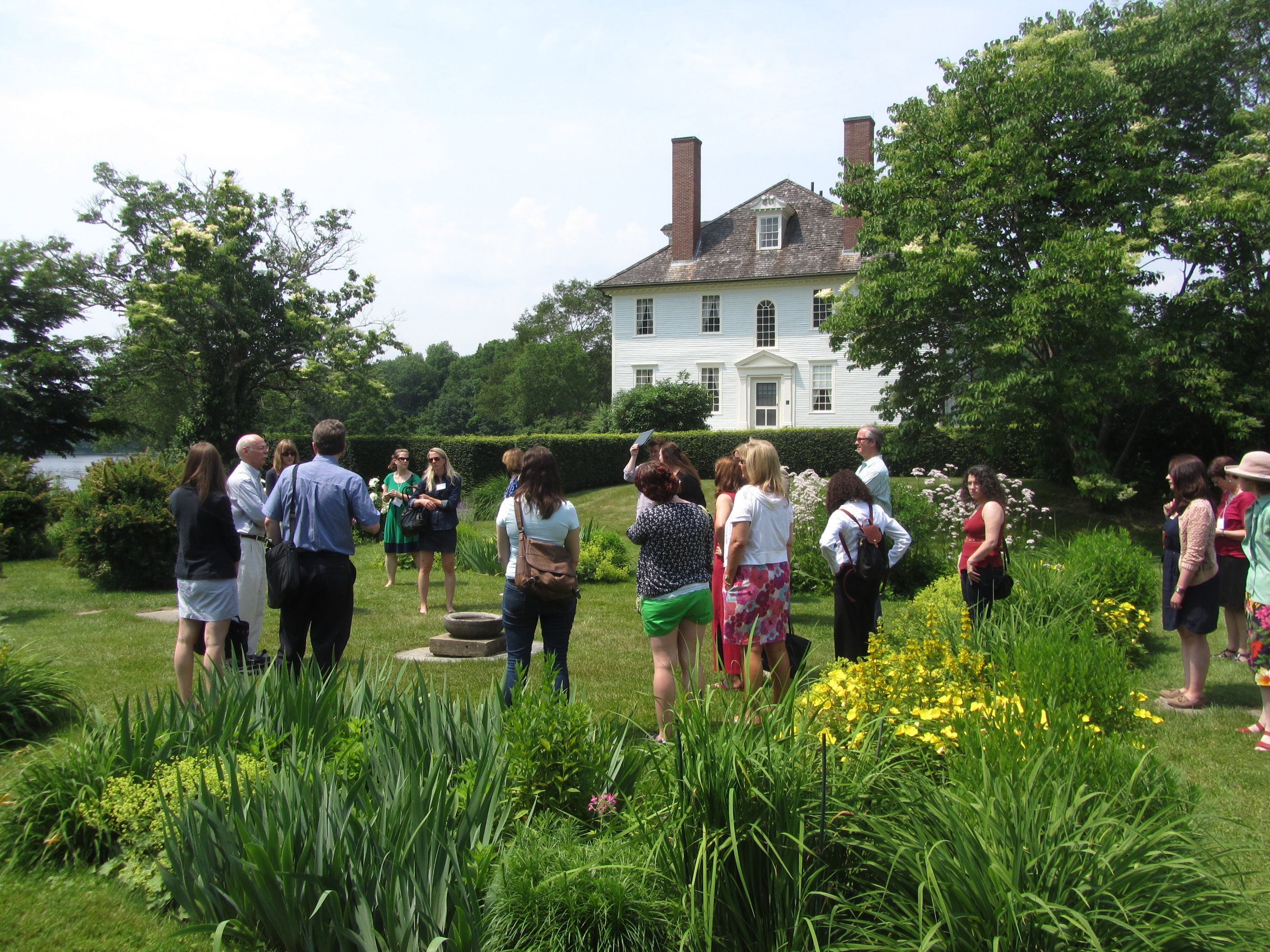
Program in New England Studies Offering Diversity Scholarships

Program in New England Studies at Hamilton House, 2013.

Program in New England Studies at Hamilton House, 2013.

Historic New England presents its Program in New England Studies, an intensive week-long exploration of New England from Monday, June 16 to Saturday, June 21, 2014. Now entering its second decade, the Program in New England Studies features lectures by noted curators and architectural historians, workshops, behind-the-scenes tours, and special access to historic house museums and collections. Last year I had a chance to talk with some of the participants and they said they were attracted by the chance to see the houses and collections, but found that they really loved the expert lectures.

This year, Historic New England launches a diversity scholarship to support a mid-career museum professional or graduate student.  Applicants must represent a racial or ethnic minority group in the U.S.  The scholarship covers the full registration fee of Continue reading

Recap of Historic House Museum Symposium at Gunston Hall

This slideshow requires JavaScript.

On Saturday, the Historic House Museum Consortium of Washington DC hosted an all-day symposium on “how are historic house museums adapting to the future?” at Gunston Hall in Virginia.  The sold-out symposium featured three speakers, a tour of Gunston Hall, and lots of time to chat with colleagues during breaks and over lunch.   The cost?  A mere $15, truly a bargain.  The symposium not only attracted professionals from Virginia, Maryland, and DC, but as far away as Connecticut!

I opened the symposium by discussing Michael Porter’s “Five Forces” as a way of identifying opportunities and threats to help historic sites prepare and adapt.  If you’re not familiar with the Five Forces, it’s a framework for identifying those issues that have the biggest impact on your operations.  This is a much more useful alternative to SWOT, which may be a good outline for summarizing an analysis, but it’s not a helpful way to analyze a situation.  If you’d like to get an introduction to the Five Forces and how it applies to historic sites, take look at my presentation (warning: it’s an 18 Mb pdf).  Even better was the discussion that followed, which explored a wide range of ideas from the growing role of photography to changing demographics to the interpretation of African American history.

Jana Shafogoj at Morven Park discussed how the current emphasis on STEM has allowed their site to Continue reading

Are Historic House Museums Adapting for the Future?

Gunston Hall, Lorton, Virginia.

Gunston Hall, Lorton, Virginia.

In March, the Historic House Museum Consortium of Washington, DC will be examining how historic house museums are adapting to the future at its annual Historic House Museum Symposium.  Presented alongside the 2014 Virginia Association of Museums conference, the symposium will feature three speakers, a boxed lunch, and a special tour of Gunston Hall on Saturday, March 15, 2014 from 9 am to 3 pm at George Mason’s Gunston Hall in Lorton, Virginia.  Registration is limited and is $15 per person.

Speakers include Continue reading

New England’s History and Architecture Explored in June

Program in New England StudiesHistoric New England presents the tenth annual Program in New England Studies (PINES), an intensive learning experience with lectures by curators and architectural historians, workshops, and behind-the-scenes tours of Historic New England’s properties and collections, as well as of other museums and private homes in the region.  This year’s program begins on June 17 with Cary Carson on the 17th century in the Boardman House and ends on June 22 with Richard Nylander and Nancy Carlisle on the Colonial Revival at Beauport.

PINES examines New England history and material culture from the seventeenth century through the Colonial Revival, and delves into building design and technology, and the wide-ranging lifestyles illustrated by the historic sites on the itinerary.  Highlights include private tours of Historic New England properties in Greater Boston; Essex County, Massachusetts; Portsmouth, New Hampshire; South Berwick, Maine; and Woodstock, Connecticut; workshops in furniture, ceramics, and textiles at Historic New England’s facility in Haverhill, Massachusetts; and a private tour of Continue reading