
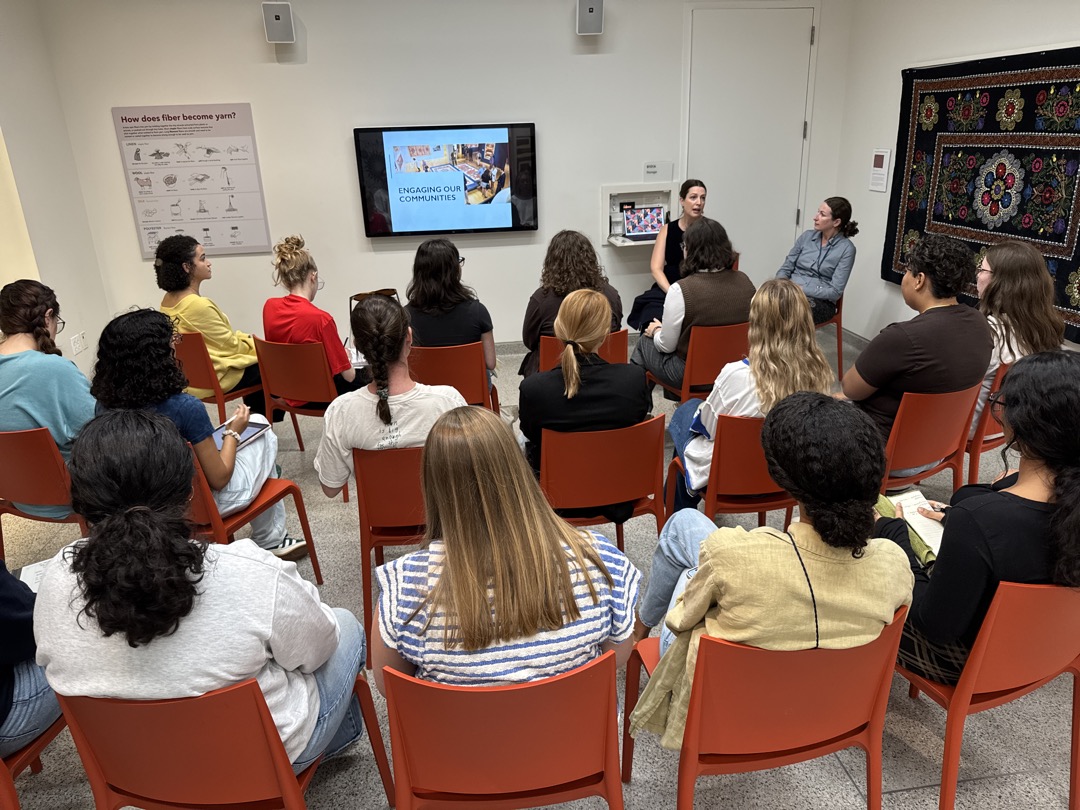
End-of-semester reflections often confirm what instructors suspect but rarely see so clearly. Read together, the reflections from my course CMST 6703: Museums and Community Engagement at George Washington University offer a useful window into how emerging museum professionals are learning to connect the theory of community engagement with its day-to-day practice. For museum leaders and practitioners, the themes echo many of the field’s ongoing debates about values, capacity, and impact.
One of the strongest patterns was a shift in how students understand community engagement. Early in the semester, many approached engagement as something measurable through attendance, participation counts, or one-off programs. By the end, their reflections show a more nuanced understanding: engagement as a relational practice grounded in mission, trust, reciprocity, and long-term stewardship. This mirrors core engagement theory, which emphasizes relationships over transactions and positions engagement as an ongoing organizational practice rather than a discrete activity.
Students also demonstrated increasing comfort applying theoretical frameworks to real institutional contexts. They reflected on analyzing museums through mission, governance, resources, and capacity—recognizing that engagement strategies cannot be separated from how an organization actually functions. The shared GW Museum case study, while initially frustrating, became a practical laboratory for testing theory against reality. Students noted that working within a single, constrained case forced them to confront tradeoffs, power dynamics, and feasibility—key elements often glossed over in more idealized engagement models.
At the same time, the reflections highlight an important learning edge: the transition from academic thinking to professional practice. Many students framed their performance in terms of effort, time, and completion of readings. Those are understandable academic markers, but community engagement in museums is evaluated differently. In practice, engagement work is judged by how clearly it advances mission, how well it aligns with institutional capacity, how responsibly it engages communities, and whether it can be sustained over time. The reflections suggest students are beginning to internalize this shift, even if they are not fully there yet.
Collaboration emerged as another critical theme tied directly to engagement practice. Students consistently cited class discussions, peer feedback, and shared problem-solving as shaping their thinking. This reinforces a foundational principle of community engagement theory: engagement is not an individual act but a collective process. The ability to listen, negotiate, and adapt to multiple perspectives is central to effective community work, both inside the museum and with external partners.
Threats and Opportunities
The opportunity for the field is clear. These reflections show that when theory and practice are intentionally linked—through real cases, explicit constraints, and reflective work—students develop a more grounded and realistic understanding of engagement. The threat lies in leaving key assumptions unexamined. Without explicit attention to power, agency, and evaluation, “community engagement” risks becoming a moral aspiration rather than a disciplined practice.
Implications for Museums and Nonprofits
For museums and nonprofits, this underscores the importance of treating community engagement as a management responsibility, not just a values statement. Institutions that host students, interns, or early-career professionals have an opportunity to model how engagement theory informs real decisions—what is possible, what is not, and why.
Next Steps for the Field
The next step is not more rhetoric, but more clarity. Museums need to be explicit about how engagement is defined, evaluated, and sustained; how communities are identified and involved; and how theory translates into practice under real constraints. If the field can continue to close that gap, community engagement can move from aspiration to durable practice—exactly the shift these reflections suggest is already underway.
 Engaging Places