
The American Alliance of Museums finished up their annual meeting in Seattle this week with about 5,000 people in attendance, including many from China, England, and Canada. The weather was jaw-dropping beautiful so trading it for the sessions indoors was a dilemma at times, but nothing would have pulled me away from the opening plenary which featured Erik Larson, author of Isaac’s Storm and Devil in the White City, who discussed his process for writing these histories. He doesn’t think of himself as an historian, however, but as an “animator of history” who seeks to “create a rich historical experience.” Hmm. Sounds like what historic sites do. I was also provoked by several very intriguing sessions related to history museums and I’ll be sharing highlights soon. In the meantime, enjoy these snapshots from the annual meeting.
Author Archives: Max van Balgooy

A Bibliography on Interpreting African American History and Culture
As many of you know, I’m assembling an anthology on the interpretation of African American history and culture at historic sites and in history museums, expected to be published by Rowman and Littlefield later this year as part of the AASLH book series. To provide an overview of the field during the past twenty years, I’ve developed an eleven-page bibliography of published articles and books. Although not comprehensive nor definitive, it provides a gateway to the breadth and width of the work underway in the United States for inspiration and best practices, and suggests needs and opportunities in the field. Due to limited space, this bibliography will be reduced in the book so I wanted to provide it here for those who are interested in the expanded version.
This bibliography primarily focuses on theories and methods (the “how”) of interpreting African American history and culture at museums and historic sites, such as tours, exhibits, events, programs, videos, and websites. Related, but not part of this bibliography, are Continue reading
Is Planning Giving You the Creeps?
 This afternoon at the annual meeting of the American Alliance of Museums in Seattle, Washington, I’ll be part of “Strategic Planning Made Simple,” a panel session discussing approaches to designing and implementing strategic plans with Liz Maurer (National Women’s Museum), Laurie Baty (National Capital Radio and Television Museum), and Steve Shwarzman (Institute of Library and Museum Services). I’ll be highlighting four ways to overcome “planning creep,” the seemingly inevitable and invisible force that pulls you away from your goals:
1. Adopting a Meaningful Purpose and Vision. Strategic plans have been with us for nearly a century, first for military purposes and then adopted by businesses in the 1970s. It’s now pretty clear that planning without a purpose is a wasted effort and now you’ll find both businesses and non-profit organizations adopting “mission statements.” While mission statements are needed, not all mission statements are helpful. I’ll be outlining the six elements of a Continue reading
Video: Why Study History?
In this 3:25 video, teacher Joanna Hayes shares the value of history through images and the music of Coldplay. She presents it on the first day of her social studies class.
Grease the Gears of Your Next Meeting
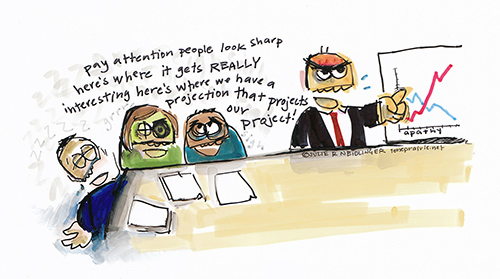 We are in meetings regularly but how many of them are productive? The minutes grind by slowly as the group argues over what it’s supposed to be doing and everyone is anxious to get back to their desks. A couple weeks later, you repeat the same meeting because no one remembers what was decided or who was responsible. I’ve been there hundreds of times but it improved about fifteen years ago when I began following the principles in How to Make Meetings Work by Michael Doyle and David Strauss (1993). It introduced me to the value of agendas, the decision-making process, and the important role of a facilitator. The facilitator is a neutral third party whose sole purpose is to manage the meeting process and ensure it is productive. He or she doesn’t make decisions but helps the group discuss issues collegially to arrive at decisions thoughtfully. The facilitator makes meetings easier, putting grease on the gears that would otherwise grind and bind. If you’re a regular reader of this blog, you are probably serve as a facilitator from time to time.
Over the years I’ve become increasingly aware of the importance of facilitation, especially as organizations move from a top-down, command-and-control form of management to Continue reading
Webinar: Better Board Governance
Stanford Social Innovation Review, a quarterly journal devoted to informing and inspiring leaders of social change, is hosting a free hour-long webinar on improving board performance on Wednesday, May 21, 2014 at 2 pm Eastern/11 am Pacific. This webinar is for non-profit board members, executive directors, and managers/staff who work with board members—anyone who seeks to create an organization with consistently effective governance in order to radically increase impact for its community and visitors. Thanks to the support of the Henry R. Kravis Prize in Leadership, this webinar is free but advance registration is required.
In this webinar you will learn the nine attributes of effective nonprofit board governance and be able to make significant improvements in your organization’s board. Join Kim Starkey Jonker and William F. Meehan III as they expand on their recent Stanford Social Innovation Review article, “A Better Board Will Make You Better.” They will discuss the difficulties of achieving consistently effective governance and provide actionable suggestions for overcoming these challenges. Kathy Spahn, recipient of the 2014 Henry R. Kravis Prize in Leadership, will join Jonker and Meehan to discuss Helen Keller International’s governance experiences and provide real-world examples about what works.
Video: Sheriff Andy Griffith Explains American History
This 5:16 excerpt from the “Andy Griffith Show” has the Sheriff convincing the neighborhood boys to study history. Terribly inaccurate but remember, this is just a fictional tv show.
The Future of Leadership: A Perspective from Business Workforce Trainers
 What’s the future of leadership look like? Five leaders in the field of business workforce training and development shared their perspectives at a session at the 2014 ASTD conference yesterday (and just renamed itself the Association for Talent Development). In the conversation, Debbie Blanchard (Ken Blanchard Companies), James Kirkpatrick (Kirkpatrick Partners), Halley Bock (Fierce, Inc.) and Tacy Byham (Development Dimensions International) discussed their experiences and observations as consultants who work with companies around the world. The session was presented in a question-and-answer format, but I’ve synthesized and distilled their responses to highlight key ideas.
1. Leadership is not a “soft skill”; it is an intentional practice to improve organizational performance and profitability. You cannot thrust people into leadership to see if they can swim, instead it has to be initiated, conducted, and practiced intentionally.
2. Leadership has moved from a hierarchical, single command-and-control structure to Continue reading
What’s the ROI of Your Historic Site?

Jack Phillips (right) discussing ROI at ASTD 2014.
Foundations and donors are increasingly questioning the impact of their funds at museums and historic sites, a trend that’s growing as well in business according to Jack Phillips and James Kirkpatrick at a session at the ASTD conference yesterday. After the recent recession, they’ve found that CEOs are increasingly asking about the return on investment (ROI) of every program and activity, including employee training and education. Although training claims to be an essential contributor to business productivity and performance, it hasn’t been adequately measured or evaluated, and thus can’t prove their value. That surprised me because I thought that was a struggle only for museums and historic sites. We seem to be continually fighting to prove our worth and other than economic impact, haven’t been able to show why we matter in our communities. It looks like we’re not alone.
Phillips and Kirkpatrick are the leaders in the field of measuring performance in business and developed frameworks that “define the levels at which programs are evaluated and how data are captured at different times from different sources.” Although they disagree on whether the framework should have four or five levels, they both agree that Continue reading
Getting the Big Picture of Training
This week I’m attending the annual conference of the American Society of Training and Development (ASTD) in Washington, DC, the “world’s largest professional association dedicated to the training and development field.” There must be thousands of people attending from all over the world and hundreds of educational sessions on training technology, meeting facilitation, staff management, career development, learning measurement, science of learning, and leadership development. As someone who specializes in interpretation and education at museums and historic sites, it puts my work in a global perspective and I quickly realized that while business spends more than $160 billion (yes, billion) annually on workforce learning to maximize their return on investment, non-profit organizations do very little in this area. Thankfully, many of our professional associations provide this essential service.
Although I won’t be able to share everything I learn at the conference this week, I’ll try to share some highlights. Yesterday Ruth Clark, author of Evidence-Based Training Methods, discussed some of the misconceptions around learning styles, a framework that Continue reading
 Engaging Places