In the 2:34 video, Tianwei Studio documents “The Warehouse,” a three-channel video installation installed in an old warehouse in downtown Lubbock, Texas. It’s part of “The Memory Series is a series of site-specific video installations exams personal and collective experiences of memory. Through the over used public imagery, brings historic awareness and collective memory to the obsolete industrial architectural space, where memory is not based on an illusion of static and eternal time, but derives from the awareness of temporal change.” It’s much more aesthetic than interpretive, but you might find some new ideas for interpretive methods (such as filling an entire doorway with a projected image) for your historic site.
Author Archives: Max van Balgooy

Hot Topics in Collections Management Tackled in St. Paul
The annual meeting of the American Association for State and Local History always covers a diverse range of topics, but collections management is certain to be among this. This year in St. Paul was no exception and three very different projects caught my attention.

“Deteriora and the Agents of Destruction” by the Indiana Historical Society.
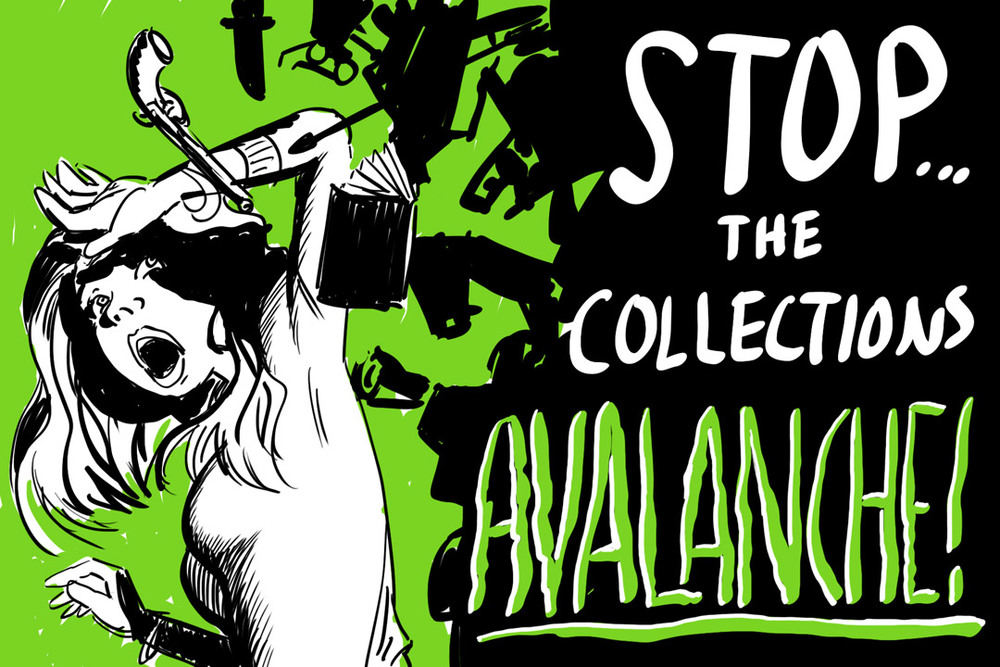
In a poster session, Tamara Hemmerlein shared Deteriora and the Agents of Destruction, a publication of the Indiana Historical Society. Presented as a “living graphic novel,” it informs readers about the various ways to preserve collections from light damage, pests, dust, and mishandling (represented by such villians as Ultra Violet, Mass-O-Frass, and Miss Handler) and includes links for additional information. I’m not sure of the intended audience, but it’s a lot more fun than reading a collections management policy.
 Chatting in the hallway, Continue reading
Know a Museum or Site Making an Impact with History?

Discussing the History Relevance Campaign at a packed session at AASLH in St. Paul. Photo by Lee Wright.
At the American Association for State and Local History annual meeting in St. Paul, the History Relevance Campaign presented an update on their work to a packed audience. During the session, we presented the Impact Project, a year-long process for identifying and studying historic sites and history museums that are making history relevant in their community. The goals of the Impact Project are to:
- Increase the use of history as a way to understand and address critical community issues.
- Help board members and staff make an impact in their communities by integrating best practices into their strategic and interpretive plans
- Encourage AASLH and other professional associations to include standards on community relevance and impact
- Encourage academic programs in history, public history, and museum studies to include community relevance and impact in their curriculum
- Encourage elected officials, funders, and communities to provide more support for history organizations that are making an impact
- Provide every Governor with at least one example of history organizations that are making an impact in their state
We Need Your Help
We are looking for history museums, historic sites, and similar organizations that are Continue reading
Arts-and-Crafts Meets Machine at the Gamble House
Fans of the Gamble House, the Arts-and-Crafts masterpiece created by Greene and Greene in 1908, will either be thrilled or horrified this Halloween season. The Machine Project has transformed the House during the Pasadena Art Council’s two-week AxS Curiosity Festival to reveal the history and visual ideas behind the historic site in subtle and not-so-subtle ways. Called the “Field Guide to The Gamble House,” it includes experimental tours and dances, group naps, operatic bird beaks, seances, videos, architectural lawn furniture and a secret Swiss-Japanese fusion restaurant. Complementing those live events, they’ve installed contemporary paintings and sculptures throughout the house to juxtapose today’s artistic ideas with 1908′s architectural style. On-site, hands-on workshops offer lessons in topics ranging from soap-making (a tribute to the family’s business) to solar robotics, from Craftsman-style cat houses to basic electronics, bringing the Arts and Crafts movement in parallel with today’s Maker groups.
Here’s a rundown of some of the events: Continue reading
Video: Walkthrough the Mauritshuis ‘Het Gebouw’ exposition
Mauritshuis, the 17th-century house in the Netherlands that has an extraordinary collection of Dutch and Flemish paintings has recently reopened following a two-year renovation. This 1:45 video shows the new temporary interactive exhibit about the building developed by Haute Technique.
AASLH Annual Meeting Recap
The AASLH Annual Meeting in St. Paul was a whirlwind for me, starting on Wednesday by stepping off the plane and heading directly into a five-hour Council meeting and then joining the evening reception at the Mill City Museum. The rest of the week held the same pace with walking tours of St. Paul at 7 am (had to skip breakfast), educational sessions throughout the day, and chatting with colleagues over dinner. It was great fun but it didn’t give me much time share on this blog what was happening during the conference. I’ll talk about a couple sessions in more detail later, but here are a few highlights in the meantime: Continue reading
Video: Using Technology to Reinvent the Field Trip
[youtube http://youtu.be/yOlSHShLynU?list=PLy704ec655lwz-c9dHue_MtxyS6Qnbz8r]
This 5-minute explains how the Minnesota Historical Society is reinventing the museum field trip through mobile and interactive video conferencing technology, creating personalized, accessible student learning experiences that connect the museum’s rich resources and immersive environments with in-school and out-of-school learning. This was produced a couple years ago, so I’ll be anxious to see where they are now when I visit this week during the AASLH annual meeting.
Greetings from Minnesota!

St. Paul, Minnesota along the banks of the Mississippi River.
This week I’m attending the annual meeting of the American Association for State and Local History in St. Paul, Minnesota, where I’ll be part of a couple educational sessions, debuting my new book on the interpretation of African American history and culture, and concluding my term on the Council. The Minnesota Historical Society has worked hard to encourage participation and radio raconteur Garrison Keillor is giving the keynote address, so this is expected to be among the largest annual meetings in AASLH’s history. The AASLH annual meeting has lots going on including more than 70 sessions and workshops, evening gatherings at the Minnesota History Center and Mill City Museum, a dozen tours of local museums and historic sites, affinity group luncheons, poster and pop-up sessions, an exhibit hall of vendors and companies, and lots of receptions. It’s an ideal place to keep up with what’s happening in the field as well as catch up with my colleagues and friends. If you won’t be able to make it in person, consider attending online (deadline to register is 5 pm on Wednesday, September 17).
On Thursday, I’l be moderating a session with debb Wilcox and Lee Wright, two marketing experts from outside Continue reading
A Simple Tool to Keep Users Engaged with Your Website (or Exhibit or Program)
 If you haven’t been to Ford’s Theatre in Washington, DC in the last ten years, you’ve missed a major makeover. Not only are the chairs in the theater more comfortable, but it has dramatically updated its interpretation. An extensive interactive exhibit on Lincoln and the Civil War (including Booth’s gun!) now fills the basement. Across the street, the Petersen House (“the house where Lincoln died” and the federal government’s first historic house museum) has been joined with the adjacent office building to provide several floors of exhibits and programs. Now it’s in the midst of creating Remembering Lincoln, a new website that will commemorate the 150th anniversary of Lincoln’s assassination by collecting, digitizing, and sharing local responses from the 13 months following his death. It won’t launch until 2015, but in the meantime they are sharing their progress and most importantly, their process on a blog.
It’s essential that you know the purpose and goals with any project, but even more so when there are more than a dozen institutional partners. You’ve got to be clear about what you’re trying to achieve to keep you focused—you don’t want people pulling in different directions. To keep their eyes on the road, Ford’s Theatre developed a “product definition document” for the Remembering Lincoln website which: Continue reading
Upcoming Workshop on Understanding Audiences
If you want to engage your audiences to build support and increase your impact, you first need to understand their interests, needs, and motivations. In today’s busy world, the traditional tactics of advertising, rackcards, and signs are no longer sufficient to attract visitors to museums and historic sites. We have to refresh our understanding of today’s audiences and develop new approaches that will engage them.
On September 22, 2014 from 9:00 am to 4:00 pm, I’ll be facilitating a one-day workshop on Understanding Audiences at the Middlesex County Community College in Edison, New Jersey. Sponsored by the New Jersey Historical Commission and New Jersey Historic Trust, this is part of a series of three workshops on engagement for nonprofit history organizations. The workshop will be based on the Standards and Excellence Program for History Organizations of the American Association for State and Local History. Registration is $20 (a bargain) and includes breakfast and lunch (even better!); deadline is September 18.

