Category Archives: Community engagement

NEH Shares Film Series on Civil Rights

This slideshow requires JavaScript.

The National Endowment for the Humanities and the Gilder Lehrman Institute of American History recently launched Created Equal, a new program to bring four nationally-acclaimed films on civil rights to historic sites, museums, and libraries.  They can easily fill a summer series of programs when accompanied by an historian and spark a conversation about your community’s experience with civil rights.

The films include:

  • The Abolitionists.  A small group of moral reformers in the 1830s launched one of the most ambitious social movements imaginable: the immediate emancipation of millions of African Americans who were enslaved. 
  • Slavery by Another Name.  Even as slavery ended in the south after the Civil War, new forms of forced labor kept thousands of African Americans in bondage until the onset of World War II. Produced and directed by Sam Pollard. 
  • Loving Story.  The moving account of Richard and Mildred Loving, who were arrested in 1958 for violating Virginia’s ban on interracial marriage. Their struggle culminated in a landmark Supreme Court decision, Loving v. Virginia (1967). 
  • Freedom Riders.  The Freedom Rides of 1961 were a pivotal moment in the long Civil Rights struggle that redefined America. This documentary film offers an inside look at the brave band of activists who challenged segregation in the Deep South. 

Up to 500 communities across the nation will receive these four inspiring NEH-funded films, accompanied by programming resources to guide public conversations. Each participating site will receive an award of up to $1,200 to support public programming exploring the themes of the Created Equal project.  Applications are due May 1, 2013 and open to museums and historical societies; humanities councils; public, academic, and community college libraries; and nonprofit community organizations. 

Highlights from the Virginia Association of Museums conference

This slideshow requires JavaScript.

Last week the Virginia Association of Museums (VAM) held its annual conference at the Homestead Resort in Hot Springs, Virginia, and I was fortunate to be asked to speak at their historic house forum.  It was my first time at their conference and I was so impressed by the quality of the sessions and the camaraderie of the participants.  I wasn’t able to stop by every session, but I wanted to provide some highlights from a few I did attend.

The Nexus of Art and Science.  Rebecca Kamen, professor of art at Northern Virginia Community College, talked about the ability of art to interpret historic scientific and medical collections found in museums and libraries.  Rachel Carson’s The Sense of Wonder (1965) prompted her to work with such diverse institutions as the American Philosophical Society, Chemistry Museum, and the National Institutes of Health.  A recent work, “Divining Nature: An Elemental Garden,” explores the orbital rotations of elements in the periodic table through sculptures.  I’ve seen lots of examples of science being explained in new ways, but I’ve only encountered a few glimpses of it being done with history–anyone have any suggestions?

Using Social Media to Conduct Historical Research.  Lynn Rainville, a professor at Sweet Briar College, discussed how she used Facebook, Tumblr, and other social media to study Continue reading

NEA Survey Reveals Patterns in Historic Site Visitation

On Monday, March 11, I’ll be a plenary speaker at the Virginia Association of Museums conference to discuss the trends, challenges, and opportunities facing historic house museums.  It will be followed by a forum with historic site managers, tourism experts, preservationists, and community leaders on the needs and opportunities for historic sites in Virginia, such as a statewide association for historic house museums.  It’s great timing for this topic:  Governor McDonnell declared 2013 as the Year of the Virginia Historic Home in recognition of the bicentennial of the Executive Mansion and Virginia’s more than 100 historic homes, most of which are open to the public as museums and historic sites.

Whenever I’m asked to give a presentation or write an article, it’s an opportunity to do some research and reading to gains some new or deeper perspectives on the issue.  For the VAM presentation, I’ve been looking closely at the Survey of Public Participation in the Arts by the National Endowment of the Arts.  For decades, NEA has interviewed thousands of people across the United States to learn about their involvement in music, art, theater, festivals, reading, and dance.   NEA conducted the last survey in 2008 and published a series of analytical reports in 2009-2011.

Looking back over 30 years, the survey confirms that attendance closely correlates with Continue reading

Rethinking the Mission Statement

Historic map and toolsThis week I’m attending the Small Museums Association‘s 29th annual conference in Ocean City, Maryland, where I’ll be giving a plenary address this morning on, “Mild-Mannered Superheroes Rarely Make a Difference.”  As you might have guessed, it’s a mash-up of a quotation by Laurel Thatcher Ulrich and the conference theme on superheros.  I hope to encourage attendees to rethink their mission, vision, and strategy to become more relevant and engaging in their communities.  Unfortunately, most museum mission statements are mild-mannered, with the usual phrase of “collect, preserve, and interpret” stuck behind the name of the organization.

Funding agencies, museum accreditation, and strategic plans require a mission statement, so many organizations create a least offensive version that can be approved by the board.  The result is that mission statements are often so vague that they’re ignored, have little to no influence on day-to-day activities, and are viewed as empty public relations gestures that provokes cynicism.  No doubt they’ve found that having a mission statement doesn’t have much impact, but a recent study shows that the right kind of mission statement can significantly improve financial success and organizational performance.

In “Looking at the Value of Mission Statements: A Meta-Analysis of Continue reading

Seeing Indiana’s Historic Sites From an Artist’s Perspective

Ronald Mack. Photo courtesy of Indiana Plein Air Painters Association.

Ronald Mack. Photo courtesy of Indiana Plein Air Painters Association.

Indiana Landmarks, one of the most active statewide historic preservation organizations in the nation, has an innovative program that brings together local artists and historic sites.  To preserve the tradition of plein air painting and focus artists on capturing historic places, Indiana Landmarks is partnering with the Indiana Plein Air Painters Association (IPAPA) on the third volume of the coffee-table book series, Painting Indiana

“Plein air painting is an important tradition, famously practiced in the late nineteenth and early twentieth centuries by T. C. Steele, William Forsyth, Ottis Adams and other noted Hoosier artists,” says Indiana Landmarks’ president Marsh Davis. “When places are captured in paintings, it increases the public’s Continue reading

History News looks at Historical Interpretation

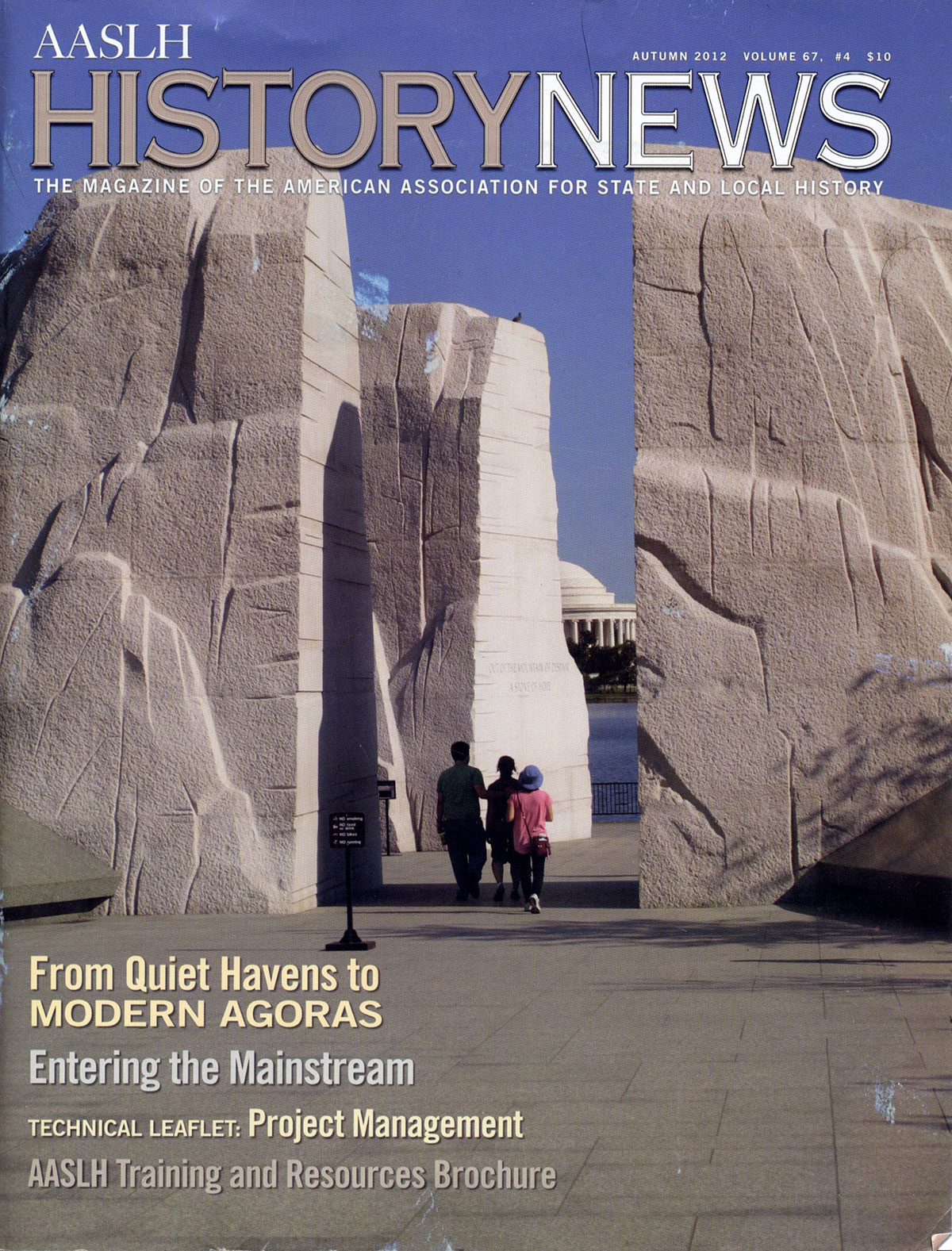
History News, Autumn 2012

History News, Autumn 2012

The autumn 2012 issue of History News arrived in my mailbox a couple weeks ago and its four feature articles on interpretation that will be of interest to historic sites:

  • “From Quiet Havens to Modern Agoras:  Libraries and Museums in an Era of Participatory Culture” by Nancy Rogers, Susanna Seidl-Fox, and Deborah Mack is a report, including the key overarching messages, from an international seminar held in Salzburg, Austria in October 2011.
  • “‘No More Wiggle-Tail Water’: Interpreting the History of Morgantown’s Water Supply at the West Virginia Botanic Garden” by Barbara Howe is a case study on integrating history in a place that focuses on horticulture and nature.
  • “When Histories Horrify: Supporting Visitors’ Responses through Responsible Interpretation” by Linda Norris, Danny Cohen, and Stacey Mann is a continuation of a session at the American Alliance of Museum’s annual meeting on the roles and responsibilities of museums in preserving and mediating horrific histories of crimes, violence, terrorism, and oppression, with references to the Kilmainham Gaol, Majdanek, Robben Island, and the Greensboro Woolworth.
  • “Entering the Mainstream:  Interpreting GLBT History” by Ken Turino and Susan Ferentinos addresses four common challenges (institutional policies on discussing sex, lack of documentary evidence, applying modern labels to historical figures, pressure to avoid controversial topics) using examples from Pendarvis, Walt Whitman House, Beauport, Sarah Orne Jewett House, Alice Austen House, and Charles Gibson House.

Also included are Continue reading

An Interactive Holiday Calendar for Historic Sites

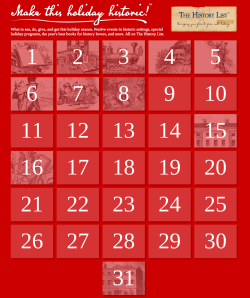
Make Your Holidays Historic at The History List.

Make Your Holidays Historic at The History List.

Lee Wright at The History List has developed a clever interactive calendar for the holidays which highlights events at historic sites around the country with changing images and sounds wrapped in an attractive bright red package.  It’s fun to play with it to find what’s hidden underneath each date and the best part is that any historic site or history organization can participate.  So far, it includes a Victorian Christmas at the Ramsey House, a whiskey tasting at Jefferd’s Tavern, and a holiday masquerade at Tryon Palace.  If you’d like to include your event, Lee provides instructions for participating via History List or Facebook.

December’s calendar is part of The History List’s, “Make this Holiday Historic” campaign, however, you can include events from the rest of the year as well.  The History List is Lee Wright’s effort to create a one-stop place for history lovers to find places and events happening near them, whether at home or on the road, as well as provide a convenient, easy-to-use online calendar for Continue reading

The Many Flavors of Touring Historic Places

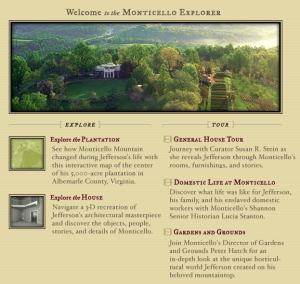
Monticello Explorer provides several virtual tours.

Monticello Explorer provides several virtual tours.

Although guided tours of period rooms is the most common form of interpretation at historic sites, audio tours, video tours, and virtual tours are growing in popularity thanks to technologies that are lowering the cost of production and increasing access to new audiences.  From a short list of examples, the students in my “historic site interpretation” class at George Washington University developed a list of ten best practices for different types of tours of historic sites.  You’ll discover that many of their suggestions emphasize the need for a plan, themes, and a focus–and projects that failed to have these elements were weaker and less effective.

A.  Guided Tours of Period Rooms

Reviewed by Johanna Bakmas, Melissa Dagenais, Emma Dailey
 

Suggested Best Practices

Do
  1. Develop an interpretive plan and themes
  2. Consult primary sources for the property
  3. Decide whether to have reproduction or original pieces Continue reading

Picturing the Seasonal Changes at Your Historic Site

Views of the exhibit gallery under construction in January, February, March, and April 2012 at the Museum of History and Industry.

The Museum of History and Industry in Seattle is moving into a new facility this year and to give the public a chance to experience the work and construction progress behind-the-scenes, they’ve installed a webcam overlooking the main exhibit gallery.  Webcams aren’t a new idea (remember the panda cubs at the National Zoo?) but what’s clever about the construction camera provided by OxBlue is that users can see timelapse movies and four views for different dates at the same time.

Many historic sites change their programs, events, and exhibits throughout the year to reflect the changing seasons, but I wonder if this same system could be used to Continue reading

Responding to Frequently Requested Directions by Visitors

Business card rack with directions to frequently requested destinations.

At the reception desk at the Inn at Middleton Place, I spotted a clever way to share directions to frequently requested places.  It’s a plexiglass business card rack filled with written directions to the airport, downtown, and other historic sites on slips of paper.  Guests just pick up the directions they need and they don’t need to worry about remembering them or jotting them down correctly.

Here’s an example of the written directions:

Downtown Charleston/Meeting Street

Turn left out of the Inn onto 61.  Follow road approximately 13 miles until the road splits.  Veer right onto bridge.  Travel through 1st light and get in left lane.  Follow signs to Calhoun St.  Once on Calhoun, travel 9 lights up to Meeting St.  Take right on Meeting St. to go to Battery.  Turn left on Meeting St. to go to tourist visitor center.  Times to avoid: 7 am-9 am and 5 pm-7 pm.

Now you know why they wrote down those instructions!

By the way, if you like contemporary architecture and historic gardens, the Inn at Middleton Place in Charleston is a perfect place to stay.  The Inn has received an AIA Honor Award for its contemporary design and fits in peacefully with the surrounding landscape on the banks of the Ashley River.  Your stay includes admission for two to the adjacent Middleton Place, where you can enjoy the gardens, even after it has closed to the public.