Category Archives: Fundraising

Changes Rumored for IMLS Grants

I recently heard a rumor that the Institute of Museum and Library Services made significant changes to their grant programs for museums on February 13, 2012 including:

  • All grant programs will have the same deadline:  January 15.  This will require organizations to have sufficient capacity to prepare several applications at one time during the busy holiday and year end season.
  • Conservation grants are now part of the broader Museums for America (MFA) grant program.  Organizations can no longer apply for separate conservation and MFA grants–they have to choose one.
  • 21st Century Museum Professionals and National Leadership Grants have been combined.  Applicants (particularly museum associations) will now have to choose one and can’t do both.

It seems the public and museum field had no opportunity to comment on these changes, however, some of the additional issues that have been raised are:

  • With this consolidation, it reduces the number of grants available to the museum field.  It is particularly vexing when Continue reading

A Six-Stage Strategy for Engaging People

Engaging people is one of the primary responsibilities of an historic site, although we might call it membership, attendance, advocacy, support, fundraising, or “resources development” (yup, that’s what it was called at one place I worked).  Expanding and growing engagement is usually focused on direct and simple efforts, such as working on individuals to give increasingly greater sums or putting out more announcements to increase attendance.  Results are usually sporadic, rough, and unpredictable.
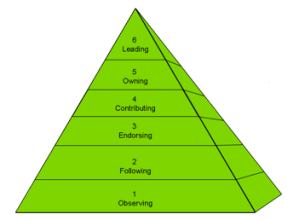
Engagement Pyramid by Gideon Rosenblatt.

I recently learned of a thoughtful strategy from Gideon Rosenblatt, the former executive director of Groundwire, a company that helps environmental organizations connect, inspire, and mobilize their communities.  He lays out engagement in a spectrum of six stages from Observers to Leaders and each has a decreasing number of people involved.  This is best illustrated as a pyramid, with the large group of Observers at the bottom and the small group of Leaders at the top.  He’s found that each group has a specific mindset and communication preference, and therefore, organizations can effectively engage Continue reading

Welcoming New Members: Examples from the Field

This slideshow requires JavaScript.

As part of my year-end giving, I decided to join four different history organizations (one historic site, three historic preservation organizations).  I support the mission of every organization I joined–there’s no attempt to embarrass them here–but I also wanted to see how a new member and unsolicited gift was received.  In this tight economy, every organization seems to placing a great emphasis on growing membership and support, so it’s useful to learn what others are doing.  Admittedly, this is just a limited experiment, but for each one I downloaded their membership forms from their websites, filled it out, and then sent it in with a check for the basic individual membership level all on the same day in mid December.  So far, I received responses from three of the four organizations (and they arrived about a day apart) and here’s how they compared: Continue reading