
Soundworks documents the creation of “authentic sound” for Steven Spielberg’s film, Lincoln. The sound designer discusses his efforts to collect sounds at historic sites and in museum collections, such as the clocks and doors at the White House and a pocket watch at the Kentucky Historical Society.
Category Archives: Historical interpretation
Video: Smithsonian Museum of African American History and Culture
This short feature by BET includes an interview with director Lonnie Bunch, highlights of artifacts, and a computer-generated fly-through of the new Smithsonian Museum of African American History and Culture. In honor of African American history month, I’ll be sharing other related videos on Fridays.
Seeing Indiana’s Historic Sites From an Artist’s Perspective

Ronald Mack. Photo courtesy of Indiana Plein Air Painters Association.
Indiana Landmarks, one of the most active statewide historic preservation organizations in the nation, has an innovative program that brings together local artists and historic sites. To preserve the tradition of plein air painting and focus artists on capturing historic places, Indiana Landmarks is partnering with the Indiana Plein Air Painters Association (IPAPA) on the third volume of the coffee-table book series, Painting Indiana.
“Plein air painting is an important tradition, famously practiced in the late nineteenth and early twentieth centuries by T. C. Steele, William Forsyth, Ottis Adams and other noted Hoosier artists,” says Indiana Landmarks’ president Marsh Davis. “When places are captured in paintings, it increases the public’s Continue reading
Predictions for Education Technology in 2013
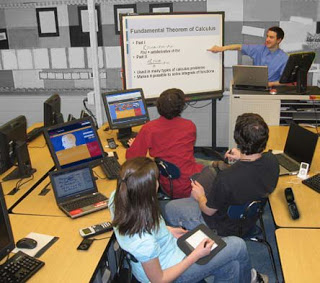
Image courtesy of HamiltonRentals.Wordpress.com.
T.H.E. Journal brought together five technology experts who work in schools to predict the future of technology in the classroom–and may help you decide where the opportunities lie for your museum or historic site as you work with students and teachers. Here’s a quick summary, and if you want more details, check out the entire article in the December 2012 issue.
- HOT: Common Core Online Assessments. “As more and more curriculum departments align their learning resources to the Common Core, the next step will be to create the systems for implementation, including content management and new methods of assessment. Mobile devices will play a role in Common Core assessments.” [Every history organization that works with schools should notice that this issue not only suggests following and understanding the Common Core but that schools continue to have inconsistent and unreliable computer technology, so providing information only online may hinder students and teachers, rather than help.]
- HOT: iPads. LUKEWARM: Tablet Computers other than iPads. “iPads will continue to Continue reading
Workshops for History Museums and Historic Sites
The American Association for State and Local History unveiled an assortment of workshops for spring (there’s one in every time zone!):
Project Management for History Professionals
Dates: March 7 – 8
Location: History Colorado, Denver, CO
Instructor: Dr. Steven Hoskins, Trevecca Nazarene University, Nashville, TN
Cost: $475 members / $550 nonmembers
$40 discount if payment is received by January 31 (coming up next week!)
This unique two-day workshop improves how history museums operate and serve their community by teaching the fundamentals of project management to history professionals. Everyday work—exhibitions, programming, fundraising, special events, outreach, and collections care—benefit from the knowledge gained. Registration for the onsite workshop also includes access to an online course with related material.
From Children to Adults: Public Programming at History Organizations
Dates: March 14 – 15
Location: Homestead Museum, City of Industry, CA
Instructors: Tim Grove, National Air and Space Museum, Smithsonian Institution, Washington, DC; Alexandra Continue reading
Historic Homeowners Get Special Behind-the-Scenes Access
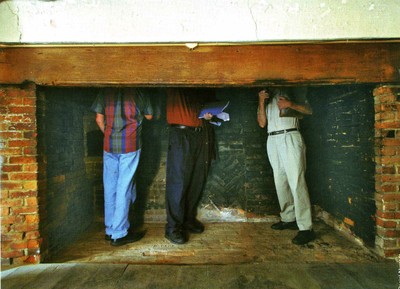
Getting a closer look at the chimney in the 17th century Boardman House in Massachusetts.
This month Historic New England launched, “Insight on Site: Inside the Old House” to give historic homeowners an opportunity to go behind the scenes with staff and learn how to date building materials and identify architectural styles.
Insight on Site takes visitors into parts of Historic New England properties rarely seen by the public, such as the Modern house located adjacent to the newly acquired Eustis Estate in Milton, Massachusetts; a caretaker’s residence at the seventeenth-century Browne House in Watertown, Massachusetts; and the newly reacquired Jewett Eastman House in South Berwick, Maine. Free and exclusively for Historic Homeowner members, the series of four Insight on Site programs runs from January 12 to Continue reading
Collecting Memories from Visitors
Maymont, a Gilded Age estate that’s now a public park in Richmond, Virginia, has an extensive exhibit on the domestic servants in the first half of the twentieth century. To continue to collect stories about and remember the many people who work in domestic service, the exhibit includes a small area that invites family, friends, and neighbors to share their memories with a label that reads:
Sharing Memories
In creating this painting–a symbolic tribute to the individuals who worked as domestic employees at Maymont–I felt special gratitude to my own loved ones. My grandmother, mother, two aunts, and three uncles were all once employed on the Dooley staff.
Was there a significant person in your life who Continue reading
History News looks at Historical Interpretation
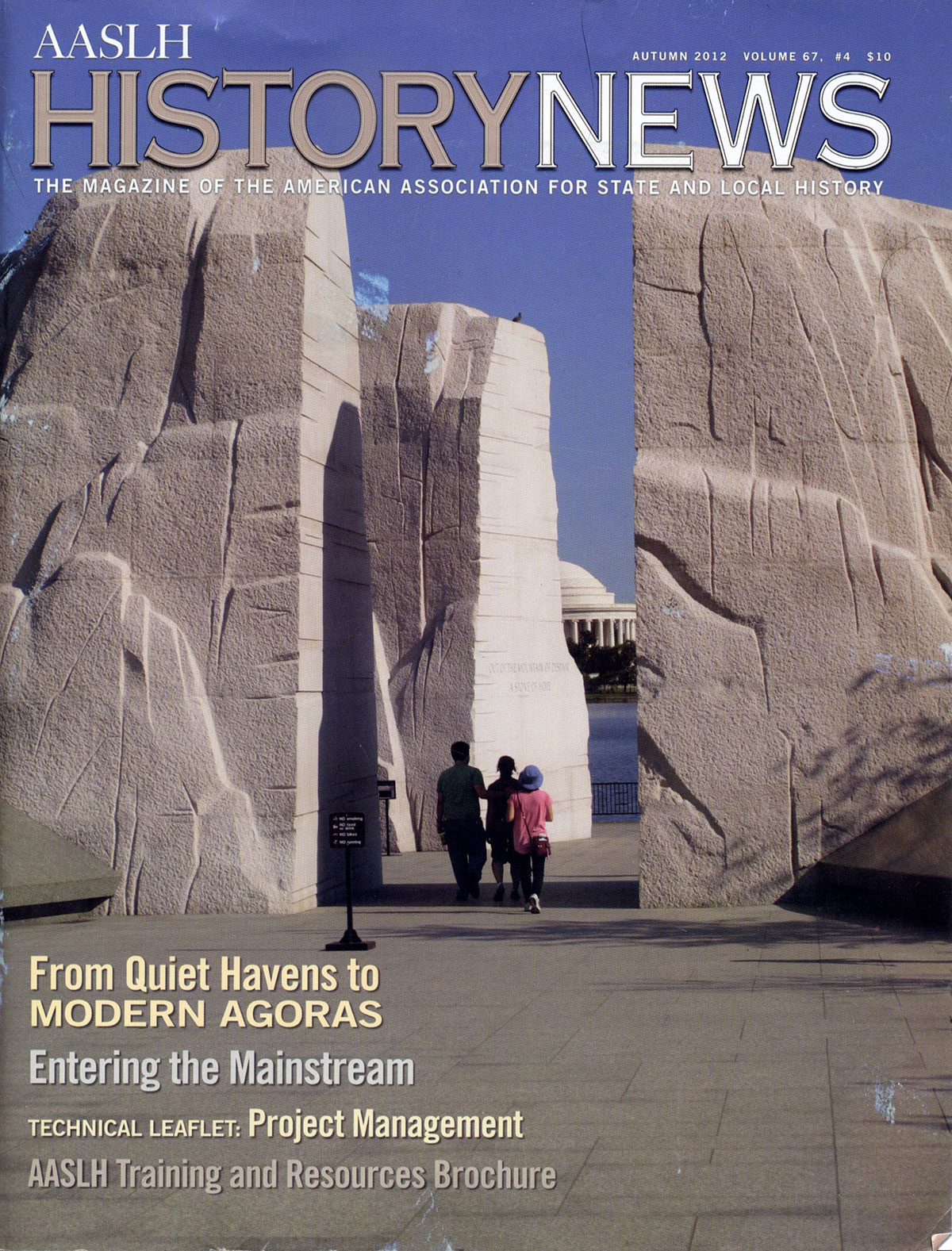
History News, Autumn 2012
The autumn 2012 issue of History News arrived in my mailbox a couple weeks ago and its four feature articles on interpretation that will be of interest to historic sites:
- “From Quiet Havens to Modern Agoras: Libraries and Museums in an Era of Participatory Culture” by Nancy Rogers, Susanna Seidl-Fox, and Deborah Mack is a report, including the key overarching messages, from an international seminar held in Salzburg, Austria in October 2011.
- “‘No More Wiggle-Tail Water’: Interpreting the History of Morgantown’s Water Supply at the West Virginia Botanic Garden” by Barbara Howe is a case study on integrating history in a place that focuses on horticulture and nature.
- “When Histories Horrify: Supporting Visitors’ Responses through Responsible Interpretation” by Linda Norris, Danny Cohen, and Stacey Mann is a continuation of a session at the American Alliance of Museum’s annual meeting on the roles and responsibilities of museums in preserving and mediating horrific histories of crimes, violence, terrorism, and oppression, with references to the Kilmainham Gaol, Majdanek, Robben Island, and the Greensboro Woolworth.
- “Entering the Mainstream: Interpreting GLBT History” by Ken Turino and Susan Ferentinos addresses four common challenges (institutional policies on discussing sex, lack of documentary evidence, applying modern labels to historical figures, pressure to avoid controversial topics) using examples from Pendarvis, Walt Whitman House, Beauport, Sarah Orne Jewett House, Alice Austen House, and Charles Gibson House.
Also included are Continue reading
Navigating a Changing Economy: A New Normal for Museums?
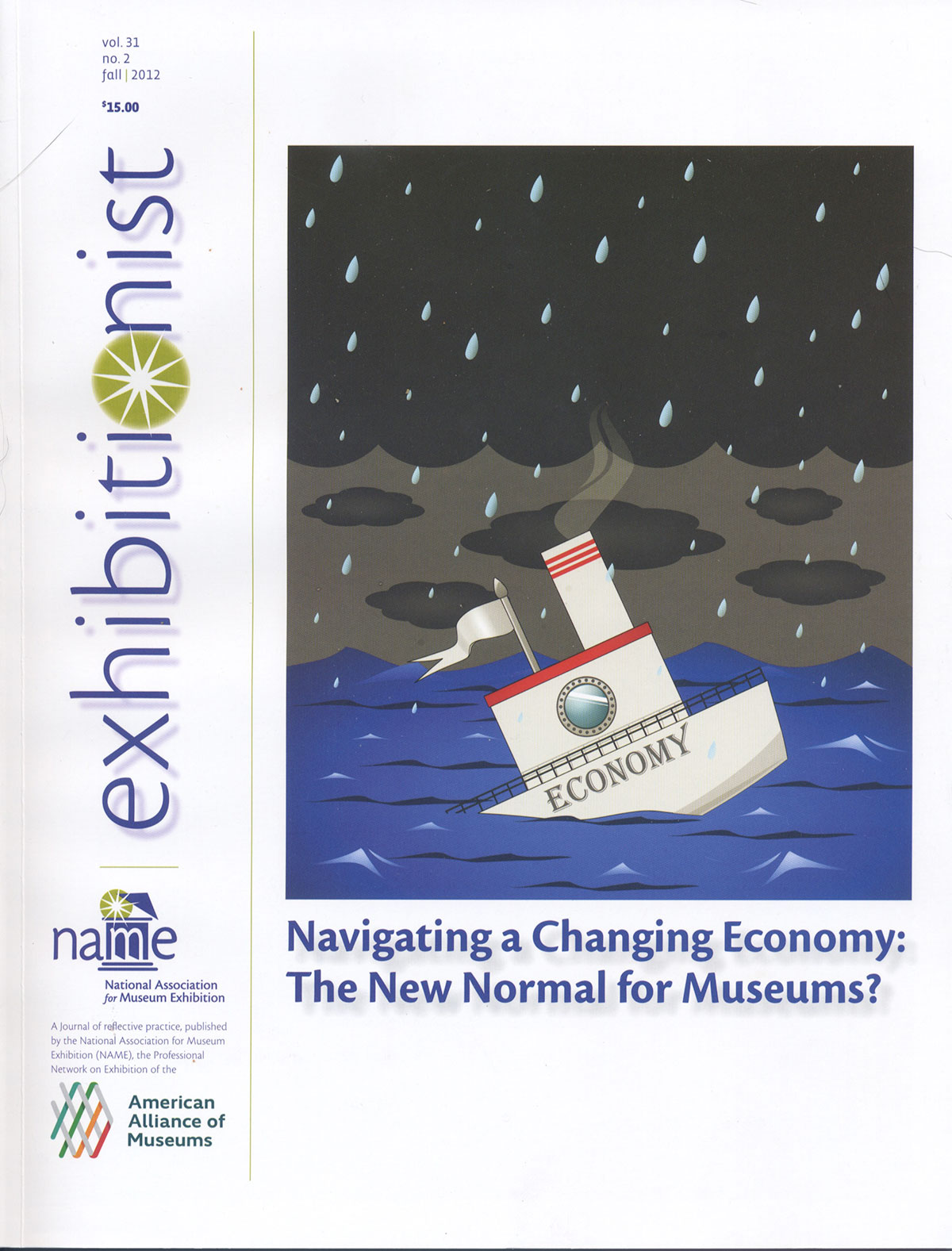
Exhibitionist, Fall 2012
The Exhibitionist, the journal of the National Association for Museum Exhibition (NAME), has devoted its fall 2012 issue to the longterm impact of the economic downturn on the museums. Daniel Spock, director of the Minnesota History Center, and Marilyn Hoyt, a fundraising consultant, discuss the trends affecting exhibitions but whose lessons can apply to other museum departments. Spock believes that museums may be, “moving into a period of permanent instability–a special challenge for museums which have traditionally been in the continuity business.” Hoyt sees that museums are compensating by relying more on in-house resources and phasing projects, often with good side effects, including more prototyping of ideas and a fresh look at familiar collections.
Complementing these opening articles are: Continue reading
Virginia Turns Penal Colony into Art Colony
I recently had an opportunity to visit the Occoquan Workhouse Prison, an early 20th century federal prison in northern Virginia, which was transformed by Fairfax County in 2008 into the Workhouse Arts Center, a collection of 100 artist studios and galleries. Once regarded as a model for reform-minded incarceration with open dormitory-style residences accompanied by honest work on the surrounding country farm, its image was soon tarnished by the imprisonment and force-feeding of the women who were picketing the White House for suffrage–which helped turn public opinion against the Wilson Administration. I had long known about this infamous event and wanted to get a better sense of the conditions. At the small museum on site, I learned much about the prison’s history and the struggle for woman’s suffrage, however, I also learned that Continue reading

