In this 5:17 video, author David McCullough shares the five most important ideas high school students should learn before graduating (and it’s not memorizing dates and quotations). This was recorded by CSPAN at the 2011 National Book Festival.
In this 5:17 video, author David McCullough shares the five most important ideas high school students should learn before graduating (and it’s not memorizing dates and quotations). This was recorded by CSPAN at the 2011 National Book Festival.
In this 32-second video, Tom Mison and Orlando Jones, stars of the television show “Sleepy Hollow” promote the historic sites of North Carolina.


The National Council on Public History held its annual conference in Monterey, California a couple weeks ago. More than 600 people attended from around the country plus ten countries, making it the largest stand-alone meeting (at times, NCPH will co-host a conference with another organization, such as AASLH). Monterey, of course, is a wonderful place to enjoy history and nature, especially if you’ve been enduring a long winter. This year’s theme was sustainability and a task force is developing a white paper, which is available for public comments.
I attended primarily to discuss the History Relevance Campaign and collect more comments and ideas on our goals and projects. I also participated in a couple sessions, a morning of speed networking (graduate students and new professionals rotate among several mid-career and seasoned pros), and ran into lots of friends and colleagues in the hall and on the street. NCPH is a mix of Continue reading
James Kendra, who has been teaching social studies at Kenowa Hills Middle School for the past nineteen years, explains his approach of a “content-free social studies classroom.” In this 12:35 video from TEDx Muskegon, he explains that social studies is the most important class students take in school but not when the emphasis is on facts and dates. “Students want to know why these events are happening,” Kendra says. “Historical events (if they were truly significant) would connect to events of today. We shouldn’t be telling students which events were important, but them discovering how past and present connect.” How would your tours or exhibits change if they were based on current events and then looked to the past for explanations and understanding?
Tom Carroll explores “places that might change people’s perceptions of Los Angeles” in a series of thirteen short hip videos and demonstrate what is possible to create with just a handful of people. Carroll studied art at Occidental College and led tours at the Los Angeles State Historic Park and at the Los Angeles County Museum of Art. In creating these videos, he uses, “a lot of what I learned as a tour guide, speaking loudly and slowly, knowing when you are losing your audience.” Could you create a short video exploring an historic place in your community?
In preparation for my presentations at the upcoming Historic House Symposium at Gunston Hall and the National Council on Public History annual meeting, I’m analyzing financial information about history organizations in the United States. I’m currently researching state historical societies, working my way from the most populous state (California with 37 million residents) to the least (Wyoming with about half a million residents). So far I’m about halfway done, but I wanted to share what I’ve learned and get your reactions.
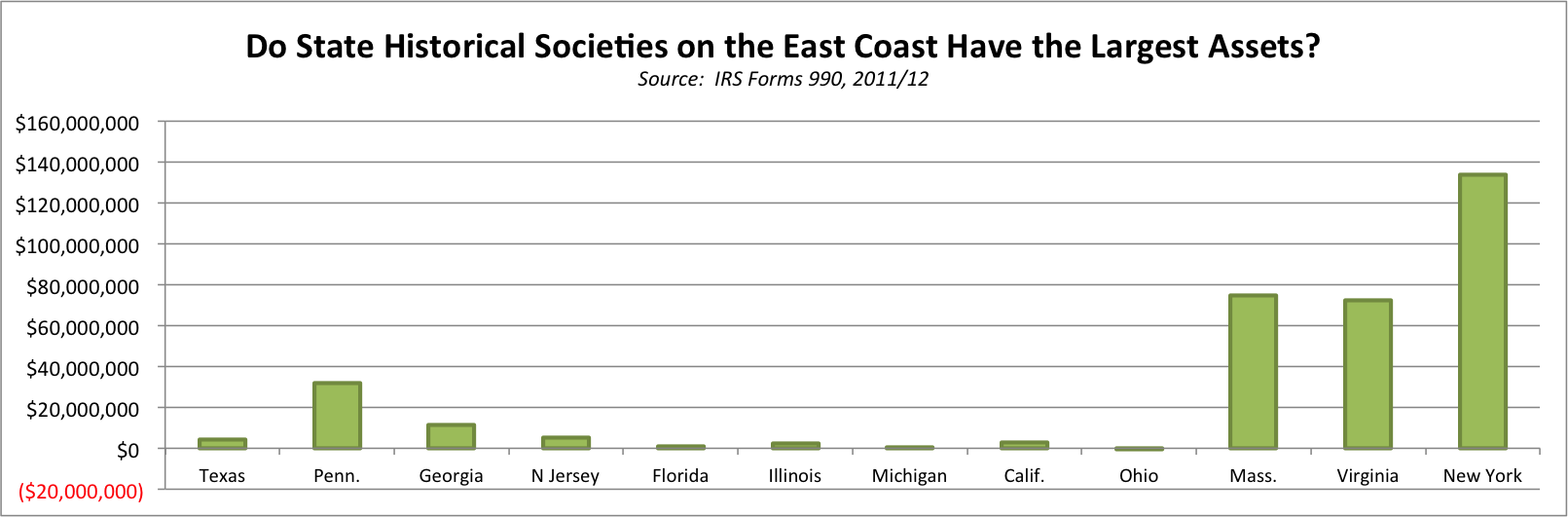
Among my preliminary discoveries is the dramatic difference among state historical societies. Some are incredibly big (the New York Historical Society has $133 million in net assets) and some states don’t seem to have a statewide historical society (anyone know what’s happening in North Carolina?). One might assume that the biggest states have the biggest historical societies, but Continue reading
Last Friday, January 3, about 65 people braved the winter cold of Washington, DC (okay, compared to Midwest right now, it’s balmy) to participate in a discussion on the relevance of history to Americans. Leading the discussion with me were Tim Grove of the Smithsonian Institution and Cathy Gorn and Kim Fortney of National History Day.
It was an exciting mix of participants. The room was not only filled with historians who were attending the American Historical Association conference, but also people who work at history organizations in the DC region. These various perspectives sparked a Continue reading
 In the last year I’ve become part of an group to find ways to make history more meaningful and relevant to Americans. The History Relevance Campaign, for lack of a better name, is an informal grassroots effort made up of public historians, preservationists, educators, historic site managers, and museum leaders who are creating a national, broad-based strategy to assert the relevance of history.
Just to clarify, the History Relevance Campaign is not connected to any one history organization. From its start in early 2013, the group has strived to be as inclusive as possible. Secondly, it is not a lobbying group. Its main audience is the general public, not elected officials and public policy makers. Thirdly, its intent is to show that history skills are just as important as Continue reading
Angela Smith, assistant professor and director of the public history program at North Dakota State University shares this six minute general overview of the value of history and how the Public History Program at NDSU has contributed through several student projects. This video was presented at the College Honors Day on October 11, 2013.
James Singewald, is photographing and researching ten historic streets in Baltimore for his project, Baltimore: A History Block by Block. This 4:30 video explains his project and presents a series of his photographs that show the rich variety of architecture that survives (and may be soon demolished) and is raising funds for 4×5 film, processing, research, and publication on Kickstarter. It’s a great way to raise funds to research and document historic neighborhoods, and he’d appreciate your support with a gift of $10 or more (he’s raised nearly half of his expenses with 65 backers). Singewald received his MFA from the Maryland Institute College of Art abd is currently the imaging services technician at the Maryland Historical Society> He funded his previous book, Old Town, East Baltimore, in 2010 through Kickstarter.
 Engaging Places