Category Archives: Social media

Amelia Wong Joins Museum Studies Faculty at GWU

Amelia Wong, currently the US Holocaust Memorial Museum’s senior social media strategist, will be joining the fulltime faculty of the Museum Studies Program at George Washington University this fall as an assistant professor. Amelia holds a BA from UCLA in history and a PhD in American Studies from the University of Maryland, College Park. Amelia’s scholarship focuses on how museums, especially those concerned with democratization, can engage critically with technology for their goals. Her dissertation, “Museums, Social Media, and the Fog of Community,” reflects her research interests and
is the first book-length project about social media in American museums.

At the Holocaust Museum, the Twitter community has grown from 2000 to over 100,000 people under her direction. Amelia also developed and produced an ongoing Web series, “Curators’ Corner,” which gives the public, donors and others an inside look at the
museum’s collections via short multimedia presentations narrated by museum staff. During her first year at the museum, Amelia proposed, Continue reading

Changes at Google+ Creates Opportunities for Museums and Sites

Okay, everyone knows about Google but Google+ and Google Places is still a mystery for many people.  It may become a bit simpler because the rumor is that Google Places is slowly being replaced by Google+ Local.  Or did that just complicate things?  Let’s start over.

Google search results for “historic sites in philadelphia”

Google has launched new search results that include the usual title, web link, and brief description, but now adds the address, phone number, shows the location on a map, a link to reviews, and a Zagat ranking on a scale of 1 to 30.  In the example to the left, you’ll see the search results for “historic sites in Philadelphia” and that the Eastern State Penitentiary (the third item) received a Zagat rating of 25 (it really is an amazing place) and has 81 Google reviews (wow! their visitors have opinions).  This new form of listing doesn’t occur for every city, just those that seem to have enough places to warrant them (right now, this list appears for Denver but not San Francisco).  Local information is being integrated across Google (including the Zagat ratings, which was acquired by Google last year), so you’ll find Continue reading

2012 Webby Awards Point Out Models for Historic Sites

Historic sites are always looking for good models for online activities, such as websites and mobile applications, and one of the best places to look for inspiration is the annual Webby Awards, the leading international award honoring excellence on the Internet. Established in 1996 during the Web’s infancy, the Webbys are presented by the International Academy of Digital Arts and Sciences.

The 2012 Webby Awards received nearly 10,000 entries from over 60 countries and all 50 states and awards were given in over a hundred categories for website, interactive advertising and media, online film and video, and mobile and apps. As a result, there is a lot to cull through but here are several that seem to be most related to historic sites (and hang on, this is a long list):

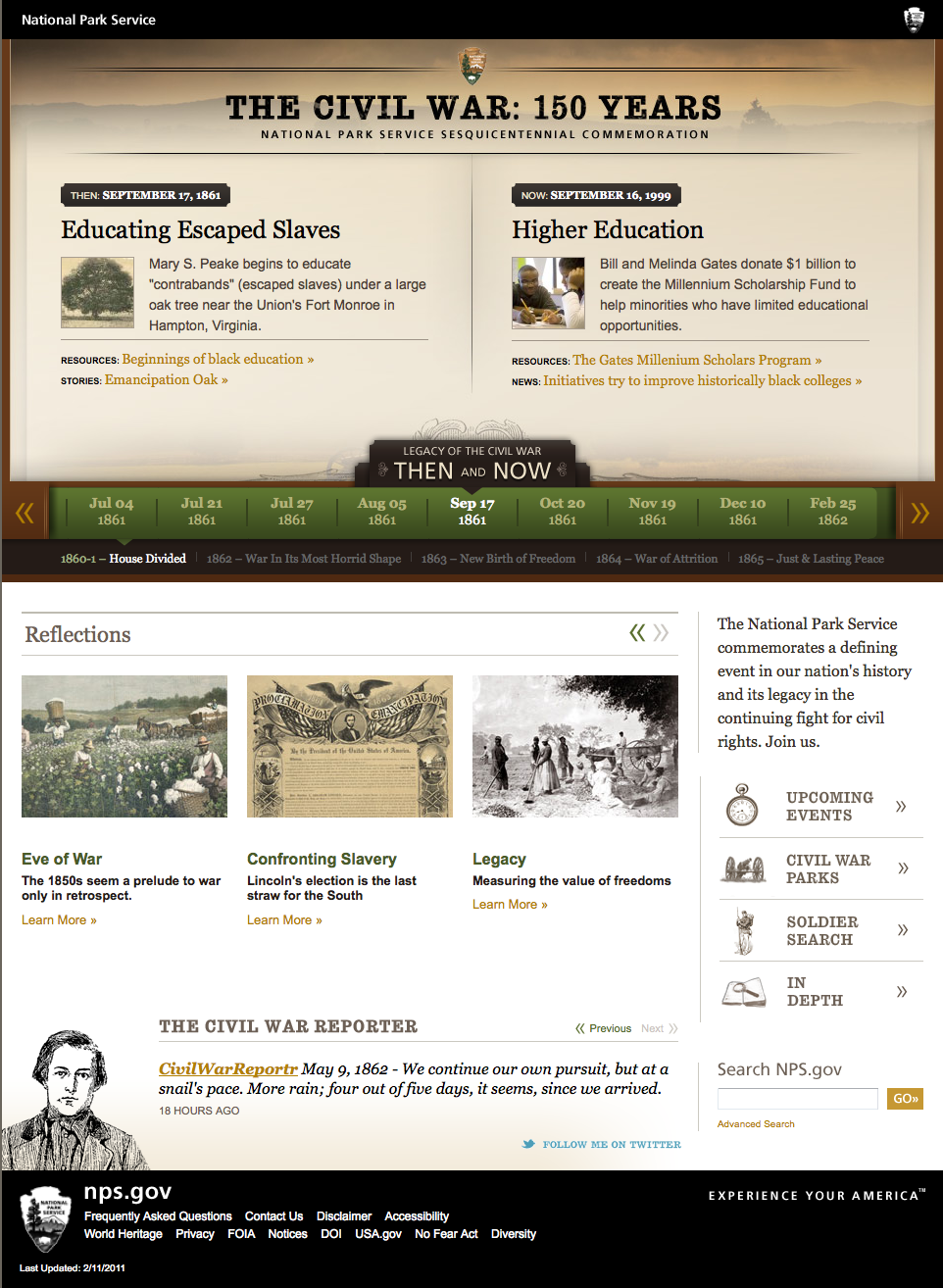
  • NPS’ Civil War: 150 Years features a Then and Now Timeline at the top and a Civil War Reporter sending tweets at the bottom.

    The Civil War: 150 Years has the form and content of websites that will be most familiar to historic sites, except that it commemorates “a defining event in our nation’s history and its legacy in the continuing fight for civil rights” rather than a specific place.  I like their use of Twitter to create a virtual “Civil War Reporter” whose tweets report on events from the 1860s but the major innovation is the featured Then and Now Timeline that compares similar events during the Civil War and today (although I was only able to jump months, not years).  Another way to compare the past and the present is demonstrated by Slavery Footprint, a website and mobile app that was launched on the 149th anniversary of the announcement of the Emancipation Proclamation.  It’s designed to raise awareness of modern-day slavery and can tell you approximately how many slaves have pitched in to make the goods you enjoy on a daily basis.

  • Timelines appeared in several other forms in the winning entries and along with the Then and Now version is Continue reading

WebWise 2012: Using Volunteers Online

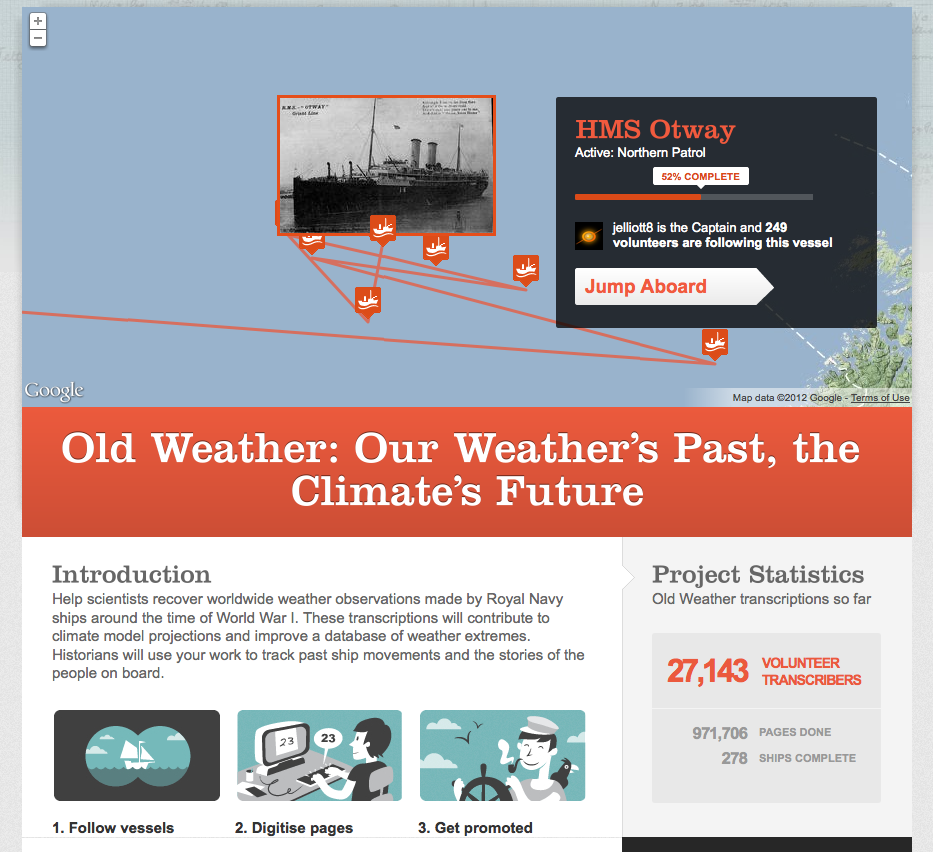
Much of the work at historic sites and history museums wouldn’t be possible without volunteers (and we just passed National Volunteer Week) but very few organizations have recruited volunteers for work online.  Is it possible? What would they do? A session at WebWise 2012 explored these ideas in a panel called, “Sharing Public History Work: Crowdsourcing Data and Sources.”

OldWeather.org, a project of the Citizen Science Alliance

Ben Brumfield of FromThePage Open-Source Transcription Software shared his experiences from small crowdsourcing projects.  He noted that many organizations often object to public participation in scholarly projects because they don’t have the skills or expertise, but he’s found that those people participating are self-selecting and highly focused.  Participation is not equally distributed but mostly done by a small number of people, thus it’s not really crowdsourcing but nerdsourcing.  He provided some examples of “well informed enthusiasts” conducting exemplary work, such as Continue reading

WebWise 2012: Learning and Participation on the Move

WebWise 2012 in Baltimore.

It’s been a couple weeks since the WebWise conference in Baltimore, but the information hasn’t gone stale yet.  It’s still cutting edge and thought-provoking because most of the projects discussed are still underdevelopment and it’s unclear if they’ll succeed or not.  However, they do provide a glimpse of current and potentially future practices in the use of technology for historic sites. The webcast videos are now available except for LeVar Burton’s presentation, which is waiting for broadcast permission. Heritage Preservation will be using portions of the webcasts to create webinars that will be available later this summer including, “Crowdsourcing in Public History” and “Oral History in the Digital Age.”

The first panel session, History Places and Spaces:  Learning and Participation on the Move, was moderated by Nancy Proctor and looked at the ways that mobile technologies (that is, technologies that are aware of your location) can provide new and better experiences for visitors.

Rob Stein at the Indianapolis Museum of Art opened the session by stating that the field already recognizes that location should be a required element in basic content but the challenge is the proliferation of software and hardware platforms.  Every digital device (website, cellphone, tablet) seems to be in a unique format and requires special treatment.  To overcome this, Stein suggested we rethink Continue reading

Nonprofit Benchmarks for Online Communications

Email Messaging Benchmark infographic

Online communications–electronic newsletters, Facebook, e-fundraising, Twitter–have become a standard for non-profit organizations but often we’re unsure if they’re effective.  We can track the number of Facebook Fans or times an email has been opened, but those numbers mean little by themselves.  Benchmarking is one way to measure effectiveness and progress, and one of the easiest ways to do this is by comparing your results consistently over time (for example, number of Facebook Fans on December 31, 2012 compared to December 31, 2011).

But to really see how you’re doing, you need to compare yourself to similar organizations.  The American Association of Museums has developed an online benchmarking tool for comparisons across the museum field, however, it doesn’t include e-communications at this time (they’re collecting lots of data in other areas, though, so please participate).  M+R Strategic Services and the Nonprofit Technology Network just released its 2012 eNonprofit Benchmarks Study as an infographic to show the highlights.   These results are based on a study of 44 leading nonprofits in 2011 and among the many benchmarks are:

  • 12-15% of email messages are opened, with a response rate for advocacy around 4% and for fundraising at less than 1%.
  • The average one-time online gift is $62.
  • For every 1,000 email subscribers, nonprofits have an average of 103 Facebook Fans and 29 Twitter Followers.

The full study will be released on April 5 at the Nonprofit Technology Conference (although you can attend in-person free in Washington DC) and will be presented as a webinar on April 18.

WebWise Attracts 400 Museums, Libraries, and Research Orgs

This slideshow requires JavaScript.

This week I was fortunate to spend two days in Baltimore with 400 persons representing museums, libraries, archives, and research organizations from 40 states at WebWise, the annual conference hosted by the Institute of Museum and Library Services.  This is always one of my favorite conferences and despite a rapid sell-out, I was able to snag a seat.

There seems to be a growing number of history museums and historic sites attending WebWise, and perhaps that’s due to increased recognition that digital technologies are no longer a fad but an essential part of a successful organization (indeed, one of the presenters remarked that staff with technology in their titles are rising up to senior levels with more frequency).  Among the history organizations represented this year are the American Continue reading

HBR: What Virals Ads can Tell Us About Engaging Visitors

Evian's Roller Babies commercial demonstrates what makes an ad go viral.

The March 2012 issue of the Harvard Business Review focuses on U. S. business competitiveness in the world and won’t interest most readers of EngagingPlaces.net, however, there are a few smaller stories scattered around that are relevant.  Thales Texiera’s article on “The New Science of Viral Ads” lays out five techniques that encourage people to watch and share their commercials (in other words, “go viral”) and I’ve modified three of them to address the needs of visitors at historic sites:

  • Play down the logo, play up the brand.  If your logo is too dominant or intrusive, visitors will be turned off by this obvious attempt to manipulate them.  A few places are fine and expected (e.g. letterhead, entrance sign, mugs in the store) but I’ve visited sites where a logo is on every sign, including the one pointing to the bathroom.  It may make your board happy, but it’ll turn off your visitors.  Instead, unobtrusively weave your brand (not logo) throughout the visitor experience.  Texiera uses Coca-Cola’s “Happiness Factory” ad as an example (how was the Coca-Cola logo used?).
  • Create joy and surprise right away.  Visitors stay engaged in large part if they encounter joy or surprise.  So in tours, for example, add an element of joy or surprise into the introduction rather than saving it only for the conclusion.  Each site will need to figure this out for themselves, but it can be a surprising fact or an earnest welcome. Bud Light’s “Swear Jar” ad is an example of delivering humor and surprise to maintain viewers’ interest (and just a warning, this ad may offend some people and because it promotes the drinking of alcohol, you’ll need to register as an adult on YouTube to view it).
  • Build an emotional roller coaster.  Just as in a good novel, the rhythm or flow helps carry the visitor along and keeps them engaged with fresh twists and turns.  Tours too often are presented as just one fact/object/room after another.  Instead of building a tour solely on cognitive elements (e.g. facts, names, and dates), integrate some affective ones (e.g., humor, surprise, suspense, drama, fun)–just make sure it’s appropriate, authentic, and based on fact.  Evian’s “Roller Babies” cuts between scenes for an emotional roller coaster of continual surprises.  With more than 50 million views on YouTube, it’s a major hit.

For more, read Thales Texiera’s article on “The New Science of Viral Ads” online or watch the five-minute interview that accompanies the story.

What the Latest Trends in Mobile Tech Mean for Historic Sites

comScore, Inc., a leader in measuring the digital world, recently released its 2012 Mobile Future in Focus report. This annual report examines the use of mobile devices (e.g., smartphones, tablets) in 2011 in the United States, Canada, and overseas (France, Germany, Italy, Spain, United Kingdom, Japan).  According to Mark Donovan, comScore Senior Vice President of Mobile:

2011 proved to be a groundbreaking year for the mobile industry, with smartphones hitting the mainstream, tablets emerging as a formidable fourth screen, and consumers increasingly integrating mobile behaviors into their lifestyles. As the industry continues to innovate and more consumers look to multiple devices and platforms to consume digital media, we expect the mobile and connected device landscape to be shaken up even further in 2012.  As mobile channels present a more personal, social, and ubiquitous experience to consumers, advertisers and publishers have an opportunity to better engage target audiences, given an understanding of how to connect and leverage the unique characteristics of these emerging platforms.

For history organizations and historic sites, some of the findings you’ll find most applicable are:

  • Smartphones Gain Adoption Among ‘Early Majority’, Driving Mobile Media Consumption.  “Nearly 42 percent of all U.S. mobile subscribers now use smartphones, along with 44.0 percent of mobile users across the EU5 (comprised of France, Germany, Italy, Spain, and the UK). Mobile media use – defined as browsing the mobile web, accessing applications, or downloading content – saw increased growth as a result, surpassing the 50-percent threshold in many markets, supported by the proliferation of high-speed networks and increased public WiFi availability.”  Nearly half of cell phone users have internet access, so ensure your website is maintained and up-to-date because increasing numbers of people will be using the smartphones to make decisions as they travel.  What we don’t know is how popular smartphones are among visitors to historic sites and history museums–that may be something to explore at your site (just ask!).
  • Mobile Retail Information Leads to Emergence of Smartphone Shopping Behaviors.  “More than half of the U.S. smartphone population used their phone to perform retail research while inside a store in 2011, illustrating the emergence of savvy smartphone shoppers who bring online shopping behaviors in-store – a trend seen in other markets as well. At the end of 2011, nearly 1 in 5 smartphone users scanned product barcodes and nearly 1 in 8 compared prices on their phone while in a store.”  You may discover that visitors are looking at their phones when they are in your store.  They could be evaluating your products, comparing prices, or making a purchase (“this is a great book, let me order it on Amazon.com so I don’t have to carry it with me now”).  Your little museum store has just become part of the global marketplace so you’ll need to increasingly think about what’s distinctive, unique, or better than your competitors around the world and may have to change your inventory in response.   And I bet that visitors will be doing the same comparison soon as they choose among the many things to do in your community (“hmm, should we go to an historic site, a winery, or downtown?  Let’s see what Yelp recommends.”).
  • Mobile Devices Fuel Social Networking On-The-Go, Driving Real-Time Online Interaction.  “64.2 million U.S. smartphone users and 48.4 million EU5 smartphone users accessed social networking sites or blogs on their mobile devices at least once in December 2011, with more than half of these mobile social networking users accessing social media almost every day. While mobile social networking users showed the highest propensity to read posts from people they knew personally, more than half of those in the U.S. and nearly half in the EU5 also reported reading posts from brands, organizations, and events.”  With so many people using social media such as Facebook, Google+, Flickr, Yelp, and Foursquare, remind them to share their experiences of your site (at the end of the tour, remind visitors to share their visit on Facebook and Yelp).  You’ll slowly build a reputation.  And if you haven’t already, be sure to create and maintain a page in Facebook, Google+, Flickr, Yelp, or Foursquare.
  • Mobile Connectivity and Connected Devices Encourage Cross-Platform Digital Media Consumption among ‘Digital Omnivores’.  “Tablets quickly rose in popularity in 2011, taking less than two years to account for nearly 40 million tablets in use among U.S. mobile users and outpacing smartphones which took 7 years to reach the same. By the end of 2011, nearly 15 percent of U.S. mobile users also had tablets – a trend seen across other markets as well.”  Tablets are quickly becoming a common technology along with smartphones and laptop computers.  That won’t affect historic sites very much as long as you keep your website and apps up to date (see below), but it may open up a new opportunity for producing unique digital guides or visitor experiences through Kindle or iBooks.  Apps, e-books, or websites designed for tablets may soon replace or supplement portable DVDs, podcasts, and audioguides.

Thinking about developing an app?

  • Smartphone Platform Wars Intensify As Android and Apple Take the Lead in Most Markets.  “The Google Android and Apple iOS smartphone platforms emerged as the leaders of the U.S. smartphone market in 2011, with Android just a few points shy of capturing half of the smartphone market and iOS accounting for nearly 30 percent of the market. In the EU5, Android saw similarly significant gains, unseating market leader Symbian in 3 out of the 5 European markets measured.”  If you are developing an app, sorry, you’ll still need to develop it for both Android and Apple iOS.
  • Surge in Mobile App Usage Shapes a Dual Mobile Browsing Experience, Fueling Category Growth.  “In 2011, both the U.S. and EU5 saw the growth in mobile app use exceed the growth in mobile browser use, leading to both markets seeing the same percentage of their mobile audience use both apps and browsers to access mobile media. Health ranked as the fastest-growing mobile media category in the U.S. in 2011, followed by Retail and other commerce-related categories such as Electronic Payments and Auction Sites.”  The use of apps has grown this past year and it looks like it’s caught up to mobile browser use–smartphone owners are using apps and internet browsers at the same rate  (if these distinctions are confusing, check out the explanation at the New Media Campaigns blog).  And if you aren’t thinking about online sales and payments, start now or risk losing revenue (check out PayPal and Google Checkout and see if they still have special rates for non-profits).

For more details, download a free copy of 2012 Mobile Future in Focus report.

Attending WebWise in Baltimore?

Max van Balgooy

I’ll be attending WebWise in Baltimore next week and posting a series of blogs about the presentations in the weeks to follow.  These sessions are typically packed with ideas and projects, offering cutting-edge approaches and solutions for the work at historic sites and history organizations (and other museums).  If you’re attending, I’d love to meet you and hear about what you’re doing.  Living part of my life in the blogosphere, I have unusual relationships:  people will know me through my blog but I often have no idea who they are, so please introduce yourself and let’s talk during a break (IMLS always keeps the troops at WebWise well stocked with coffee, tea, and snacks!).  In case you don’t know what I look like, I’ve included my picture for identification and I usually sit off to the side so I can get up to take photos of the sessions without disturbing others.