
Tom Carroll explores “places that might change people’s perceptions of Los Angeles” in a series of thirteen short hip videos and demonstrate what is possible to create with just a handful of people. Carroll studied art at Occidental College and led tours at the Los Angeles State Historic Park and at the Los Angeles County Museum of Art. In creating these videos, he uses, “a lot of what I learned as a tour guide, speaking loudly and slowly, knowing when you are losing your audience.” Could you create a short video exploring an historic place in your community?
Category Archives: Social media
Amazon.com May Help Your Fundraising Efforts

AmazonSmile customer start-up page.
This holiday season, Amazon.com is mixing business with charity in its newest project, AmazonSmile. By shopping at smile.amazon.com instead of plain old amazon.com, 0.5 percent of the value of their purchases will be donated to the customer’s preferred charity (i.e., a $100 purchase becomes a 50 cent donation). When first visiting AmazonSmile, customers are prompted to select a charitable organization from almost one million eligible organizations. What’s even more amazing is that there seems to be no limit to the amount Amazon will give to charity, although as of now auto-renewed subscription purchases and digital products aren’t included. Donations will be made by the AmazonSmile Foundation, so customers using AmazonSmile will not be able to claim donations as charitable deductions.
Charitable organizations can register for free to receive donations at Continue reading
Video: A Virtual Summer Camp using Google+
Invention meets social media in a summer camp format. In 2012, MAKE held a Maker Camp on Google+, introducing an online summer camp inspired by the creative and diverse maker culture. It was a six-week program featuring 30 days of projects and activities for teens 13-18. Every day a different counselor posted how-to instructions and hosted a Hangout, giving campers a chance to ask questions and show off their projects. It was free and open to everyone with a Google+ profile.
How can new technologies transform or expand your programs? Can Google+ or Hangout help you work with colleagues to complete projects? Check out what the Henry Ford Museum is doing with Maker Faire Detroit. Can your summer camps incorporate some ideas from Maker Faire®?
Rethinking the “Do Not Touch” Sign


Museums and historic sites are well known for their “do not touch” signs. The UK National Trust worked with The Click Design Consultants to change the rules to engage visitors. According to The Click,
The campaign, titled ‘Nature’s Playground’, is designed to entice visitors to explore, enjoy, savour and touch. A series of nine signs were created which, at first glance, look like warnings or instructions not to do something, whereas actually they encourage the opposite.
The physical signs were packaged up and sent out to National Trust properties across the east of England. The properties were then briefed to install the signs in appropriate locations within their grounds and / or estate. The inclusion of a hashtag (#NaturesPlayground), encourages visitors to Continue reading
AAM Annual Meeting: Report to the Field
Last week’s annual meeting of the American Alliance of Museums was held just 30 miles from my house but I wasn’t able to attend due to other commitments. I missed seeing so many of my friends! Fortunately, Terri Anderson, a colleague working at the Corcoran Gallery of Art, shared her experiences:

Terri Anderson
I had a great time attending the American Alliance of Museums annual conference this week, held in Baltimore, Maryland. AAM put on an excellent conference, full of interesting sessions. To be completely honest, I haven’t said that about an AAM conference in a while. I was pleasantly surprised by how interesting and informative each session was. Also a first for me was being completely blocked from a session. “How We Did It: The Move of the Barnes Collection” was so full, the AAM volunteer had to close the doors and wouldn’t let in any more people even to stand in the back. All the sessions I attended (in the collections management track) were full or over-full—I hope AAM can get arrange for bigger rooms for its collections sessions next time.
A great feature of this year’s conference is that Continue reading
Highlights from the Virginia Association of Museums conference
Last week the Virginia Association of Museums (VAM) held its annual conference at the Homestead Resort in Hot Springs, Virginia, and I was fortunate to be asked to speak at their historic house forum. It was my first time at their conference and I was so impressed by the quality of the sessions and the camaraderie of the participants. I wasn’t able to stop by every session, but I wanted to provide some highlights from a few I did attend.
The Nexus of Art and Science. Rebecca Kamen, professor of art at Northern Virginia Community College, talked about the ability of art to interpret historic scientific and medical collections found in museums and libraries. Rachel Carson’s The Sense of Wonder (1965) prompted her to work with such diverse institutions as the American Philosophical Society, Chemistry Museum, and the National Institutes of Health. A recent work, “Divining Nature: An Elemental Garden,” explores the orbital rotations of elements in the periodic table through sculptures. I’ve seen lots of examples of science being explained in new ways, but I’ve only encountered a few glimpses of it being done with history–anyone have any suggestions?
Using Social Media to Conduct Historical Research. Lynn Rainville, a professor at Sweet Briar College, discussed how she used Facebook, Tumblr, and other social media to study Continue reading
WebWise Conference Coming Up in Early March

WebWise 2012: Project demonstrations
WebWise, the annual conference hosted by the Institute of Museum and Library Services, will be held in Baltimore on March 6-8, 2013. This year’s conference is co-sponsored by the Roy Rosensweig Center for History and the New Media and is being organized and presented in a very different manner. In advance, participants (anyone, actually) voted on the proposed workshop topics and then the conference organizers recruit speakers to fill the slots. For the project demonstrations, the participants will be divided into three groups and then rotate through three different sets of presentations. In addition, there will be a series of three-minute lightning talks over lunch, facilitated project/partnership incubator groups, and one-on-one speed consulting sessions. Indeed, there’s only one plenary session scheduled for the entire conference–Audrey Watters of Hack Education–as a keynote on the last day.
I’ve attended as many WebWise Conferences as possible because the content has been outstanding and I often come away with new approaches and strategies, even from the sessions that are far outside my field. This year’s reformatting seems intriguing, but much of the content remains a mystery so Continue reading
Predictions for Education Technology in 2013
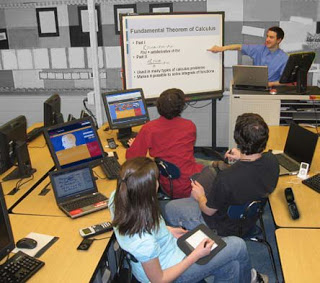
Image courtesy of HamiltonRentals.Wordpress.com.
T.H.E. Journal brought together five technology experts who work in schools to predict the future of technology in the classroom–and may help you decide where the opportunities lie for your museum or historic site as you work with students and teachers. Here’s a quick summary, and if you want more details, check out the entire article in the December 2012 issue.
- HOT: Common Core Online Assessments. “As more and more curriculum departments align their learning resources to the Common Core, the next step will be to create the systems for implementation, including content management and new methods of assessment. Mobile devices will play a role in Common Core assessments.” [Every history organization that works with schools should notice that this issue not only suggests following and understanding the Common Core but that schools continue to have inconsistent and unreliable computer technology, so providing information only online may hinder students and teachers, rather than help.]
- HOT: iPads. LUKEWARM: Tablet Computers other than iPads. “iPads will continue to Continue reading
History News looks at Historical Interpretation
History News, Autumn 2012
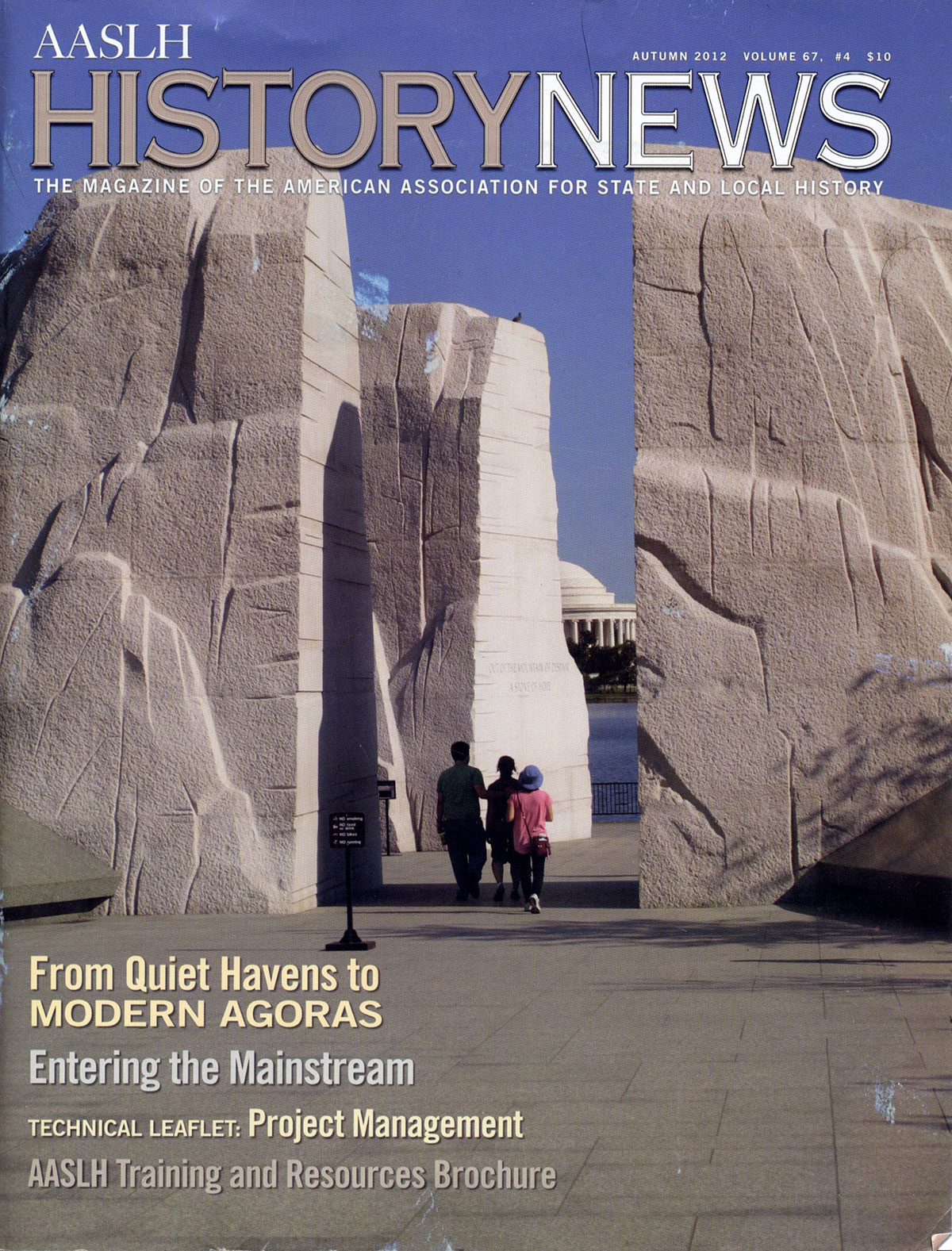
The autumn 2012 issue of History News arrived in my mailbox a couple weeks ago and its four feature articles on interpretation that will be of interest to historic sites:
- “From Quiet Havens to Modern Agoras: Libraries and Museums in an Era of Participatory Culture” by Nancy Rogers, Susanna Seidl-Fox, and Deborah Mack is a report, including the key overarching messages, from an international seminar held in Salzburg, Austria in October 2011.
- “‘No More Wiggle-Tail Water’: Interpreting the History of Morgantown’s Water Supply at the West Virginia Botanic Garden” by Barbara Howe is a case study on integrating history in a place that focuses on horticulture and nature.
- “When Histories Horrify: Supporting Visitors’ Responses through Responsible Interpretation” by Linda Norris, Danny Cohen, and Stacey Mann is a continuation of a session at the American Alliance of Museum’s annual meeting on the roles and responsibilities of museums in preserving and mediating horrific histories of crimes, violence, terrorism, and oppression, with references to the Kilmainham Gaol, Majdanek, Robben Island, and the Greensboro Woolworth.
- “Entering the Mainstream: Interpreting GLBT History” by Ken Turino and Susan Ferentinos addresses four common challenges (institutional policies on discussing sex, lack of documentary evidence, applying modern labels to historical figures, pressure to avoid controversial topics) using examples from Pendarvis, Walt Whitman House, Beauport, Sarah Orne Jewett House, Alice Austen House, and Charles Gibson House.
Also included are Continue reading
An Interactive Holiday Calendar for Historic Sites
Make Your Holidays Historic at The History List.
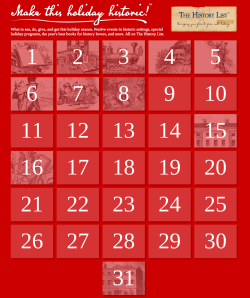
Lee Wright at The History List has developed a clever interactive calendar for the holidays which highlights events at historic sites around the country with changing images and sounds wrapped in an attractive bright red package. It’s fun to play with it to find what’s hidden underneath each date and the best part is that any historic site or history organization can participate. So far, it includes a Victorian Christmas at the Ramsey House, a whiskey tasting at Jefferd’s Tavern, and a holiday masquerade at Tryon Palace. If you’d like to include your event, Lee provides instructions for participating via History List or Facebook.
December’s calendar is part of The History List’s, “Make this Holiday Historic” campaign, however, you can include events from the rest of the year as well. The History List is Lee Wright’s effort to create a one-stop place for history lovers to find places and events happening near them, whether at home or on the road, as well as provide a convenient, easy-to-use online calendar for Continue reading

