Category Archives: Social media

The Many Flavors of Touring Historic Places

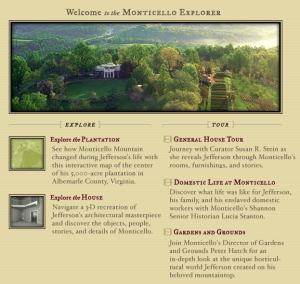
Monticello Explorer provides several virtual tours.

Monticello Explorer provides several virtual tours.

Although guided tours of period rooms is the most common form of interpretation at historic sites, audio tours, video tours, and virtual tours are growing in popularity thanks to technologies that are lowering the cost of production and increasing access to new audiences.  From a short list of examples, the students in my “historic site interpretation” class at George Washington University developed a list of ten best practices for different types of tours of historic sites.  You’ll discover that many of their suggestions emphasize the need for a plan, themes, and a focus–and projects that failed to have these elements were weaker and less effective.

A.  Guided Tours of Period Rooms

Reviewed by Johanna Bakmas, Melissa Dagenais, Emma Dailey
 

Suggested Best Practices

Do
  1. Develop an interpretive plan and themes
  2. Consult primary sources for the property
  3. Decide whether to have reproduction or original pieces Continue reading

Report from the 2012 AAAM Conference in Baltimore

This slideshow requires JavaScript.

Last week I attended the Association of African American Museums conference along with two hundred other people from across the country.  I’d never attended before but since it was close by in Baltimore, I decided to take a chance and it turned out to both educational and fun.  Although I only attended one day, I’d like to share some of the highlights from the sessions I observed.

In “Understanding Exhibition Design and Planning“, the panelists all stressed the importance of pre-design, which includes determining which spaces will be devoted to exhibits, visiting other exhibits to clarify what you like (and don’t like), conducting visitor research, identifying potential artifacts and images, roughing out a budget and schedule (is the exhibit feasible?), and determining the maintenance costs.  The Harpers Ferry Center of NPS offers an exhibit planning template for FileMaker Pro.  The panel also provided a rough estimates of exhibition costs for design and fabrication:

  • $150-250/sf: 2D items, graphics, pedestals for 3D objects, little to no media.
  • $250-350/sf: 3D object displays, more extensive use of graphics, some media elements
  • $350-500+/sf: custom cases, media, electromechanical interactives, theatrical lighting/projectors.

They stress that costs could be lower, but it will then rely heavily on reusing ideas or elements from earlier exhibits or projects.  The panelists also believed that better designs are the result of longer development schedules, not more money.  More time allows for more iterations of designs to refine ideas.  Finally, for new buildings, they suggest that exhibit designers be brought in early to the process because they help program the space because they tend to “design from the inside out”–but that will require that the architect is willing to collaborate.  For a copy of the PowerPoint presentation, contact Chris Danemeyer at Proun Design.

Claudine Brown, the Assistant Secretary for Education and Access at the Smithsonian Institution, was the luncheon speaker.  She laid out the new interpretive direction for the Smithsonian and why they matter to museums, especially those that focus on African American history and culture.  The challenges facing the Smithsonian is that they need to preserve the evidence of the past, be relevant in the present, and be prepared for the future [and these are ideas all museums and historic sites can follow].  The three big topics the Smithsonian will be interpreting are:

  • Americans All: a shared experience as immigrants, everyone came from somewhere else, but all share a common country.
  • Waterways:  Water is a serious problem and its estimated that 2/3rds of the world will suffer water shortages by 2025.
  • Creativity and Innovation:  With our current high unemployment rates, museums can be part of the solution by providing learning opportunities that simulate real life and helping the next generation learn how to organize, strategize, and act.

The session on developing mobile applications was led by the Digital Humanities Center at Michigan State University, which maintains an online clearinghouse of mobile museum applications.  The session provided some estimated costs for producing various applications, as follows:

  • $0-?: mobile-ready website (creating a website that can be easily viewed on a smartphone; most common solution)
  • $5,000-$60,000:  native application (self-contained program that’s downloaded and works without an internet connection)

The session stressed that mobile applications rarely generate revenue–the average return on investment is $688 and takes 51 years–so look for other benefits to the institution.  It may be possible to generate revenues from after-market sales, such as an app that promotes a book, photoprints, music, and attendance at an event.  When I asked about the effectiveness of applications, the person sitting next to me suggested I look at #SocialMedia Daily, a blog that aggregates news about social media and apps.

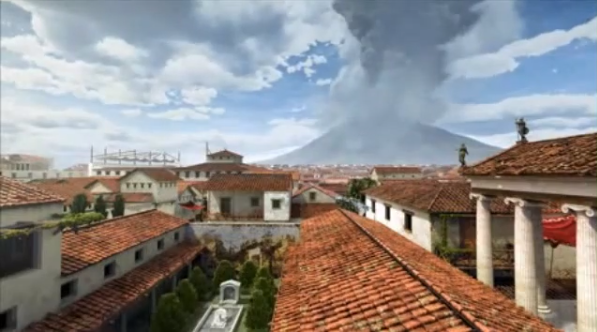
Remembering the 1,933rd Anniversary of the Eruption of Mt. Vesuvius

Animation still from “A Day in Pompeii,” You Tube video at http://youtu.be/w82yVDOMIa0

This may seem far-afield from the interests of most historic sites, but 1,933 years ago today, Mount Vesuvius erupted and buried the city of Pompeii (resulting in one of the world’s most popular historic sites about 1,700 years later).  The Denver Museum of Nature and Science is marking the anniversary by tweeting the last day of Pompeii as it happened, starting at 10 a.m. today by @Elder_Pliny (formerly known as Pliny the Elder, who witnessed the events) in preparation for an exhibit on Pompeii opening on September 14.  So far, he has more than 3,000 followers and he just tweeted that he’s preparing his boat to get a closer look (should I warn him?).  Along with the tweets, the Museum has created a mashup with Google maps to follow Pliny around Pompeii, is hosting “Bacchus Raucous” (a fundraising gala dressed in a Roman toga) and is featuring a lecture on Ceren, a Mayan village that was also encased by a volcanic eruption centuries ago.

Thanks to Sandra Smith at the Heinz History Center sharing this clever approach in interpretation.

Google Expands its Access to Museums (but not yet Historic Sites)

Floor plan of the American Museum of National History displayed as a Google Map on a smartphone.

Google Maps recently expanded its capabilities of mapping indoor places (mostly  airports and shopping malls) by including two dozen museums in the United States (such as the Philadelphia Museum of Art, Indianapolis Museum, and the Smithsonia–the many museums that make up the Smithsonian Institution) and England (such as the British Museum, Victoria and Albert Museum, and the National Portrait Gallery).  Currently, this feature is only available on Android smartphones or tablets (that may seem limiting but nearly 2 million people have downloaded this app).  More museum maps are in the works but it doesn’t look like any historic sites are participating.  Consider how useful it would be to visitors at such places as Colonial Williamsburg, Gettysburg Battlefield, Sturbridge Village, the Huntington, and James Madison’s Montpelier.  If you’re interested in adding your site details to Google Maps, you can upload floor plans yourself or get help from Google.

In a similar vein, Google Street View just added 360-degree panoramic views of Yosemite and four other national parks in California.  And of course, these are nice complements to the Google Art Project.  It looks like Google is taking a much greater interest in museums along several paths, but historic sites currently seem to be left out of the mix.  I don’t think that’s intentional. I just think it’s a common oversight because most people don’t associate museums with historic sites.  Perhaps I’ll give them a call.

Thanks to John Durel for alerting me to this news item!

Amelia Wong Joins Museum Studies Faculty at GWU

Amelia Wong, currently the US Holocaust Memorial Museum’s senior social media strategist, will be joining the fulltime faculty of the Museum Studies Program at George Washington University this fall as an assistant professor. Amelia holds a BA from UCLA in history and a PhD in American Studies from the University of Maryland, College Park. Amelia’s scholarship focuses on how museums, especially those concerned with democratization, can engage critically with technology for their goals. Her dissertation, “Museums, Social Media, and the Fog of Community,” reflects her research interests and
is the first book-length project about social media in American museums.

At the Holocaust Museum, the Twitter community has grown from 2000 to over 100,000 people under her direction. Amelia also developed and produced an ongoing Web series, “Curators’ Corner,” which gives the public, donors and others an inside look at the
museum’s collections via short multimedia presentations narrated by museum staff. During her first year at the museum, Amelia proposed, Continue reading

Changes at Google+ Creates Opportunities for Museums and Sites

Okay, everyone knows about Google but Google+ and Google Places is still a mystery for many people.  It may become a bit simpler because the rumor is that Google Places is slowly being replaced by Google+ Local.  Or did that just complicate things?  Let’s start over.

Google search results for “historic sites in philadelphia”

Google has launched new search results that include the usual title, web link, and brief description, but now adds the address, phone number, shows the location on a map, a link to reviews, and a Zagat ranking on a scale of 1 to 30.  In the example to the left, you’ll see the search results for “historic sites in Philadelphia” and that the Eastern State Penitentiary (the third item) received a Zagat rating of 25 (it really is an amazing place) and has 81 Google reviews (wow! their visitors have opinions).  This new form of listing doesn’t occur for every city, just those that seem to have enough places to warrant them (right now, this list appears for Denver but not San Francisco).  Local information is being integrated across Google (including the Zagat ratings, which was acquired by Google last year), so you’ll find Continue reading

2012 Webby Awards Point Out Models for Historic Sites

Historic sites are always looking for good models for online activities, such as websites and mobile applications, and one of the best places to look for inspiration is the annual Webby Awards, the leading international award honoring excellence on the Internet. Established in 1996 during the Web’s infancy, the Webbys are presented by the International Academy of Digital Arts and Sciences.

The 2012 Webby Awards received nearly 10,000 entries from over 60 countries and all 50 states and awards were given in over a hundred categories for website, interactive advertising and media, online film and video, and mobile and apps. As a result, there is a lot to cull through but here are several that seem to be most related to historic sites (and hang on, this is a long list):

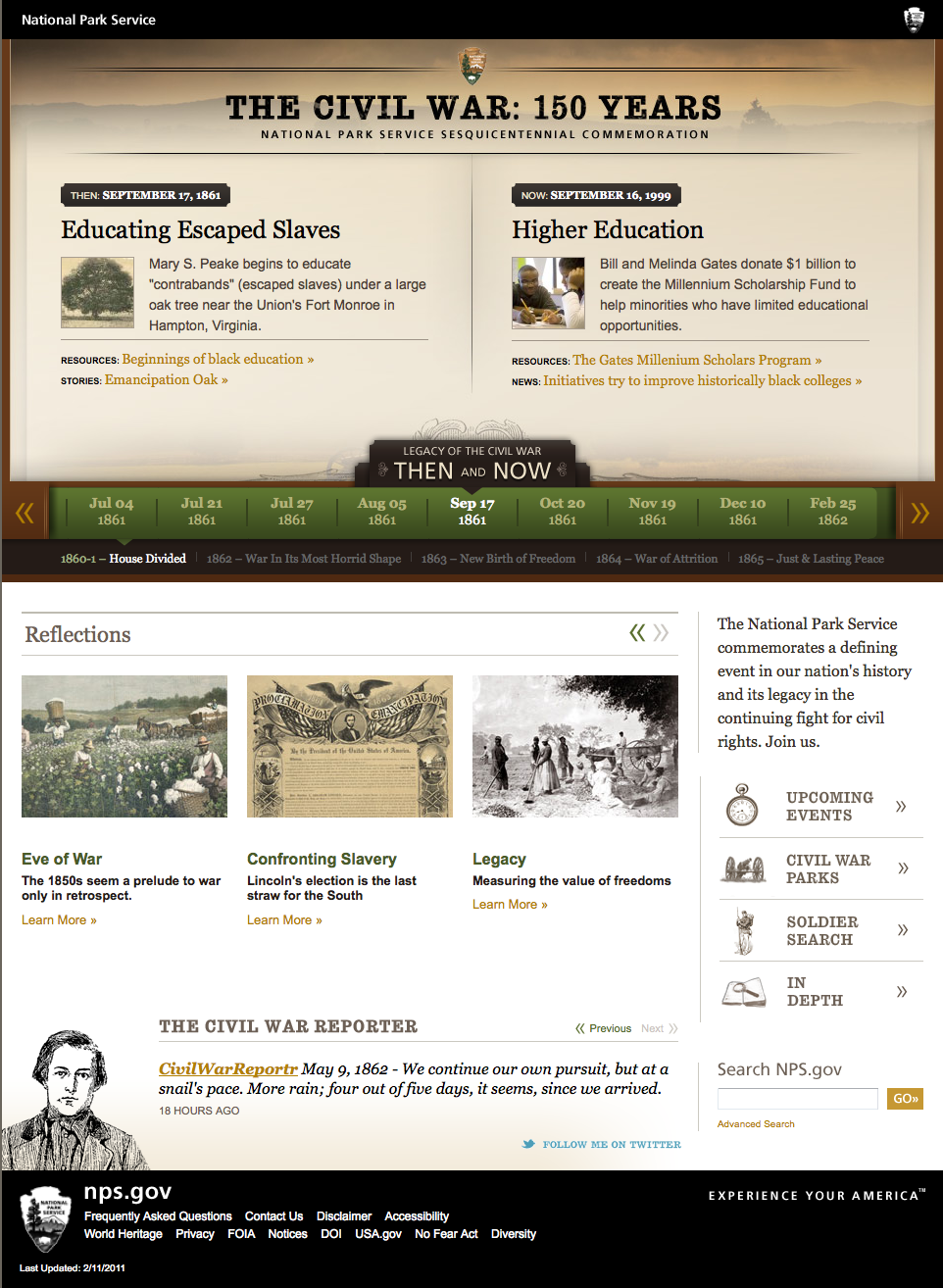
  • NPS’ Civil War: 150 Years features a Then and Now Timeline at the top and a Civil War Reporter sending tweets at the bottom.

    The Civil War: 150 Years has the form and content of websites that will be most familiar to historic sites, except that it commemorates “a defining event in our nation’s history and its legacy in the continuing fight for civil rights” rather than a specific place.  I like their use of Twitter to create a virtual “Civil War Reporter” whose tweets report on events from the 1860s but the major innovation is the featured Then and Now Timeline that compares similar events during the Civil War and today (although I was only able to jump months, not years).  Another way to compare the past and the present is demonstrated by Slavery Footprint, a website and mobile app that was launched on the 149th anniversary of the announcement of the Emancipation Proclamation.  It’s designed to raise awareness of modern-day slavery and can tell you approximately how many slaves have pitched in to make the goods you enjoy on a daily basis.

  • Timelines appeared in several other forms in the winning entries and along with the Then and Now version is Continue reading

WebWise 2012: Using Volunteers Online

Much of the work at historic sites and history museums wouldn’t be possible without volunteers (and we just passed National Volunteer Week) but very few organizations have recruited volunteers for work online.  Is it possible? What would they do? A session at WebWise 2012 explored these ideas in a panel called, “Sharing Public History Work: Crowdsourcing Data and Sources.”

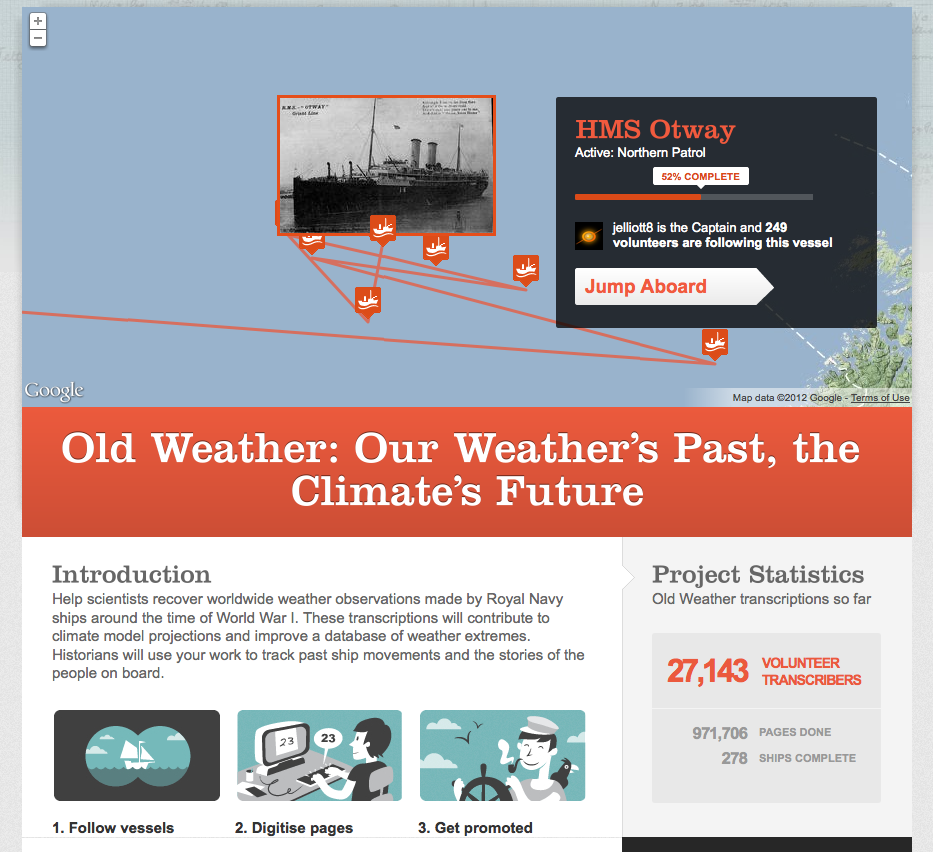
OldWeather.org, a project of the Citizen Science Alliance

Ben Brumfield of FromThePage Open-Source Transcription Software shared his experiences from small crowdsourcing projects.  He noted that many organizations often object to public participation in scholarly projects because they don’t have the skills or expertise, but he’s found that those people participating are self-selecting and highly focused.  Participation is not equally distributed but mostly done by a small number of people, thus it’s not really crowdsourcing but nerdsourcing.  He provided some examples of “well informed enthusiasts” conducting exemplary work, such as Continue reading

WebWise 2012: Learning and Participation on the Move

WebWise 2012 in Baltimore.

It’s been a couple weeks since the WebWise conference in Baltimore, but the information hasn’t gone stale yet.  It’s still cutting edge and thought-provoking because most of the projects discussed are still underdevelopment and it’s unclear if they’ll succeed or not.  However, they do provide a glimpse of current and potentially future practices in the use of technology for historic sites. The webcast videos are now available except for LeVar Burton’s presentation, which is waiting for broadcast permission. Heritage Preservation will be using portions of the webcasts to create webinars that will be available later this summer including, “Crowdsourcing in Public History” and “Oral History in the Digital Age.”

The first panel session, History Places and Spaces:  Learning and Participation on the Move, was moderated by Nancy Proctor and looked at the ways that mobile technologies (that is, technologies that are aware of your location) can provide new and better experiences for visitors.

Rob Stein at the Indianapolis Museum of Art opened the session by stating that the field already recognizes that location should be a required element in basic content but the challenge is the proliferation of software and hardware platforms.  Every digital device (website, cellphone, tablet) seems to be in a unique format and requires special treatment.  To overcome this, Stein suggested we rethink Continue reading

Nonprofit Benchmarks for Online Communications

Email Messaging Benchmark infographic

Online communications–electronic newsletters, Facebook, e-fundraising, Twitter–have become a standard for non-profit organizations but often we’re unsure if they’re effective.  We can track the number of Facebook Fans or times an email has been opened, but those numbers mean little by themselves.  Benchmarking is one way to measure effectiveness and progress, and one of the easiest ways to do this is by comparing your results consistently over time (for example, number of Facebook Fans on December 31, 2012 compared to December 31, 2011).

But to really see how you’re doing, you need to compare yourself to similar organizations.  The American Association of Museums has developed an online benchmarking tool for comparisons across the museum field, however, it doesn’t include e-communications at this time (they’re collecting lots of data in other areas, though, so please participate).  M+R Strategic Services and the Nonprofit Technology Network just released its 2012 eNonprofit Benchmarks Study as an infographic to show the highlights.   These results are based on a study of 44 leading nonprofits in 2011 and among the many benchmarks are:

  • 12-15% of email messages are opened, with a response rate for advocacy around 4% and for fundraising at less than 1%.
  • The average one-time online gift is $62.
  • For every 1,000 email subscribers, nonprofits have an average of 103 Facebook Fans and 29 Twitter Followers.

The full study will be released on April 5 at the Nonprofit Technology Conference (although you can attend in-person free in Washington DC) and will be presented as a webinar on April 18.