Category Archives: Social media

An App That Easily Merges Oral History and Images

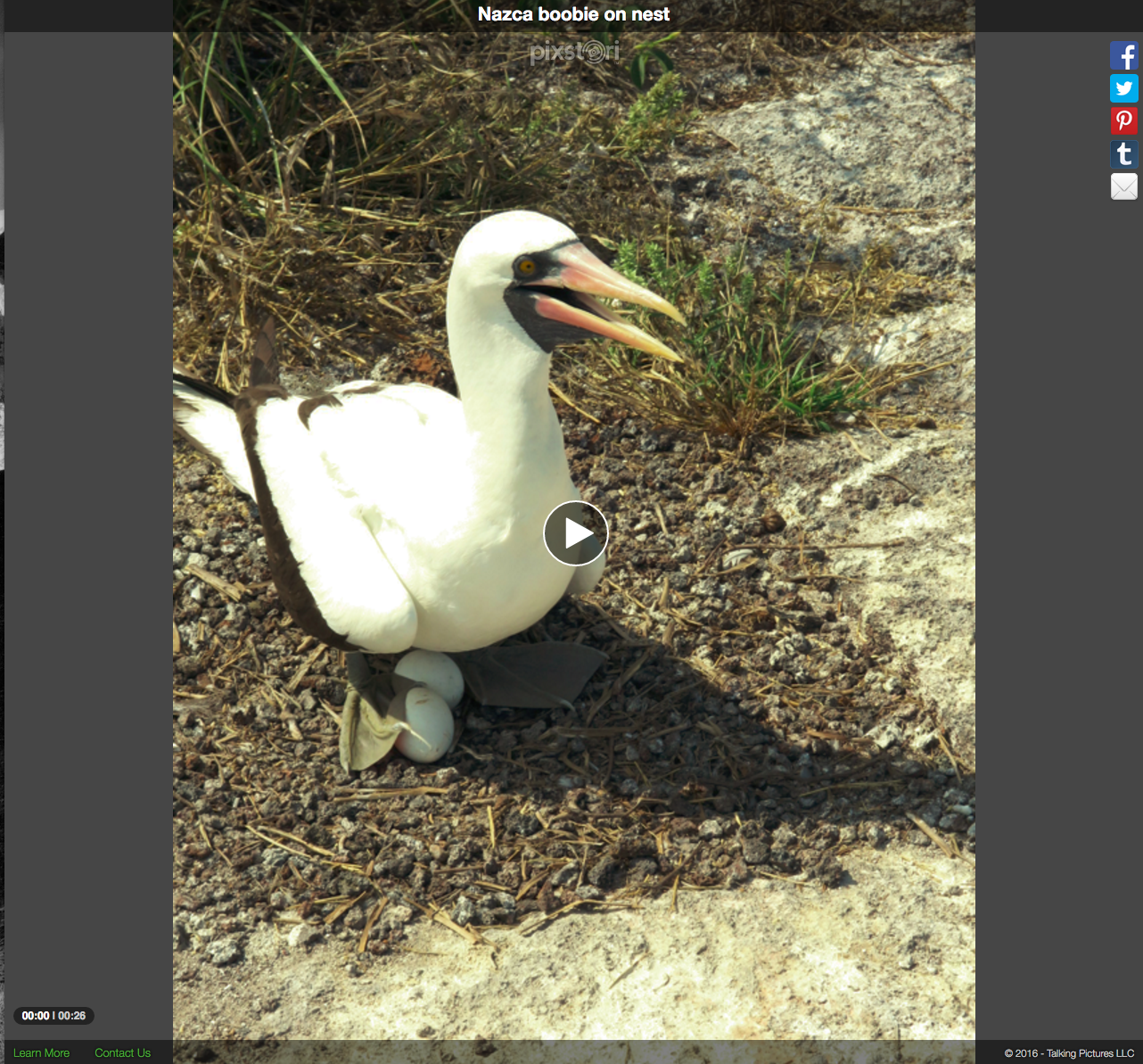
My recording about a bird nest on the Galapagos Islands using PixStori.

My recording about a bird nest on the Galapagos Islands using PixStori.

At the National Council on Public History conference last week in Baltimore, Michael Frisch of the University of Buffalo introduced PixStori, a iOS app that he helped develop that easily shares photographs with audio recordings.  Frisch is a leader among oral history practitioners and he developed the app as a way for people to record short oral histories to accompany photographs.

Users pull up a photo from their iPhone or iPad and then record a short message (up to 20 minutes), which can then be shared via email, Twitter, or Facebook.  I experimented with a photo of a bird and it’s remarkably easy to use.  It’s definitely fun for sharing photos, but I can easily see museums and archives using it to share historic images or documents with a comment by an historian or help promote an upcoming event.  But I can also see how it might be used in-house to record visitor reaction to proposed exhibit or to send a message to your staff about a site emergency. It appears that the recordings are stored at PixStori, so recipients don’t need to have the app installed but do need an internet connection to see and hear the file. The app is available free for iOS devices and an Android version is underway.
Can the Folger Library Figure Out Its Schizophrenic Photo Policy?

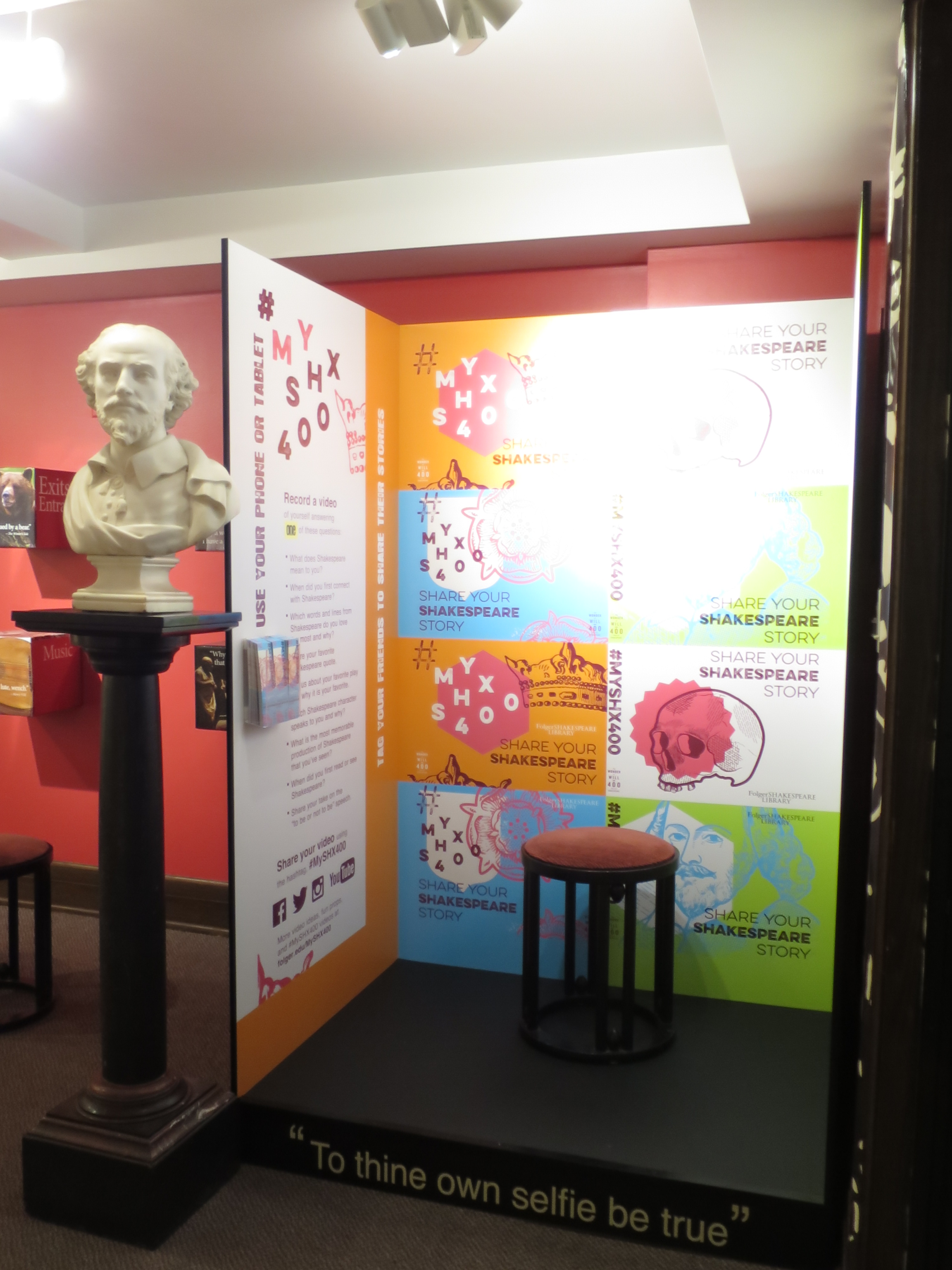
Photo booth at the exhibit that prohibits photography at the Folger Library.

Photo booth at the exhibit that prohibits photography at the Folger Library.

The Folger Library in Washington, DC is one of my favorite places because it’s about books and Elizabethan England, two things that fascinate me.  As an historian, books are not an unusual passion but as an American historian, I’m interested in the Elizabethan period because of the comparisons to our Colonial era.  So every time the Folger mounts an exhibit in their gallery, I go no matter the topic and want to document what I’ve seen and learned through photos (and share them with you!).  And yet, while copyright protects none of the material on exhibit, the guards frequently stop me from taking photos and one time I even had to prove I deleted the images from my camera.  The latest exhibit on Shakespeare was photo-prohibited because it was on loan, but again, none of the materials were protected by copyright (all pre-dated 1700). Ironically, at the entrance to the exhibit is a special booth where visitors were asked to share videos or photos of themselves talking about Shakespeare on Twitter, Instagram, and Facebook. Huh? To thine own selfie be true, as long as it doesn’t include any actual historic objects on exhibit.

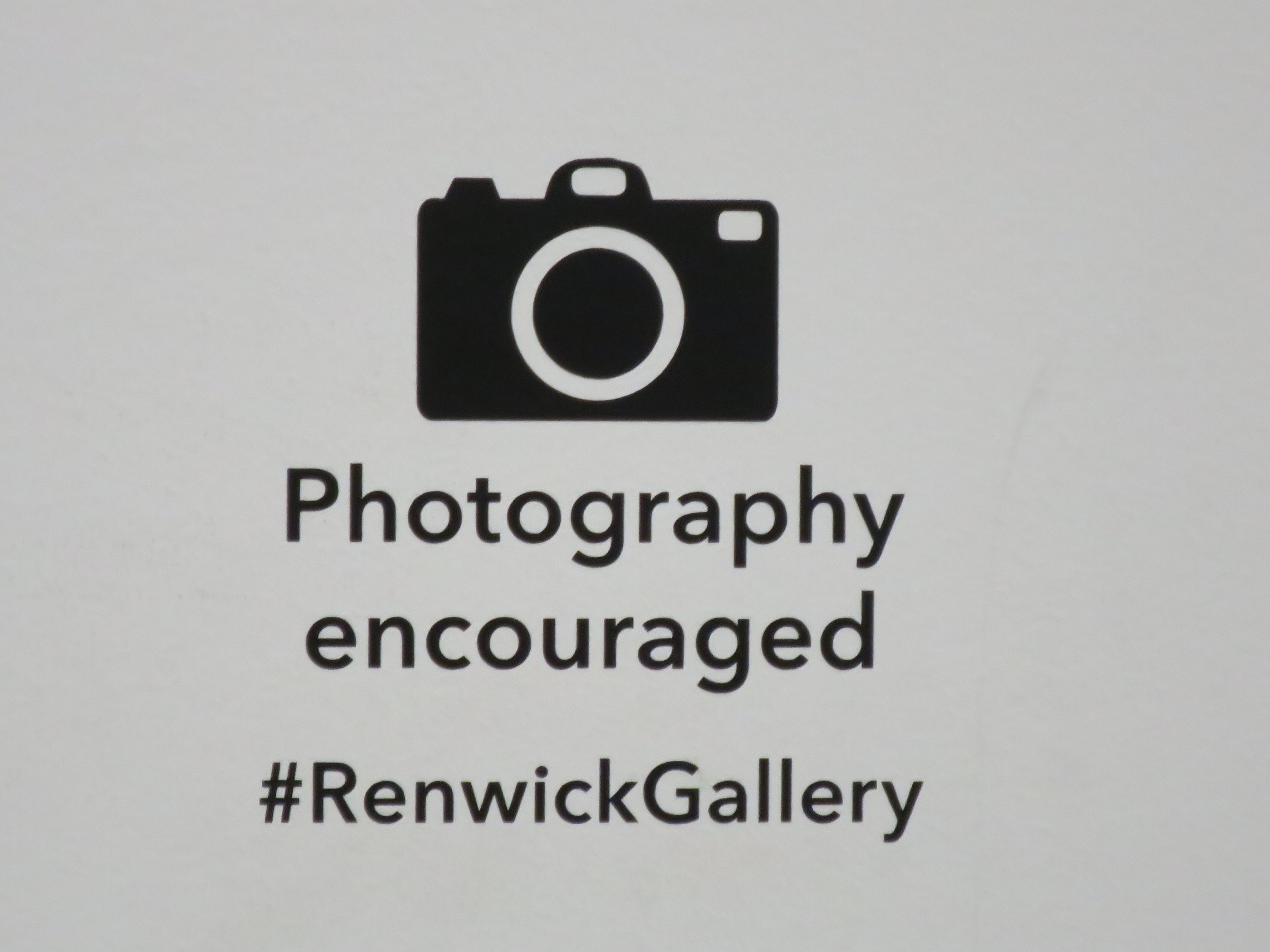
IMG_0499That’s such a contrast to other museums in DC which encourage photography.  The “Wonder” exhibit at the Renwick Gallery of Art in Washington, DC, is filled with contemporary art, which is typically tied up in a particularly rabid form of copyright protection, encourages photography with signs mounted in nearly every gallery. Somehow they’ve figured out how to allow photography by the public without jeopardizing their collections, reputation, or loan agreements.

Museums and libraries have to figure out how to embrace photography.*  While overall attendance has dropped for the past thirty years, interest in photography has grown by leaps in bounds.**  Indeed, it’s the only cultural or artistic activity that’s growing in the US and by prohibiting it unconditionally, museums and libraries are only further distancing themselves from the rest of America.

*The Rauschenberg Foundation recently developed a radical but thoughtful photography policy, which is described in the New York Times.

**National Endowment for the Arts, “Survey of Public Participation in the Arts,” 2012.


Unconference in DC Poised to Transform Museums


Openlab is convening an unconference, talks, and a planning workshop in Washington, DC on December 1-2 to “to accelerate the speed and impact of transformational change in the GLAM (gallery, library, archive, and museum) sector” in order to “to increase and disseminate knowledge; to encourage civic dialogue and engagement; and to support individuals in their right to access and participate in culture.”  The brain child of Michael Peter Edson of the Smithsonian, much of OpenLab’s work seems to be focused on using digital technologies to solve age-old questions, such as “what needs to change in galleries, libraries, archives, and museums?” and “what is missing in the current funding and support landscape for GLAMs and the humanities?”  It’s all a bit nebulous and unclear, but that’s the core nature of an unconference. Nevertheless, it’s one of many concurrent efforts to increase the impact of museums in society (and yes, we’re still in the fragmented stage).

The first day on December 1 (today) is the unconference and a series of Ignite talks from 2-7 pm in Arlington, Virginia that’s free and open to the public.  The second day, however, Continue reading

President Lincoln’s Cottage Tackles Immigration

This slideshow requires JavaScript.

President Lincoln’s Cottage, the presidential summer retreat just a few miles north of the US Capitol, recently opened an exhibit in their visitor education center the compares immigration issues in the 19th century to the present day.  Titled, “American by Belief,” the introductory label reads:

The United States of America is, and always has been, a nation of immigrants. Abraham Lincoln recognized immigrants as one of America’s greatest resources and its best hope for the future. He believed America, in return, owed immigrants the full realization of its founding promises and a fair chance to succeed.

Our world is different than Lincoln’s. But what continues to bring immigrants here would look familiar to him: an opportunity to rise higher, improve themselves, live safely under the rule of law, become citizens, and count themselves as American by right of belief.

This is a small temporary exhibit, perhaps 200 square feet at most, and primarily consists of panels featuring text and images (no historic objects).  In the center of the room is a map of the world made of pegs, which visitors can use to link places associated with them using colored rubber bands (this looks cool but I’m not sure Continue reading

What’s the Twack Record for Your Tweets?

Followers Dashboard from Twitter.

Followers Dashboard from Twitter.

The growth of social media has added new layers of complexity to the promotional efforts at museums and historic sites.  Along with mailing newsletters and event announcements and maintaining a website, we feel an increasing need to connect with our supporters through blogs, Twitter, Facebook, and LinkedIn.  But is all this work having any impact? How can I better use these tools to engage my audiences?

You may have noticed that I’ve been experimenting with Twitter this past year, adding a feed to the sidebar of my blog and sending out about three tweets each morning on news related to museums and historic sites using @maxvanbalgooy (@engagingplaces was already taken) and tagging them with #museum or #preservation.  It’s nice to see the number of Followers grow and merit a Favorite or Retweet occasionally (thanks Bob!), but what’s the impact?  You may find some answers in the Followers dashboard that Twitter recently launched.

The dashboard provides several analytical tools that not only highlights Continue reading

SlideShare: Promoting Teen Night Out Using Social Media

In this 17 slide deck, the Lukens Company explains how they promoted Teen Night Out at the Seattle Art Museum using social media.  Since 2007, the museum has held thirteen Teen Night Outs with over 8,000 attendees.   You’ll find that it’s a well-rounded campaign that carefully defined the target audience and used several measures of success.  If you want to reach teenagers, you’ll want to check this out.

At the press: Interpreting African American History and Culture

Cover Interpreting Af Am History smallMy book, Interpreting African American History and Culture at Museums and Historic Sites is now at the press and will be available in December from Rowman and Littlefield.  I’ve been assembling it for the past two years and just completed the index, so now it’s firmly in the hands of the publisher.  This book is part of a new “interpreting” series launched by Rowman and Littlefield and the American Association for State and Local History.  Also released this year are books on topics that include slavery, Native American history and culture, LGBT history, and the prohibition era.  If you’d like to order a copy of any of these books at a nice 25 percent discount, use the code 4F14MSTD by December 31, 2014.

Interpreting African American History and Culture at Museums and Historic Sites is another step in a path being laid by many people for nearly 150 years. Although much has been accomplished at museums and historic sites to enhance and improve the interpretation of African American history and culture, we’ve also learned Continue reading

Video: We Are Museums 2014 (Warsaw, Poland)

This 3:45 video gives a quick overview of We Are Museums, a two-day international conference on innovation and creativity within museums.  Hosted by the National Gallery of Art and the State Ethnographic Museum, it combines workshops, exhibitions, and presentations.  Presenters included Seb Chan of the Cooper-Hewitt National Design Museum and Sarah Hromack of the Whitney Museum of American Art.

Video: Happy 4th from Philadelphia

In this 1:39 video, Historic Philadelphia features Benjamin Franklin and a dozen living history actors dancing to Pharrel William’s “Happy” on the streets of the City of Brotherly Love. Dozens of ongoing and special events will take place on and around Independence Mall over Independence Week and the summer and this video shows the fun and lively side of its history.  It was produced by Historic Philadelphia, Inc. (@HistoricPhilly), Independence Visitor Center (@PHLVisitorCntr), National Constitution Center (@ConstitutionCtr), Visit Philadelphia (@VisitPhilly), and Independence National Historical Park (@INDEPENDENCENHP). More information is available at www.historicphillysummer.com.   Thanks to Sandy Lloyd for sharing this video.

Are Bloggers Mostly Educators?

Museum bloggers converse over morning coffee at AAM 2014.

Museum bloggers converse over morning coffee at AAM 2014.

Blogging is a new form of communication, often falling somewhere between professional journalism and personal journaling.  There are lots of people who love museums and historic sites, and they’ve spawned lots of blogs devoted exclusively to them (including this one).  To give you a sense of this specialized blogosphere, Jamie Glavic at Museum Minute has conducted more than seventy (70!) interviews with museum bloggers.

Last month at the American Alliance of Museums annual meeting in Seattle, Jamie convened an informal gathering of a dozen museum bloggers to meet and chat about their work over morning coffee.  I wasn’t able to catch everyone’s name, but the conversation included Rowanne Henry of Museum Stories, Chris O’Connor of the Royal BC Museum, Ed Rodley of Thinking About Museums, Jennifer Foley of Runs with Visitors, Scott Tennent at Unframed, Annelisa Stephan at the Getty Museum, and Kellian Adams at Green Door Labs.

I noticed that most of them were educators, not curators, conservators, collections managers, or administrators, which launched a discussion about the circumstances that seem to be creating this social media distinction in the museum field, including:

  • curators and conservators don’t consider blogging as scholarship; it’s not regarded equal to an article or exhibit catalog for measuring job performance or professional development.
  • blogs provide a place where educators can be heard and voice their opinions; curators dominate conversations in museums
  • blogs require a different type of writing; curators use a language couched in academia, which usually isn’t suitable for blogs
  • blogging isn’t a priority for the organization
  • blogging doesn’t work well in the institutional culture of museums; blogging requires some comfort with risk and letting go

What do you think? Does the cultural divide between educators and curators continue online? Are the distinctions around museum blogging accurate and true? Share your thoughts in the comments below.