
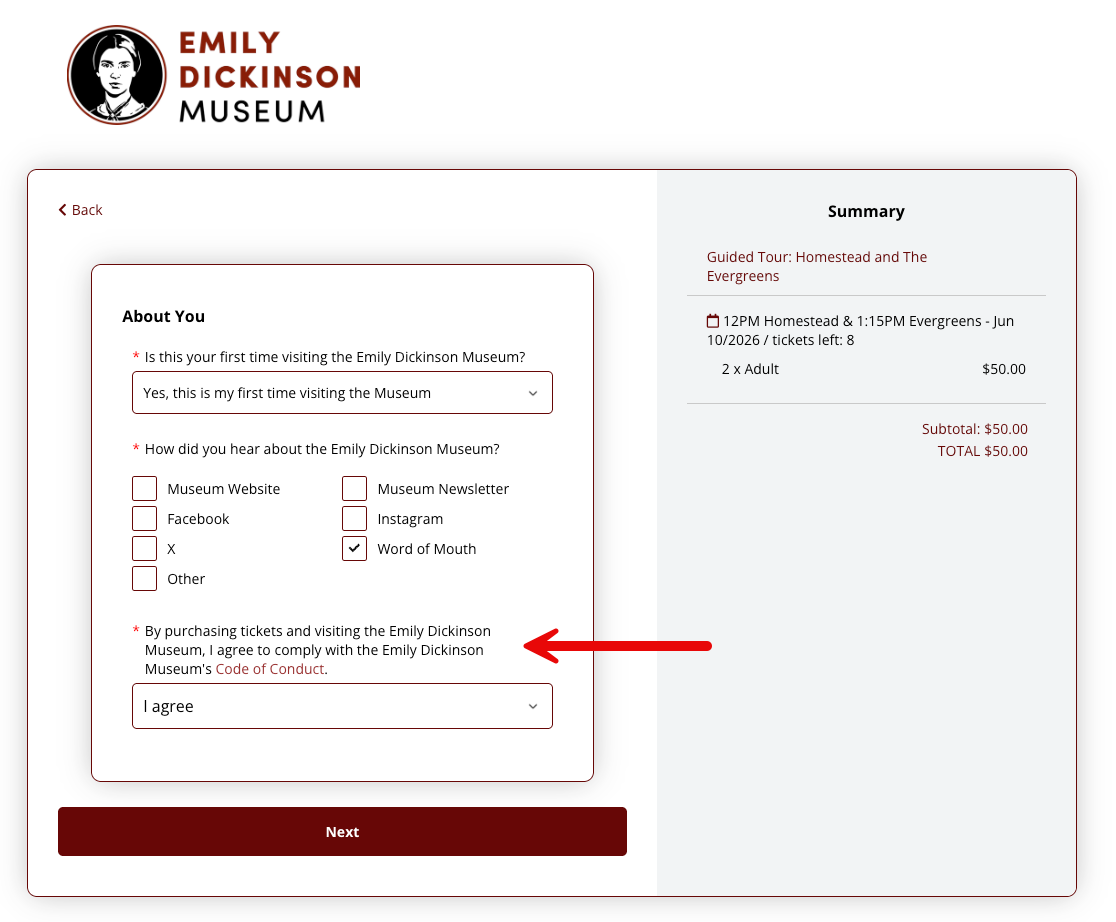
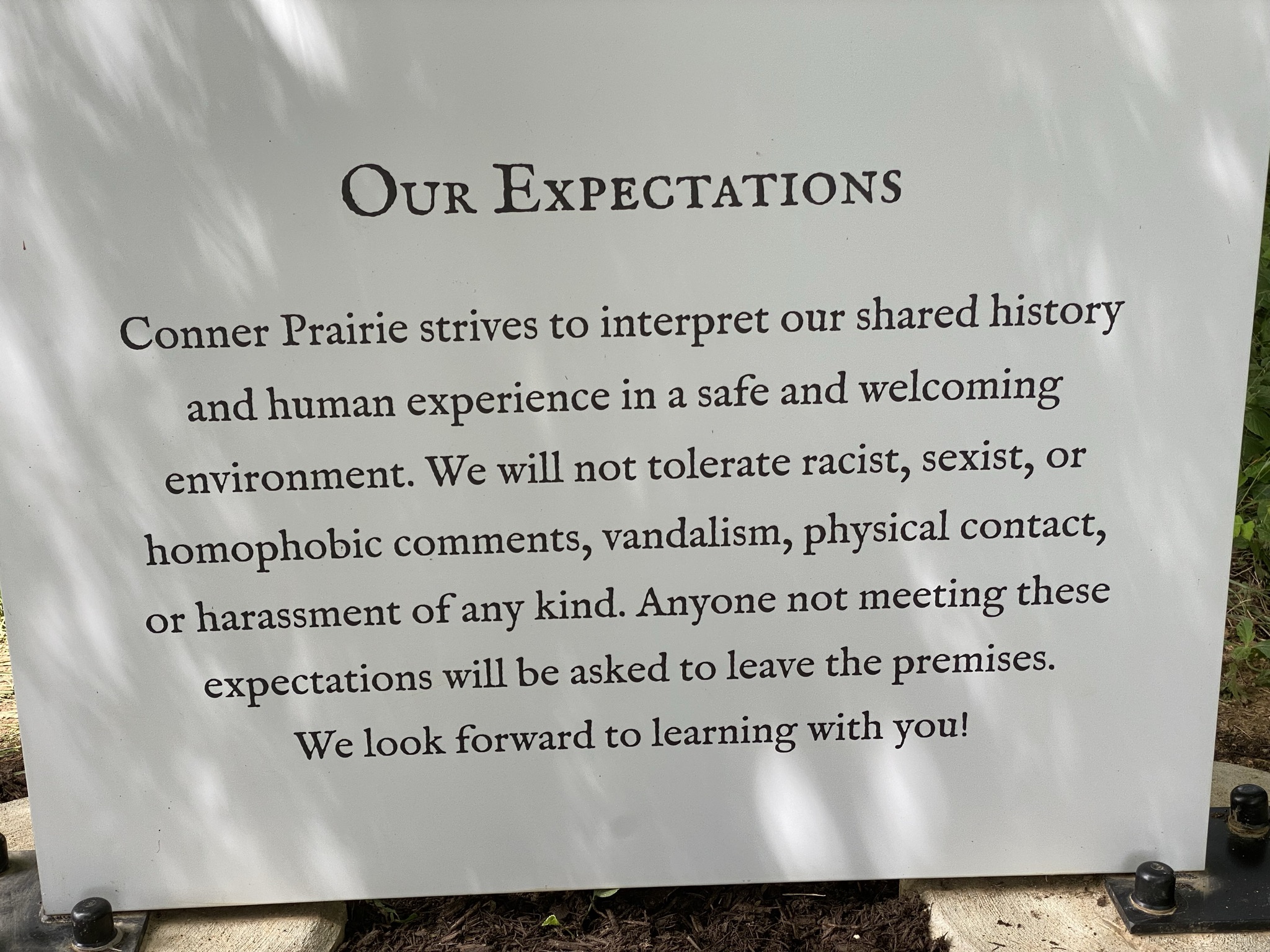
I’m encountering codes of conduct more frequently as I visit museums and historic sites. They’re not only posted near entrances, but increasingly appear on websites as I buy tickets or plan a visit. Museums and historic sites have always had expectations for visitors—don’t touch, no food—but they’ve never seemed so prominent.
That made me wonder: are our efforts to be more inclusive and welcoming attracting visitors who are unfamiliar with our expectations? Has the current political climate encouraged more conflict and confrontation in public spaces? Are front-line staff experiencing more difficult visitor behavior? Or are museums simply becoming more explicit about rules that were once assumed?
To find out, I examined dozens of visitor codes of conduct from museums and historic sites in the United States that were available online using Google’s search feature. This was not a scientific or comprehensive study. It was more of an initial exploration of what seems to be happening in the field.
What I found is that visitor codes of conduct are no longer just about protecting collections. They are becoming management tools.
The older model of visitor rules was largely about preservation and safety: no food, no flash photography, no backpacks, no running, no touching. Those expectations are still there, especially in art museums, historic houses, and sites with fragile interiors. But many current codes go much further. They address harassment, discrimination, hate speech, disruptive behavior, weapons, vaping, drones, commercial photography, political demonstrations, visitor privacy, livestreaming, and staff authority to remove or ban visitors. It’s become much more complex! These codes not only protect objects, buildings, and landscapes, but also staff, volunteers, visitors, and the quality of the visitor experience.
Some of these changes are welcome. Museum staff, especially front-line staff, are often the people who carry the burden of difficult visitor behavior. A clear code of conduct gives them institutional backing. It tells visitors that staff deserve respect, that harassment will not be tolerated, and that museums have a responsibility to maintain safe spaces for everyone.
At the same time, codes of conduct carry risks. If they are too long, too legalistic, or too focused on prohibition, they can make museums feel less welcoming before the visit even begins. A visitor buying a ticket online may wonder, “Will I do something wrong? Will I be shamed?” That concern may be especially strong for first-time visitors, families with children, people unfamiliar with museums, teenagers, visitors with disabilities, or people who have not always felt that museums were meant for them.
This is the tension at the heart of the issue: a good code of conduct clarifies the conditions of welcome. A bad one reinforces exclusion.
The tone varies considerably by museum type:
- Children’s museums often use positive, developmental language: be kind, be safe, share, take turns, stay with your adult (e.g., Boston Children’s Museum; Minnesota Children’s Museum; KidsWork Children’s Museum).
- Art museums tend to be precise about distance from objects, photography, sketching materials, bags, and gallery behavior (e.g., Virginia Museum of Fine Arts; Metropolitan Museum of Art; Museum of Modern Art; Honolulu Museum of Art; Clyfford Still Museum).
- Historic sites and house museums focus on protecting furnishings, architecture, and landscapes (e.g., Emily Dickinson Museum; Historic Columbia; Winterthur; Mount Vernon, Intrepid Museum).
- Gardens and estate museums emphasize staying on paths, protecting plants, respecting wildlife, and maintaining a peaceful atmosphere (e.g., Dumbarton Oaks; Hillwood Estate, Museum & Gardens; United States Botanic Garden, Old Westbury Gardens, Daniel Stowe Conservancy).
- History and civic museums increasingly focus on respectful dialogue, especially where interpretation involves race, religion, immigration, slavery, war, politics, or national identity (e.g., Chicago History Museum; Tenement Museum; Minnesota Historical Society; Jamestown-Yorktown Foundation; National Constitution Center; Museum of the American Revolution; U.S. Holocaust Memorial Museum; Maryland Center for History and Culture; Massachusetts Historical Society).
The most interesting pattern is that codes of conduct often define the proper mode of visitation. At an art museum, visitors are expected to look carefully. At a children’s museum, they are expected to play safely. At a historic house, they are expected to move carefully. At a memorial museum, they are expected to be dignified. At a garden, they are expected to slow down.
That makes codes of conduct more than a list of prohibitions. They teach people how to be visitors in a particular kind of museum. But we should be careful about what we are teaching.
Museums have a long history of communicating—sometimes explicitly, often implicitly—that certain kinds of people belong and others do not. Earlier forms of museum etiquette often reflected elite social norms: quiet voices, restrained bodies, particular dress, articulate speech, informed questions, and deference to experts. A contemporary code of conduct can unintentionally revive those older habits if it treats unfamiliar behavior as misbehavior.
There is a meaningful difference between a visitor who harasses staff and a visitor who does not know that large bags should be stored, children should not sit on platforms, or flash photography may harm collections. One calls for intervention. The other calls for orientation.
That distinction matters because many rules are subjective. “Disruptive behavior,” “appropriate attire,” “loitering,” “inconsiderate conduct,” and “loud voices” may be necessary phrases, but they can be enforced unevenly. Without training and managerial support, staff may apply them differently depending on a visitor’s age, ethnicity, culture, education, disability, clothing, or perceived social status. A policy that looks neutral on paper can become exclusionary in practice.
So the issue is not whether museums should have codes of conduct. They should. The issue is whether those codes are developed and implemented as tools of hospitality or tools of control.
The strongest codes I reviewed usually began with a welcome or values statement. They explained the kind of environment the museum wanted to create: safe, inclusive, respectful, reflective, playful, educational, or peaceful. Then they moved into specific examples of expectations and behaviors. Finally, they stated what staff may do if visitors refuse to comply.
That sequence matters. Starting with enforcement can make a museum feel defensive or suspicious. Starting with welcome, followed by clear boundaries, communicates both hospitality and authority.
For museum leaders, this raises several practical questions:
- Does your code of conduct reflect the kind of visitor experience you want to create?
- Does it protect staff as clearly as it protects collections?
- Does it help newcomers understand expectations, or does it assume they already know them?
- Are the rules specific enough to guide behavior without relying too heavily on subjective judgment?
- Does it address current visitor behaviors, including photography, social media, vaping, drones, harassment, and disruptive recording?
- Does it give front-line staff enough authority to act and enough training to act fairly?
- Is it visible before a problem occurs, but not so prominent that it overwhelms the welcome?
Codes of conduct will not solve every visitor-behavior challenge. They are only useful if staff are trained, managers support enforcement, and institutional culture backs up the words on a website. They also should not substitute for better design, signage, orientation, staffing, and interpretation. If visitors are constantly touching objects, entering restricted areas, or misunderstanding expectations, the problem may not be the visitors. It may be the design of the experience.
Still, codes of conduct are becoming an important part of visitor experience planning. Like signage, wayfinding, interpretation, and accessibility, they shape how people understand where they are and what is expected of them.
Museums and historic sites have long assumed that visitors know how to behave. That assumption may no longer hold—and perhaps it never held as broadly as we thought. If we want to welcome more people into our spaces, we need to be clearer about the shared responsibilities that make those spaces safe, meaningful, and sustainable.
The challenge is to avoid sending the message, “You are welcome only if you already know our rules.” A better message is: “You are welcome here. Others are welcome here too. Here is how we share this place together.”
Museums with Unusual Rules
- “Children may not be carried on another person’s back or shoulders outside of a baby carrier.” Virginia Museum of Fine Arts
- “No organic materials such as live flowers or plants—this includes lei. Lei made of ribbon and other non-live materials are welcome.” Honolulu Museum of Art
- “Using restrooms for bathing, laundering or extended personal hygiene care [is prohibited].” Maryland Center for History and Culture
- “Don’t feed the wildlife—some animals might bite!” US Botanic Garden
- “Be Compassionate: We all make mistakes. As an organization, we exist to share Chicago’s complex history. We are committed to learning from the triumphs and mistakes of the past and expect that all who participate in our programming will allow others the opportunity to do the same.” Chicago History Museum


Sadly, I agree that we have entered an age when visitors need to be reminded about how to work with a museum and each other to enjoy their experiences. But I’m less sure that signage is the way to help. People don’t read signs; I’m guilty of it myself sometimes. I recently saw a visitor reach out and touch an object on a platform while literally standing beside a sign that said “Please do not touch.” When reminded of the rules, he said he just hadn’t been thinking. A sign prohibiting harassment would be equally ineffective. A few years ago I was surrounded by a group of young teenage boys rudely shouting questions as a joke while I was interpreting a site, directly breaking a published rule against disrespectful actions. Some visitors do not respect rules, written or otherwise. I can understand posting signs for legal reasons. But I don’t expect them to be much practical help for museum objects or interpreters.
LikeLike
Expressed policies help staff and volunteers feel more empowered to act when they, hopefully, rarely, encounter people who behave in ways that necessitate immediate response and attention.
LikeLike
You’ve made an important observation—these codes are helpful for both visitors and staff. Often staff don’t know what to do or if they’re allowed to intervene if something unusual happens.
LikeLike
This subject would make a timely conference presentation or publication. I work primarily with school groups in the museum and children-adults mixed groups are a wild combination of compliance and chaos, tending towards increasing chaos, that calls the very existence and purpose of time-honored field trips into question. Historic sites are a unique blend of both preservation and visitor safety controls that occasionally feel too restrictive to visitors, understandably. I like the approach of starting with value-setting language.
LikeLike
This would be a good session for a conference. Discussing various scenarios in different types of museums would be very helpful.
LikeLike