Category Archives: Strategy

Recap of Historic House Museum Symposium at Gunston Hall

This slideshow requires JavaScript.

On Saturday, the Historic House Museum Consortium of Washington DC hosted an all-day symposium on “how are historic house museums adapting to the future?” at Gunston Hall in Virginia.  The sold-out symposium featured three speakers, a tour of Gunston Hall, and lots of time to chat with colleagues during breaks and over lunch.   The cost?  A mere $15, truly a bargain.  The symposium not only attracted professionals from Virginia, Maryland, and DC, but as far away as Connecticut!

I opened the symposium by discussing Michael Porter’s “Five Forces” as a way of identifying opportunities and threats to help historic sites prepare and adapt.  If you’re not familiar with the Five Forces, it’s a framework for identifying those issues that have the biggest impact on your operations.  This is a much more useful alternative to SWOT, which may be a good outline for summarizing an analysis, but it’s not a helpful way to analyze a situation.  If you’d like to get an introduction to the Five Forces and how it applies to historic sites, take look at my presentation (warning: it’s an 18 Mb pdf).  Even better was the discussion that followed, which explored a wide range of ideas from the growing role of photography to changing demographics to the interpretation of African American history.

Jana Shafogoj at Morven Park discussed how the current emphasis on STEM has allowed their site to Continue reading

Are Historic House Museums Adapting for the Future?

Gunston Hall, Lorton, Virginia.

Gunston Hall, Lorton, Virginia.

In March, the Historic House Museum Consortium of Washington, DC will be examining how historic house museums are adapting to the future at its annual Historic House Museum Symposium.  Presented alongside the 2014 Virginia Association of Museums conference, the symposium will feature three speakers, a boxed lunch, and a special tour of Gunston Hall on Saturday, March 15, 2014 from 9 am to 3 pm at George Mason’s Gunston Hall in Lorton, Virginia.  Registration is limited and is $15 per person.

Speakers include Continue reading

HBR: The Truth About the Customer Experience

Harvard Business Review, September 2013

Harvard Business Review, September 2013

The September 2013 issue of Harvard Business Review features four articles on women in leadership, which will be of interest to many people who work at historic sites and museums.  The first is on the subtle gender bias that obstructs women’s access to leadership in even the most well-meaning organizations (and how to correct the problem), the second article describes companies who have successfully incorporated inclusivity, and the third reveals the way women make buying decisions differently in a business-to-business (B2B) setting from men.  The fourth article is a roundup of recent research on women in the workplace, such as women receive less criticism but also less challenging assignments.  Of course, the museum and historic site field is dominated by women, so I wonder what these statistics would look like for us.

There’s also a good article on “customer journey mapping.”  It’s a relatively new method of studying a customer’s buying experience by identifying all the places that a company interacts with a customer and evaluating each of these “touchpoints.”   By mapping the customer’s journey to buy a product from their initial search for information to its delivery and installation, a company can better understand the Continue reading

AASLH Begins to Lead Itself Out of Challenges

The Council (board of trustees) of the American Association for State and Local History took a big step at its June meeting to lead itself out of its challenges, rather than just trying to manage them.  That’s one of the decisions we made in response to the impact of the 2008 economic downturn and the multi-year embezzlement by its chief financial officer.  We recognize that our governance needs to expand from merely enacting stronger policies and procedures to also include a clear direction for the future when we get through these pressing challenges.

So on Saturday, June 29, the entire Council and many of the staff members participated in an all-day retreat at the Museum Center in Cincinnati, Ohio, to identify its strengths and weaknesses, determine what makes AASLH distinctive, clarify Continue reading

Profiling Your Members Will Improve Engagement

This week I’m teaching a workshop on historic house museum management with George McDaniel for the American Association for State and Local History.  It’s great fun working with people from all over the country because we learn so much from each other.

One of the most popular sections is membership (who doesn’t want more supporters?).  George uses his experience from Drayton Hall to demonstrate some techniques in the tour for showing “membership dollars at work,” which gets visitors so excited that many join at the end of the tour.  With members in more than 7,500 households in all 50 states, Drayton Hall must have one of the nation’s largest membership programs for an historic site, so their techniques work.

I provide a complementary perspective, using profiles to understand member motivations and interests.  In an exercise, I have the class combine a mission statement with a member profile to develop a membership program or activity.  I’m always surprised by Continue reading

Resources for Historic Sites from the American Alliance of Museums

The American Alliance of Museums (formerly known as the American Association of Museums) is offering several resources and workshops that may be interest to historic sites, including:

TrendsWatch 2013: Upcoming Town Hall
This year’s edition of TrendsWatch, the annual report on key social, economic, technological and other trends that are shaping the future of museums, will be released next month.  You can also learn about it at the Alliance’s Web-based Town Hall on March 27 at 2 pm ET, which will be hosted by their Center for the Future of Museums.  Registration is free for Alliance members, and will open soon.  Meanwhile, read (or re-read) TrendsWatch 2012 for a taste of the future.

2012 National Comparative Museum Salary Study Available
A national salary study has long been a top request from Alliance members. Demonstrating that we’re stronger together, the 2012 study was prepared in collaboration with the Association of Midwest Museums (AMM), the Mountain-Plains Museums Association (MPMA), the New England Museum Association (NEMA) and the Southeastern Museums Conference (SEMC) and based on surveys conducted in their regions. Together, these associations represent 36 states, 64 percent of the American population and approximately two-thirds of all museums in the United States. Available free to Continue reading

Workshops for History Museums and Historic Sites

The American Association for State and Local History unveiled an assortment of workshops for spring (there’s one in every time zone!):

Project Management for History Professionals
Dates: March 7 – 8
Location: History Colorado, Denver, CO
Instructor: Dr. Steven Hoskins, Trevecca Nazarene University, Nashville, TN
Cost: $475 members / $550 nonmembers
$40 discount if payment is received by January 31 (coming up next week!)

This unique two-day workshop improves how history museums operate and serve their community by teaching the fundamentals of project management to history professionals. Everyday work—exhibitions, programming, fundraising, special events, outreach, and collections care—benefit from the knowledge gained. Registration for the onsite workshop also includes access to an online course with related material.

From Children to Adults: Public Programming at History Organizations
Dates: March 14 – 15
Location: Homestead Museum, City of Industry, CA
Instructors: Tim Grove, National Air and Space Museum, Smithsonian Institution, Washington, DC; Alexandra Continue reading

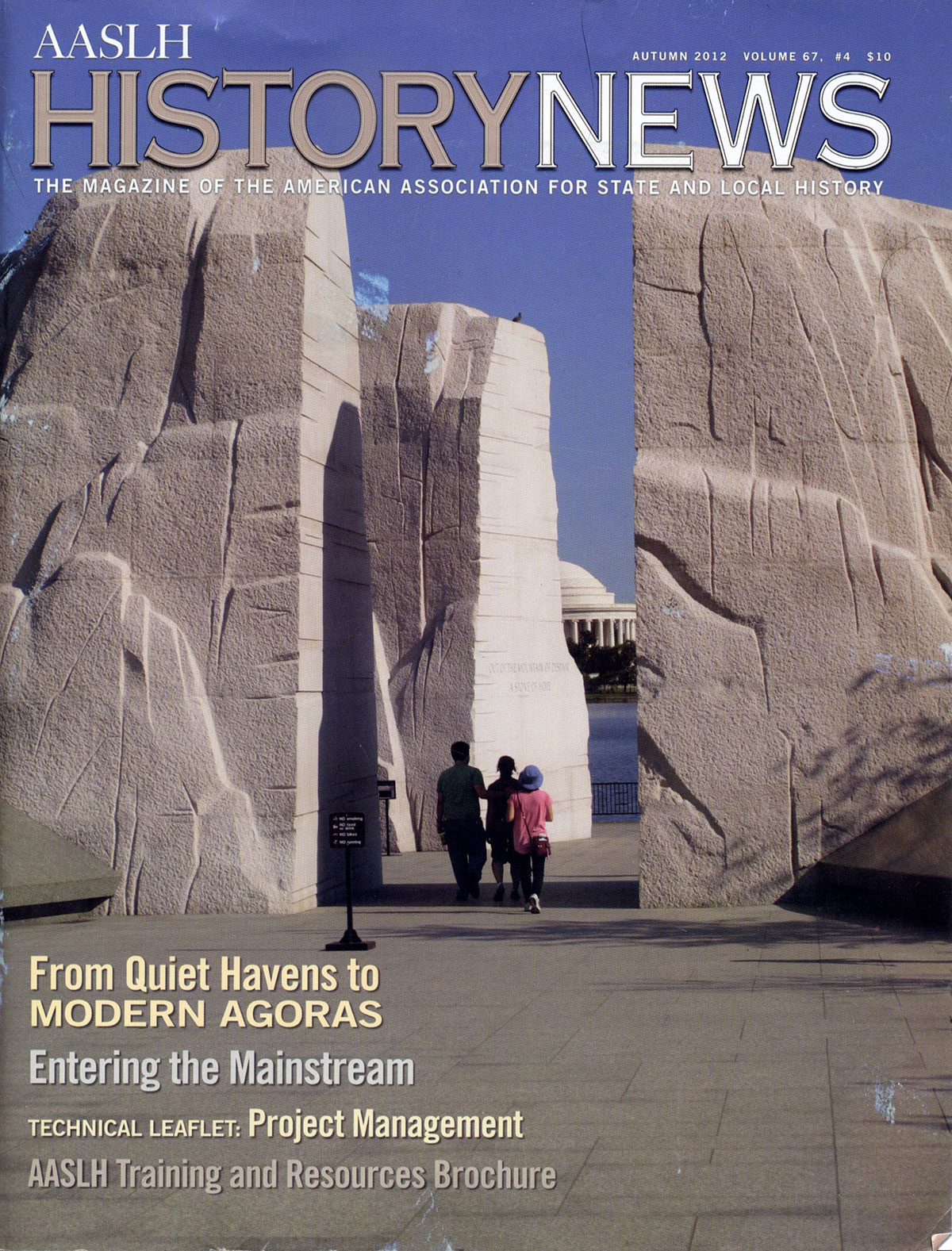
History News looks at Historical Interpretation

History News, Autumn 2012

History News, Autumn 2012

The autumn 2012 issue of History News arrived in my mailbox a couple weeks ago and its four feature articles on interpretation that will be of interest to historic sites:

  • “From Quiet Havens to Modern Agoras:  Libraries and Museums in an Era of Participatory Culture” by Nancy Rogers, Susanna Seidl-Fox, and Deborah Mack is a report, including the key overarching messages, from an international seminar held in Salzburg, Austria in October 2011.
  • “‘No More Wiggle-Tail Water’: Interpreting the History of Morgantown’s Water Supply at the West Virginia Botanic Garden” by Barbara Howe is a case study on integrating history in a place that focuses on horticulture and nature.
  • “When Histories Horrify: Supporting Visitors’ Responses through Responsible Interpretation” by Linda Norris, Danny Cohen, and Stacey Mann is a continuation of a session at the American Alliance of Museum’s annual meeting on the roles and responsibilities of museums in preserving and mediating horrific histories of crimes, violence, terrorism, and oppression, with references to the Kilmainham Gaol, Majdanek, Robben Island, and the Greensboro Woolworth.
  • “Entering the Mainstream:  Interpreting GLBT History” by Ken Turino and Susan Ferentinos addresses four common challenges (institutional policies on discussing sex, lack of documentary evidence, applying modern labels to historical figures, pressure to avoid controversial topics) using examples from Pendarvis, Walt Whitman House, Beauport, Sarah Orne Jewett House, Alice Austen House, and Charles Gibson House.

Also included are Continue reading

AASLH and AAM Align Efforts to Raise Standards and Practices

The American Association for State and Local History (AASLH) and the American Alliance of Museums (AAM) recently announced they will work together to raise awareness of national museum standards and align their assessment programs in order to streamline application and self-study processes.  The agreement outlines ways in which applicants of AAM’s Museum Assessment Program (MAP) will benefit after completing AASLH’s StEPs program, in other words,  AASLH and AAM have linked StEPs with MAP.  If you understand that sentence, you’ve been working in this field a long time.

What’s this mean for historic sites?  Both StEPs and MAP are great programs for improving your organization’s work, but they’re very different from each other.  StEPs allows you to Continue reading

Is Your Historic Site Unsure About Next Steps?

In this uncertain environment, many organizations are unsure about the direction to pursue for their historic site or house museum.  Through a self-study process and a personal assessment by an external professional colleague, the Museum Assessment Program (MAP) offers a thoughtful and proven approach to refine your operations, programs, and collections.  I’ve participated in several MAPs and clever organizations have used it to confirm a strategy, refine a project, resolve a vexing issue, support a funding proposal, or move to the next level of operations.  I can’t think of a better program available, except if you’re accredited by AAM, you have a large professional staff, or if you’re able to afford a large team of experts.  Really.  To stay sharp, every historic site and house museum in America needs to go through this program every decade and in between, they should be tackling a section of AASLH’s Standards and Excellence Program.  Really. If you’re not sure, call the director of the historic sites that participated this year:  Montpelier Mansion (Maryland), Old Barracks Museum (New Jersey), Louis Armstrong House (New York), Seward House (New York), Stewart House (Ohio), French Legation Museum (Texas), Poplar Forest (Virginia), and Pabst Mansion (Wisconsin).

To participate, your organization needs to meet some basic requirements (such as be open to the public at least 90 days a year), Continue reading