
Tag Archives: Women

Rethinking How We Find and Interpret Women at Historic Sites

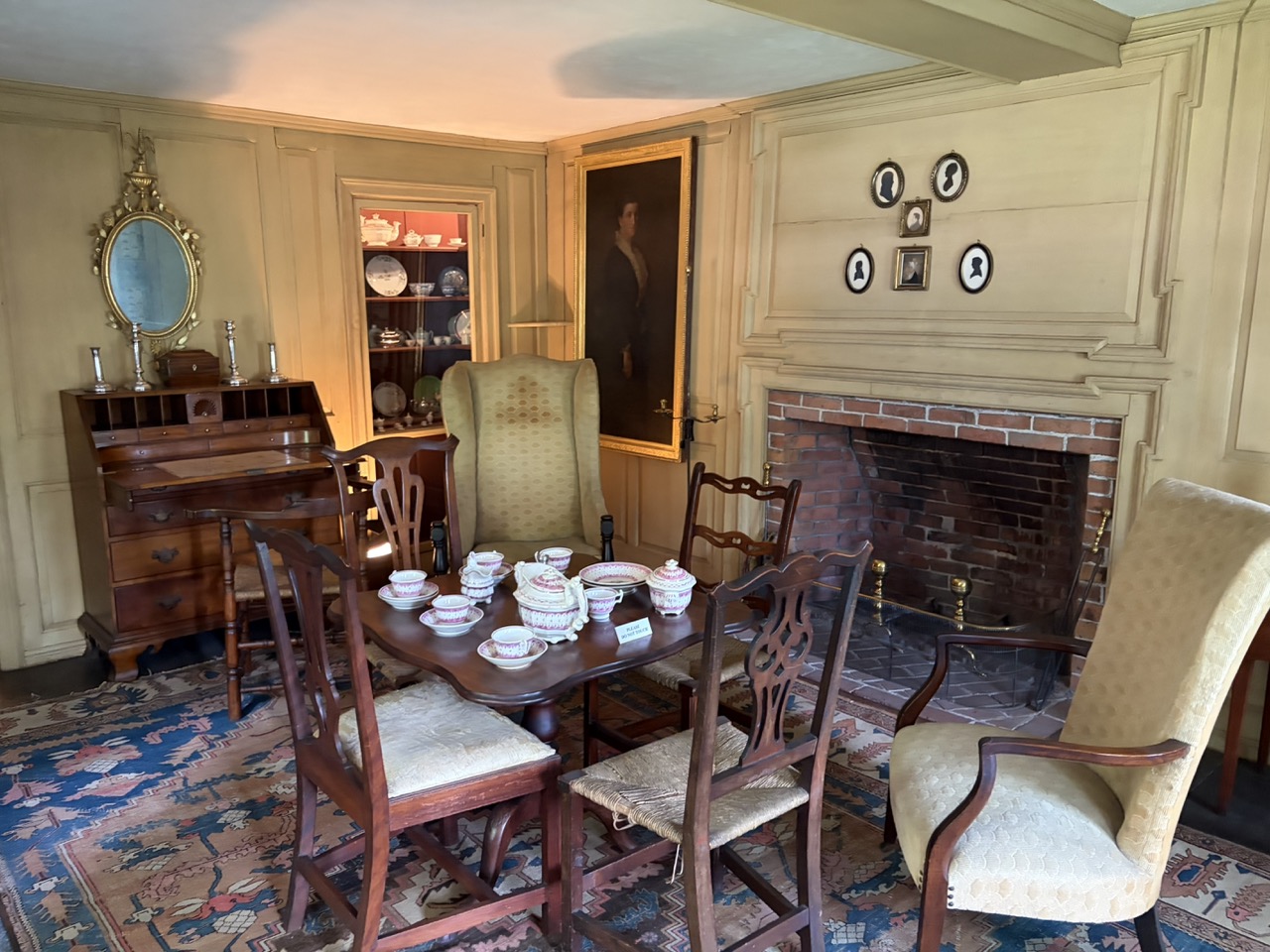
The parlor in the Frary House at Historic Deerfield in Deerfield, Massachusetts. C. Alice Baker restored the house in the 1890s as her Colonial Revival home.

For years, I have heard the same frustration from people working at historic sites: “It is so hard to find information about the women who lived here.” But finding women is only part of the challenge. Even when information about them exists, interpreting their lives can be difficult. Too often, interpretation emphasizes familiar domestic roles and spaces—the kitchen, nursery, or parlor—without exploring the fuller range of women’s experiences.

Earlier this year, I heard many of these same concerns during an American Association for State and Local History (AASLH) discussion on women’s history. Participants described women appearing only in passing in historical records or being found through records associated with men. Others pointed to museum collections that historically documented women’s domestic lives more readily than other aspects of their experiences. The discussion raised two related questions: How do we find the women, and what do we do with what we find?

These questions lie at the heart of a book I am now writing, Interpreting Women’s Lives at Historic House Museums. The challenge is not simply finding more evidence about women. It is reconsidering the approaches we use to find and understand their lives and then bringing that understanding back to the historic places where their stories are told.

Learning from Women’s History

Traditional methods of historical research were largely developed around the activities through which men exercised public power: politics, government, military service, property ownership, and business. Those approaches have produced an enormous body of historical knowledge.

But historians of women discovered decades ago that those same approaches could not simply be applied to women and expected to produce the same results. If we look for women only where we have traditionally found men, women can appear marginal to the historical story. And if we measure women’s lives against men’s experiences, we risk overlooking the ways women exercised power, earned money, maintained relationships, acquired and transferred property, participated in communities, moved through the landscape, and shaped the world around them.

The problem therefore requires more than adding women’s names to an existing story. It requires drawing on methods developed by historians of women to examine women’s lives on their own terms. Those methods have shaped the practical approach I am developing for historic house museums.

Continue reading

Tackling Race, Gender, Religion, and Sex in Prison: Oh My!

The big gray brooding mass of Eastern State Penitentiary in Philadelphia.

The big gray brooding mass of Eastern State Penitentiary in Philadelphia.

Despite the winter weather, I’ve been traveling extensively this month around the country.  In Philadelphia I finally had a chance to visit the Eastern State Penitentiary, an enormous prison close the city’s art museums but otherwise oh so far away.  When built in the early 19th century, it was the most famous and expensive prison in the world, but after it closed in 1971, it became a forgotten ruin.  Today, a private non-profit organization preserves and manages this National Historic Landmark with an usual mission statement:

Eastern State Penitentiary Historic Site, Inc. works to preserve and restore the architecture of Eastern State Penitentiary; to make the Penitentiary accessible to the public; to explain and interpret its complex history; to place current issues of corrections and justice in an historical framework; and to provide a public forum where these issues are discussed. While the interpretive program advocates no specific position on the state of the American justice system, the program is built on the belief that the problems facing Eastern State Penitentiary’s architects have not yet been solved, and that the issues these early prison reformers addressed remain of central importance to our nation.

In a way, old prisons are historic houses so I’ve been intrigued by the way these popular tourist destinations are interpreted to the public.  Eastern State is a significant contrast from Alcatraz Island, which Continue reading

HBR: The Truth About the Customer Experience

Harvard Business Review, September 2013

Harvard Business Review, September 2013

The September 2013 issue of Harvard Business Review features four articles on women in leadership, which will be of interest to many people who work at historic sites and museums.  The first is on the subtle gender bias that obstructs women’s access to leadership in even the most well-meaning organizations (and how to correct the problem), the second article describes companies who have successfully incorporated inclusivity, and the third reveals the way women make buying decisions differently in a business-to-business (B2B) setting from men.  The fourth article is a roundup of recent research on women in the workplace, such as women receive less criticism but also less challenging assignments.  Of course, the museum and historic site field is dominated by women, so I wonder what these statistics would look like for us.

There’s also a good article on “customer journey mapping.”  It’s a relatively new method of studying a customer’s buying experience by identifying all the places that a company interacts with a customer and evaluating each of these “touchpoints.”   By mapping the customer’s journey to buy a product from their initial search for information to its delivery and installation, a company can better understand the Continue reading