The museum field has always been a challenging place for job seekers. Even in the best of times, there are often more talented people than positions available, and salaries tend to lag behind comparable roles in business or government. But with the recent elimination of federal funding through IMLS and NEH, and with looming threats of layoffs at the Smithsonian Institution, National Park Service, and National Gallery of Art, the situation is becoming even more precarious. I’m deeply concerned about what lies ahead for our field, not just for those losing jobs, but for the ripple effects on institutions, communities, and careers.
Fifteen years ago, I faced a similar moment when the National Trust for Historic Preservation laid off about a third of its staff. I was fortunate: I had a generous severance package and a consulting project waiting (thank you, Jim Vaughan!). But not everyone will be so lucky this time. In that difficult season, a few books proved invaluable to me, and I strongly recommend them to anyone now facing an unexpected job search:
Strong research and writing skills are essential for museum professionals, whether you’re publishing an article, preparing grant proposals, or mentoring new colleagues. That’s why I created a new eight-minute video, Chicago Style Basics, to introduce the fundamentals of citation and documentation using the Chicago Manual of Style — just updated with its 18th edition ($75!).
The video walks through what a citation is, why citations matter, and the basic parts of a properly formatted citation. It also provides real examples of how to cite a book with one author, a chapter within a larger book, and a journal article — essential formats for anyone writing in our field. The video closes with a quick summary and a few resource suggestions for those who want to dig deeper.
At the Museum Studies Program at George Washington University, we require our graduate students to demonstrate professional-level research and writing, and this video was created to support those expectations. But it’s also a useful refresher for anyone preparing manuscripts for publication, developing course materials, or helping new professionals get their footing.
The world of historic house museums has been grappling with fundamental questions about purpose and sustainability for many years. Two significant gatherings, the Kykuit II Summit in 2007 and the recent 2025 Historic House Summit, highlight key moments in this ongoing discussion. Bridging these two events is the American Association for State and Local History’s (AASLH) STEPS program, particularly its standards for interpretation, which emerged directly from the needs identified in that earlier period. Looking at these three points in time reveals not only evolving ideas but also the increasing urgency and specific challenges facing interpretation today.
The Kykuit II Summit: The Call for Sustainability and Standards
The Kykuit II Summit, held in April 2007 at the John D. Rockefeller estate, brought together leaders to discuss “the sustainability of historic sites.” This was a follow-up to a similar meeting five years prior. The discussions focused on finding ways for historic sites, the largest segment of the museum community, to thrive. Key questions included the challenging, “unmentionable” ones: “Does America need another house museum?” or “Can America support the existing historic sites it now has?”
By Mary A. van Balgooy, Vice President, Engaging Places LLC
Last week, I attended the 2025 AASLH Historic House Museums Summit, “Interpreting Historic House Museums Today,” held at the Edsel and Eleanor Ford House in Grosse Pointe Shores, Michigan. Over 100 museum professionals from across the country came together to assess where interpretation stands today and how it should evolve over the next decade. The Summit’s objectives were clear: attendees would examine the current scope of historic house interpretation, identify trends for the next 10-15 years, and define the major issues shaping the field. Through keynotes, breakout sessions, and informal discussions, attendees tackled major questions about our roles, responsibilities, and hopes for the sector.
Big Ideas from the 2025 AASLH Summit
One of the most powerful themes to emerge was the need to embrace “whole history.” Instead of narrowly focusing on furniture, technology, or architectural details, participants stressed telling a full, human-centered story. This includes voices often left out of traditional interpretation: women, people of color, laborers, and marginalized groups. The idea is not merely to add these perspectives but to reframe interpretation through them, reflecting the complexity and moral ambiguity of historical figures and events.
A second major idea was that historic house museums must move beyond passive presentation into active engagement. Museums should create dialogic experiences where visitors reflect, question, and even challenge the past. Skills like listening, civil discourse, and conflict navigation were identified as essential for future staff training.
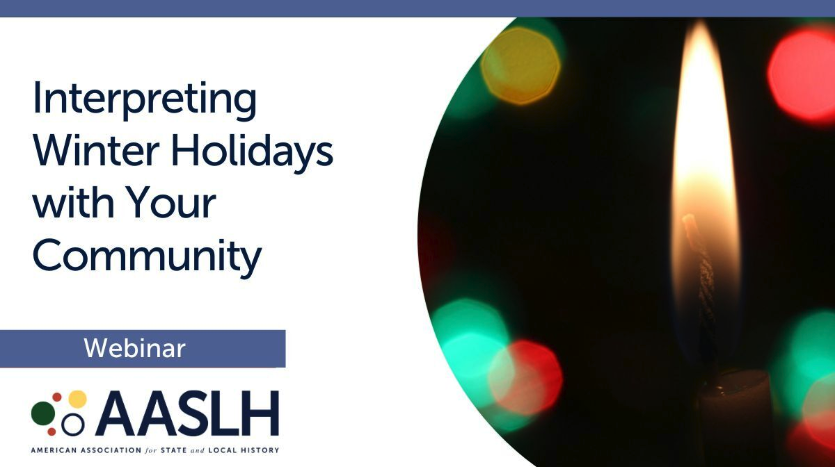
I know, we’re barely out of winter and we’re talking about winter holidays?? If you work at a museum or historic site, I know you’re already planning and we’re here to help!
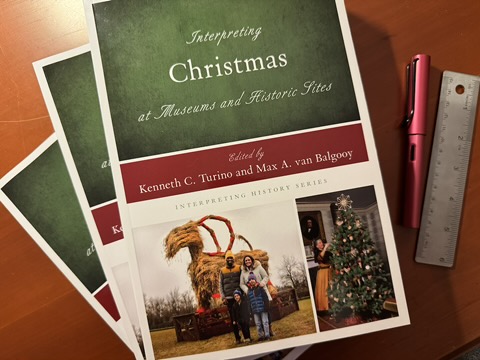
Building upon the AASLH publication Interpreting Christmas at Museums and Historic Sitesand our 2024 webinar on Maximizing Your Museum’s Holiday Potential, this webinar will explore how historic houses and history museums can transform the holiday season into a powerful opportunity for community engagement, inclusivity, and innovation. Focusing on Christmas, Hanukkah, and Kwanzaa, this presentation will offer case studies of successful programming and exhibits from across the country and brainstorming on how participants can scale and adapt these ideas to fit their local contexts and community needs.
Museums are feeling the pinch as public funding declines and operational costs grow. But don’t worry—there are creative ways to boost your financial health without losing sight of your mission. Two recent studies offer fresh ideas to help museums thrive while connecting more deeply with their audiences.
Make the Most of What You Offer The first study, “Value Capture for Nonprofits: The Case of Museums’ New Business Models” (Thomas & Tobelem, 2024), urges museums to think more like entrepreneurs. Museums create tremendous value through exhibitions, programs, and digital content—but often struggle to turn that value into income. The solution? Find ways to align financial opportunities with what you already do best.
For instance, you could:
Introduce tiered pricing for digital experiences, like charging for premium virtual tours.
Partner with local businesses to create themed events that support your mission.
Offer exclusive experiences, like behind-the-scenes access, for a fee.
These strategies not only bring in revenue but also allow museums to stay true to their values. The takeaway: look at what you already offer and think creatively about how to monetize it in a way that feels authentic.
If you missed out on purchasing a copy at the annual meeting or were unable to attend, you can order it online at Rowman.com or mail this order form. Use code RLFANDF30 at checkout to save 30%. This discount is available through September 2025. The book officially releases on September 20, so it should ship immediately when you order.
If you’ve had a chance to read Interpreting Christmas, we’d greatly appreciate a review on Amazon.com. Since history museums and historic sites are such a specialized field, your feedback can help others make more informed purchasing decisions.
In an earlier post, I shared a sneak peek of our book, Interpreting Christmas at Museums and Historic Sites. Next week, Ken and I will provide a comprehensive overview during the upcoming AASLH webinar, “Jingle All the Way: Maximizing Your Museum’s Holiday Potential.” This webinar draws from the book but is not an hour-long sales pitch. Instead, we’ll share key advice and ideas on leveraging holiday celebrations, researching the local history of Christmas, planning and hosting holiday events, expanding traditional programs, and enhancing cultural sensitivity and inclusivity. With so much to cover, we’ll be hitting the highlights. If you’re seeking inspiration for Christmas during these hot summer days, join us on July 23, 2024 at 3:00 pm Eastern. For more details and to register, visit here. Plus, you’ll receive a 30% discount code for the book upon registration.
With proofs in hand, the book is moving closer to reality with a publishing date in fall, but more likely later than earlier. It has 21 chapters, 40 images, and an extensive bibliography of nearly 175 books and articles packed into 270 pages, which is about 25% longer than my Interpreting African American History and Culture at Museums and Historic Sites that Rowman & Littlefield published ten years ago (btw, Rowman was recently acquired by Bloomsbury Publishing). It’s now available for pre-order at Rowman.com for $50 for paperback and a jaw-dropping $125 for hardcover (I don’t set the prices but a 30% discount code is available for webinar attendees).
Behind the Scenes of Indexing
Ken Turino, Sara Bhatia, and I spent nearly two months creating he index, despite the publisher allocating just two weeks. The delay was partly due to other commitments (I was closing out the semester and attending the Newport Summer School), but also because the scope of the book made it significantly more complex. As anticipated, there’s an abundance of content on gifts, trees, lights, ornaments, decorating, and a variety of Santas. Rather than list two dozen pages that mention “lights,” we added subheadings for candles and electric lights, as well as safety considerations, and included “see also” references to help readers find specific information more quickly. But geez, that was slow going.
My chapter, “I’m Dreaming of a Warm Christmas: Researching California (and Other Local Places)” was initially indexed by GPT-3.5, then corrected manually as seen in this example. GPT-4o is more accurate when trained for indexing, but every entry still needs to be confirmed.
We experimented with GPT to produce the index, and the results were mixed. While GPT can generate an initial index with proper nouns and some concepts correctly formatted with page numbers, about half of the entries are usually either missing or incorrect (see example above). Thus, manual review of the proofs is still necessary, but at least GPT provides a head start. If you are interested in learning more in using GPT for indexing, I’m happy to share what I learned.
The index eventually grew to 22 pages, which is longer than most chapters! Indexing required a meticulous review of every page, during which we discovered errors that had slipped past four proofreaders. Ugh. Should we consider these flaws a characteristic of an artisanal, handcrafted gift to the field?
We’re now at the midpoint of the Newport Summer School and by the end of each day, we all share sore feet and stiff backs—except for Richard Guy Wilson, the director of the program. He may be in his 80s, but he has a bottomless reserve of energy.
Participating in the course are a wide range of interests. We have a couple people who lead historic preservation organizations and a couple more who are in graduate school and getting ready to enter the field. We have a handful who work with historic sites, including Edith Wharton’s The Mount, National Park Service, and Lisbon Cathedral. A couple of interior designers and a few who don’t work in the field but love the art and architecture of the 19th century. Ages stretch from early 20s to late 60s.
The diversity of interests and experiences makes for fun conversations and as several noted, can feel comfortable “nerding out” about a preservation issue or an architectural feature. But I’ve also discovered the value of the program—and it varies. Everyone wants to learn about 19th century architecture in Newport, which has an extraordinary collection by some of America’s best architects and interior designers. The combination of illustrated lectures and field sessions allows us to see a lot in a very short time. For graduate students, it creates a foundation of knowledge that will inform their studies and careers. For mid-career professionals, it provides comparisons for our projects and communities, broadening our perspectives. Perhaps more importantly, it also “feeds our soul,” providing a much needed break from the demands of the office while refreshing our passions.
Today we head north to Providence, starting earlier and returning later than usual, so I expect another exhausting day. But it will be worth it.
I’m in Newport, Rhode Island for the Newport Summer School. The Victorian Society in America (an offshoot of the one in London) has been hosting this week-long program for 42 years. Directed by Dr. Richard Guy Wilson, a well-recognized expert in the field of architectural history, it is a mix of lectures and guided tours of significant houses, churches, and civic buildings that are both open to the public and private. In a week, you gain a deep understanding of the history of Newport through architecture—and a network of new colleagues.
Our first day was devoted to the 18th century, considered Newport’s first Golden Age because it brought new wealth to the town and a higher level of architectural design. That wealth came from trade, including enslaved people, a topic that is increasingly being addressed in the interpretation at historic sites and museums.
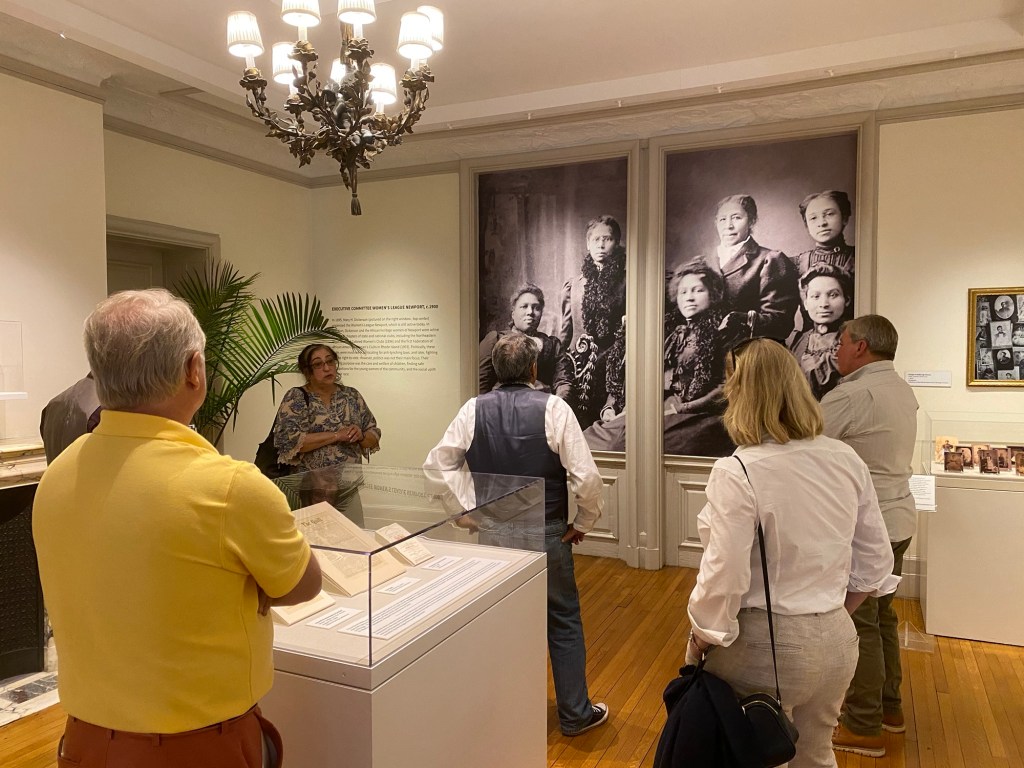
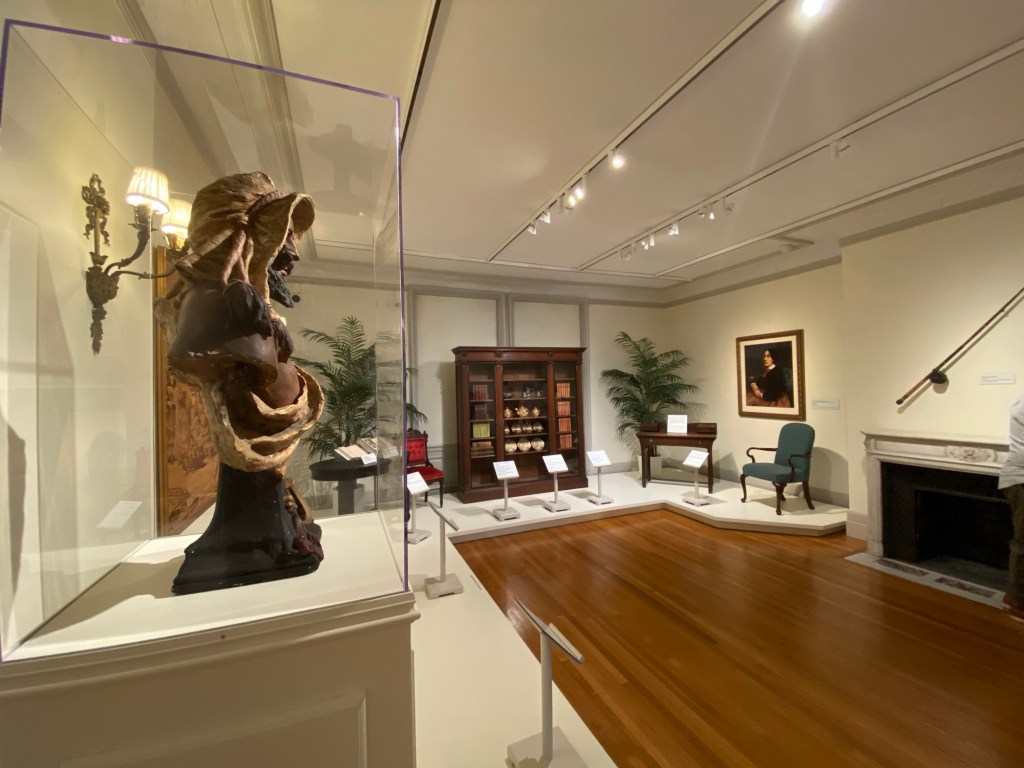
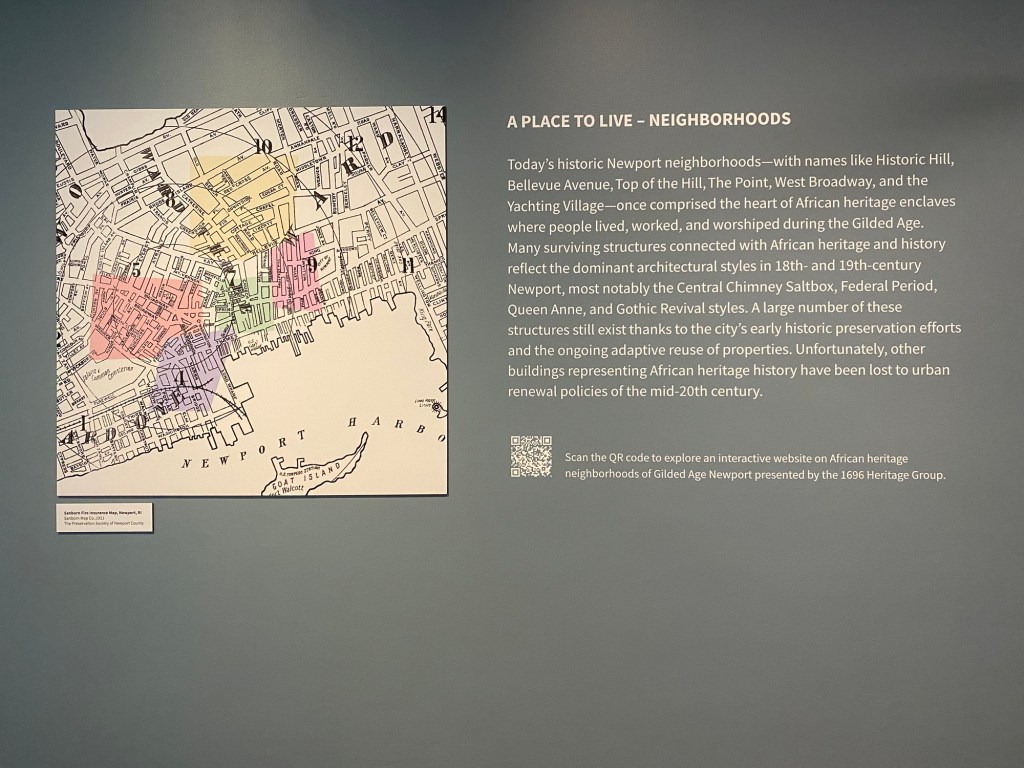
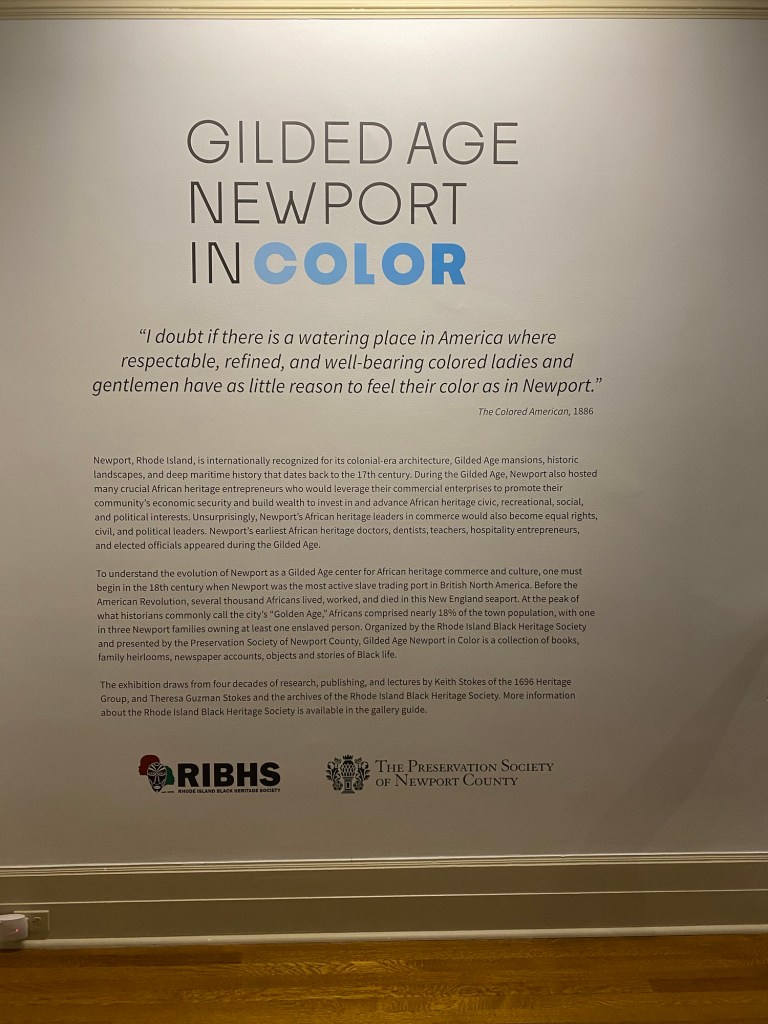
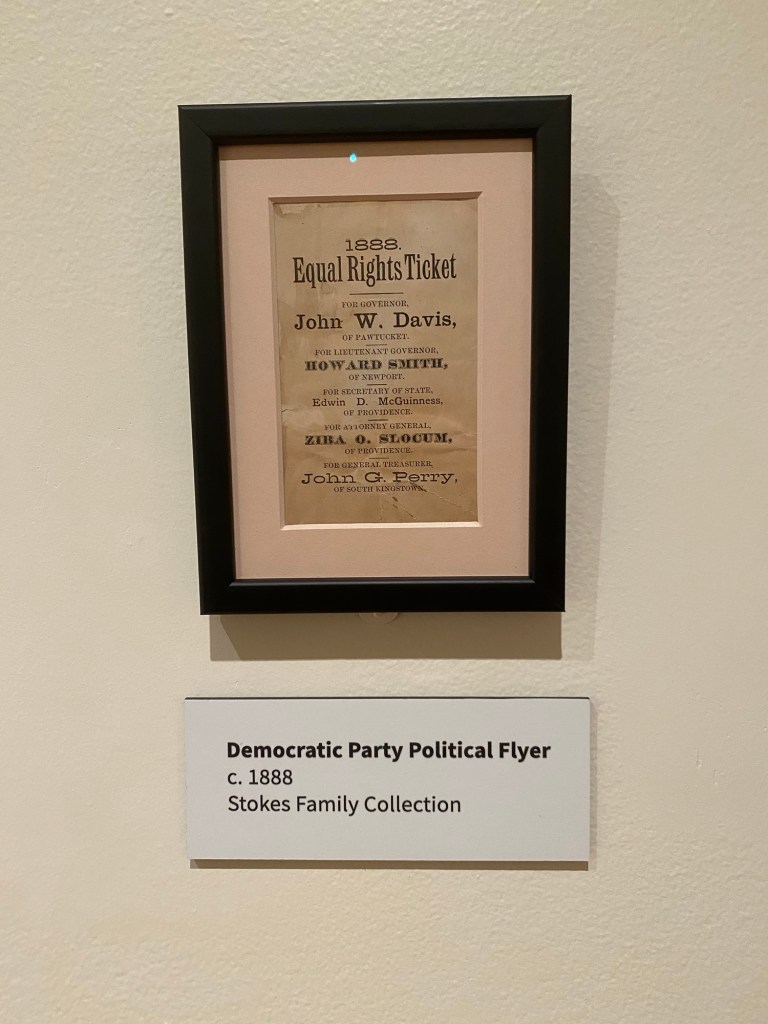
Indeed, the Rhode Island Black Heritage Society, Newport Historical Society, and the Preservation Society of Newport County are collaborating on exhibitions on the history and contributions of African Americans in the region. Before we officially began the course, Soni Stokes, curator of the exhibition, generously gave me and a small group of colleagues a tour of “Gilded Age Newport in Color” at Rosecliff, one of the mansions owned by the Preservation Society. It discusses the lives of dozens of people and families of African heritage through geography, biography, and topics such as business, entrepreneurship, religion, recreation, and politics. What most impressed me was the variety of documents and objects in the exhibition, most on loan from a private collection, giving me a much more holistic view into the lives of African Americans in New England.
Soni Stokes discussing the role of women. Section on recreation and spot.African heritage neighborhoods in Newport.Introductory label to the exhibition.Equal Rights party ticket, 1888.










 Engaging Places