Video: Happy 4th from Philadelphia

In this 1:39 video, Historic Philadelphia features Benjamin Franklin and a dozen living history actors dancing to Pharrel William’s “Happy” on the streets of the City of Brotherly Love. Dozens of ongoing and special events will take place on and around Independence Mall over Independence Week and the summer and this video shows the fun and lively side of its history.  It was produced by Historic Philadelphia, Inc. (@HistoricPhilly), Independence Visitor Center (@PHLVisitorCntr), National Constitution Center (@ConstitutionCtr), Visit Philadelphia (@VisitPhilly), and Independence National Historical Park (@INDEPENDENCENHP). More information is available at www.historicphillysummer.com.   Thanks to Sandy Lloyd for sharing this video.

How Museums Can Optimize Revenue Through Dynamic Pricing

pricing-productsOptimizing revenue by increasing pricing for special exhibits or peak times (e.g. weekends) is widely adopted in the performing arts (e.g., matinee vs evening performances at the theater) but rarely used by museums.  A few museums, however, are beginning to experiment with dynamic or demand-based pricing to maximize their revenues.   For example, the San Francisco Museum of Modern Art increased their price $2 for the last four weeks they were open before renovation began and received no complaints.  In 2008, the EMP Museum dropped its admission fee from $30 to $15 and it did not affect visitation, so in 2011 they increased prices and in 2013 they moved to 2013 to dynamic pricing. During the last 3 weeks, they earned an additional $15,000.

In “What Price is Right?”, a session at the recent AAM annual meeting, Heather Calvin (Museum of Science), Jill Robinson (TRG Arts), and Jessica Toon (EMP Museum) discussed how museums can use demand-based pricing strategies to set admission prices, service fees, discounts, and membership dues.  It was a wide-ranging presentation so I’m sharing the highlights here to Continue reading

Video: Vacant Not Blighted: Revitalizing Detroit

This 4:12 video by the Michigan Historic Preservation Network shows that preservation and rehabilitation are much more effective than demolition to address “blight” in Detroit. The video was created in Mindfield and features a host of interesting people across the city working on rehab projects from firehouses to garages, homes to schools.  Thanks to Jay Vogt for telling me about this video.

Are Bloggers Mostly Educators?

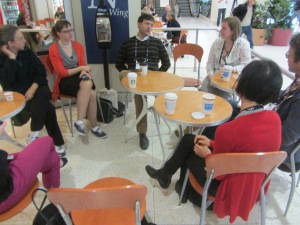
Museum bloggers converse over morning coffee at AAM 2014.

Museum bloggers converse over morning coffee at AAM 2014.

Blogging is a new form of communication, often falling somewhere between professional journalism and personal journaling.  There are lots of people who love museums and historic sites, and they’ve spawned lots of blogs devoted exclusively to them (including this one).  To give you a sense of this specialized blogosphere, Jamie Glavic at Museum Minute has conducted more than seventy (70!) interviews with museum bloggers.

Last month at the American Alliance of Museums annual meeting in Seattle, Jamie convened an informal gathering of a dozen museum bloggers to meet and chat about their work over morning coffee.  I wasn’t able to catch everyone’s name, but the conversation included Rowanne Henry of Museum Stories, Chris O’Connor of the Royal BC Museum, Ed Rodley of Thinking About Museums, Jennifer Foley of Runs with Visitors, Scott Tennent at Unframed, Annelisa Stephan at the Getty Museum, and Kellian Adams at Green Door Labs.

I noticed that most of them were educators, not curators, conservators, collections managers, or administrators, which launched a discussion about the circumstances that seem to be creating this social media distinction in the museum field, including:

  • curators and conservators don’t consider blogging as scholarship; it’s not regarded equal to an article or exhibit catalog for measuring job performance or professional development.
  • blogs provide a place where educators can be heard and voice their opinions; curators dominate conversations in museums
  • blogs require a different type of writing; curators use a language couched in academia, which usually isn’t suitable for blogs
  • blogging isn’t a priority for the organization
  • blogging doesn’t work well in the institutional culture of museums; blogging requires some comfort with risk and letting go

What do you think? Does the cultural divide between educators and curators continue online? Are the distinctions around museum blogging accurate and true? Share your thoughts in the comments below.

 

IMLS’ Count of Museums in the US May Be Exaggerated

LIMLS Museum Distribution by Type 2014q3ooking for museums in your county or state?  Want to know how you compare to other museums across the nation? You’ll find them in the Museum Universe Data File recently produced by the Institute of Museum and Library Services (IMLS).  It’s a free database of museums in the US that includes names, addresses, contact information, total revenue and expenses, and GIS data.

IMLS held a webinar today to explain the datafile and answer questions.  They constructed the list from several sources, including the Internal Revenue Service and Foundation Center,  which were then reconciled to remove duplicates. Data will be updated every six months based on continuing research and community feedback. IMLS will be using the datafile to conduct sampling surveys for future research projects, such as collections care, to inform their programs and share results with the field and Congress, however, you are encouraged to use it as well.

The big news is that of the 35,144 total museums in the US, most are related to Continue reading

Snapshots from the AAM Annual Meeting in Seattle

This slideshow requires JavaScript.

The American Alliance of Museums finished up their annual meeting in Seattle this week with about 5,000 people in attendance, including many from China, England, and Canada.  The weather was jaw-dropping beautiful so trading it for the sessions indoors was a dilemma at times, but nothing would have pulled me away from the opening plenary which featured Erik Larson, author of Isaac’s Storm and Devil in the White City, who discussed his process for writing these histories.   He doesn’t think of himself as an historian, however, but as an “animator of history” who seeks to “create a rich historical experience.”  Hmm.  Sounds like what historic sites do.  I was also provoked by several very intriguing sessions related to history museums and I’ll be sharing highlights soon.  In the meantime, enjoy these snapshots from the annual meeting.

A Bibliography on Interpreting African American History and Culture

As many of you know, I’m assembling an anthology on the interpretation of African American history and culture at historic sites and in history museums, expected to be published by Rowman and Littlefield later this year as part of the AASLH book series.  To provide an overview of the field during the past twenty years, I’ve developed an eleven-page bibliography of published articles and books.  Although not comprehensive nor definitive, it provides a gateway to the breadth and width of the work underway in the United States for inspiration and best practices, and suggests needs and opportunities in the field.  Due to limited space, this bibliography will be reduced in the book so I wanted to provide it here for those who are interested in the expanded version.

This bibliography primarily focuses on theories and methods (the “how”) of interpreting African American history and culture at museums and historic sites, such as tours, exhibits, events, programs, videos, and websites.  Related, but not part of this bibliography, are Continue reading

Is Planning Giving You the Creeps?

Scope CreepThis afternoon at the annual meeting of the American Alliance of Museums in Seattle, Washington, I’ll be part of “Strategic Planning Made Simple,” a panel session discussing approaches to designing and implementing strategic plans with Liz Maurer (National Women’s Museum), Laurie Baty (National Capital Radio and Television Museum), and Steve Shwarzman (Institute of Library and Museum Services).  I’ll be highlighting four ways to overcome “planning creep,” the seemingly inevitable and invisible force that pulls you away from your goals:

1.  Adopting a Meaningful Purpose and Vision.  Strategic plans have been with us for nearly a century, first for military purposes and then adopted by businesses in the 1970s.  It’s now pretty clear that planning without a purpose is a wasted effort and now you’ll find both businesses and non-profit organizations adopting “mission statements.”  While mission statements are needed, not all mission statements are helpful.  I’ll be outlining the six elements of a Continue reading

Grease the Gears of Your Next Meeting

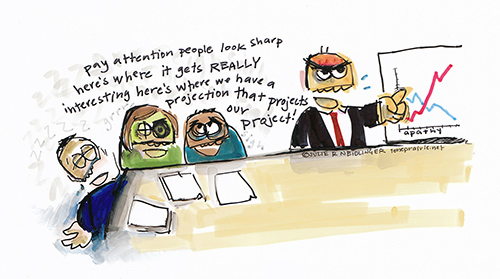
meetingsWe are in meetings regularly but how many of them are productive?  The minutes grind by slowly as the group argues over what it’s supposed to be doing and everyone is anxious to get back to their desks.  A couple weeks later, you repeat the same meeting because no one remembers what was decided or who was responsible.  I’ve been there hundreds of times but it improved about fifteen years ago when I began following the principles in How to Make Meetings Work by Michael Doyle and David Strauss (1993).  It introduced me to the value of agendas, the decision-making process, and the important role of a facilitator.  The facilitator is a neutral third party whose sole purpose is to manage the meeting process and ensure it is productive.  He or she doesn’t make decisions but helps the group discuss issues collegially to arrive at decisions thoughtfully.  The facilitator makes meetings easier, putting grease on the gears that would otherwise grind and bind.  If you’re a regular reader of this blog, you are probably serve as a facilitator from time to time.

Over the years I’ve become increasingly aware of the importance of facilitation, especially as organizations move from a top-down, command-and-control form of management to Continue reading