Webinar: Better Board Governance

Stanford Social Innovation Review, a quarterly journal devoted to informing and inspiring leaders of social change, is hosting a free hour-long webinar on improving board performance on Wednesday, May 21, 2014 at 2 pm Eastern/11 am Pacific. This webinar is for non-profit board members, executive directors, and managers/staff who work with board members—anyone who seeks to create an organization with consistently effective governance in order to radically increase impact for its community and visitors.  Thanks to the support of the Henry R. Kravis Prize in Leadership, this webinar is free but advance registration is required.

In this webinar you will learn the nine attributes of effective nonprofit board governance and be able to make significant improvements in your organization’s board. Join Kim Starkey Jonker and William F. Meehan III as they expand on their recent Stanford Social Innovation Review article, “A Better Board Will Make You Better.” They will discuss the difficulties of achieving consistently effective governance and provide actionable suggestions for overcoming these challenges. Kathy Spahn, recipient of the 2014 Henry R. Kravis Prize in Leadership, will join Jonker and Meehan to discuss Helen Keller International’s governance experiences and provide real-world examples about what works. 


The Future of Leadership: A Perspective from Business Workforce Trainers

Strategy and leadershipWhat’s the future of leadership look like? Five leaders in the field of business workforce training and development shared their perspectives at a session at the 2014 ASTD conference yesterday (and just renamed itself the Association for Talent Development).  In the conversation, Debbie Blanchard (Ken Blanchard Companies), James Kirkpatrick (Kirkpatrick Partners), Halley Bock (Fierce, Inc.) and Tacy Byham (Development Dimensions International) discussed their experiences and observations as consultants who work with companies around the world.  The session was presented in a question-and-answer format, but I’ve synthesized and distilled their responses to highlight key ideas.

1.  Leadership is not a “soft skill”; it is an intentional practice to improve organizational performance and profitability.  You cannot thrust people into leadership to see if they can swim, instead it has to be initiated, conducted, and practiced intentionally.

2.  Leadership has moved from a hierarchical, single command-and-control structure to Continue reading

What’s the ROI of Your Historic Site?

Jack Phillips (right) discussing ROI at ASTD 2014.

Jack Phillips (right) discussing ROI at ASTD 2014.

Foundations and donors are increasingly questioning the impact of their funds at museums and historic sites, a trend that’s growing as well in  business according to Jack Phillips and James Kirkpatrick at a session at the ASTD conference yesterday. After the recent recession, they’ve found that CEOs are increasingly asking about the return on investment (ROI) of every program and activity, including employee training and education.  Although training claims to be an essential contributor to business productivity and performance, it hasn’t been adequately measured or evaluated, and thus can’t prove their value.  That surprised me because I thought that was a struggle only for museums and historic sites.  We seem to be continually fighting to prove our worth and other than economic impact, haven’t been able to show why we matter in our communities.  It looks like we’re not alone.

Phillips and Kirkpatrick are the leaders in the field of measuring performance in business and developed frameworks that “define the levels at which programs are evaluated and how data are captured at different times from different sources.”  Although they disagree on whether the framework should have four or five levels, they both agree that Continue reading

Getting the Big Picture of Training

This slideshow requires JavaScript.

This week I’m attending the annual conference of the American Society of Training and Development (ASTD) in Washington, DC, the “world’s largest professional association dedicated to the training and development field.”  There must be thousands of people attending from all over the world and hundreds of educational sessions on training technology, meeting facilitation, staff management, career development, learning measurement, science of learning, and leadership development.  As someone who specializes in interpretation and education at museums and historic sites, it puts my work in a global perspective and I quickly realized that while business spends more than $160 billion (yes, billion) annually on workforce learning to maximize their return on investment, non-profit organizations do very little in this area.  Thankfully, many of our professional associations provide this essential service.

Although I won’t be able to share everything I learn at the conference this week, I’ll try to share some highlights.  Yesterday Ruth Clark, author of Evidence-Based Training Methods, discussed some of the misconceptions around learning styles, a framework that Continue reading

Video: David McCullough’s 5 Lessons Every High School Student Show Know

In this 5:17 video, author David McCullough shares the five most important ideas high school students should learn before graduating (and it’s not memorizing dates and quotations).  This was recorded by CSPAN at the 2011 National Book Festival.

Can the Exploratorium Help Us Explore History?

Last week I visited the Exploratorium in its new home on Pier 15 in San Francisco. If you haven’t veen there, it’ll seem like a science center but you’ll quickly discover it’s really a place about learning, especially through direct experiences with art, tinkering, and phenomena (yep, that’s how they describe it).  It’s an incredibly active place (almost to the point of overwhelming) that seems to effectively engage its visitors, so I continually watch to see if any of their exhibits or ideas can be applied to historic sites or history museums.  During my latest visit, I found two exhibits that with a mild tweak could be really be innovative for interpreting history.

This slideshow requires JavaScript.

1.  Question Bridge:  Black Males.  This temporary exhibit is, “comprised of many individuals asking and answering questions about the experience of black men in modern America.”  Inside the small dark room are Continue reading

Video: 2014 NCPH Conference Recap

The Institute of Oral History at the University of Texas at El Paso just produced a 2:49 video covering the 2014 annual conference of the National Council Public History in Monterey, California.   Using video from the conference and Monterey along with interviews, it highlights the value of the conference.  This was created by Karina Arroyo and Jesus Genaro Limon, who I believe are students at UTEP.  Perhaps your site could create something like this for your events or conferences with the help of a local college or university.  

Ten Answers to Eleven Questions of Museum Bloggers

On March 19, the Berlin Museum of Natural History launched a series of eleven questions for museum bloggers on Museum Blogger Day, which is slowly making its way around the blogosphere.   I received the list of questions from Gretchen Jennings of Museum Commons, who received it from Linda Norris at the Uncatalogued Museum, who received it from Jamie Glavic at Museum Minute, who received it from Jenni at Museum Diary, who received it from the Museum Things blog at Natureskundemuseum.   I suppose this might be a new version of the old “chain letter,” but more fun and with no dire consequences if you fail to participate (and of course, the questions were modified along the way, just like a telephone tree).   It’s also introduced me to another neighborhood of bloggers!

1. Who are you and what do you like about blogging?

I’m the president of Engaging Places, LLC, a design and strategy firm that connects people to historic places.  I love visiting and working with museums and historic sites, so the blog allows me to Continue reading

Webinar: Making Heritage Tourism Work for Your Community

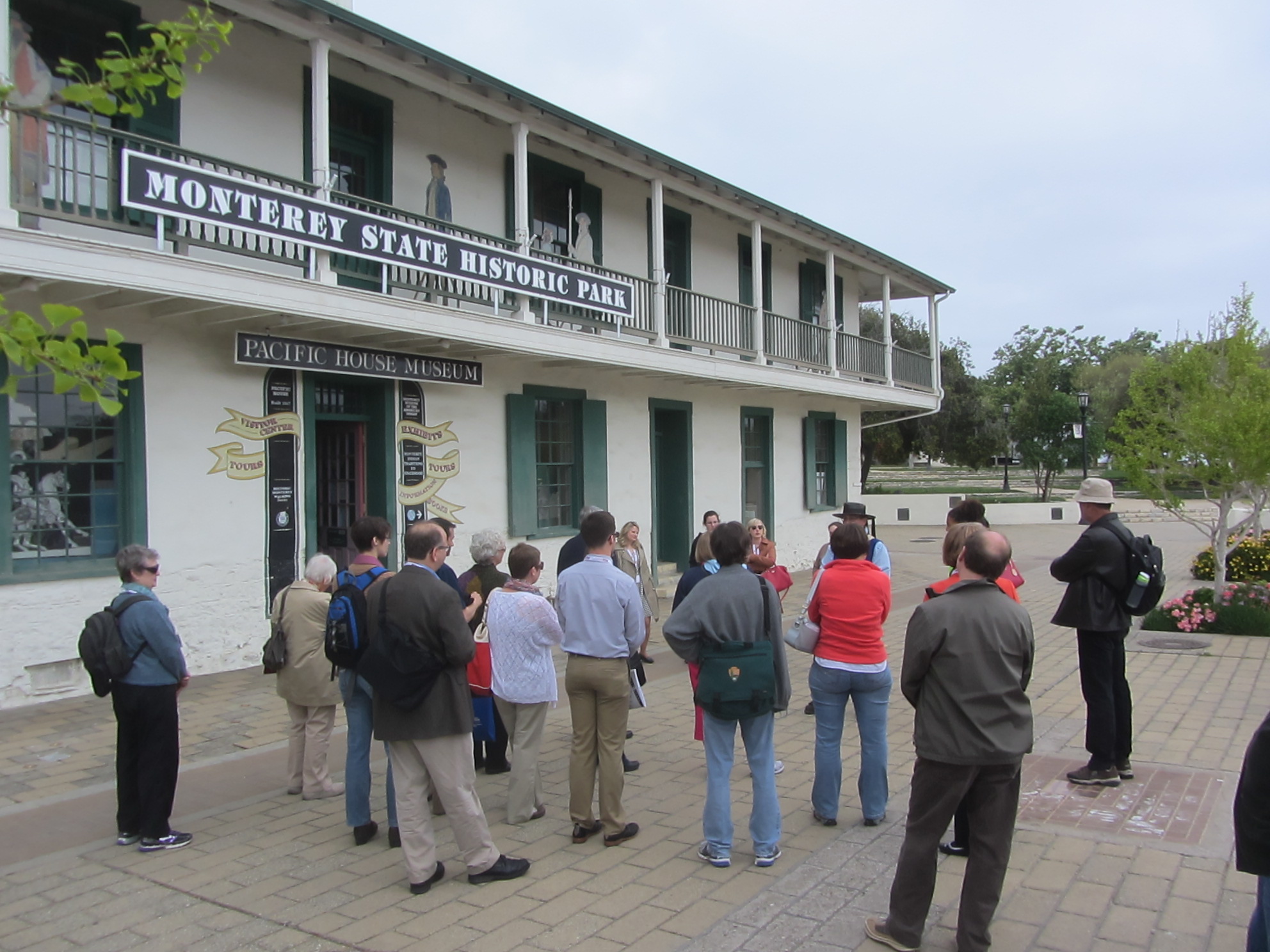
Walking tour of historic Monterey, California.

Walking tour of historic Monterey, California.

Heritage tourism is a growing industry that can improve community engagement, economic revitalization, and preservation advocacy. People want authentic and meaningful experiences—and are willing to pay for them.  On May 13, 2014 from 12 noon to 1:30 pm Pacific Time, I’ll be presenting a webinar for the California Preservation Foundation exploring the benefits of heritage tourism and how it may (or may not) benefit your community or region. We will examine the latest research on the motivations and interests of tourists (they’re not all alike), how to identify or create destinations that will attract tourists, and how to build support and attract funding for a heritage tourism program.  You’ll learn the overall elements of a heritage tourism program and leave with a list of the next steps to take in your community.  Although much of the webinar will be focused on California, the principles and process for developing a heritage tourism program will be same for other places.  Cost is $45 for CPF members ($60 for non-members) and advance registration is required.

It’s part of a three-part webinar series on economic development using historic preservation from the California Preservation Foundation.  For those interested in continuing education credit, it’s available for AIA, AICP, and ASLA.