
Chowder Inc. recently produced this 4:45 video promoting the Mark Twin House and Museum in Connecticut. It’s a gentle tour of the house interspersed with comments by “visitors” wearing Twain’s signature mustache.
Museum Advocacy Day Highlights
Last week was Museums Advocacy Day and this week is Historic Preservation Advocacy Day, so Congress is getting lots of visits from people who care about our nation’s history and culture.
Museums Advocacy Day has improved each year. The schedule is well organized and the training and materials are thoughtfully assembled to give everyone a clear idea of what might happen during a congressional visit and the priorities for requests (with lots of good background information so you can speak about issues confidently). At the top of the list was a request for “robust funding” for the Office of Museum Services at IMLS, protection of the charitable deduction, and permission for museums to be eligible with schools for federal teacher training funds. Even if you weren’t able to join us, the American Alliance of Museums provides lots of information and ideas for advocacy at home (although the handy “Issues at a Glance” from the Advocate Handbook doesn’t seem to be available online).
IMLS, NEH, NPS, NFS, and NEA talked about their needs but they didn’t seem to be aware Continue reading
Video: The Leopold Museum
A hip video by Philipp Kaindl promoting the Leopold Museum in Vienna, which houses the world’s largest collection of paintings by Egon Schiele. The video is not just about the collections but also the activities and people in and around the museum and told without any words. Can any of these ideas be applied to historic sites or history museums?
Video: Review of “12 Years a Slave”
Azie Dungey, star and producer of “Ask a Slave,” and actress Amani Starnes, creator of “United Colors of Amani,” reflect on “12 Years a Slave,” the award-winning movie directed by Steve McQueen.
Period Rooms at a Modern University
During a recent visit to Pittsburgh, I visited the Cathedral of Learning at the University of Pittsburgh. At 535 feet, it’s the tallest university building in the nation and dominates the skyline east of downtown. Despite its name, it’s more skyscraper than cathedral. It’s also an historical and architectural landmark, built between 1926 and 1937 as an Art Deco “cake” with Gothic Revival “frosting.” For those of us working at historic house museums, what’s most interesting are the Nationality Rooms, a series of 29 classrooms on the first and third floors designed and furnished to represent different nations and ethnicities.
The classrooms vary in size but each have Continue reading
Video: Ask a Slave, Episode 1
In honor of Black History Month, we’re sharing Ask a Slave, a series of short interviews with Lizzie Mae, “personal housemaid to President and Lady Washington.” It’s based on the experiences of Azie Dungey, who was an interpreter at George Washington’s Mt. Vernon. She wrote, produced, and created these videos as a way to, “present all of the most interesting, and somewhat infuriating encounters that I had, the feelings that they brought up, and the questions that they left unanswered. I do not think that Ask A Slave is a perfect way to do so, but I think that it is a fun, and a hopefully somewhat enriching start.” Although Dungey portrays an enslaved African servant, many of her experiences are shared by others who interpret historic sites, no matter the period or topic. For those of us working at historic sites, they’re incredibly funny but they also reveal some of the challenges we have interpreting other times and places. You’ll want to look at some the comments on YouTube to get the full national scope, plus take a look at the number of views to get a sense of the impact.
Dungey is currently working in Los Angeles on another series, although focused on the 19th century. Can’t wait to see what she produces.
Interpreting African American History at Your Site or Museum?
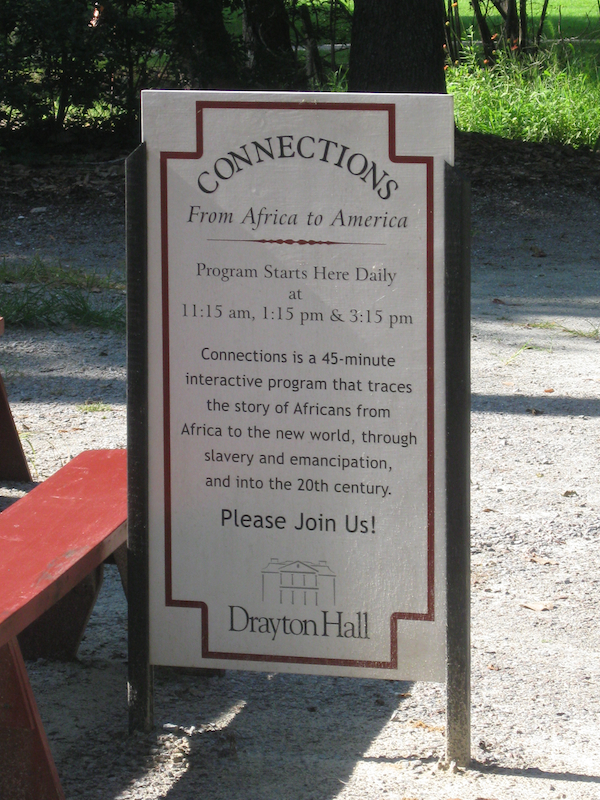
Every day Drayton Hall offers “Connections,” a 45-minute program that traces the story of Africans from Africa to the new world and into the 20th century.
If you’ve been involved with the planning, development, presentation, or evaluation of an outstanding exhibit, program, or project interpretation of African American history and culture at a museum or historic site in the last five years, consider sharing it as a case study for a book I’m editing for Rowman and Littlefield Publishers. This book will be part of a series on the interpretation of various topics published by the American Association for State and Local History that are slated for release later this year. The first part of the book will be a wide-ranging anthology of articles written by experts and scholars from a variety of perspectives, including Bernard Powers, Matthew Pinsker, Kristin Gallas, James DeWolf Perry, George McDaniel, Amanda Seymour, Donna Graves, Julia Rose, and Lila Teresa Church with a foreword written by Lonnie Bunch. If you know any of these people, you know it’ll be an interesting and thought-provoking book.
I need help with the second half of the book: a set of 12-16 case studies of exemplary programs that can be adapted by others. Are you aware of any Continue reading
Unsettling State of State Historical Societies
In preparation for my presentations at the upcoming Historic House Symposium at Gunston Hall and the National Council on Public History annual meeting, I’m analyzing financial information about history organizations in the United States. I’m currently researching state historical societies, working my way from the most populous state (California with 37 million residents) to the least (Wyoming with about half a million residents). So far I’m about halfway done, but I wanted to share what I’ve learned and get your reactions.
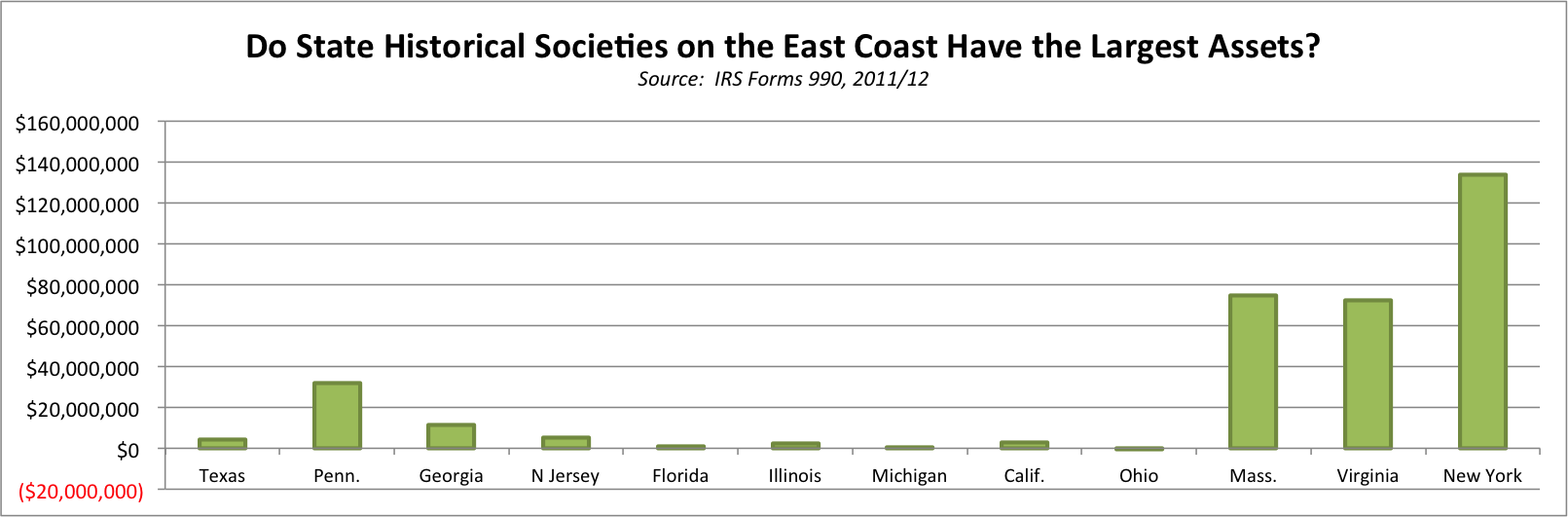
Among my preliminary discoveries is the dramatic difference among state historical societies. Some are incredibly big (the New York Historical Society has $133 million in net assets) and some states don’t seem to have a statewide historical society (anyone know what’s happening in North Carolina?). One might assume that the biggest states have the biggest historical societies, but Continue reading
Video: Passing
An excerpt from “Passing,” a one-woman play written and directed by Dara Harper and performed by Holly Smokovitz from February 1-16, 2014 at the Charles H. Wright Museum of African American History.
Exploring History and Historic Sites in Monterey in March 2014

Historic downtown Monterey with the Cooper-Molera Adobe in the background.
The National Council on Public History will hold its annual conference in Monterey, California from March 19-22, 2014. It will be the first time I’ve attended a NCPH conference and I’m thrilled–the schedule is packed with a variety of sessions that will appeal to those who are working on the cutting edge of historic sites and house museums, including:
- Educational sessions on co-created exhibits, tribal partnerships, preserving LGBT sites, interpreting slavery, the history of museums, stewardship of archaeological sites, cultural landscapes, and the sustainability of museums.
- “THATCamp NCPH” is an afternoon learning laboratory on digital projects that Continue reading
 Engaging Places