If you hear the words, “experiential, expeditionary, or hands-on learning,” “adventure education,” or “outdoor education director” in your school district, it may be an opportunity to present your museum or historic site as a valuable resource. For decades, schools have focused on formal educational process emphasizing lectures and textbooks, but that seems to be changing according to Jenny Anderson in her New York Times article, “For Bronx Private School, All the City’s a Classroom in an Experiential Course.” She describes the City Semester: The Bronx Experience, new educational venture by the private Ethical Cultural Fieldson School. It’s a semester-long program that, “integrates history, English, science, ethics, language, civic leadership and the arts around the study of New York City- through the lens of the Bronx. Like other semester programs, City Semester offers a chance to step outside your everyday routine, have an adventure, challenge your assumptions and grow in new ways.” Each week the class combines classwork with at least one day in the city visiting businesses and historic sites (such as Woodlawn Cemetery and the Louis Armstrong House), Continue reading
VSA: Why Teachers Visit Historic Sites
The April 2012 (15:1) issue of Visitor Studies, the semi-annual journal of the Visitor Studies Association, just arrived and it includes, “Motivating Participation in National Park Service Curriculum-Based Education Programs” by Marc Stern, Elizabeth Wright, and Robert Powell. It’s a rare examination of the reasons why teachers visit (or don’t visit) historic sites. For anyone that provides school programs, its findings provide some useful guidelines.
The study attempts to “understand why teachers at schools within the immediate vicinity of Great Smoky Mountains National Park attend, or don’t attend, the park’s curriculum-based programs.” To discover the perceived benefits and disadvantages of participation, they conducted a preliminary focus group with teachers and then surveyed 400 teachers in fourteen schools and interviewed school administrators. Although this study’s focus was on a national park’s programs for a middle and high school audience, there are some surprising findings that may cause you to question your assumptions even if you’re an historic site focusing on the elementary grade levels. Here’s a quick summary:
- Administrators are most concerned about Continue reading
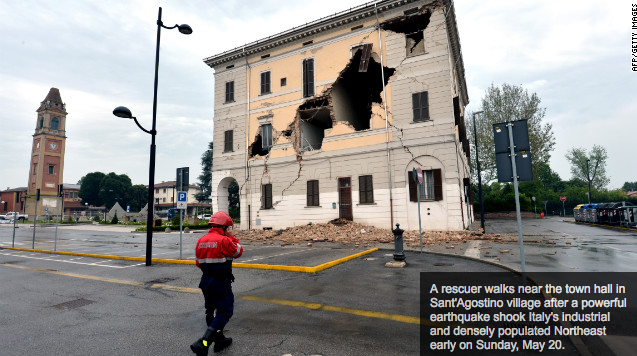
Earthquake in Northern Italy destroys Historic Sites
On Sunday morning, the area near Bologna in northern Italy was struck by a major earthquake with aftershocks occurring today. Damage to historic buildings is significant and about seven people have died. Information is still coming in but the latest on CNN (with many photos) is:
Northern Italy was shaken by an aftershock Monday morning, a day after a magnitude-6.0 quake killed at least seven people and left thousands of survivors huddling in tents or cars overnight. Continue reading
A Collections Loan that Would Prompt a Career Change
The National Gallery of Art in Washington, DC, holds “The Farm,” one of Joan Miro’s masterpieces and its provenance makes for a great story as told by Jim Conaway in “Getting the Picture” in the May 2012 issue of Washingtonian. Here’s a glimpse into its complex history when the painting was owned by Ernest Hemingway and slated for an exhibition loan:
Alcohol–and his own vituperation–was catching up to Hemingway by 1959, when, then on his fourth and final wife, Mary, he agreed to loan “The Farm” to the Museum of Modern Art. Hemingway was nervous about exposing the painting to the hostilities stirred by Fidel Castro’s revolution while trying to get it out of the country [Cuba]. He insisted that the museum insure “The Farm” and send an emissary to squire it back to New York, but no company would issue such a policy.
Hemingway finally agreed to let the museum’s emissary, David Vance, take the painting, but he ran into roadblocks: Continue reading
2012 Webby Awards Point Out Models for Historic Sites
Historic sites are always looking for good models for online activities, such as websites and mobile applications, and one of the best places to look for inspiration is the annual Webby Awards, the leading international award honoring excellence on the Internet. Established in 1996 during the Web’s infancy, the Webbys are presented by the International Academy of Digital Arts and Sciences.
The 2012 Webby Awards received nearly 10,000 entries from over 60 countries and all 50 states and awards were given in over a hundred categories for website, interactive advertising and media, online film and video, and mobile and apps. As a result, there is a lot to cull through but here are several that seem to be most related to historic sites (and hang on, this is a long list):
-

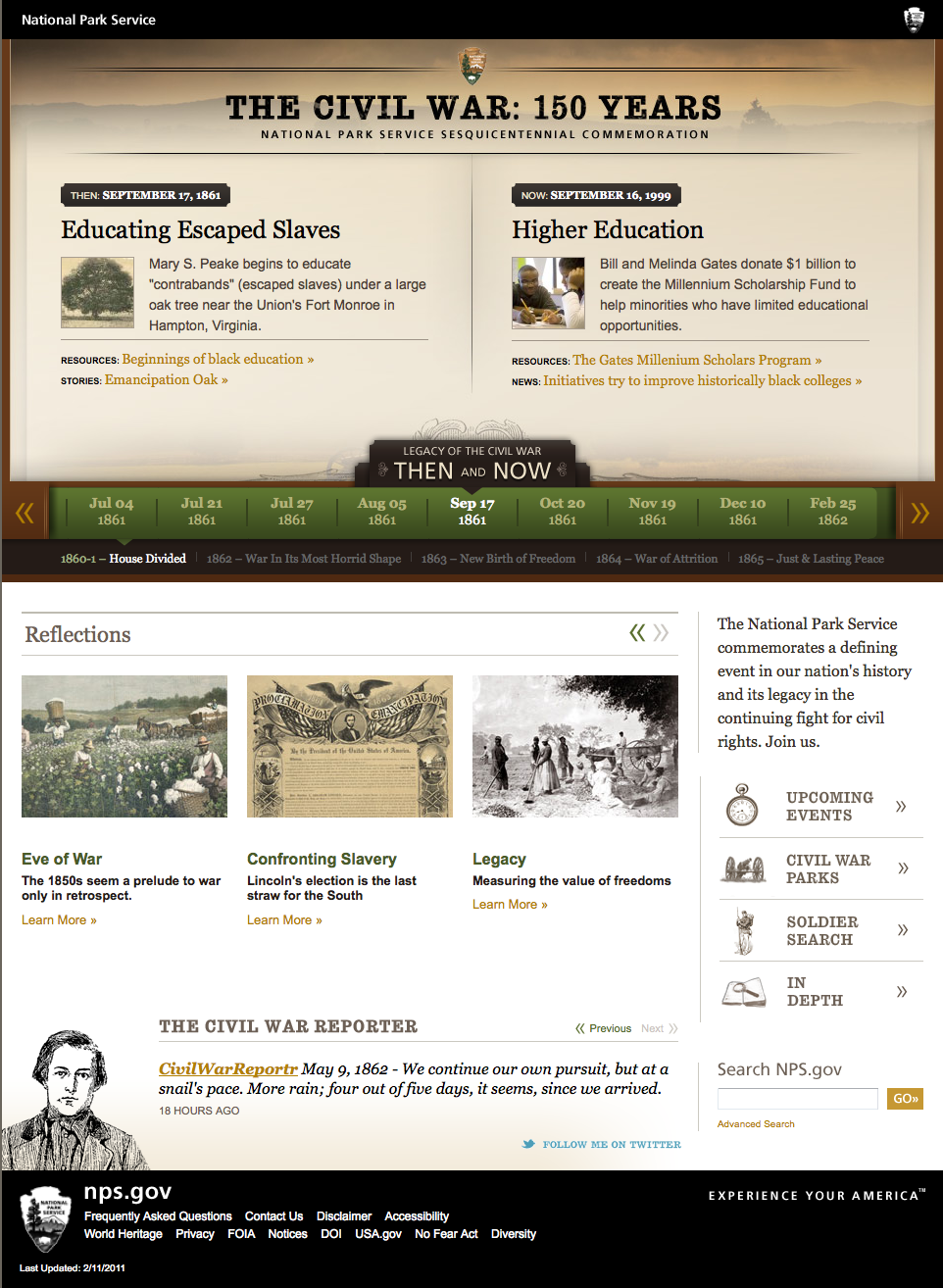
NPS’ Civil War: 150 Years features a Then and Now Timeline at the top and a Civil War Reporter sending tweets at the bottom.
The Civil War: 150 Years has the form and content of websites that will be most familiar to historic sites, except that it commemorates “a defining event in our nation’s history and its legacy in the continuing fight for civil rights” rather than a specific place. I like their use of Twitter to create a virtual “Civil War Reporter” whose tweets report on events from the 1860s but the major innovation is the featured Then and Now Timeline that compares similar events during the Civil War and today (although I was only able to jump months, not years). Another way to compare the past and the present is demonstrated by Slavery Footprint, a website and mobile app that was launched on the 149th anniversary of the announcement of the Emancipation Proclamation. It’s designed to raise awareness of modern-day slavery and can tell you approximately how many slaves have pitched in to make the goods you enjoy on a daily basis.
- Timelines appeared in several other forms in the winning entries and along with the Then and Now version is Continue reading
Sold! Frank Lloyd Wright Home and Studio in Oak Park
On Monday, the National Trust for Historic Preservation sold Frank Lloyd Wright’s Home and Studio in Oak Park, Illinois but don’t worry, it’ll still be preserved and open to the public. It was acquired by the Frank Lloyd Wright Preservation Trust, who has been operating and managing the site for nearly four decades and I suspect will be there for many more. In the 1970s, the FLWPT was a fledging organization that was attempting to save the Prairie-style home and studio of Frank Lloyd Wright, which had become badly deteriorated and cut up into a half dozen apartments by a private owner. It didn’t have the ability to purchase the property when it came up for sale, so they partnered with the National Trust to buy the property. The FLWPT would eventually repay the National Trust for its half of the $260,000 purchase price but in the meantime, the National Trust would hold the title and lease it to the FLWPT at a nominal price. The success of this venture prompted these two organizations to partner on the preservation of the Robie House, a Frank Lloyd Wright masterpiece which is owned by the University of Chicago but was badly maintained (another example of a university mistreating historic places!). With the sale of the Home and Studio, the Robie House partnership is also concluded and the FLWPT will work directly with the University.
I’m not sure what the change in relationship means, but just a few days ago, the Robie House and Frank Lloyd Wright Home and Studio were National Trust Historic Sites, two of 29 historic places sprinkled across the United States. It’s a ragtag collection that by itself makes no interpretive sense, doesn’t adequately represent American history or culture, isn’t connected by ownership (some NTHS are owned by others) or management (most NTHS are operated by other non-profits), and wasn’t formed to achieve a specific strategy or vision (they were mostly added as opportunities arose, donors made offers, or presidents were seduced). But with this transition, I hope it sparks some discussion around two important national issues for historic sites: Continue reading
Details on the new National Museum of African American History and Culture
Yesterday I joined a meeting of the curatorial and education staff at the National Museum of African American History and Culture to discuss a potential partnership with Drayton Hall, and it was great to see again Rex Ellis, Debbie Mack, Bill Pretzer, and Michele Gates Moresi as well as meet so many of the other staff who are working to make this new museum a reality. The museum recently broke ground on the Mall in Washington, DC and is scheduled to open in 2015.
While I was there, I spied a three-dimensional model of the new museum in the lobby and it thought I’d share some photos to give you a close up of the design (and sorry for the reflections–it’s in a vitrine near a big window). Freelon Adjaye Bond/SmithGroup, a consortium of four independent architectural firms that designed the building, laid out this vision: Continue reading
iPavement
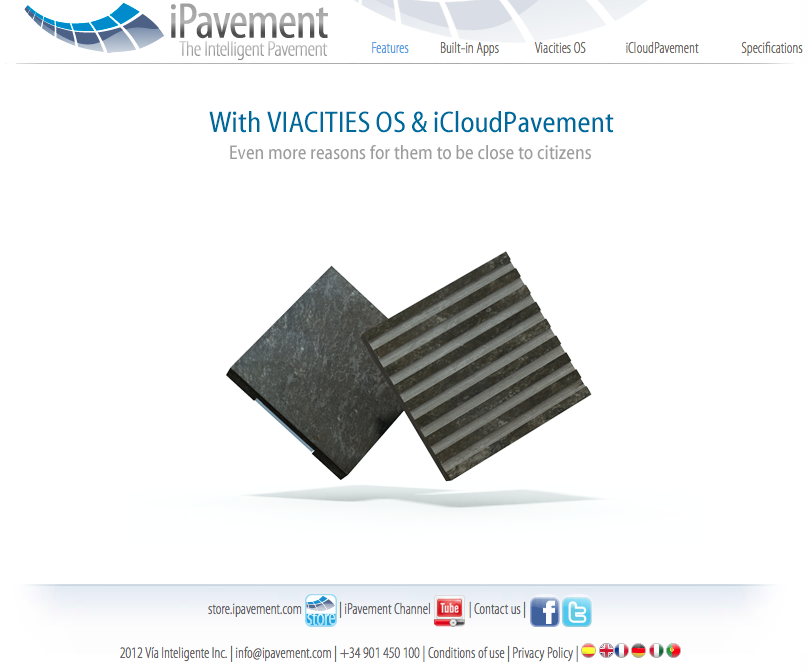
Looking to connect your historic site to the information superhighway? You might be interested in the newest gizmo out of Spain: iPavement. It’s a 16 x 16 inch calcium carbonate paving tile with a computer inside the three-inch thick body. The computer operates under Linux, has motion and temperature sensors, and provides wifi and Bluetooth access. And it also comes in a grooved anti-slip surface and operates between -22 to 167 degrees Fahrenheit (that’s probably sufficient; I can’t imagine any pedestrians walking on these pavers outside of these extremes).
What would you do with this high tech tile? According to the website, you can use its various integrated apps to “transform streets from analogical to digital entities” by:
- putting a library on the street. It can be a “highly useful distribution tool for the promotion of culture and the distribution of works in digital media.”
- sending alerts by phone or email of icy or hazardous conditions.
- monitoring pedestrian use to provide you Continue reading
Let’s Give SWOT a REST
A SWOT analysis (a listing of strengths, weaknesses, opportunities, and threats) is a common exercise in business planning and reached the shores of the non-profit world decades ago. Some of you probably have experienced a SWOT analysis at your site as part of your strategic or long-range planning. The staff and board gathers around a flipchart to list your organization’s internal strengths and weaknesses, and then your external opportunities and threats. Sometimes there’s a bit of confusion over definitions (what’s a threat?) or where an item should be listed (is this a strength or opportunity?). You might feel a bit of competition to mention a particularly incisive opportunity or are sweating because you can’t name a strength (all the good ones have already been mentioned!). Eventually, the list might be prioritized and some items consolidated so it can be typed up and included in the strategic plan as a basis for decision-making.
Despite its popularity, I’ve come to the conclusion that we need to give SWOT a rest:
- The analysis depends heavily on the people participating and it’ll always be biased in that direction. If you conduct a SWOT exercise with board members who really aren’t involved with the organization, the analysis will probably be superficial and light. Stock the group with lots of educators, the results will lean towards education. There are no surprises here–people talk about what they know. The problem is that the bias is typically not recognized and you wind up building a plan on a foundation that’s skewed or weak.
- It’s often long on strengths and even longer on Continue reading
WebWise 2012: Managing Oral History Collections and Projects
The final session from WebWise 2012 that I’ll be reporting on is creating and preserving oral history collections. If you think that oral histories are just about recording hour-long interviews with oldtimers, the digital age has changed that considerably. Not only are oral histories collected digitally, but they are being presented in many new ways, including audio tours, podcasts, radio programs, and in websites. Remember, if you want the complete details, the videos from WebWise are now available at online and you’ll find this session on Day Two.
Eileen McAdam discussed how she was using 21st century tools to reach new audiences. She’s been working for many years to engage people in the Hudson Valley through stories through the Sound and Story Project of the Hudson Valley. Rather than deliver audio tours as lectures, she presents stories from the people who live there. She noted that it was difficult to find oral histories that were recorded previously (often they’re not catalogued or easily available) which led to a partnership project to identify what had been done, conduct condition assessments, access the content, and then use the materials to engage new audiences. Much of the initial growth of oral histories came with the availability of inexpensive cassette tape recorders in the 1970s and this project’s work was to graduate these collections to digital formats. In her presentation, she outlined the process of digitizing and editing files to select compelling content and create 1-2 minute stories, recommending Audacity (free), Garage Band (comes with Mac), and Hindenburg (inexpensive), and providing some examples of edited snippets and presentation methods, including Continue reading