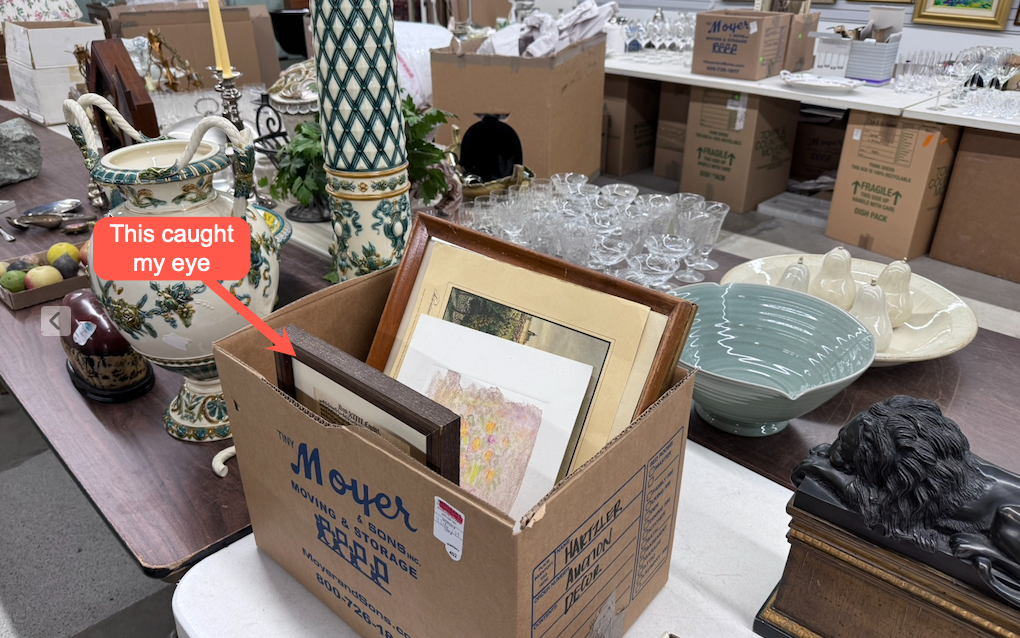
It was a brown cardboard box at a local auction filled with framed prints and miscellaneous ephemera. The sort of lot you bid on partly out of curiosity and partly because, if you’re lucky, you might discover something interesting. I did—it was a framed page from a 500-year-old German book.
As a historian, I enjoy reading. But more than that, I love books as objects. Their design, typography, and material presence give me tremendous joy. I got the bug in college in a federal work-study position in the rare books and special collections department of the library, where I learned how much evidence a single page can hold: paper quality, typeface, layout, illustration style, and wear patterns can all reveal a story before you even understand the words.
This page immediately caught my attention.
The typeface was Gothic, clearly German, probably around 1500. But the illustrations were strange. Instead of familiar late-medieval imagery (saints, cities, plants, kings) one woodcut showed a man lying in bed while another pressed a knife to his neck. Another showed a dining table with people seated around a severed head on a platter. Huh?
It was unmistakably early printed material, but not religious, political, or medical.
In an earlier post, I shared a sneak peek of our book, Interpreting Christmas at Museums and Historic Sites. Next week, Ken and I will provide a comprehensive overview during the upcoming AASLH webinar, “Jingle All the Way: Maximizing Your Museum’s Holiday Potential.” This webinar draws from the book but is not an hour-long sales pitch. Instead, we’ll share key advice and ideas on leveraging holiday celebrations, researching the local history of Christmas, planning and hosting holiday events, expanding traditional programs, and enhancing cultural sensitivity and inclusivity. With so much to cover, we’ll be hitting the highlights. If you’re seeking inspiration for Christmas during these hot summer days, join us on July 23, 2024 at 3:00 pm Eastern. For more details and to register, visit here. Plus, you’ll receive a 30% discount code for the book upon registration.
With proofs in hand, the book is moving closer to reality with a publishing date in fall, but more likely later than earlier. It has 21 chapters, 40 images, and an extensive bibliography of nearly 175 books and articles packed into 270 pages, which is about 25% longer than my Interpreting African American History and Culture at Museums and Historic Sites that Rowman & Littlefield published ten years ago (btw, Rowman was recently acquired by Bloomsbury Publishing). It’s now available for pre-order at Rowman.com for $50 for paperback and a jaw-dropping $125 for hardcover (I don’t set the prices but a 30% discount code is available for webinar attendees).
Behind the Scenes of Indexing
Ken Turino, Sara Bhatia, and I spent nearly two months creating he index, despite the publisher allocating just two weeks. The delay was partly due to other commitments (I was closing out the semester and attending the Newport Summer School), but also because the scope of the book made it significantly more complex. As anticipated, there’s an abundance of content on gifts, trees, lights, ornaments, decorating, and a variety of Santas. Rather than list two dozen pages that mention “lights,” we added subheadings for candles and electric lights, as well as safety considerations, and included “see also” references to help readers find specific information more quickly. But geez, that was slow going.
My chapter, “I’m Dreaming of a Warm Christmas: Researching California (and Other Local Places)” was initially indexed by GPT-3.5, then corrected manually as seen in this example. GPT-4o is more accurate when trained for indexing, but every entry still needs to be confirmed.
We experimented with GPT to produce the index, and the results were mixed. While GPT can generate an initial index with proper nouns and some concepts correctly formatted with page numbers, about half of the entries are usually either missing or incorrect (see example above). Thus, manual review of the proofs is still necessary, but at least GPT provides a head start. If you are interested in learning more in using GPT for indexing, I’m happy to share what I learned.
The index eventually grew to 22 pages, which is longer than most chapters! Indexing required a meticulous review of every page, during which we discovered errors that had slipped past four proofreaders. Ugh. Should we consider these flaws a characteristic of an artisanal, handcrafted gift to the field?
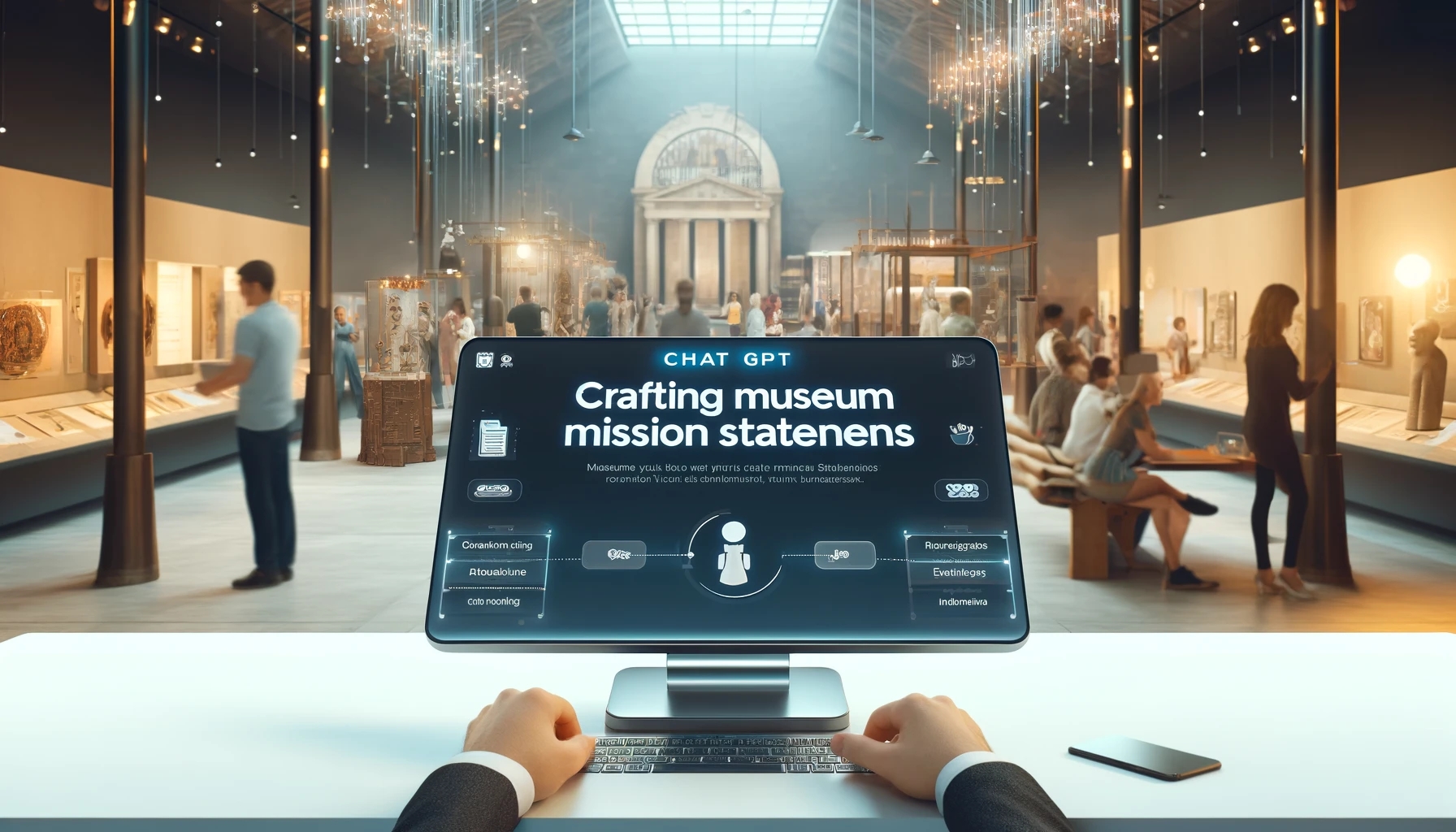
ChatGPT-4o created this image in less than a minute.
The highly anticipated release of ChatGPT-4o has once again thrust artificial intelligence (AI) into the spotlight. So how can historic sites and house museums harness the power of ChatGPT to craft thought-provoking mission statements, an essential element of effective management?
The American Alliance of Museums states that excellence requires that, “all aspects of the museum’s operations are integrated and focused on meeting its mission.” And yet, crafting mission statements is among the most difficult tasks for an organization. Writing and revising as a board or staff committee can result in circular arguments, the infinite parsing of words, or resignation to a milk-toast statement that offends no one. So how can you take a mission statement that’s weak or mild and turn it into something stronger and more meaningful?
My typical response is that a small committee of diverse leaders within the organization discuss the purpose and role of the museum in the community, and then appoint one person to draft a mission statement for approval. Although that’s much more effective than writing-by-committee, it can also result in a tremendous commitment of time and frustrations during the review as members defend their ideas. Instead, I’ve found ChatGPT to be much more efficient and less frustrating. You can revise frequently and quickly, try out variants and new ideas easily, and even better, criticize the “robot” and it won’t care.
The mission of The Gamble House is to inspire the public’s appreciation and understanding of architecture as a fine art through the example of The Gamble House, the most complete and best-preserved work of American Arts and Crafts architects Charles and Henry Greene.
Using a simple prompt, “Create a mission statement for the Gamble House in Pasadena, California,” ChatGPT-3’s version was:
Our mission at the Gamble House is to preserve and celebrate the legacy of this iconic American Arts and Crafts masterpiece. As a cultural destination and community resource, we aim to inspire and educate visitors about the significance of the Gamble House’s architecture and design, and its enduring influence on American culture.
The first sentence is the usual celebratory mission statement but notice that the next sentence goes further to explain why it matters today (“its enduring influence on American culture”). That’s a significant improvement that can improve the mission statement’s ability to guide decisions and establish priorities—which is the core function of a mission statement.
Going further, you can use ChatGPT to create mission statements inspired by the ideas of influential thinkers. English designer and writer William Morris inspired the Arts and Crafts Movement, so he’s an ideal choice for the Gamble House. By changing the prompt to, “Create a mission statement for the Gamble House in Pasadena, California in style of William Morris,” the result is:
“Our mission at the Gamble House is to preserve the beauty and integrity of this magnificent home, which is a masterpiece of American craftsmanship and design. Through our efforts to maintain the house and its surroundings in a state of harmony and balance, we seek to embody the principles of the Arts and Crafts movement, which holds that art and beauty should be an integral part of everyday life. By promoting the values of craftsmanship, simplicity, and authenticity, we aim to create a more just and equitable society, one in which the arts and culture are accessible to all, and the beauty of the natural world is cherished and protected.”
Far too long to be a modern mission statement for a museum, it does offer some intriguing ideas, particularly in the last sentence. By mentioning “craftsmanship,” “equitable society,” and “accessible to all,” it addresses values that could be meaningful to modern visitors and supporters of the Gamble House and inspire innovative programming.
In the year that followed, I’ve continued to explore how ChatGPT can help historic sites and house museum improve their mission statements, as well as create a vision and values. Lest anyone think that ChatGPT is a simple mindless hack to the usual hard work of crafting a mission statement, the use of AI requires a thoughtful human hand on the computer keyboard. ChatGPT can be biased, inaccurate, and hallucinate, so you need to know the organization and theories of management strategy. A weak or poor mission statement can harm a nonprofit organization, whether created by humans or AI.
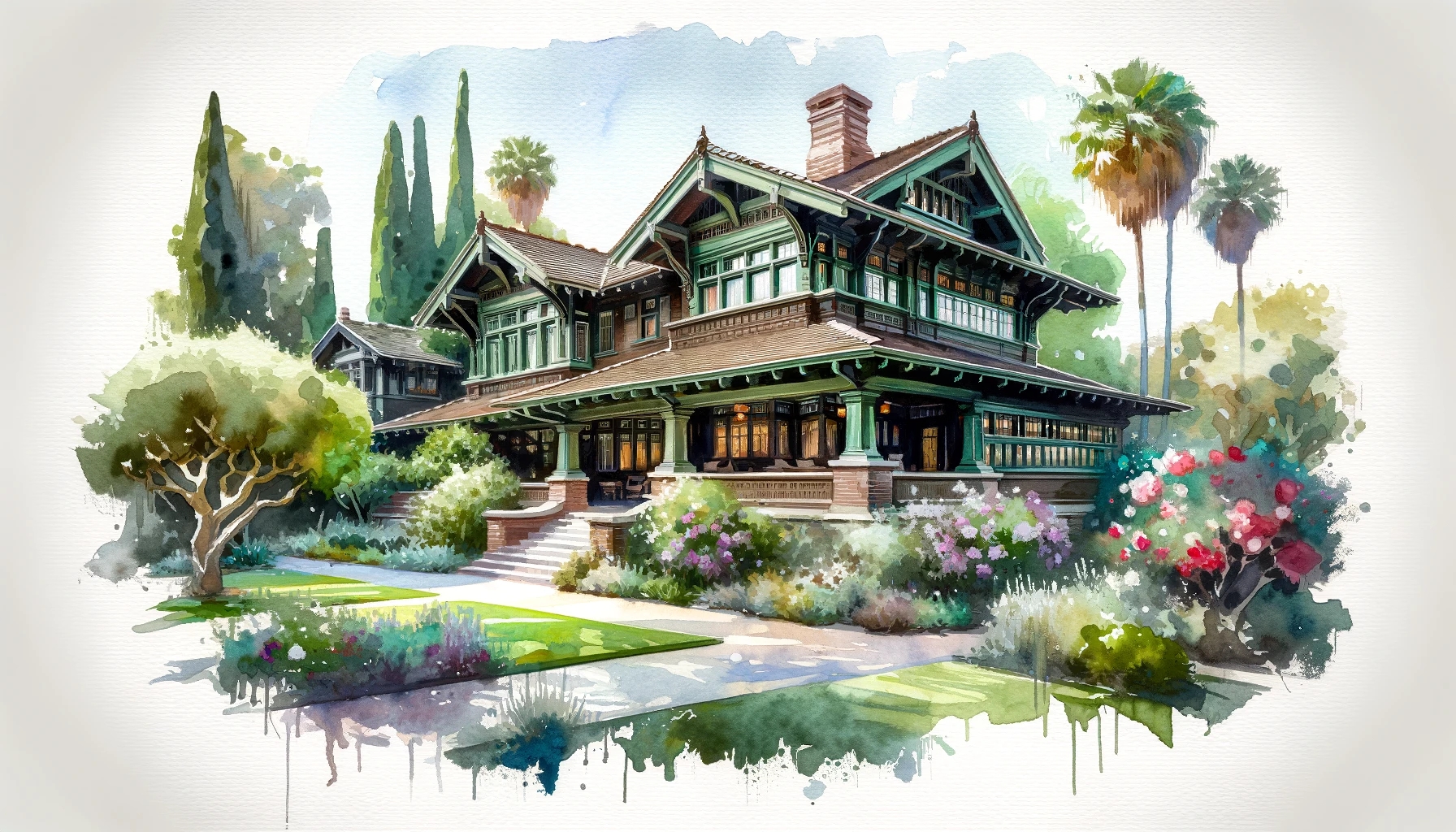
ChatGPT-4o created this image of the Gamble House, demonstrating the need for the human expert—there’s very little that is correct in this image.
Getting Started
If you’re interested in the best explanation and practices of AI and ChatCPT, read Ethan Mollick’s Co-Intelligence: Living and Working with AI (2024) or listen to an interview with him on the HBR IdeaCast, “Tech at Work: What GenAI Means for Companies Right Now.” If you’re interested in practical applications with lots of examples, read AI and the Future of Education (2023) by Priten Shah. AI is being incorporated into an increasing number of applications, including Microsoft Word, Evernote, Notion, and WordPress, but if you want to explore ChatGPT, it is available free with registration at OpenAI.
If you want to use ChatGPT to craft a mission statement, be aware that it relies on the information that is available to it. If your organization has a very small presence on the Internet or in publications (unlike the Gamble House), a simple prompt will be ineffective. You’ll need to take an additional step to provide it with information, such as the museum’s goals, primary audiences, collection strengths, historical background, and what makes it unique or distinctive. If you’re unsure how to do this in ChatGPT, start with the prompt, “I need help writing a mission statement for [your museum name]. Here are the details: [insert information].” You can follow up with additional instructions, such as “”Give me three different mission statement options,” “Can you make this mission statement more engaging for a younger audience?”, or “I like the direction of this mission statement, but can you make it shorter?”
If ChatGPT has helped your organization improve or rethink its mission statement, please share your experiences in the comments.



 Engaging Places