House museums across the country are confronting difficult questions about relevance, sustainability, and meaning in the 21st century. What worked twenty years ago—traditional tours, decorative arts displays, and carefully preserved interiors—often isn’t enough today to engage visitors or generate financial stability. Communities are changing, audiences have new expectations, and historic sites are under increasing pressure to demonstrate their value.
That’s why Ken Turino (formerly at Historic New England) and I developed Reimagining the Historic House Museum, an intensive one-day workshop that helps professionals and volunteers tackle these challenges head-on. Over the past decade, we’ve led this program at sites across the United States, working with hundreds of staff, board members, and volunteers to think creatively about interpretation, audience engagement, and business models. Each workshop is highly interactive, blending case studies, small-group activities, and practical exercises. Participants leave not only with new ideas, but with concrete tools to implement change at their own sites.
This fall and next spring, we’ll be offering two opportunities to join us in person:
I’m excited to announce that I’ll be co-teaching two Reimagining the Historic House Museum workshops in Texas this November with Ken Turino, hosted by the American Association for State and Local History in collaboration with the Texas Historical Commission. It’s a big state, so we’re offering it twice! If you’re a museum professional, volunteer, or student interested in exploring fresh strategies for engaging visitors and revitalizing historic house museums, these workshops are a great opportunity to explore new ideas and connect with colleagues.
Why Attend?
Historic house museums are at a pivotal moment, navigating changes in visitor expectations, community needs, and funding models. These workshops are designed to help you tackle these challenges, offering practical solutions for making your house museum more accessible, sustainable, and relevant. By focusing on innovative interpretation, strategic planning, and community engagement, you’ll be empowered to breathe new life into your historic house museum.
What You’ll Learn
This one-day, hands-on workshop explores the most pressing challenges and rewarding opportunities facing historic sites in America today. We’ll delve into the latest social and economic research to help you identify how these trends impact your own house museum, sparking new ideas for growth and engagement.
Throughout the day, we’ll introduce a variety of field-tested tools and techniques drawn from diverse areas like non-profit management, business strategy, and even software development. You’ll hear about innovative historic sites that are successfully adopting new models to engage their communities, offering fresh interpretation and programming, and generating income to boost financial sustainability.
A key highlight of the workshop is our facilitated brainstorming session based on Michael Porter’s Five Forces framework, where you’ll work with fellow participants to reinvent an event or program for an actual house museum. This practical exercise not only puts theory into action but also showcases the power of collaborative thinking to drive change.
Details and Registration
Mesquite Workshop (near Dallas): November 12, 2024 – Heritage Plaza Visitor Center
Houston Workshop: November 14, 2024 – Bayou Bend Collection and Gardens
Cost: $350 for non-members, $225 for AASLH members
Registration: Visit AASLH’s website for more information and to sign up. Participation is limited.
I hope to see you there as we explore how to bring new life and relevance to historic house museums. Together, let’s make these vital cultural spaces vibrant, engaging, and sustainable for generations to come!
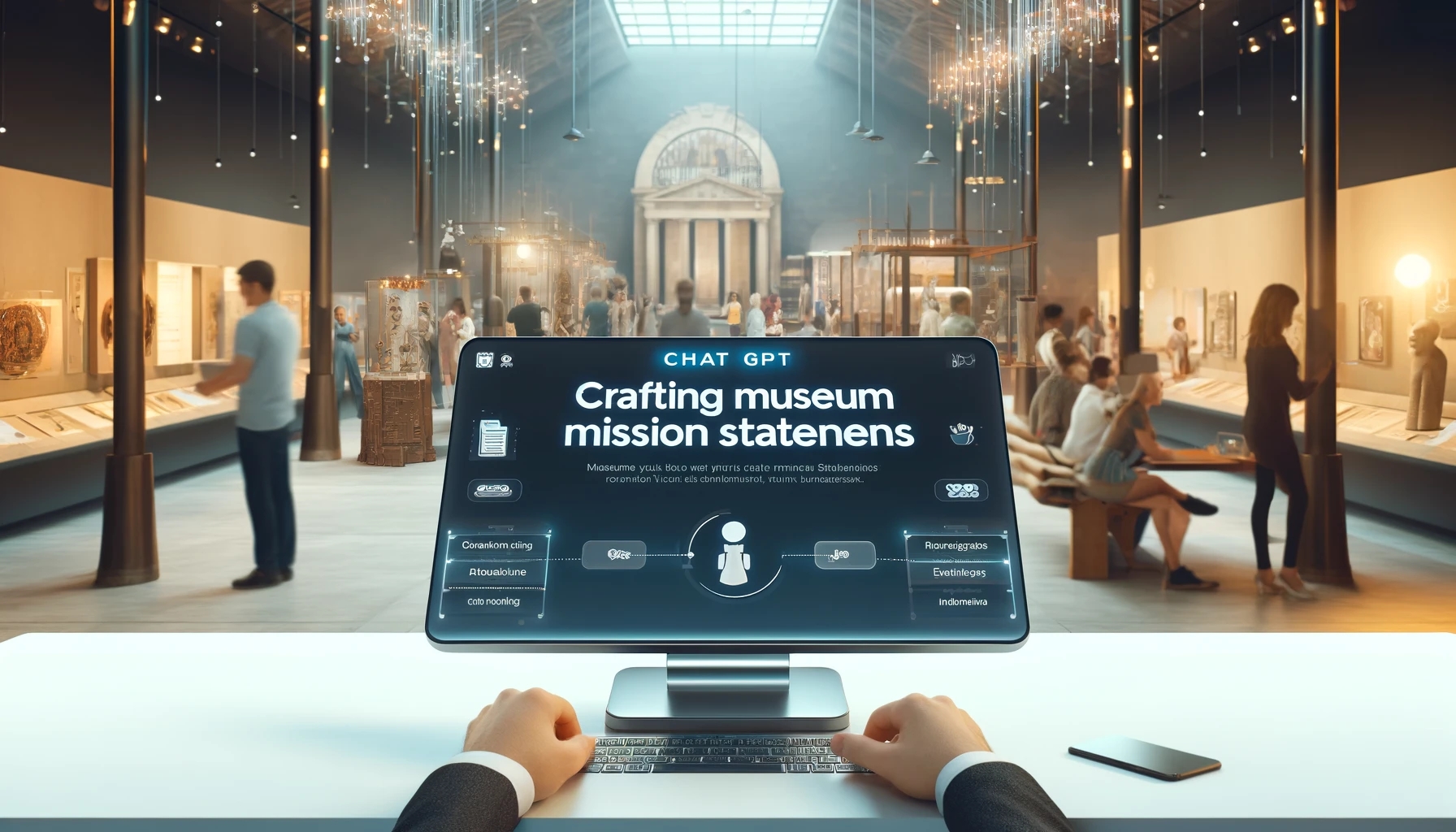
ChatGPT-4o created this image in less than a minute.
The highly anticipated release of ChatGPT-4o has once again thrust artificial intelligence (AI) into the spotlight. So how can historic sites and house museums harness the power of ChatGPT to craft thought-provoking mission statements, an essential element of effective management?
The American Alliance of Museums states that excellence requires that, “all aspects of the museum’s operations are integrated and focused on meeting its mission.” And yet, crafting mission statements is among the most difficult tasks for an organization. Writing and revising as a board or staff committee can result in circular arguments, the infinite parsing of words, or resignation to a milk-toast statement that offends no one. So how can you take a mission statement that’s weak or mild and turn it into something stronger and more meaningful?
My typical response is that a small committee of diverse leaders within the organization discuss the purpose and role of the museum in the community, and then appoint one person to draft a mission statement for approval. Although that’s much more effective than writing-by-committee, it can also result in a tremendous commitment of time and frustrations during the review as members defend their ideas. Instead, I’ve found ChatGPT to be much more efficient and less frustrating. You can revise frequently and quickly, try out variants and new ideas easily, and even better, criticize the “robot” and it won’t care.
The mission of The Gamble House is to inspire the public’s appreciation and understanding of architecture as a fine art through the example of The Gamble House, the most complete and best-preserved work of American Arts and Crafts architects Charles and Henry Greene.
Using a simple prompt, “Create a mission statement for the Gamble House in Pasadena, California,” ChatGPT-3’s version was:
Our mission at the Gamble House is to preserve and celebrate the legacy of this iconic American Arts and Crafts masterpiece. As a cultural destination and community resource, we aim to inspire and educate visitors about the significance of the Gamble House’s architecture and design, and its enduring influence on American culture.
The first sentence is the usual celebratory mission statement but notice that the next sentence goes further to explain why it matters today (“its enduring influence on American culture”). That’s a significant improvement that can improve the mission statement’s ability to guide decisions and establish priorities—which is the core function of a mission statement.
Going further, you can use ChatGPT to create mission statements inspired by the ideas of influential thinkers. English designer and writer William Morris inspired the Arts and Crafts Movement, so he’s an ideal choice for the Gamble House. By changing the prompt to, “Create a mission statement for the Gamble House in Pasadena, California in style of William Morris,” the result is:
“Our mission at the Gamble House is to preserve the beauty and integrity of this magnificent home, which is a masterpiece of American craftsmanship and design. Through our efforts to maintain the house and its surroundings in a state of harmony and balance, we seek to embody the principles of the Arts and Crafts movement, which holds that art and beauty should be an integral part of everyday life. By promoting the values of craftsmanship, simplicity, and authenticity, we aim to create a more just and equitable society, one in which the arts and culture are accessible to all, and the beauty of the natural world is cherished and protected.”
Far too long to be a modern mission statement for a museum, it does offer some intriguing ideas, particularly in the last sentence. By mentioning “craftsmanship,” “equitable society,” and “accessible to all,” it addresses values that could be meaningful to modern visitors and supporters of the Gamble House and inspire innovative programming.
In the year that followed, I’ve continued to explore how ChatGPT can help historic sites and house museum improve their mission statements, as well as create a vision and values. Lest anyone think that ChatGPT is a simple mindless hack to the usual hard work of crafting a mission statement, the use of AI requires a thoughtful human hand on the computer keyboard. ChatGPT can be biased, inaccurate, and hallucinate, so you need to know the organization and theories of management strategy. A weak or poor mission statement can harm a nonprofit organization, whether created by humans or AI.
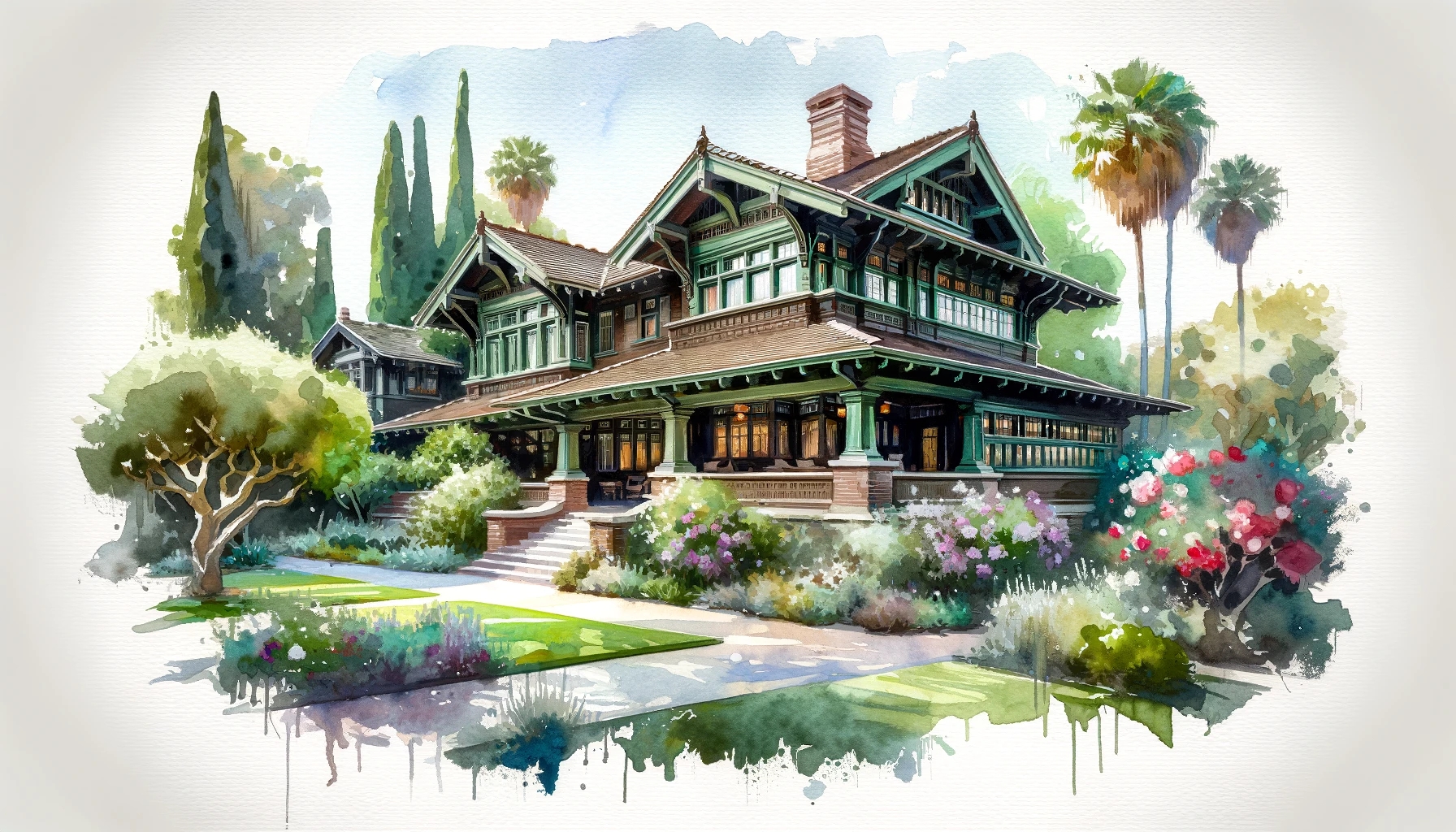
ChatGPT-4o created this image of the Gamble House, demonstrating the need for the human expert—there’s very little that is correct in this image.
Getting Started
If you’re interested in the best explanation and practices of AI and ChatCPT, read Ethan Mollick’s Co-Intelligence: Living and Working with AI (2024) or listen to an interview with him on the HBR IdeaCast, “Tech at Work: What GenAI Means for Companies Right Now.” If you’re interested in practical applications with lots of examples, read AI and the Future of Education (2023) by Priten Shah. AI is being incorporated into an increasing number of applications, including Microsoft Word, Evernote, Notion, and WordPress, but if you want to explore ChatGPT, it is available free with registration at OpenAI.
If you want to use ChatGPT to craft a mission statement, be aware that it relies on the information that is available to it. If your organization has a very small presence on the Internet or in publications (unlike the Gamble House), a simple prompt will be ineffective. You’ll need to take an additional step to provide it with information, such as the museum’s goals, primary audiences, collection strengths, historical background, and what makes it unique or distinctive. If you’re unsure how to do this in ChatGPT, start with the prompt, “I need help writing a mission statement for [your museum name]. Here are the details: [insert information].” You can follow up with additional instructions, such as “”Give me three different mission statement options,” “Can you make this mission statement more engaging for a younger audience?”, or “I like the direction of this mission statement, but can you make it shorter?”
If ChatGPT has helped your organization improve or rethink its mission statement, please share your experiences in the comments.
The Reimagining the Historic House Museum workshop at the Decorative Arts Center of Ohio in June 2023.
“Reimagining the Historic House Museum,” the one-day workshop co-led by me and Ken Turino (Historic New England) will be held on Friday, April 19, 2024, from 8:30 am to 5:00 pm at Montpelier, a 1780s house museum in Laurel, Maryland (between DC and Baltimore). This workshop is part of the professional development series produced by AASLH. Registration is $325 but it’s $200 for AASLH members (and you receive an additional $50 discount if you register by March 22!). Participation is limited to 35 people.
Our workshop, while inspired by the book Reimagining Historic House Museums (2019), provides a more comprehensive hands-on exploration of house museums’ challenges. We assess current programs using a “double-bottom” line for a holistic view, analyze influencing forces to pinpoint opportunities and hurdles, and spotlight how house museums have successfully reinvented themselves. While the day is rich with information and activities, we ensure a well-deserved lunch break and networking time. You’ll leave with new tools and ideas to enhance your historic site and have an enjoyable experience.
Our last Reimagining House Museums workshop was held at Dumbarton House in Washington, DC in June 2019!
Ken Turino and I will once again lead our workshops on reimagining historic house museums in 2023 after taking several years off due to the pandemic. Our first workshop will be held at the Gamble House in Pasadena, California on Friday, April 1 and our second will be held at the Decorative Arts Center of Ohio in Lancaster, Ohio on Thursday, June 22. AASLH is managing the workshop and registration is $325 but it’s $200 for AASLH members (and it’s $150 if you register by February 1!). Participation is limited to 25 people for the April workshop.
The workshop is closely related to the book, Reimagining Historic House Museums (2019), but we take a much deeper dive into the challenges facing house museums, assess current programs against a “double-bottom” line for a big-picture perspective, analyze the five forces that affect programs and events to find opportunities and obstacles, and highlight some of the ways that house museums have reinvented themselves. The day is packed with information and activities, but we take a good break in the middle of the day for lunch and we get to meet lots of other people who are working hard to make their historic site better. Plus it’s great fun!
Flipping to the index in Reimagining Historic House Museums tells you much more about the contents that the table of contents.
Do you flip to the back of a book before you buy it? Indexes and bibliographies, more than a table of contents, provide a better glimpse into the ideas of a book. I appreciate them when they’re at my fingertips but assembling them is a tedious task that requires absolute attention to every page. But one of the benefits, as Ken Turino and I discovered while indexing Reimagining Historic House Museums, are the common ideas that cut across the chapters contributed by two dozen leaders in the field. Rising up to the top were three factors that are most essential to navigating to success at historic sites and house museums:
1. Finding a Mission and Purpose That’s Meaningful.
Mission statements have long been used in nonprofit organizations and the version of “collect, preserve, and interpret [insert your museum’s topic here]” has now become a cliché. Better mission statements are an overlap of the site’s historical significance and the visitors’ needs, interests, and motivations. In our book, President Lincoln’s Cottage, the Harriet Beecher Stowe Center, and the Trustees demonstrate how meaningful mission statements permeate decision-making at every level of the organization. Indeed, as my thinking continues to evolve on mission statements, they should not simply describe the work of the organization but address a major problem or issue in the community—that’s what makes them meaningful to a broader segment of the public. Why do museums collect, preserve, and interpret? To what end?




 Engaging Places