
Tag Archives: Slavery

When “Accuracy” Means Ideology: A Closer Look at the Heritage Foundation’s Historic Sites Guide

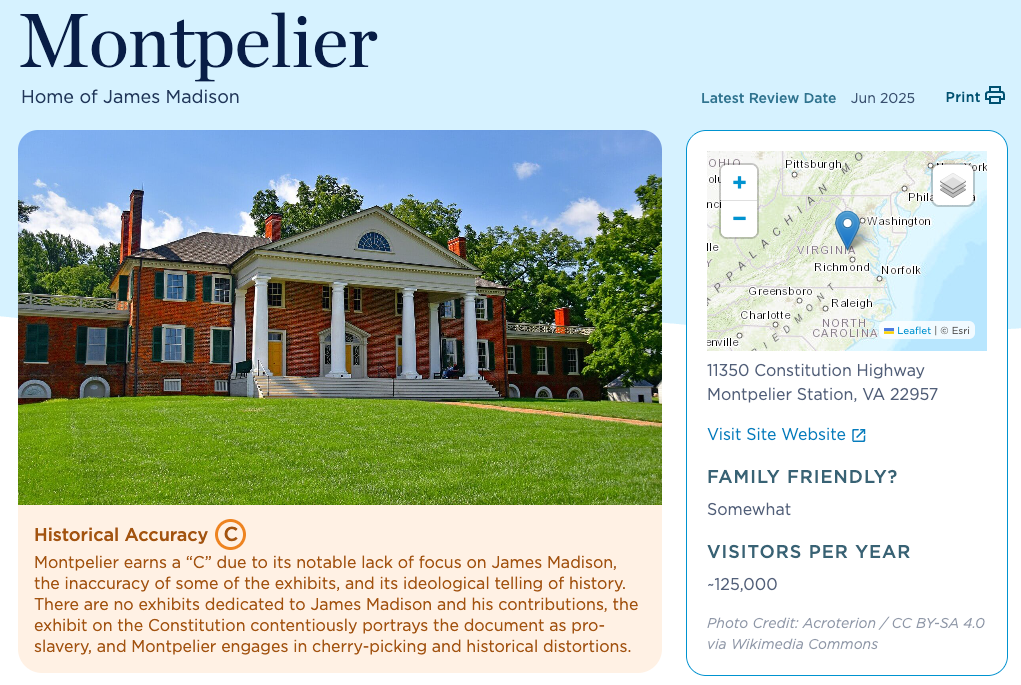
The Heritage Foundation’s new The Heritage Guide to Historic Sites: Rediscovering America’s Heritage promises to help Americans find “accurate” and “unbiased” history at presidential homes and national landmarks. Presented as a travel and education tool for the nation’s 250th anniversary, the site grades historic places from A to C for “accuracy” and “ideological bias.”

At first glance, it looks like a public service. But a closer look reveals that even when Heritage cites “evidence,” its historical reasoning exposes deep methodological and ideological flaws.
The Appearance of Evidence

The Heritage Foundation awards James Madison’s Montpelier in Virginia a C for historical accuracy, claiming the site shows a “notable lack of focus on James Madison” and that:

Continue reading

Mapping Slavery in Amsterdam: Reflections on a Heritage Guidebook

During a recent trip to the Netherlands, I picked up a copy of Amsterdam Slavery Heritage Guide (Gids Slavernijverleden Amsterdam) , the second extended edition published in 2018. Although it’s been around for nearly a decade, this was my first encounter with it—and I’m glad I made the discovery. As someone interested in the interpretation of African American history and culture, as well as city guides, I found it to be a compelling model for documenting and acknowledging slavery’s legacy in public spaces.

The full-color Guide identifies over 100 locations throughout the city connected to slavery, from major institutions to architectural details that would be easy to overlook. Each site is presented with a bilingual (Dutch and English) description that varies in length, sometimes accompanied by historical context. The locations are not limited to traditional sites such as mansions and churches—many are ordinary houses or warehouses, gablestones, offices, or former homes of prominent individuals. A map at the beginning allows you to design your own exploration of the city’s slavery heritage.

The content is categorized among four topics:

  • Trade and Profit
  • Africans and Asians in Amsterdam
  • Resistance and Abolition
  • Museums and Archives
Continue reading

Interpreting Slavery at Historic Sites Workshop on May 25

George Mason's Gunston Hall, Virginia.

George Mason’s Gunston Hall, Virginia.

George Mason’s Gunston Hall in Virginia will become a hands-on laboratory to explore how to create a comprehensive and conscientious interpretation of slavery at an historic site at a one-day workshop on Wednesday, May 25, 2016 from 9:30 am to 6:30 pm (right before the AAM annual meeting).  You’ll learn how to better connect and extend your site’s interpretation of its history of slavery and help staff and volunteers achieve a greater understanding of difficult knowledge and complicated emotions.  Registration is $90 and includes morning refreshments, lunch, and a post-workshop reception.  For more details and to register, visit http://bit.ly/SlaveryWorkshop.

The workshop will be led by Kristin Gallas, co-editor of Interpreting Slavery at Museums and Historic Sites and includes presentations by Continue reading

Interpreting Bondage and Freedom in the Chesapeake

This slideshow requires JavaScript.

Visiting Annapolis a few weeks ago, I had a chance to see the nearly completed installation of Freedom Bound: Runaways of the Chesapeake, a year-long exhibit about the resistance to servitude and slavery in the Chesapeake Bay region from the colonial period to the Civil War.  Heather Ersts and Ariane Hofstedt of the Historic Annapolis Foundation graciously provided a personal tour of the exhibit, which is installed in several museums and historic sites around the city.  It’s an exhibit worth seeing not only for the content, but also the design, and several items jumped out at me:

1.  The exhibit looks at the varied experiences of people through nine persons.  Seven of these persons were enslaved Africans, but two are white–a convict servant and an indentured servant–which will surprise most visitors.  It complicates the usual narrative that only Africans were held in bondage (of course, being owned as a slave is very different from being incarcerated as a convict) and it’s by encountering the unexpected that people are more likely to learn.  The typical exhibit about slavery trots out the same 1850 drawing of the slave ship Brooks, a pair of iron shackles, and perhaps a tag from Charleston.  Yes, those are all authentic and true, but the constant repeat of these items renders them Continue reading