Author Archives: Max van Balgooy

Unknown's avatar

About Max van Balgooy

President of Engaging Places LLC, a design and strategy firm that connects people to historic places.

Subtle Ways to Recognize Donors

This slideshow requires JavaScript.

During a recent visit to the Meridian International Center in Washington, DC, I encountered the most subtle donor recognition methods I’ve ever witnessed.  I usually discourage donor plaques within an historic house museum because it doesn’t advance the educational mission of the organization, distracts from the visitor’s experience of “imagining the past,” and can be installed in a manner that permanently damages the historic materials but if a director or board insists, the Meridian Center offers a potential solution.  The Meridian Center holds its offices and meeting rooms in two early twentieth century houses–Meridian House and White-Meyer House–that are listed on the National Register and although they aren’t museums, the donor recognition plaques are so subtle that they border on being acceptable in historic house museums.

Plaques can be found in nearly every room but are typically integrated into the existing decor with matching materials in small type or placed strategically and discretely to avoid attracting much attention, except if you take a close look.  They are considering a donor wall for their upcoming capital campaign, but it will be installed outdoors under the supervision of preservation architect Belinda Reeder.

Kat Imhoff named president of James Madison’s Montpelier

Kat Imhoff at James Madison’s Montpelier.

The Montpelier Foundation has appointed Katherine L. “Kat” Imhoff as president effective January 1, 2013.  The Foundation manages James Madison’s Montpelier, where Madison was born, developed his ideas for the Constitution, and retired after his presidency.  Imhoff returns to Virginia after a successful five-year tenure as State Director for The Nature Conservancy in Montana, where she led the organization’s Montana Legacy Project – the purchase of more than 300,000 acres for nearly $500 million – representing the largest conservation project ever undertaken by The Nature Conservancy.

“Montpelier is a place for making authentic, tangible connections with the past that can inspire us to build on James Madison’s legacy of constitutional self-government,” said Gregory May, Chairman of The Montpelier Foundation. “Kat Imhoff is a respected preservationist with demonstrated ability to generate support for visionary advances like those Montpelier now is prepared to undertake.”

Before she went to Montana, Imhoff was Continue reading

Picturing the Seasonal Changes at Your Historic Site

Views of the exhibit gallery under construction in January, February, March, and April 2012 at the Museum of History and Industry.

The Museum of History and Industry in Seattle is moving into a new facility this year and to give the public a chance to experience the work and construction progress behind-the-scenes, they’ve installed a webcam overlooking the main exhibit gallery.  Webcams aren’t a new idea (remember the panda cubs at the National Zoo?) but what’s clever about the construction camera provided by OxBlue is that users can see timelapse movies and four views for different dates at the same time.

Many historic sites change their programs, events, and exhibits throughout the year to reflect the changing seasons, but I wonder if this same system could be used to Continue reading

Responding to Frequently Requested Directions by Visitors

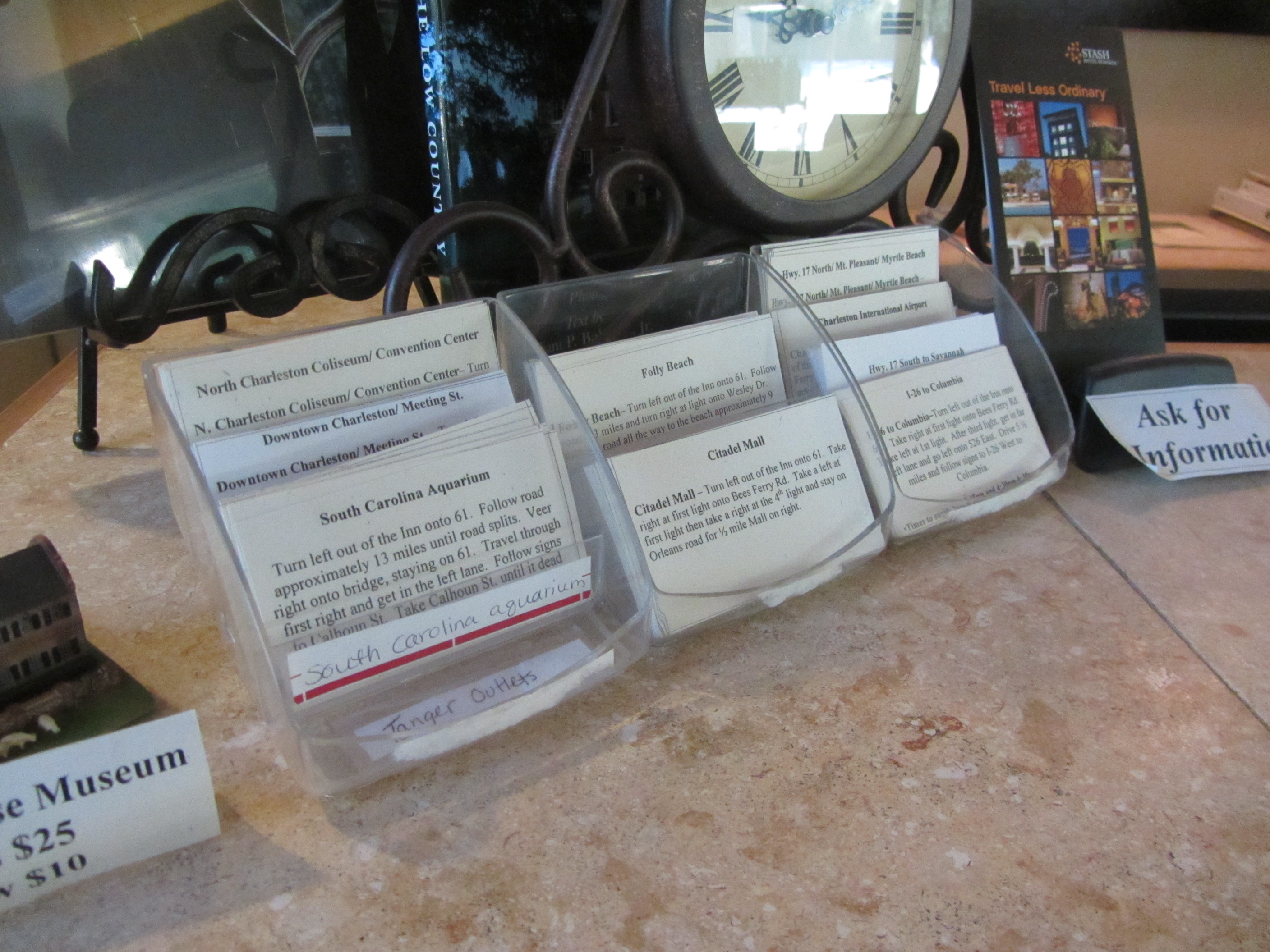
Business card rack with directions to frequently requested destinations.

At the reception desk at the Inn at Middleton Place, I spotted a clever way to share directions to frequently requested places.  It’s a plexiglass business card rack filled with written directions to the airport, downtown, and other historic sites on slips of paper.  Guests just pick up the directions they need and they don’t need to worry about remembering them or jotting them down correctly.

Here’s an example of the written directions:

Downtown Charleston/Meeting Street

Turn left out of the Inn onto 61.  Follow road approximately 13 miles until the road splits.  Veer right onto bridge.  Travel through 1st light and get in left lane.  Follow signs to Calhoun St.  Once on Calhoun, travel 9 lights up to Meeting St.  Take right on Meeting St. to go to Battery.  Turn left on Meeting St. to go to tourist visitor center.  Times to avoid: 7 am-9 am and 5 pm-7 pm.

Now you know why they wrote down those instructions!

By the way, if you like contemporary architecture and historic gardens, the Inn at Middleton Place in Charleston is a perfect place to stay.  The Inn has received an AIA Honor Award for its contemporary design and fits in peacefully with the surrounding landscape on the banks of the Ashley River.  Your stay includes admission for two to the adjacent Middleton Place, where you can enjoy the gardens, even after it has closed to the public.

AASLH and AAM Align Efforts to Raise Standards and Practices

The American Association for State and Local History (AASLH) and the American Alliance of Museums (AAM) recently announced they will work together to raise awareness of national museum standards and align their assessment programs in order to streamline application and self-study processes.  The agreement outlines ways in which applicants of AAM’s Museum Assessment Program (MAP) will benefit after completing AASLH’s StEPs program, in other words,  AASLH and AAM have linked StEPs with MAP.  If you understand that sentence, you’ve been working in this field a long time.

What’s this mean for historic sites?  Both StEPs and MAP are great programs for improving your organization’s work, but they’re very different from each other.  StEPs allows you to Continue reading

Best Practices for Community Engagement

Community engagement has become an increasingly important aspect in state and local history as a strategy for increasing impact, gaining support, and becoming relevant.  The challenge for most organizations is that engagement can be so daunting and difficult, they don’t know where to begin, how to prioritize among several good ideas, or measure success.

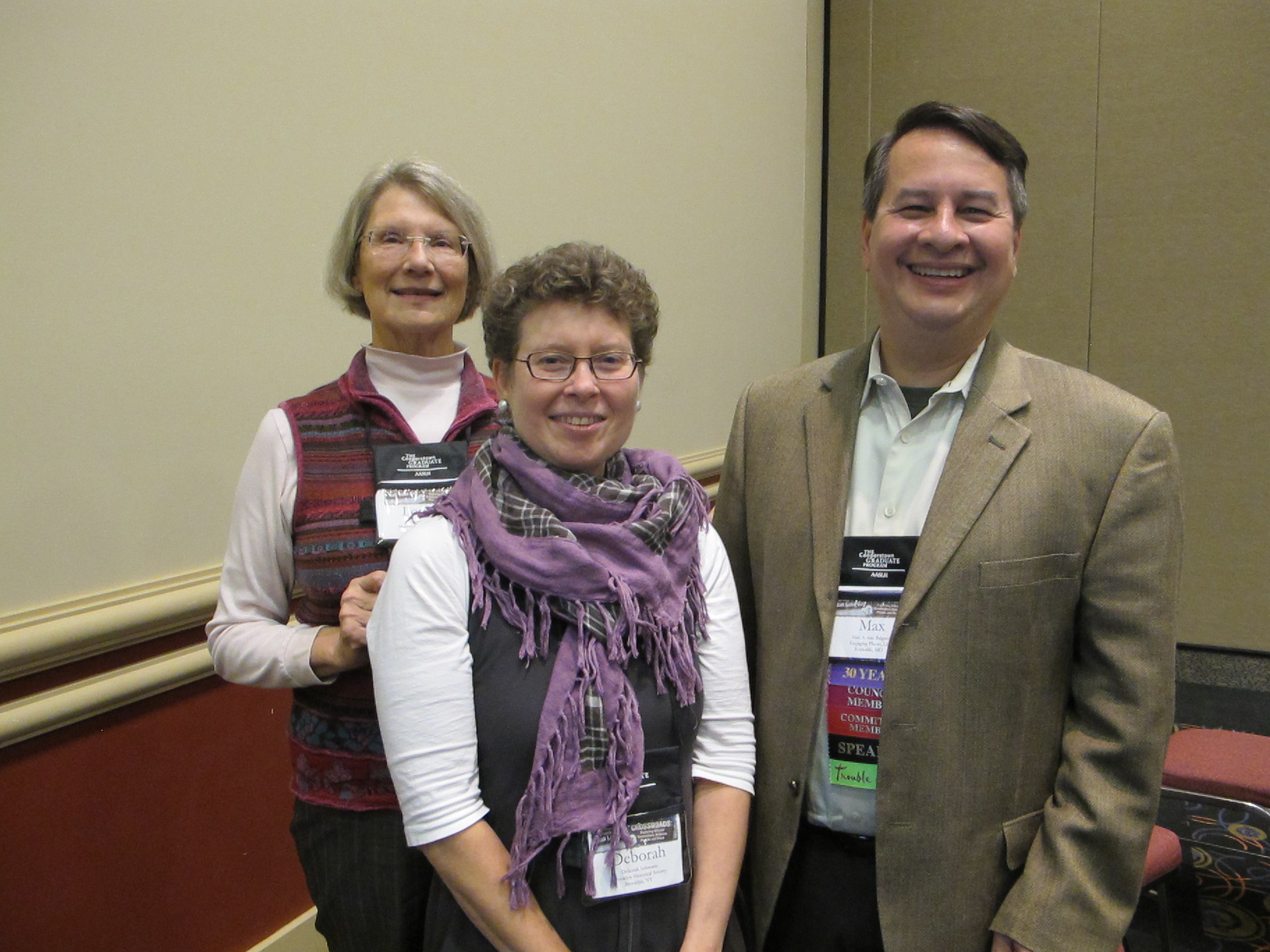
Lorraine McConaghy, Deborah Schwartz, and Max van Balgooy at AASLH 2012.

At the recent AASLH annual meeting, I moderated a session on the experiences of two very different history organizations—the Brooklyn Historical Society and the Museum of History and Industry—whose work in community engagement is not well known in the field yet offer exemplary case studies to examine common strategies, how they should be modified to suit each place’s unique characteristics, and steps to avoid.

Deborah Schwartz, president of the Brooklyn Historical Society, described two programs that reach audiences that are typically underserved by museums: Continue reading

Outdoor Interpretive Panel for Hot Humid Places

This slideshow requires JavaScript.

During a recent visit to Middleton Place, an historic site in Charleston, South Carolina, I spotted an outdoor interpretive sign that’s so nicely crafted that it’s withstood several years of weathering outdoors.  The wooden frame supports a one-inch thick plywood panel (two thinner panels secured together) whose edges are sealed and entire surface painted black (black is Middleton’s standard color for sign posts).  The interpretive sign is printed on a 1/16″ thick sheet of vinyl (or a similar synthetic material) and glued onto the face of the panel.  The top edge of the sign is protected from rain by a copper cap. One corner of the vinyl has turned up over time, but otherwise, the sign seems to be in perfect condition, despite the heat and humidity of summer in the Lowcountry.

Is Your Historic Site Unsure About Next Steps?

In this uncertain environment, many organizations are unsure about the direction to pursue for their historic site or house museum.  Through a self-study process and a personal assessment by an external professional colleague, the Museum Assessment Program (MAP) offers a thoughtful and proven approach to refine your operations, programs, and collections.  I’ve participated in several MAPs and clever organizations have used it to confirm a strategy, refine a project, resolve a vexing issue, support a funding proposal, or move to the next level of operations.  I can’t think of a better program available, except if you’re accredited by AAM, you have a large professional staff, or if you’re able to afford a large team of experts.  Really.  To stay sharp, every historic site and house museum in America needs to go through this program every decade and in between, they should be tackling a section of AASLH’s Standards and Excellence Program.  Really. If you’re not sure, call the director of the historic sites that participated this year:  Montpelier Mansion (Maryland), Old Barracks Museum (New Jersey), Louis Armstrong House (New York), Seward House (New York), Stewart House (Ohio), French Legation Museum (Texas), Poplar Forest (Virginia), and Pabst Mansion (Wisconsin).

To participate, your organization needs to meet some basic requirements (such as be open to the public at least 90 days a year), Continue reading

Montpelier Archaeologists Discover James Madison’s Threshing Machine

This slideshow requires JavaScript.

The rich red clay at Montpelier, the Virginia home of the Father of the Constitution has given up more secrets: the remnants of James Madison’s barn and threshing machine, and evidence that Dolley’s son destroyed both in an attempt to remove the machine from Montpelier before the new owner took possession.

As archaeologists excavated the field slave quarters this summer, they found perplexing evidence they had to research and decipher. First, they found bits of iron that appeared to be pieces of machinery, which indicated that the building was used to house farming equipment. Then, in the soil layers below the iron pieces, they found a trench, which proved to be the outline of a 16-foot x 16-foot building. The trench also contained a set of postholes that held more iron pieces. “The iron and postholes in the trench tell us that the building was modified to allow a piece of machinery to be mounted inside the building,” said Dr. Matthew Reeves, Montpelier director of archaeology and landscape restoration.

More digging revealed bits of bone and ceramics, which indicate that Continue reading

AASLH Meets in Salt Lake City

This slideshow requires JavaScript.

The American Association for State and Local History held its annual meeting in Salt Lake City, Utah last week, attracting about 600 staff, volunteers, and board members of history organizations around the country (and about 30 of them were from the Minnesota Historical Society).  Four days of educational sessions, workshops, speeches, and receptions kept everyone busy and thinking about improving our work as historians, educators, collections managers, curators, and directors of historical societies, museums, and historic sites.  I’ll provide more reports in the future, but for now, enjoy some pics from the meeting.