Author Archives: Max van Balgooy

Unknown's avatar

About Max van Balgooy

President of Engaging Places LLC, a design and strategy firm that connects people to historic places.

Interpretive Planning for Dozens of Sites

Arroyo Seco Parkway National Scenic Byway Interpretive Plan produced by Engaging Places for the Mountains Recreation and Conservation Authority in May 2012.

If you’re interpreting a group of sites or a heritage area, you might be interested in reviewing an interpretive plan I completed earlier this year for the Arroyo Seco Parkway National Scenic Byway.  When the Parkway was completed in 1940, it connected Los Angeles and Pasadena and began southern California’s Freeway Age.  It’s also a region that has a dense concentration of museums, historic sites, parks, historic Main Streets, architectural landmarks, and unique businesses, including the Gamble House, Huntington Library, Lummis Home, Heritage Square, and Olvera Street.  To bring attention to these cultural riches, the Mountains Recreation and Conservation Authority commissioned me to develop this plan and work with a local stakeholders, build on an inventory of assets developed by the National Trust for Historic Preservation, and integrate audience research conducted by the Community Land Use and Economic Group and Decision Support Partners.

The planning process followed a traditional approach by collecting content to develop topics and themes; conducting visitor research to identify target audiences; and finally Continue reading

AAM Unveils New Logo, Name, and Attitude

AAM logos: old and new

Today, the American Association of Museums becomes the American Alliance of Museums, which may appear at first to be merely a cosmetic change ushered in by a marketing consultant, but actually signals some significant changes in attitude.  Those of us in the history field often felt like outsiders at AAM, which seemed to be dominated by art museums, our classier and richer cousins.  But take look at the new AAM and you may find two major changes that may appeal to history organizations:

1.  Accreditation becomes the end Continue reading

Challenges and Opportunities Facing Historic Sites and House Museums

This fall I’ll be teaching the historic site and house museum interpretation class in the Museum Studies Program at George Washington University.  Department Chair Kym Rice graciously offered me this opportunity earlier this summer and I couldn’t resist.  I’ve been impressed by the caliber of GW students and I count many of their graduates among my friends and colleagues.  Today is the first class and participating are fifteen graduate students, mostly in museum studies with a handful from history and anthropology.  We will  have some fun discussions!

During the next few months, I’ll share my experiences with you and I thought I’d start by laying out the initial readings for the course, which focus on the opportunities and challenges in interpreting historic sites.  It was hard to pick and choose among Continue reading

Report from the 2012 AAAM Conference in Baltimore

This slideshow requires JavaScript.

Last week I attended the Association of African American Museums conference along with two hundred other people from across the country.  I’d never attended before but since it was close by in Baltimore, I decided to take a chance and it turned out to both educational and fun.  Although I only attended one day, I’d like to share some of the highlights from the sessions I observed.

In “Understanding Exhibition Design and Planning“, the panelists all stressed the importance of pre-design, which includes determining which spaces will be devoted to exhibits, visiting other exhibits to clarify what you like (and don’t like), conducting visitor research, identifying potential artifacts and images, roughing out a budget and schedule (is the exhibit feasible?), and determining the maintenance costs.  The Harpers Ferry Center of NPS offers an exhibit planning template for FileMaker Pro.  The panel also provided a rough estimates of exhibition costs for design and fabrication:

  • $150-250/sf: 2D items, graphics, pedestals for 3D objects, little to no media.
  • $250-350/sf: 3D object displays, more extensive use of graphics, some media elements
  • $350-500+/sf: custom cases, media, electromechanical interactives, theatrical lighting/projectors.

They stress that costs could be lower, but it will then rely heavily on reusing ideas or elements from earlier exhibits or projects.  The panelists also believed that better designs are the result of longer development schedules, not more money.  More time allows for more iterations of designs to refine ideas.  Finally, for new buildings, they suggest that exhibit designers be brought in early to the process because they help program the space because they tend to “design from the inside out”–but that will require that the architect is willing to collaborate.  For a copy of the PowerPoint presentation, contact Chris Danemeyer at Proun Design.

Claudine Brown, the Assistant Secretary for Education and Access at the Smithsonian Institution, was the luncheon speaker.  She laid out the new interpretive direction for the Smithsonian and why they matter to museums, especially those that focus on African American history and culture.  The challenges facing the Smithsonian is that they need to preserve the evidence of the past, be relevant in the present, and be prepared for the future [and these are ideas all museums and historic sites can follow].  The three big topics the Smithsonian will be interpreting are:

  • Americans All: a shared experience as immigrants, everyone came from somewhere else, but all share a common country.
  • Waterways:  Water is a serious problem and its estimated that 2/3rds of the world will suffer water shortages by 2025.
  • Creativity and Innovation:  With our current high unemployment rates, museums can be part of the solution by providing learning opportunities that simulate real life and helping the next generation learn how to organize, strategize, and act.

The session on developing mobile applications was led by the Digital Humanities Center at Michigan State University, which maintains an online clearinghouse of mobile museum applications.  The session provided some estimated costs for producing various applications, as follows:

  • $0-?: mobile-ready website (creating a website that can be easily viewed on a smartphone; most common solution)
  • $5,000-$60,000:  native application (self-contained program that’s downloaded and works without an internet connection)

The session stressed that mobile applications rarely generate revenue–the average return on investment is $688 and takes 51 years–so look for other benefits to the institution.  It may be possible to generate revenues from after-market sales, such as an app that promotes a book, photoprints, music, and attendance at an event.  When I asked about the effectiveness of applications, the person sitting next to me suggested I look at #SocialMedia Daily, a blog that aggregates news about social media and apps.
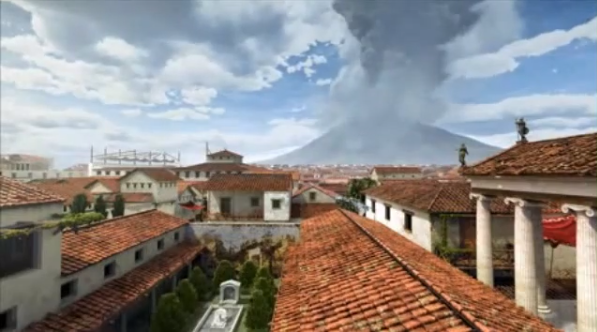
Remembering the 1,933rd Anniversary of the Eruption of Mt. Vesuvius

Animation still from “A Day in Pompeii,” You Tube video at http://youtu.be/w82yVDOMIa0

This may seem far-afield from the interests of most historic sites, but 1,933 years ago today, Mount Vesuvius erupted and buried the city of Pompeii (resulting in one of the world’s most popular historic sites about 1,700 years later).  The Denver Museum of Nature and Science is marking the anniversary by tweeting the last day of Pompeii as it happened, starting at 10 a.m. today by @Elder_Pliny (formerly known as Pliny the Elder, who witnessed the events) in preparation for an exhibit on Pompeii opening on September 14.  So far, he has more than 3,000 followers and he just tweeted that he’s preparing his boat to get a closer look (should I warn him?).  Along with the tweets, the Museum has created a mashup with Google maps to follow Pliny around Pompeii, is hosting “Bacchus Raucous” (a fundraising gala dressed in a Roman toga) and is featuring a lecture on Ceren, a Mayan village that was also encased by a volcanic eruption centuries ago.

Thanks to Sandra Smith at the Heinz History Center sharing this clever approach in interpretation.

What Sites Can Learn from the Olympics

The summer Olympic games in London are now over and if you were watching, I bet you not only reveled in the athletic competition, but you also contemplated the logistics and expenses.  Those of us who work at historic sites don’t experience events like most other people.  Sure, we like the music, food, and tours, but we also look at the placement of signs, calculate ratios between attendance and restrooms, check out the store for items we can sell, and mentally map out visitor circulation and note the bottlenecks.  Or is that just me?

The Olympics is just another special event, although it’s huge and involves a cast of thousands and decades of planning.  The designers and planners of this event are the best of the best, so what can historic sites, at a much smaller scale, learn from their experience?  One of the most valuable lessons is that Continue reading

NEH Announces $39M in Grants but Sites Fare Poorly IMHO

At the end of July, the National Endowment for the Humanities (NEH) announced $39 million in grants for 244 projects across 15 program areas (e.g., America’s Historical and Cultural Organizations, Landmarks of American History and Culture, and Sustaining Cultural Heritage Collections Grants).  NEH is the major federal source of funds for historic sites and house museums, so these grant announcements provide a sense of what’s happening in the field to see what’s innovative or excellent (or what attracts funding).  Some examples of grant recipients who are focused on historic sites include:

Chicago Architecture Foundation
NEH Program: Landmarks of American History, $172,393
Project Director: Jean Linsner
Project Title: The American Skyscraper: Transforming Chicago and the Nation
Project Description: Two one-week workshops for eighty school teachers on the
development of the skyscraper in Chicago and the relationship of skyscrapers to
urbanization.

U.S.S. Constitution Museum 
NEH Program: Landmarks of American History, $179,548
Project Director: Sarah Watkins
Project Title: The U.S.S. Constitution and the War of 1812
Project Description: Two one-week workshops for eighty school teachers on the naval War of 1812 and its most important and complex artifact, the United States frigate Constitution, anchored in Boston.

Wilderstein Preservation
NEH Program: Sustaining Cultural Heritage Collections, $50,000
Project Director: Duane Watson
Project Title: Planning for a Sustainable Preservation Environment in the Wilderstein Mansion
Project Description: A planning project to identify ways to create and maintain Continue reading

Jump Start Your Interpretation with a Scholars Workshop

As an interpretive planner, one of the common circumstances I encounter at a site or house museum is that historical research hasn’t been conducted for years, perhaps even decades.  It’s not that research and scholarship isn’t appreciated by the staff.  Typically there was lots of research done when the site first opened, but staff just hasn’t had time since then (the distractions of “toilet paper and light bulbs”, alas!) or there isn’t the incentive now that the place is open (“history hasn’t changed that much in twenty years, has it?”).

The past may not have changed, but our interests continually change.  Right now, the Civil War is hot but in a couple years it could be jazz.  Without new historical research, eventually tours, exhibits, events, and programs, and yes, even staff lose their edge and the place seems dull and boring.  And you have to stay committed to research for the long term because as other sites mimic your innovative interpretation, it eventually settles into a regional monotony when everyone does the same thing (e.g., now it seems that every Colonial house museum is discussing foodways, lives of servants, and the contradictions of liberty and slavery).

Scholars Workshop underway at Drayton Hall. Director George McDaniel is providing an introduction to the site during the first part of the workshop.

If you find that you’ve ignored research far too long or that your research endeavors need some direction and refinement, a scholars workshop may help.  For a day or two, a small team of scholars gathers at your site to review the current interpretation and historical resources (archives, collections, and buildings) and then discusses how they might be refined, updated, or approached in new ways.  They can also confirm existing plans, support new ideas, and suggest new books or archives to explore.  By including staff in the workshop, it rekindles their energy and allows them to think longterm and strategically about interpretation.  For an example of the structure of a scholars workshop, take a look at Continue reading

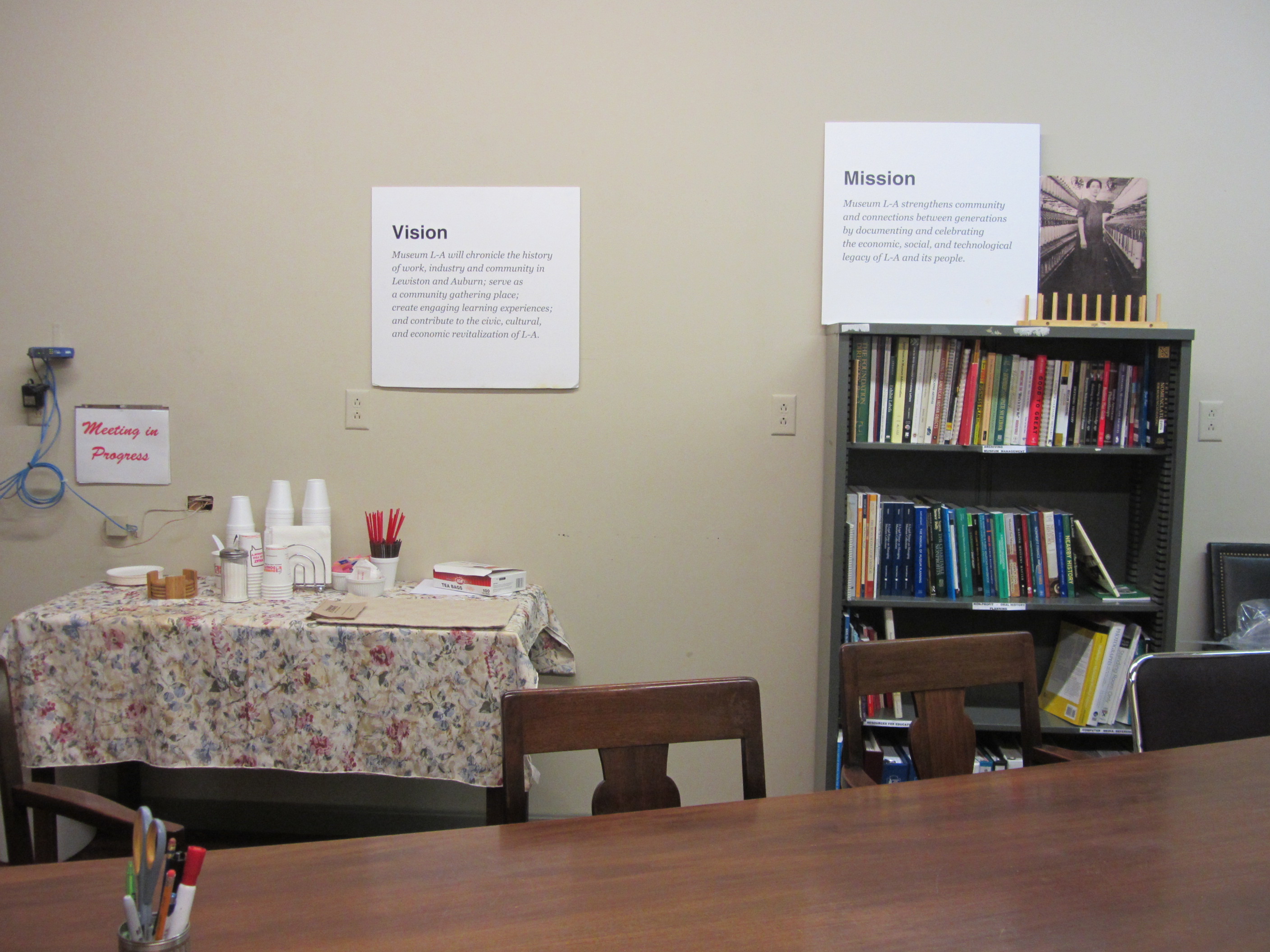
Making Mission and Vision Visible: Put it by the Coffee Pot

A recent visit to Museum L-A in Maine, a local history museum serving the communities of Lewiston and Auburn, revealed a clever way to keep the mission and vision visible and prominent.  They were posted on large boards in the conference room above the refreshments–whenever a group met, they couldn’t miss these reminders of the organization’s purpose and direction.

Their mission and vision were developed through a community-wide facilitated process led by E. Verner Johnson and they came up with statements that go far beyond the typical “collect, preserve, and educate”:

Mission

Museum L-A strengthens community and connections between generations by documenting and celebrating the economic, social, and technological legacy of L-A and its people.

Vision

Museum L-A chronicles the history of work, industry and community in Lewiston and Auburn; serves as a community gathering place; creates engaging learning experiences; and contributes to the civic, cultural, and economic revitalization of L-A.

For more details, see their strategic plan highlights on their website.  I was pretty impressed with this local history museum, so you’ll find a post or two about it in the future.

Put Your Organization to the Rorschach Test

This slideshow requires JavaScript.

If you’re finding that your organization is in a rut and you no longer feel as inspired about its work, it might be useful to look at it in a new way by creating a “word cloud” of key documents, such as a strategic plan, mission and vision statements, interpretive themes, or visitor evaluation.  A word cloud is a visual presentation of the most frequently used words, sized by frequency.  For example, if you use the word “history” ten times more than “preservation” in your strategic plan, “history” shows up much larger than “preservation” in the word cloud.  The word cloud allows you to look at your organization from a different perspective: words jump out at you and prompt questions about what’s being emphasized (and what’s not).

As examples, in the slide show above I’ve assembled word clouds from the first few paragraphs of the About section of the websites (which often includes the mission or vision statements) of the following historic sites:

I’ve used word clouds in strategic planning sessions to Continue reading