
This past Saturday, the Council (aka board) of the American Association for State and Local History met in Maine for one of their three regular meetings each year. It’s been a tough few months due to the discovery of embezzlement and fraud within the organization, so this meeting had been preceded by nearly a dozen additional meetings of the Council and several committees by conference call to deal with various aspects related to the situation, potential threats to the organization, and improvements to our current financial management by reviewing and revising various policies, procedures, and practices. This meeting adopted revised financial policies and procedures; adopted revised codes of ethics for board, staff, and organization; adopted a revised conflict of interest policy for board and staff; and discussed how the by-laws may need to revise the finance and audit committee responsibilities as well reconsider how Council members are elected to ensure we have sufficient people on board with financial skills. We also began working more strategically, looking longterm to identify priorities so we can preserve those programs that matter most to members and most effectively fulfill the mission. History News and the annual meeting/conference rose to the top as expected, but Continue reading
Author Archives: Max van Balgooy

Detour Ahead for National Trust’s Main Street Program?

Preservationists in Frederick, Maryland, which received a Great American Main Street Award in 2011.
In a move that will surprise many who work in historic preservation, the National Trust for Historic Preservation has decided to move its Main Street program to a separate non-profit subsidiary and three of its senior staff members–Doug Loescher, Lauren Adkins, and Andrea Dono–have decided to leave the organization. Main Street was created more than thirty years ago to help revitalize historic downtowns and commercial districts and its work was so highly regarded that the National Trust presented its own Honor Award to its founders–Mary Means, Scott Gerloff, Tom Moriarity, and Clark Schoettle–in 2004. In a email message on June 18, Executive Vice President David Brown wrote:
As most of you are aware, since the launch of the Preservation10X framework last September, we have been engaged in a focused and inclusive process to assess the current status of the National Trust Main Street program and the Main Street Center, in order to arrive at the best path forward for Main Street. Thank you for the excellent input many of you have provided during this process.
Main Street is one of the most valued programs of the National Trust. It has achieved unprecedented stature nationwide as a highly successful preservation-based economic development program and enjoys great popularity among a wide constituent base. In many ways it has far surpassed Continue reading
Slave for a Day? I’m Not Sure This is a Good Idea
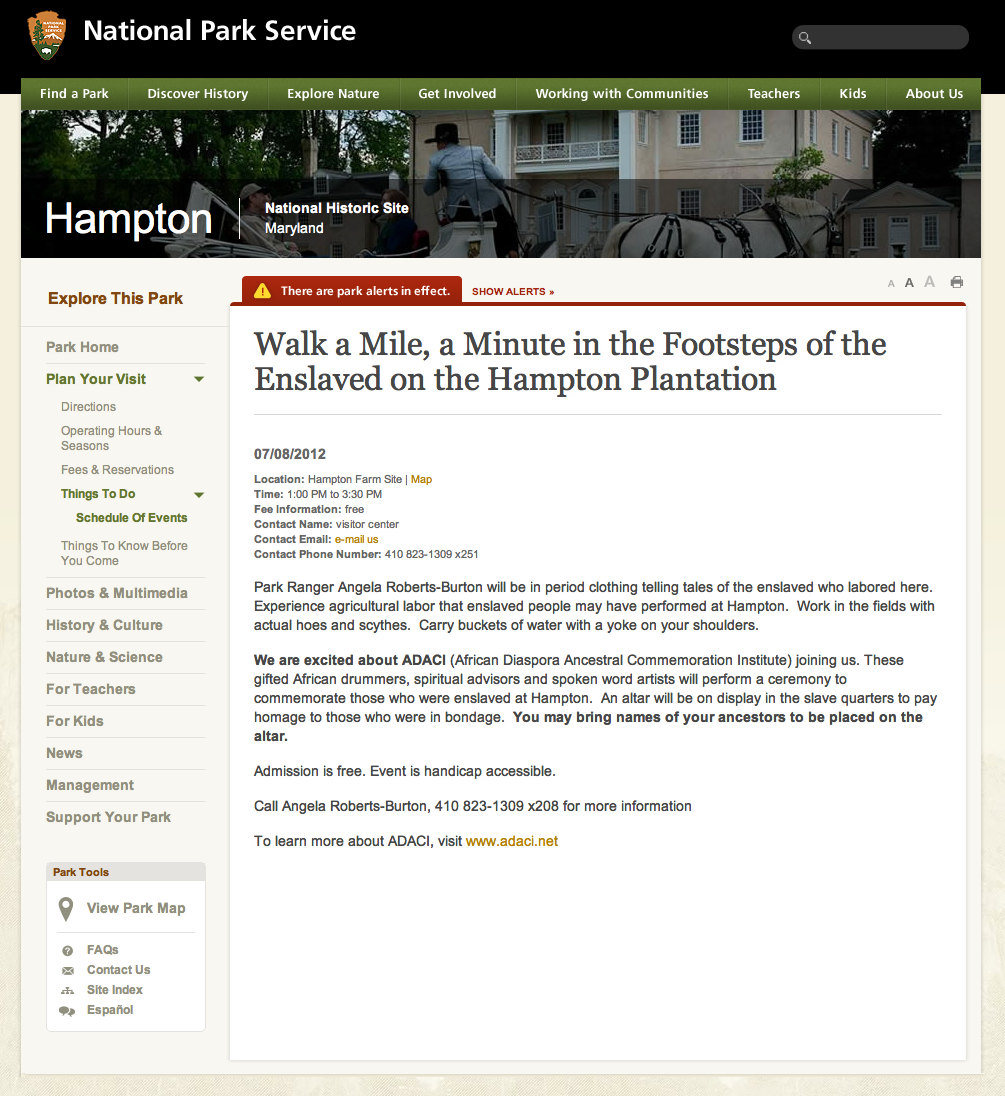
Footsteps of the Enslaved, a new program at Hampton
Hampton, a National Historic Site operated by the National Park Service, recently announced a “Slave for a Day” program which will allow visitors, to, “Experience agricultural labor that enslaved people may have performed at Hampton. Work in the fields with actual hoes and scythes. Carry buckets of water with a yoke on your shoulders.” After a chorus of howls went up on the Internet, the title was changed to the much more tame, “Walk a Mile, a Minute in the Footsteps of the Enslaved on the Hampton Plantation” but the program content remained the same. I certainly want to encourage the ranger who developed the program to continue to pursue her passion for African American history, but I’m not sure these activities, as described, get visitors to fully understand what life was like for enslaved people. Antebellum farming is about hard work; Continue reading
Changes at Google+ Creates Opportunities for Museums and Sites
Okay, everyone knows about Google but Google+ and Google Places is still a mystery for many people. It may become a bit simpler because the rumor is that Google Places is slowly being replaced by Google+ Local. Or did that just complicate things? Let’s start over.

Google search results for “historic sites in philadelphia”
Google has launched new search results that include the usual title, web link, and brief description, but now adds the address, phone number, shows the location on a map, a link to reviews, and a Zagat ranking on a scale of 1 to 30. In the example to the left, you’ll see the search results for “historic sites in Philadelphia” and that the Eastern State Penitentiary (the third item) received a Zagat rating of 25 (it really is an amazing place) and has 81 Google reviews (wow! their visitors have opinions). This new form of listing doesn’t occur for every city, just those that seem to have enough places to warrant them (right now, this list appears for Denver but not San Francisco). Local information is being integrated across Google (including the Zagat ratings, which was acquired by Google last year), so you’ll find Continue reading
IMLS’ Revised Grant Guidelines Need Revision
 In May, the Institute of Museum and Library Services (IMLS)–the national agency devoted to museums and libraries–released a new set of proposed guidelines that would significantly revise their grant programs for museums (and that includes historic sites, historical societies, house museums, and preservation organizations). Initially, these changes were proposed to go into effect without comment from the field, but fortunately enough museums spoke up that director Susan Hildreth changed her mind and announced she would welcome comments–but the comment period ends on Friday, July 6, 2012.
According to IMLS, the guidelines affect the Museums for America and National Leadership Grants for Museums programs, however, the impact is much larger because these programs are proposed to consume two other grant programs: Conservation Project Support and 21st Century Museum Professionals. Claudia French, deputy director for museums, proposed the changes so that the grant programs would align better with the IMLS strategic plan and make it easier for grantees and IMLS staff.
Here are the major changes that caught my eye:
1. One deadline to rule them all: January 15. Currently, the deadlines for Continue reading
Google Launches World Wonders Project

Independence Hall in Google World Wonders. To protect the statue’s identity, his face has been blurred!
Google recently launched its World Wonders Project, an edited compilation of world heritage sites using its Street View technology to “bring to life the wonders of the modern and ancient world.” If you’re not already familiar with Street View, it allows you to navigate Google Maps through 360-degree images so you can look left, right, up, and down. At present, they’ve assembled 132 sites from 18 countries, including Stonehenge, Pompeii, Versailles, and Himeji Castle. Sites are organized by location and theme, and each site features a large navigable photo with a map and a slide-out window of information, video, and photographs. The World Wonders Project also includes education packages for primary and secondary levels that are linked to specific “wonders,” such as “liberty and the US declaration of independence” for Independence Hall. These are large zipped files, so I didn’t investigate them.
It’s exciting that Google is working with Unesco and the World Monuments Fund to bring attention to this amazing places, but there’s some work to do. First of all, Continue reading
Experiential Courses Offer Opportunity to Explore Places

Map of City Semester field projects in New York City.
If you hear the words, “experiential, expeditionary, or hands-on learning,” “adventure education,” or “outdoor education director” in your school district, it may be an opportunity to present your museum or historic site as a valuable resource. For decades, schools have focused on formal educational process emphasizing lectures and textbooks, but that seems to be changing according to Jenny Anderson in her New York Times article, “For Bronx Private School, All the City’s a Classroom in an Experiential Course.” She describes the City Semester: The Bronx Experience, new educational venture by the private Ethical Cultural Fieldson School. It’s a semester-long program that, “integrates history, English, science, ethics, language, civic leadership and the arts around the study of New York City- through the lens of the Bronx. Like other semester programs, City Semester offers a chance to step outside your everyday routine, have an adventure, challenge your assumptions and grow in new ways.” Each week the class combines classwork with at least one day in the city visiting businesses and historic sites (such as Woodlawn Cemetery and the Louis Armstrong House), Continue reading
VSA: Why Teachers Visit Historic Sites
 The April 2012 (15:1) issue of Visitor Studies, the semi-annual journal of the Visitor Studies Association, just arrived and it includes, “Motivating Participation in National Park Service Curriculum-Based Education Programs” by Marc Stern, Elizabeth Wright, and Robert Powell. It’s a rare examination of the reasons why teachers visit (or don’t visit) historic sites. For anyone that provides school programs, its findings provide some useful guidelines.
The study attempts to “understand why teachers at schools within the immediate vicinity of Great Smoky Mountains National Park attend, or don’t attend, the park’s curriculum-based programs.” To discover the perceived benefits and disadvantages of participation, they conducted a preliminary focus group with teachers and then surveyed 400 teachers in fourteen schools and interviewed school administrators. Although this study’s focus was on a national park’s programs for a middle and high school audience, there are some surprising findings that may cause you to question your assumptions even if you’re an historic site focusing on the elementary grade levels. Here’s a quick summary:
- Administrators are most concerned about Continue reading
Earthquake in Northern Italy destroys Historic Sites
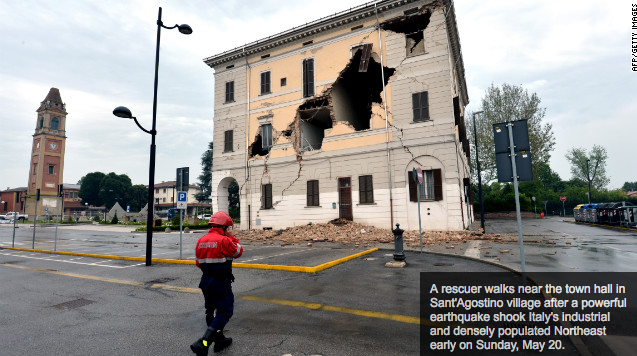
The Town Hall in Sant’Agostino, Italy, damaged by Sunday’s earthquake.
On Sunday morning, the area near Bologna in northern Italy was struck by a major earthquake with aftershocks occurring today. Damage to historic buildings is significant and about seven people have died. Information is still coming in but the latest on CNN (with many photos) is:
Northern Italy was shaken by an aftershock Monday morning, a day after a magnitude-6.0 quake killed at least seven people and left thousands of survivors huddling in tents or cars overnight. Continue reading
A Collections Loan that Would Prompt a Career Change

The Farm by Joan Miro (1921-2).
The National Gallery of Art in Washington, DC, holds “The Farm,” one of Joan Miro’s masterpieces and its provenance makes for a great story as told by Jim Conaway in “Getting the Picture” in the May 2012 issue of Washingtonian. Here’s a glimpse into its complex history when the painting was owned by Ernest Hemingway and slated for an exhibition loan:
Alcohol–and his own vituperation–was catching up to Hemingway by 1959, when, then on his fourth and final wife, Mary, he agreed to loan “The Farm” to the Museum of Modern Art. Hemingway was nervous about exposing the painting to the hostilities stirred by Fidel Castro’s revolution while trying to get it out of the country [Cuba]. He insisted that the museum insure “The Farm” and send an emissary to squire it back to New York, but no company would issue such a policy.
Hemingway finally agreed to let the museum’s emissary, David Vance, take the painting, but he ran into roadblocks: Continue reading
 Engaging Places