Author Archives: Max van Balgooy

Unknown's avatar

About Max van Balgooy

President of Engaging Places LLC, a design and strategy firm that connects people to historic places.

2012 Webby Awards Point Out Models for Historic Sites

Historic sites are always looking for good models for online activities, such as websites and mobile applications, and one of the best places to look for inspiration is the annual Webby Awards, the leading international award honoring excellence on the Internet. Established in 1996 during the Web’s infancy, the Webbys are presented by the International Academy of Digital Arts and Sciences.

The 2012 Webby Awards received nearly 10,000 entries from over 60 countries and all 50 states and awards were given in over a hundred categories for website, interactive advertising and media, online film and video, and mobile and apps. As a result, there is a lot to cull through but here are several that seem to be most related to historic sites (and hang on, this is a long list):

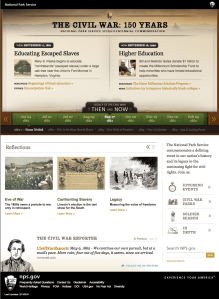
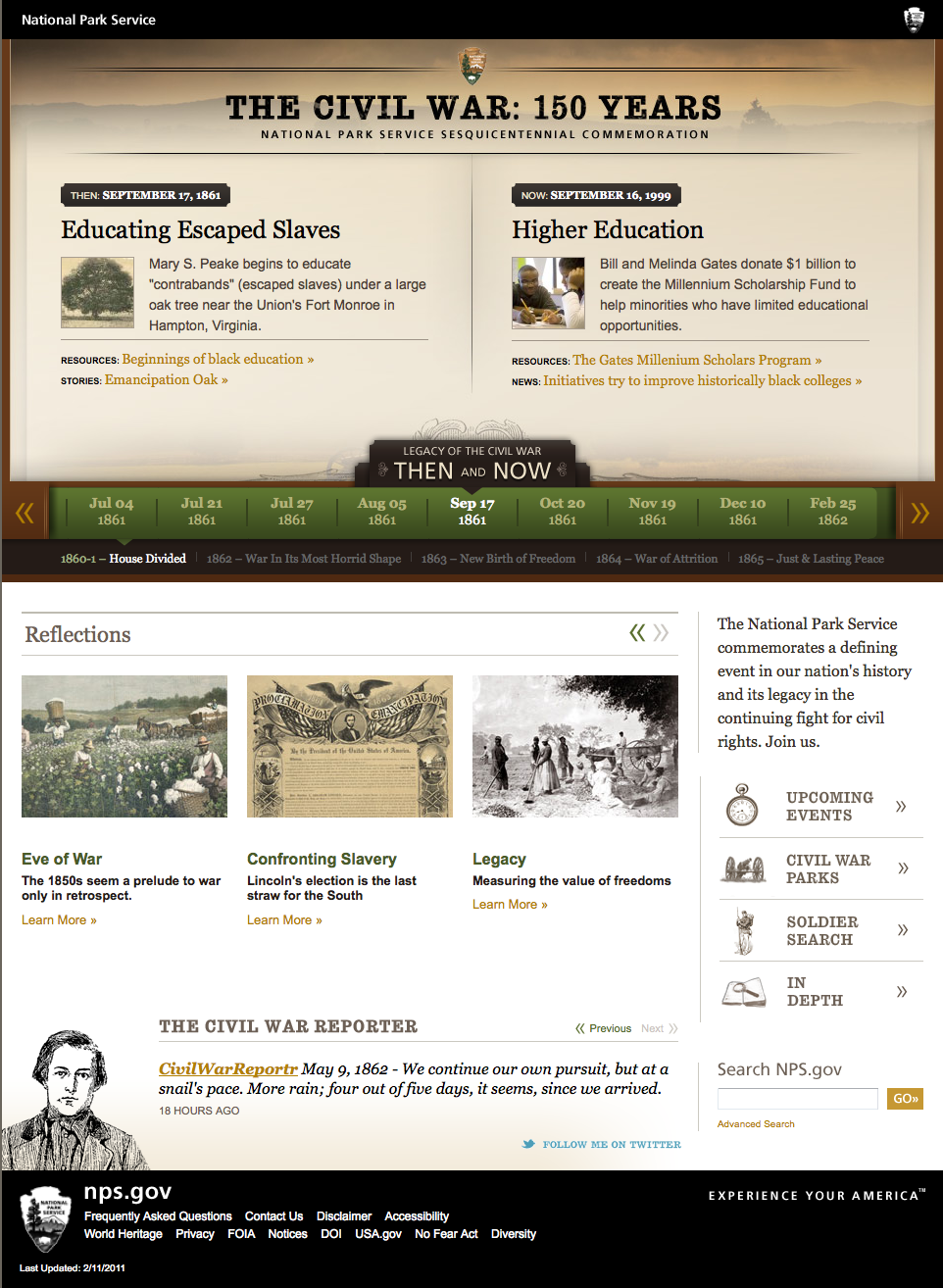
  • NPS’ Civil War: 150 Years features a Then and Now Timeline at the top and a Civil War Reporter sending tweets at the bottom.

    The Civil War: 150 Years has the form and content of websites that will be most familiar to historic sites, except that it commemorates “a defining event in our nation’s history and its legacy in the continuing fight for civil rights” rather than a specific place.  I like their use of Twitter to create a virtual “Civil War Reporter” whose tweets report on events from the 1860s but the major innovation is the featured Then and Now Timeline that compares similar events during the Civil War and today (although I was only able to jump months, not years).  Another way to compare the past and the present is demonstrated by Slavery Footprint, a website and mobile app that was launched on the 149th anniversary of the announcement of the Emancipation Proclamation.  It’s designed to raise awareness of modern-day slavery and can tell you approximately how many slaves have pitched in to make the goods you enjoy on a daily basis.

  • Timelines appeared in several other forms in the winning entries and along with the Then and Now version is Continue reading
Sold! Frank Lloyd Wright Home and Studio in Oak Park

Frank Lloyd Wright Home and Studio, Oak Park, Illinois

On Monday, the National Trust for Historic Preservation sold Frank Lloyd Wright’s Home and Studio in Oak Park, Illinois but don’t worry, it’ll still be preserved and open to the public.  It was acquired by the Frank Lloyd Wright Preservation Trust, who has been operating and managing the site for nearly four decades and I suspect will be there for many more.  In the 1970s, the FLWPT was a fledging organization that was attempting to save the Prairie-style home and studio of Frank Lloyd Wright, which had become badly deteriorated and cut up into a half dozen apartments by a private owner.  It didn’t have the ability to purchase the property when it came up for sale, so they partnered with the National Trust to buy the property.  The FLWPT would eventually repay the National Trust for its half of the $260,000 purchase price but in the meantime, the National Trust would hold the title and lease it to the FLWPT at a nominal price.  The success of this venture prompted these two organizations to partner on the preservation of the Robie House, a Frank Lloyd Wright masterpiece which is owned by the University of Chicago but was badly maintained (another example of a university mistreating historic places!).  With the sale of the Home and Studio, the Robie House partnership is also concluded and the FLWPT will work directly with the University.

I’m not sure what the change in relationship means, but just a few days ago, the Robie House and Frank Lloyd Wright Home and Studio were National Trust Historic Sites, two of 29 historic places sprinkled across the United States.  It’s a ragtag collection that by itself makes no interpretive sense, doesn’t adequately represent American history or culture, isn’t connected by ownership (some NTHS are owned by others) or management (most NTHS are operated by other non-profits), and wasn’t formed to achieve a specific strategy or vision (they were mostly added as opportunities arose, donors made offers, or presidents were seduced).   But with this transition, I hope it sparks some discussion around two important national issues for historic sites: Continue reading

Details on the new National Museum of African American History and Culture

This slideshow requires JavaScript.

Yesterday I joined a meeting of the curatorial and education staff at the National Museum of African American History and Culture to discuss a potential partnership with Drayton Hall, and it was great to see again Rex Ellis, Debbie Mack, Bill Pretzer, and Michele Gates Moresi as well as meet so many of the other staff who are working to make this new museum a reality.  The museum recently broke ground on the Mall in Washington, DC and is scheduled to open in 2015.

While I was there, I spied a three-dimensional model of the new museum in the lobby and it thought I’d share some photos to give you a close up of the design (and sorry for the reflections–it’s in a vitrine near a big window).  Freelon Adjaye Bond/SmithGroup, a consortium of four independent architectural firms that designed the building, laid out this vision: Continue reading

iPavement

iPavement from Spain

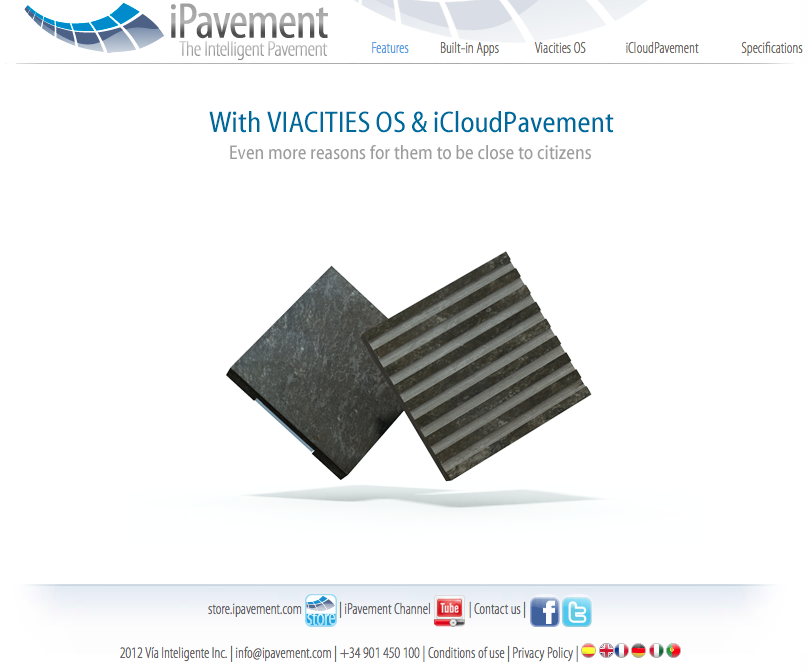
Looking to connect your historic site to the information superhighway?  You might be interested in the newest gizmo out of Spain: iPavement.  It’s a 16 x 16 inch calcium carbonate paving tile with a computer inside the three-inch thick body.  The computer operates under Linux, has motion and temperature sensors, and provides wifi and Bluetooth access. And it also comes in a grooved anti-slip surface and operates between -22 to 167 degrees Fahrenheit (that’s probably sufficient; I can’t imagine any pedestrians walking on these pavers outside of these extremes).

What would you do with this high tech tile?  According to the website, you can use its various integrated apps to “transform streets from analogical to digital entities” by:

  • putting a library on the street.  It can be a “highly useful distribution tool for the promotion of culture and the distribution of works in digital media.”
  • sending alerts by phone or email of icy or hazardous conditions.
  • monitoring pedestrian use to provide you Continue reading

Let’s Give SWOT a REST

A SWOT analysis (a listing of strengths, weaknesses, opportunities, and threats) is a common exercise in business planning and reached the shores of the non-profit world decades ago.  Some of you probably have experienced a SWOT analysis at your site as part of your strategic or long-range planning.  The staff and board gathers around a flipchart to list  your organization’s internal strengths and weaknesses, and then your external opportunities and threats.  Sometimes there’s a bit of confusion over definitions (what’s a threat?) or where an item should be listed (is this a strength or opportunity?).  You might feel a bit of competition to mention a particularly incisive opportunity or are sweating because you can’t name a strength (all the good ones have already been mentioned!).  Eventually, the list might be prioritized and some items consolidated so it can be typed up and included in the strategic plan as a basis for decision-making.

Despite its popularity, I’ve come to the conclusion that we need to give SWOT a rest:

  • The analysis depends heavily on the people participating and it’ll always be biased in that direction.  If you conduct a SWOT exercise with board members who really aren’t involved with the organization, the analysis will probably be superficial and light.  Stock the group with lots of educators, the results will lean towards education.  There are no surprises here–people talk about what they know.  The problem is that the bias is typically not recognized and you wind up building a plan on a foundation that’s skewed or weak.
  • It’s often long on strengths and even longer on Continue reading

WebWise 2012: Managing Oral History Collections and Projects

The final session from WebWise 2012 that I’ll be reporting on is creating and preserving oral history collections.  If you think that oral histories are just about recording hour-long interviews with oldtimers, the digital age has changed that considerably.  Not only are oral histories collected digitally, but they are being presented in many new ways, including audio tours, podcasts, radio programs, and in websites.  Remember, if you want the complete details, the videos from WebWise are now available at online and you’ll find this session on Day Two.

Broadcastr, an app that finds stories and tours near you

Eileen McAdam discussed how she was using 21st century tools to reach new audiences.  She’s been working for many years to engage people in the Hudson Valley through stories through the Sound and Story Project of the Hudson Valley.  Rather than deliver audio tours as lectures, she presents stories from the people who live there.  She noted that it was difficult to find oral histories that were recorded previously (often they’re not catalogued or easily available) which led to a partnership project to identify what had been done, conduct condition assessments, access the content, and then use the materials to engage new audiences.  Much of the initial growth of oral histories came with the availability of inexpensive cassette tape recorders in the 1970s and this project’s work was to graduate these collections to digital formats.  In her presentation, she outlined the process of digitizing and editing files to select compelling content and create 1-2 minute stories, recommending Audacity (free), Garage Band (comes with Mac), and Hindenburg (inexpensive), and providing some examples of edited snippets and presentation methods, including Continue reading

HBR: To Engage Your Visitors, Keep it Simple

"To Keep Your Customers, Keep it Simple" by Patrick Spenner and Karen Freeman (Harvard Business Review, May 2012)

The May 2012 issue of Harvard Business Review arrived a little early to my mailbox, but I couldn’t stop from sharing a great article on engaging customers in business world that can easily be translated to engaging visitors and building support for historic sites and museums.  In “To Keep Your Customers, Keep It Simple,” Patrick Spenner and Karen Freeman note the paradox of today’s promotional techniques:

Companies have ramped up their messaging, expecting that the more interaction and information they provide, the better the chances of holding on to these increasingly distracted and disloyal customers.  But for many consumers, the rising volume of marketing messages isn’t empowering–it’s overwhelming.  Rather than pulling customers into the fold, marketers are pushing them away with relentless and ill-conceived efforts to engage.

This conclusion is based on multiple surveys of more than 7,000 consumers which were then compared to interviews with 200 marketing executives representing 125 brands.  Their pointed out that what consumers what and what companies think consumers want didn’t correspond to each other, or in biz speak, it’s a Continue reading

WebWise 2012: Using Volunteers Online

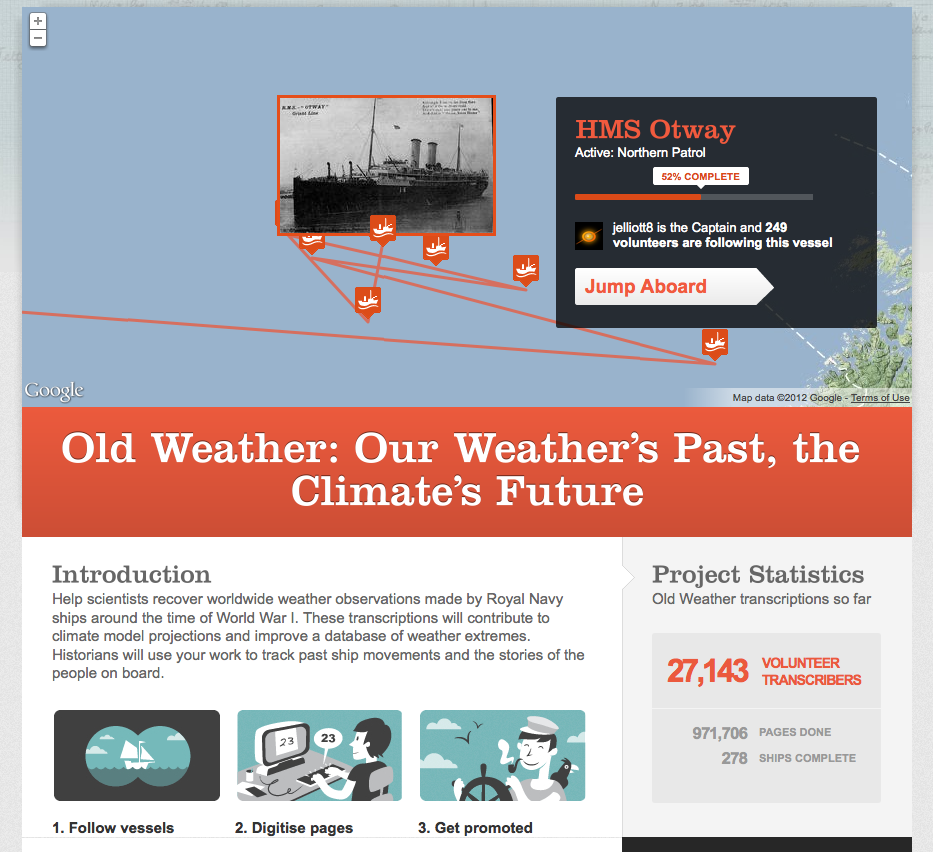
Much of the work at historic sites and history museums wouldn’t be possible without volunteers (and we just passed National Volunteer Week) but very few organizations have recruited volunteers for work online.  Is it possible? What would they do? A session at WebWise 2012 explored these ideas in a panel called, “Sharing Public History Work: Crowdsourcing Data and Sources.”

OldWeather.org, a project of the Citizen Science Alliance

Ben Brumfield of FromThePage Open-Source Transcription Software shared his experiences from small crowdsourcing projects.  He noted that many organizations often object to public participation in scholarly projects because they don’t have the skills or expertise, but he’s found that those people participating are self-selecting and highly focused.  Participation is not equally distributed but mostly done by a small number of people, thus it’s not really crowdsourcing but nerdsourcing.  He provided some examples of “well informed enthusiasts” conducting exemplary work, such as Continue reading

Attractive Outdoor Interpretive Panels are Possible at a Bargain Price

This slideshow requires JavaScript.


James Madison’s Montpelier in Virginia sports some very attractive interpretive signs that looked so good, I had to figure out how they were made. With a bit of prodding and poking, I discovered they were printed plastic attached with Velcro to a sturdy wooden frame.  Very clever!  The signs are great looking even after a couple years outside.

Peggy Vaughan, Vice President of Communications and Visitor Services, generously shared that the three signs cost about $900 total:  $90 for each 30″x 40″ PVC sign and $210 for each base. The content, design, and bases were created in-house (yes, Montpelier is fortunate to have a graphic designer and master carpenters on staff) and the signs were printed by FedEx Office (formerly Kinkos). This sign was created using Adobe Indesign, saved as a pdf, and printed directly on PVC–the image isn’t as sharp but they last longer outdoors than the alternative method of laminating a printed image onto PVC. Peggy said that, “The big advantage to these signs for us was that they are relatively cheap, and because everything around here is always changing, we did not want to spend $2,000 on a proper museum sign, as we had in the past, that would be out of date before it wore out. And, frankly, even if things don’t change at your museum, your messaging should change from time-to-time to keep up, don’t you think?”

If you’re looking for more ideas for signs at historic sites, I’ve collected dozens of images from places around the world—good, bad, and ugly—on several web albums.  Please note that one sign may serve several purposes (e.g., directional AND identification), so look in other categories, too.

Identification Signs

Directional and Wayfinding Signs

Informational Signs

Are Your Metrics Just Skin-Deep?

I’ve long been a fan of developing clear measures of success or metrics in planning.  Too often, though, boards and staff at historic sites only use total attendance or the financial bottom line to judge their success.  Certainly, having no visitors is not a good sign, but is a large number of visitors a mark of success?  Not necessarily, because high attendance may be due many factors, including some that may have nothing to do with advancing your mission in a significant manner, such as weddings rentals or dog walkers or corporate retreats.  I’m not knocking those activities and they may be an essential part of your programming, however, what I’ve most often heard at board meetings are conversations like this:

Board chair:  I heard we did well last month.  What was our attendance?

Director:  We had 2,500 visitors in March, double what we had in February.

Boardmembers (in unison):  Wow, that’s great! 

Director:  And looking at the guestbook, we had people from 14 different states and 3 foreign countries, including Latvia.

Board chair:  This must be a record for us.  Okay, let’s have the financial report–looks like the bottom line is positive.  Is there a motion to accept?

Don’t assume this only happens at the local historic house museum–it happens at the big ones as well.  As I’ve often said, Continue reading